Collaborative spaces need monitor placement that balances ergonomics, shared sightlines, and fast reconfiguration. A screen that feels perfect for one person can become too high, too narrow, or too reflective the moment two or three people gather around it.
If you have ever watched teammates crowd around a display while one person keeps nudging the stand, you already know the symptom. The fix is not just “buy a bigger monitor.” It is a smarter mix of monitor size, stand adjustability, viewing angle control, and room-aware placement that makes shared work easier without turning every desk into a neck-strain trap.

Why the Goal Changes in Shared Workspaces
One User vs. Several Viewers
At a personal desk, proper monitor position depends on viewing angle and viewing distance. In a collaborative space, those same rules still apply, but the screen also has to work for people who are standing beside the desk, sitting farther back, or rotating in and out of the station during the day.
That is why shared monitor setups behave differently from individual workstations. A solo user can optimize a 27-inch gaming monitor for one chair, one keyboard, and one line of sight. A team pod, hot desk, or meeting-side workstation has to support quick changes in height, tilt, and swivel, and shared desks and hot-desking setups benefit from fine adjustment rather than a fixed stand.
Shared Sightlines Matter More Than Perfect Centering
In larger collaboration areas, viewers should stay within 45 degrees left or right of a display’s centerline. That is a useful reminder even at desk scale: once people start viewing from the side, monitor placement stops being just an ergonomic issue and becomes a visibility issue.
For display buyers, this shifts the priority list. Height adjustment, stable off-axis image quality, and glare control matter more in shared spaces than they do at a single-user workstation. That is especially true for ultrawide monitors and high-refresh-rate displays, where screen width and panel behavior affect how well teammates can actually see what is on-screen.

The Positioning Rules That Still Matter
Height and Viewing Angle
A collaborative layout should not ignore ergonomics just because more people need to see the panel. A comfortable starting point is a monitor positioned about 15 degrees below the horizontal line of sight, with a preferred visual zone of about 30 degrees total. In practice, that usually means the top of the screen stays at or slightly below eye level, especially on tall 32-inch displays or portrait monitors.
That guidance becomes even more important when the monitor is mounted on a riser, stacked on equipment, or pushed to the back of a bench. In group settings, people often raise screens too high to make them “more visible,” but both ergonomic guidance and room-display guidance warn against that; the top of the screen should not sit more than 30 degrees above eye level.
Distance and Screen Width
Distance also changes once the screen gets wider. An arm’s length is a strong default starting point, but a source notes that wide monitors may need to move farther back to reduce neck rotation. That matters for 34-inch ultrawide monitors, 32-inch 4K displays, and curved gaming monitors that look impressive on paper but can feel oversized when several people are trying to read different parts of the panel.
A good rule for collaborative desks is to lower the screen slightly, move it back enough to keep the whole panel in view, and then use swivel to “present” the monitor when needed. That approach usually works better than buying the largest display you can fit and assuming size alone will solve collaboration.
Privacy, Glare, and Side-Angle Viewing
Privacy Is a Placement Decision Too
In open offices, privacy screens narrow the visible field using micro-louvers, which helps protect sensitive information from side-angle viewing. Some filters reduce visibility to roughly 30 degrees, while others allow a wider sharing angle. That is useful at finance, sales, HR, and support desks where one moment is collaborative and the next involves private data.
The tradeoff is obvious: the stronger the privacy filter, the worse the shared viewing experience. On a main team display, a fixed narrow-angle filter can defeat the point of a collaborative setup. On a personal monitor inside a shared area, it can be exactly the right choice.
Glare Control Should Be Reversible
For mixed-use workstations, magnetic privacy filters let users switch between privacy and screen-sharing. That is a better fit than a permanent filter on a shared monitor, because the same station may handle solo work at 9:00 AM and a two-person review at 10:00 AM.

Glare is the other half of this problem. Adjustable monitor arms make it easier to tilt and reposition a screen to prevent glare, which matters more in collaborative spaces because reflections become more obvious when people are viewing from different seats and angles. If a monitor will live near windows or glass walls, an anti-glare finish and broad stand adjustment are usually more valuable than a flashy spec sheet.
Which Monitor Type Fits Each Collaborative Setup
Standard, Ultrawide, Dual, and Portable Options
There is no single best monitor for every collaborative workspace. A standard 24-inch to 27-inch display is usually the easiest option for hot desks because it is easy to center, easy to move, and still large enough for one-on-one review. A 34-inch ultrawide often works well in a two-person pod because it keeps multiple windows on one continuous panel instead of splitting them across a bezel.

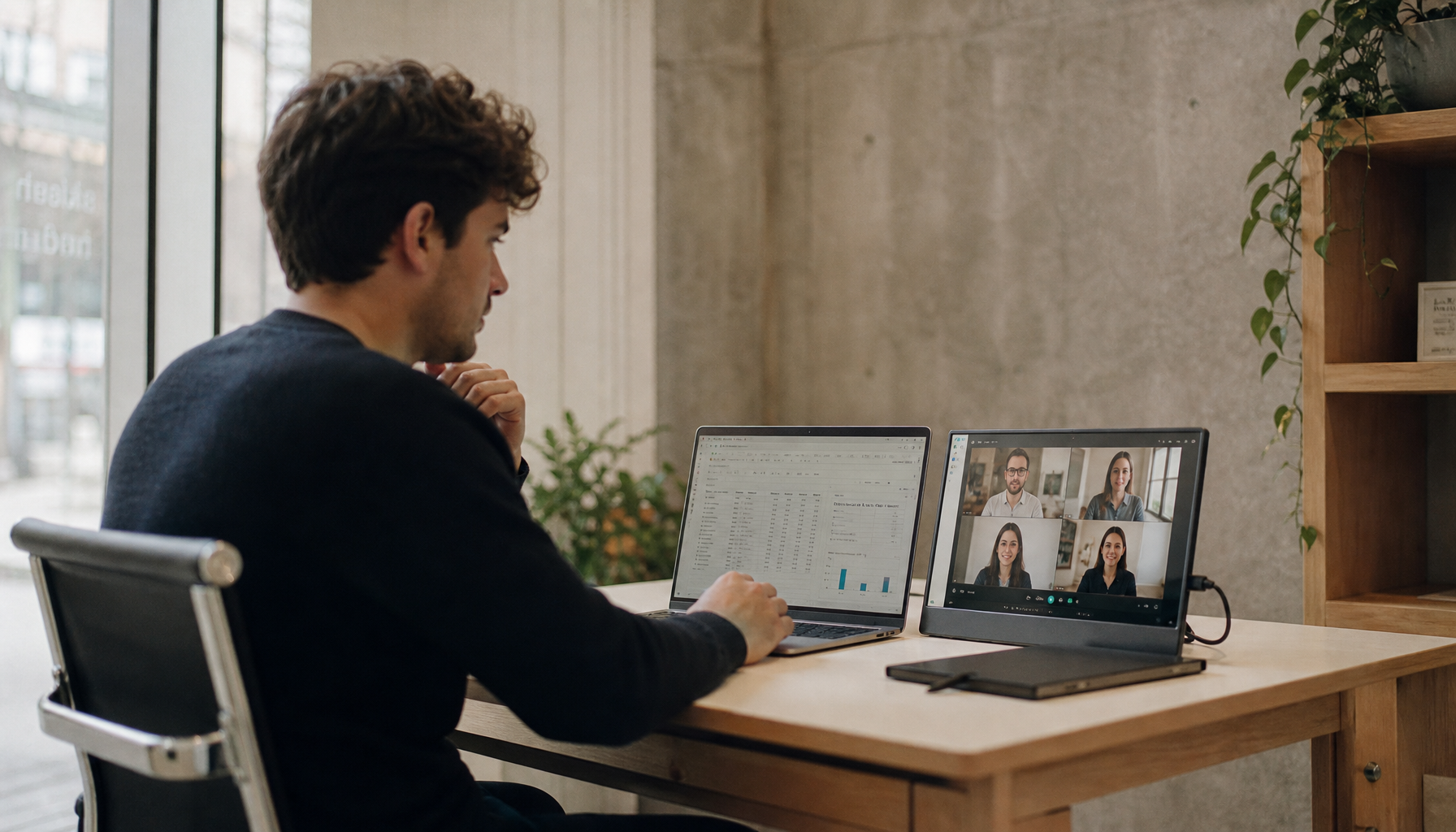
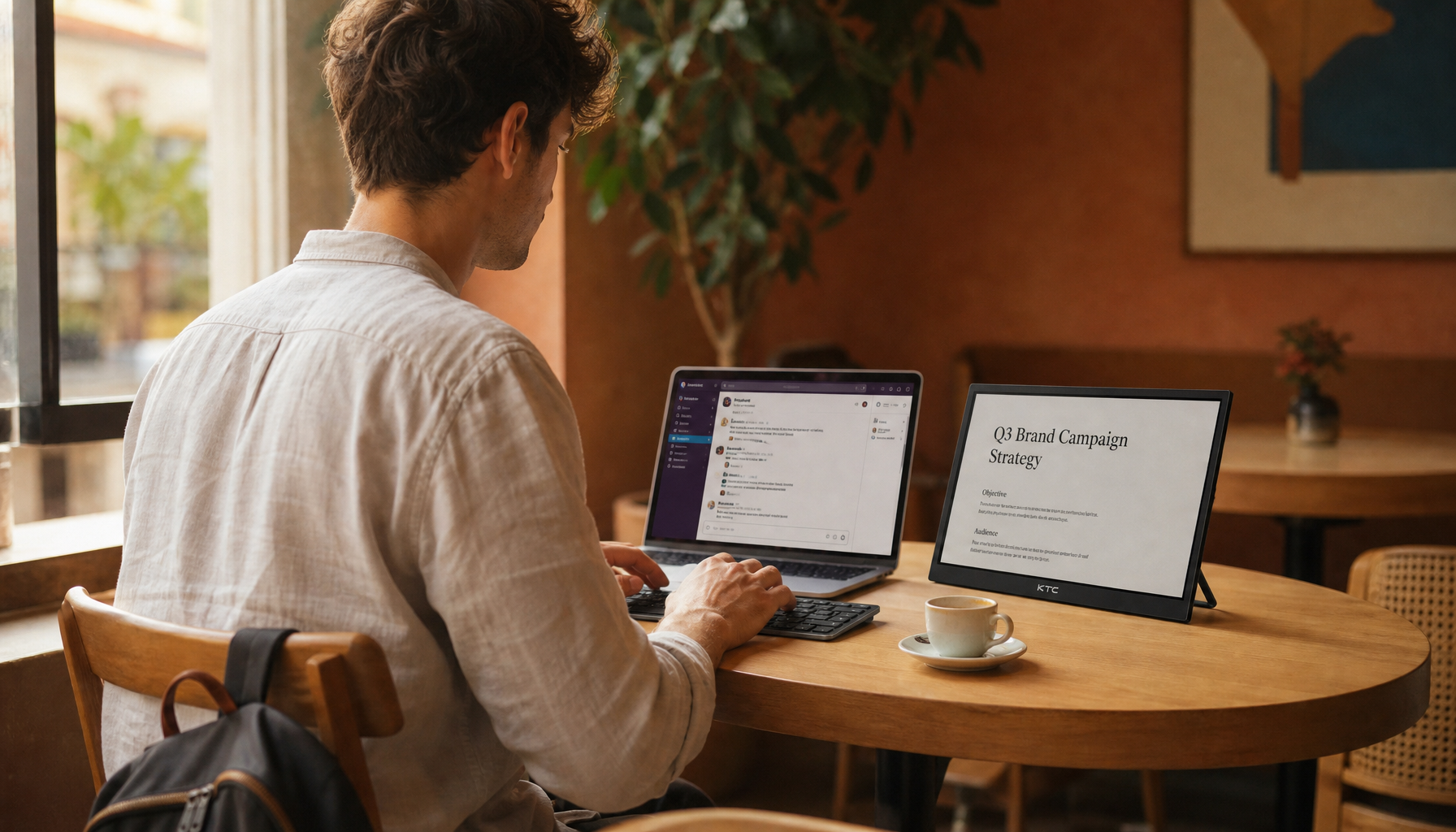
Dual monitors are usually better for individual multitasking than for shared viewing. They make sense when one person needs separate full-screen apps, but once coworkers gather around the desk, a center bezel and two different sightlines can make collaboration clumsier than expected. Portable monitors are useful as temporary side displays, but they work best as a supplement, not as the main shared screen.
Why Gaming Specs Need a Different Priority Order
High-refresh-rate and gaming monitors deserve a different buying filter in shared spaces. A 144 Hz or 240 Hz panel can make motion demos, scrolling, and gameplay footage look smoother, but collaboration usually depends more on screen position, stand range, and off-axis image stability than on raw refresh rate.
That means a fast IPS gaming monitor with solid height and swivel adjustment is often a better collaborative choice than a speed-first panel on a rigid stand. If the monitor will be used for both work and game testing, prioritize a stand or arm that can quickly shift between solo use and side-by-side viewing.
Monitor option |
Best collaborative use |
Positioning priority |
Main advantage |
Main tradeoff |
24-inch to 27-inch standard monitor |
Hot desks, one-on-one review |
Easy centering, arm’s-length distance |
Simple to adjust for many users |
Less room for side-by-side content |
34-inch ultrawide monitor |
Team pods, dashboard review, timeline work |
Move slightly farther back, keep top at or below eye level |
One continuous panel without a center bezel |
Can force more head movement if placed too close |
Dual 27-inch monitors |
Power-user desks with occasional collaboration |
Semi-circle layout, matched height |
Strong multitasking for one primary user |
Harder for groups to view comfortably |
15-inch to 17-inch portable monitor |
Temporary sharing, travel, overflow display |
Add a stand; avoid using as the main shared screen |
Very flexible and easy to move |
Limited size and weaker ergonomics |
32-inch high-refresh monitor |
Motion demos, gaming labs, mixed work/play setups |
Lower slightly and place farther back |
Smooth motion plus large image |
Needs strong off-axis performance and a good stand |
Final Takeaway
Build for Movement, Not Just for Specs
In shared environments, monitor arms that raise, tilt, swivel, and reposition the screen usually deliver more day-to-day value than simply upgrading panel size. They let a workstation adapt to different users, different tasks, and different seating positions without forcing people into awkward postures.
A better collaborative monitor setup is usually less about chasing the biggest ultrawide or the fastest gaming display and more about choosing the right screen for the space, then giving users enough adjustment to make it work. Freeing desk space and keeping the display area organized also matters, because clutter reduces both comfort and visibility.
Action Checklist
- Start with the top of the monitor at or slightly below eye level.
- Keep the screen about an arm’s length away, then move wide displays slightly farther back if needed.
- Use a monitor arm or stand with real height, tilt, and swivel range for shared desks.
- Choose ultrawide monitors for side-by-side content on one panel, not just for visual impact.
- Use removable or magnetic privacy filters when one station switches between private work and collaboration.
- Prioritize anti-glare finish, off-axis clarity, and stand adjustability over refresh rate alone in shared spaces.
FAQ
Q: Is an ultrawide monitor better than dual monitors for collaboration?
A: Often, yes for two-person review. An ultrawide keeps content on one panel without a center bezel, which makes shared viewing easier. Dual monitors are still stronger for one user who needs separate full-screen apps.
Q: Should a collaborative monitor be placed higher so everyone can see it?
A: Usually no. Raising the screen too much tends to create neck strain and awkward viewing. It is better to keep the top near eye level, move the screen back slightly, and use tilt or swivel for group viewing.
Q: Do privacy screens make shared monitors a bad idea?
A: Strong privacy filters can. They are best for personal monitors in open environments or for shared stations that sometimes handle sensitive information. Removable or magnetic models are a better fit when the same display has to switch between solo work and teamwork.