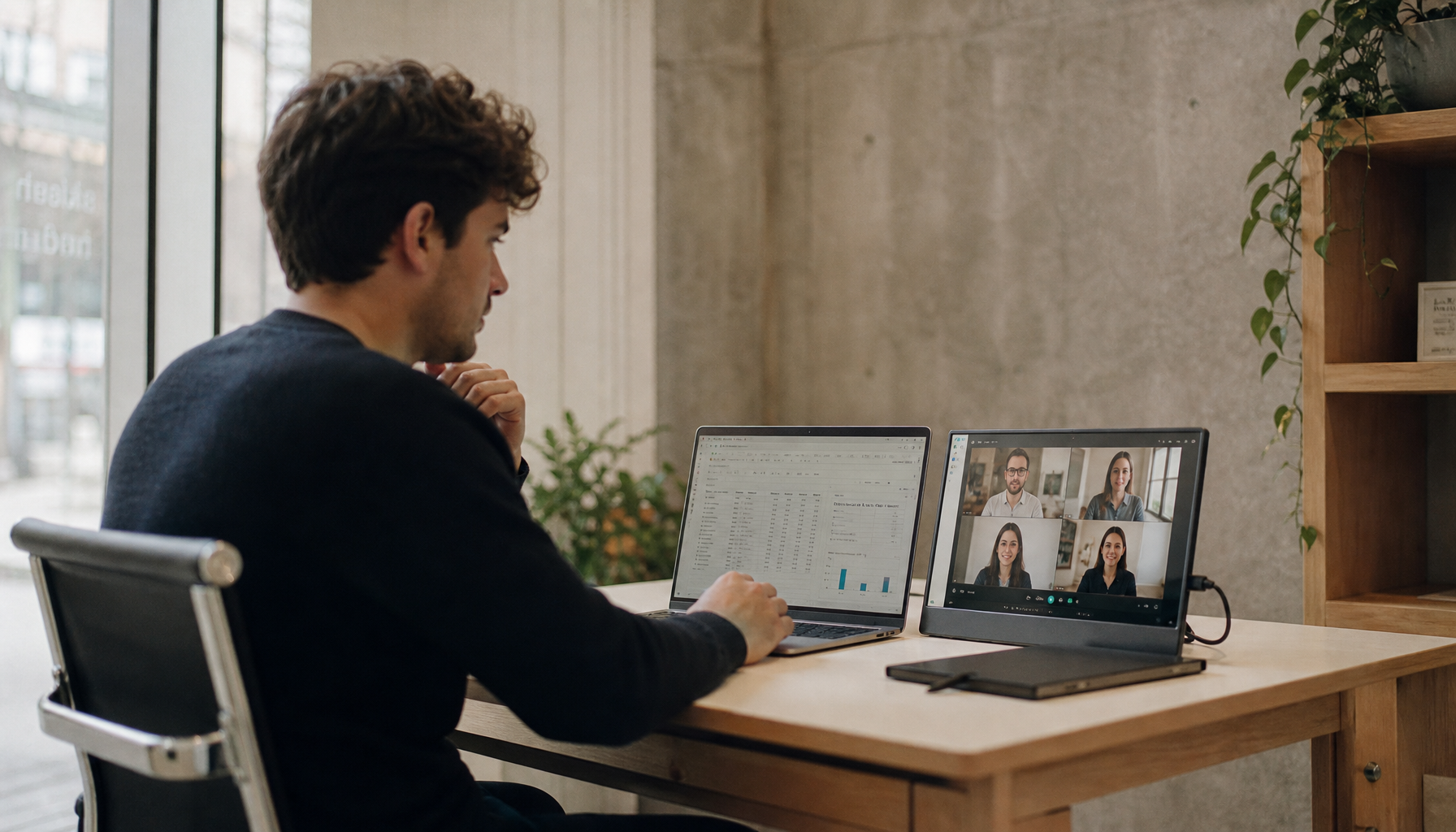
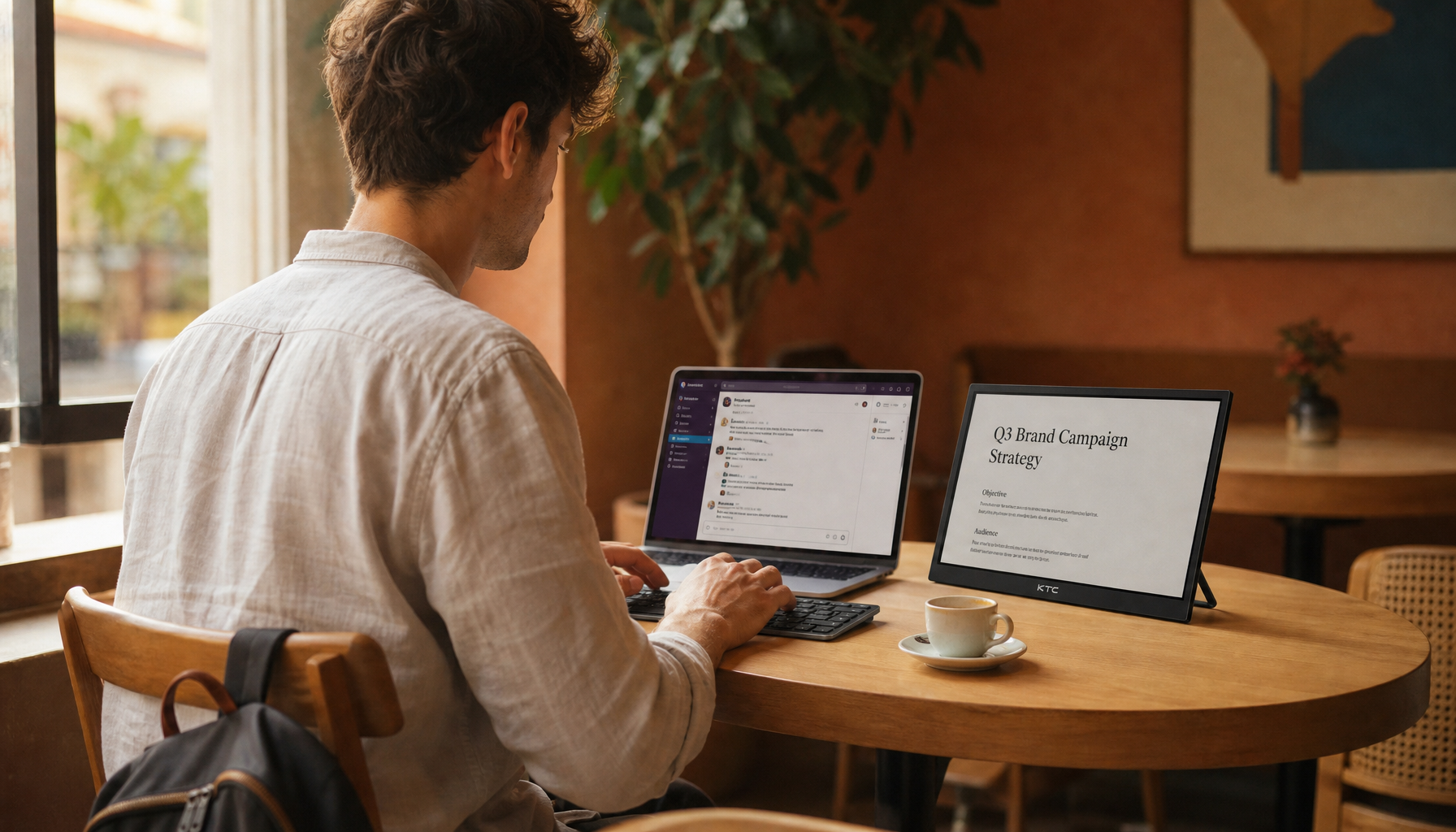
To avoid neck and shoulder pain, place your portable monitor so your main screen sits almost straight ahead, the top edge is at or slightly below eye level, and the display is far enough away that you never need to lean in.
Does your neck start to tighten by late morning when you work from a hotel desk, coffee shop table, or hot desk? Lab research found that dual-screen work increased head-neck rotation by about 9 degrees, which helps explain why a bad portable-monitor setup feels fine for 30 minutes and miserable by hour six. The fix is not complicated: set the screen where your eyes naturally land, keep your shoulders from reaching, and make your portable display work like a real monitor instead of a low side screen.
Why Portable Monitor Placement Hurts Faster Than a Fixed Desk
Portable setups magnify the most common monitor mistakes because the desk is usually shallow, the chair height is not ideal, and the display stand is limited. The screen should sit directly in front of you, at least 20 inches away, with the top line at or just below eye level; in temporary workspaces, a portable monitor often misses all three targets at once.
Dual-screen work increases head-neck rotation by about 9 degrees compared with a single monitor, and it also increases rotation range of motion. On an 8-hour mobile workday, that usually shows up as a familiar pattern: you keep turning slightly toward the portable display, then you start bracing through the neck because the screen is not where your body wants it to be.

The practical lesson for display buyers is simple. A thin panel, high refresh rate, or sharp resolution will not offset poor placement. For long sessions, the portable monitor that helps most is the one you can actually raise, center, and tilt without improvising a stack of books or sliding your whole body sideways.
Set Height, Distance, and Tilt Before Anything Else
Start With Your Natural Gaze
Eyes naturally rest 10 to 20 degrees below horizontal, so the top edge of your portable monitor should sit at or slightly below eye level. A quick field test works well in travel setups: sit upright, relax your shoulders, look straight ahead, and adjust the screen until your eyes land in the upper portion of the display without lifting your chin.
A viewing distance of about 20 to 30 inches is a good starting point for many portable monitors, especially 14-inch to 16-inch models used for writing, spreadsheets, and reference windows. If the text feels too small at that distance, increase scaling or text size first. Pulling the screen closer solves readability for five minutes, then creates the forward-head posture that makes shoulders tighten for the rest of the day.
Use Tilt to Reduce Glare, Not to Compensate for Bad Height
A mild backward tilt of about 10 to 20 degrees usually keeps the panel perpendicular to your line of sight and reduces glare without forcing a chin-up posture. This matters more than people expect with portable displays, because their glossy or semi-gloss finishes can make you crane your neck the moment a window or overhead light hits the screen.
For buying guidance, this is where portable-monitor stand design matters more than extra spec-sheet flash. If a display can only prop itself at one shallow angle, it is harder to keep both text clarity and posture. A matte panel, enough indoor brightness, and a stand with real tilt range usually help comfort more than motion-focused features alone.
Place the Portable Monitor Relative to the Laptop, Not Just the Desk
If One Screen Is Primary, Center That Screen
Two monitors should sit side by side with the edges nearly touching when you use both often, but the primary screen should be more centered than the secondary one. For many mobile workers, that means the portable monitor becomes the main display for documents, timelines, or spreadsheets, while the laptop shifts to the side for chat, email, or previews.
That layout works well because it keeps your most frequent viewing straight ahead. If you spend 70% of the day on the portable monitor, put your keyboard and body square to that screen. The laptop can stay slightly off-center without creating much trouble because you are only glancing at it, not living on it.
If You Keep Turning One Way, the Layout Is Wrong
A repeated one-sided rotation pattern is one of the clearest reasons dual-screen users develop neck and back discomfort. The classic bad setup is a main screen in front and a laptop far to one side, which makes the body twist a little more on every check-in until that twist becomes your default posture.
On narrow hotel or coworking desks, a stacked arrangement can be smarter than a wide one. If desk width is limited, placing the portable monitor above the laptop often reduces side-to-side neck turning, as long as the upper screen is the one you use most and the lower screen is reserved for less frequent content. The key is still the same: your most-used display should be the one your eyes reach first with the least head movement.
The Built-In Cover Stand Is Usually Not Enough for an 8-Hour Day
Why Adjustability Beats Convenience
Proper monitor height can vary by about 11 inches between smaller and larger users, which is why a one-angle folio cover rarely fits everyone. The included stand may be fine for a 20-minute check-in or a short flight-delay work session, but it usually leaves a 15.6-inch portable display too low for a full day.
Portable touch ergonomics depend on reach zone and support, which makes a separate stand even more useful on touch-capable models. If you need to tap or swipe, the screen has to be close enough to reach without leaning, but still high enough that you are not staring down all day. That balancing act is hard to achieve with a cover stand and much easier with a real adjustable support.
Setup option |
Best use case |
Neck impact |
Shoulder impact |
Best choice for an 8-hour day |
Built-in folio stand at desk height |
Short sessions, limited packing space |
High downward gaze risk |
Often cramped because the screen sits low |
Last resort |
Portable monitor on an adjustable stand beside a raised laptop |
Laptop still handles secondary tasks |
Lower rotation if heights match |
Good if keyboard and mouse are external |
Strong option |
Portable monitor centered as the main screen, laptop off to the side |
Writing, spreadsheets, coding, admin work |
Usually the lowest strain |
Good because the body stays square |
Best for most people |
Portable monitor stacked above the laptop |
Shallow desks, narrow tables |
Less side turning, but lower screen still needs discipline |
Good if the lower screen is secondary |
Good when width is limited |
For monitor shopping, treat stand flexibility as a core spec. A portable gaming monitor with a smoother panel can be enjoyable after hours, but for work posture, the important question is whether you can place it correctly at 9:00 AM, 1:00 PM, and 5:00 PM without rebuilding the whole desk.
Protect Your Shoulders With Better Input Placement
Raise the Screen, Then Stop Typing on the Laptop Deck
Lower shoulder activity shows up when keyboard and mouse placement keeps the arms in a better working position. In portable-monitor terms, that means the moment you raise either screen to a proper height, you should switch to a separate keyboard and mouse instead of reaching up to type on the laptop.

This is where many mobile setups fall apart. People do the hard part by elevating the display, then undo the gain by keeping the keyboard too high or too far back. Your elbows should stay close to the body, and your forearms should feel supported instead of suspended.
Keep the Mouse Close and Limit Long Touch Sessions
A far-away mouse can more than double muscle tension in the arms, neck, and shoulders compared with better input placement. If your portable setup uses a full-width keyboard or leaves the mouse stranded in a far reach zone, your shoulder often takes the load before your neck does. A compact keyboard usually makes it easier to keep the mouse close to your main screen.
Touch input adds another tradeoff. A portable touchscreen can be useful for quick navigation, markup, or presentation control, but repeated tapping on a low or poorly supported screen tires the shoulder fast. Hybrid use works better: keyboard for most input, mouse or trackpad for precision, and touch only when it is clearly faster.
Break Before the Pain Curve Builds
A 30-second break every 30 minutes is a realistic rule for mobile workdays because it is short enough to follow in a cafe, airport lounge, or client office. Stand up, drop your arms, roll the shoulders, and reset the screen before you settle back in. That habit matters more than waiting until you already feel stiff.
FAQ
Q: Should the portable monitor or the laptop be centered?
A: Center the screen you use most. If the portable monitor holds the main document, spreadsheet, dashboard, or timeline, place it directly in front of you and move the laptop to the side. If the laptop is still your primary screen, reverse the arrangement.
Q: Is the included cover stand enough for a full workday?
A: Usually not. It can be acceptable for short sessions, but most built-in stands do not offer enough height or tilt to keep the top of the screen near eye level for 8 hours.
Q: Does a high-refresh-rate portable monitor reduce neck and shoulder pain?
A: Not by itself. Higher refresh can improve motion smoothness and make a portable gaming monitor feel nicer to use, but posture relief comes from height, distance, tilt, centered placement, and keeping the mouse close.
Practical Next Steps
The most effective portable-monitor setup is usually simple: one primary screen centered in front of you, one secondary screen used for reference, and enough stand adjustment to keep both your gaze and shoulders neutral. If you can only upgrade one thing, upgrade adjustability.
- Decide which screen is primary before you open any apps.
- Put the primary screen directly in front of your body, not off to one side.
- Set the top edge at or slightly below eye level, with your eyes falling naturally into the upper part of the screen.
- Keep the display about 20 to 30 inches away, then increase scaling before moving closer.
- Use a separate keyboard and mouse, and keep the mouse close to the body side of your main screen.
- Take a 30-second reset every 30 minutes and fix glare or distance before you lean forward.
References
- A health organization workstation study on dual-monitor neck posture: http://stacks.cdc.gov/view/cdc/203743
- A workplace safety organization monitor placement guidance: http://www.osha.gov/etools/computer-workstations/components/monitors
- A university keyboard and mouse placement study: https://ergo.human.cornell.edu/AHProjects/Mouse/keyboard.html
- A medical institution ergonomics and micro-break guidance: https://www.unmc.edu/ehs/occ-health/ergonomics.html
- Portable touch monitor ergonomics: https://www.faytech.us/touchscreen-monitor/portable-touch-screen-monitor-flat/what-are-the-ergonomic-considerations-for-portable-touch-screen-monitors/?srsltid=AfmBOorJ0KAihFRclv2_ERtAJWXcg5h5LEuMYbD3WeGBUjw-8_hxf-ub
- Dual and large monitor neck syndrome overview: https://ergofitconsulting.com/large-dual-monitor-neck-syndrome/
- Monitor viewing angle guidance: https://us.ktcplay.com/blogs/desk-setups/optimal-monitor-viewing-angle-eye-comfort-posture?srsltid=AfmBOoqhb_fbFxbcEPhpuM6GkffVNnWCRtaf99KHlg4Cqc0G93Y_0Cnp
- Dual-monitor posture warning and side-switching advice: https://verticalign.com/2020/10/19/dual-monitor-causing-your-pain/
- Monitor adjustability and fit guidance: https://www.humanscale.com/insights/why-you-need-a-monitor-arm-and-not-a-monitor-stand–?srsltid=AfmBOoptg_TVKkEsv6ti6FEUoA_o4565g6Fx5DbcKph9KDVo_JFLW0ex
- Mouse distance and muscle tension summary: https://www.eurekalert.org/news-releases/1013737