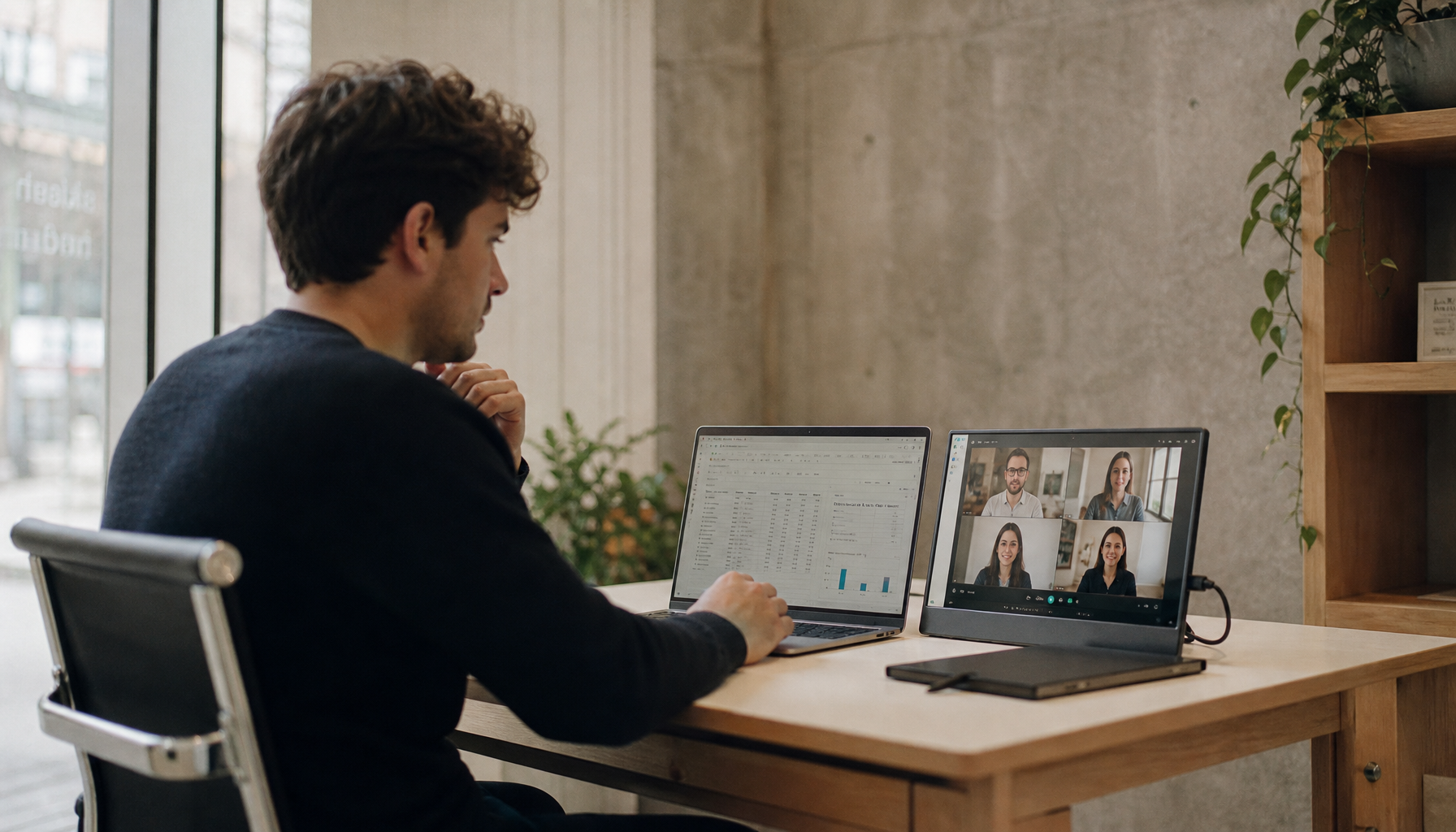
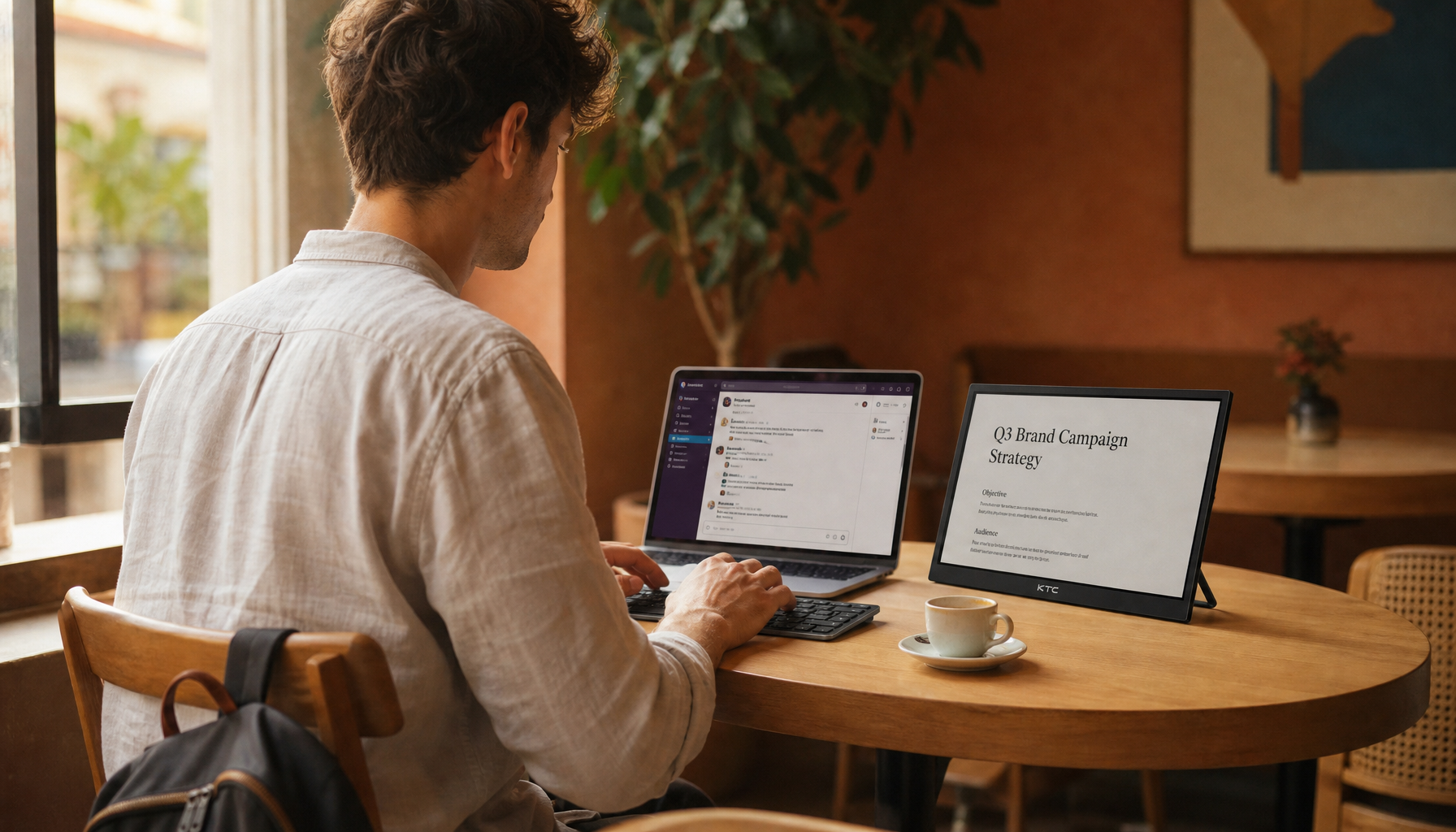
A portable monitor can feel too steep on a lap desk because most built-in covers and kickstands are designed for flat desks, not lower, softer, shifting surfaces. The fix is usually a mix of lowering the screen tilt, raising the lap surface, increasing viewing distance, or switching to a stand with real angle control.
Is your portable screen forcing you to tuck your chin, crane your neck, or watch the colors wash out every time the lap desk tilts? In real portable-monitor setups, a few degrees of stand adjustment can be the difference between a clean second screen and a posture fight you lose after 20 minutes. Here is a practical way to diagnose the angle problem, correct it, and choose better hardware next time.
The Real Reason the Stand Feels Too Steep
A portable monitor stand often feels too steep on a lap desk because the monitor, stand, and lap surface are all fighting geometry. On a normal desk, the screen sits farther away and higher relative to your eyes. On a lap desk, the screen is closer, lower, and often tilted by your thighs, sofa cushion, or reclined posture. A stand angle that works on a table can suddenly point the panel above your natural line of sight.
Ergonomic monitor guidance is consistent on one core point: the top of the display should sit at or slightly below eye level, with the screen placed around arm’s length when possible. Correct monitor height helps reduce neck, shoulder, and eye strain because your head can stay closer to neutral instead of tilting up or down for long sessions.
On a lap desk, the portable monitor may be only 18 to 24 inches from your eyes. If the kickstand locks into a high rear-lean angle, you may end up looking at the screen from below rather than straight on. That is the “too steep” feeling: the display is physically open, but optically and ergonomically misaligned.
Stand Angle Versus Viewing Angle
Stand angle and viewing angle are not the same thing. Stand angle is the physical tilt of the monitor body. Viewing angle is the range where the display remains readable and reasonably consistent when seen from off-center. A panel may advertise a wide viewing angle, yet still feel bad if the stand points it at the wrong part of your face.

A typical monitor viewing-angle spec describes the off-center arc where the image avoids major degradation, often expressed as 178 degrees horizontal and 178 degrees vertical. Viewing angle matters because off-axis use can reduce brightness, lower contrast, wash out colors, or create color inversion depending on panel type.
This is why a steep portable stand can feel worse than it looks in product photos. If your eyes sit below the center of the screen, you are not just uncomfortable; you may also be viewing the LCD through a weaker vertical angle. IPS panels usually tolerate this better than TN or some VA panels, but no panel type can fully compensate for a stand that locks you into poor posture.
Why Lap Desks Make the Problem Worse
Lap desks are convenient, but they are not stable monitor platforms. They sit on a moving body, not a fixed work surface. Your knees raise the front edge, the cushion compresses unevenly, and your posture changes depending on whether you are on a couch, bed, chair, or airplane seat. That changes the monitor’s real-world tilt even if the kickstand itself never moves.

Laptop-and-monitor setups work best when the main screen is positioned to reduce neck strain and when external input devices prevent hunching over the laptop. Laptop monitor setup guidance also emphasizes raising screens and using a keyboard and mouse so the display can be placed for vision rather than constrained by typing position.
Here is a simple test. Place the portable monitor on your lap desk, sit normally, and relax your neck. If the center of the screen is above your natural gaze or the top bezel is above eye level, the stand is too upright for that surface. If you need to lean forward to read small text, the issue may be distance, scaling, or brightness rather than tilt alone.
The Quick Adjustment That Usually Works
The fastest fix is to change the relationship between your eyes, the screen center, and the lap desk slope. Lowering the back of the monitor, raising the front of the lap desk, or placing the lap desk flatter can bring the screen into a more comfortable angle. If your stand has only one or two preset slots, even a thin wedge under the front edge of the lap desk can make the display feel less aggressive.

A practical target is a slightly upward screen tilt of about 10 to 20 degrees, not a dramatic recline. Ergonomic monitor height recommendations commonly pair that modest upward tilt with a neutral neck and a screen top near eye level.
For a real-world example, imagine a 15.6-inch portable monitor on a lap desk while you sit on a couch. If the screen is close and the kickstand leans back too far, your eyes may meet the lower third of the panel instead of the center. Moving the lap desk 3 to 4 inches farther away and reducing the rear lean can make text sharper, reduce glare, and keep your neck from locking into a raised-chin position.
When the Built-In Stand Is the Weak Link
Many portable monitors ship with magnetic folio covers because they are slim, inexpensive to pack, and protective. The downside is adjustability. A cover stand may offer only a few angles, and those angles often assume a firm table. On a lap desk, that limited range becomes obvious.

Portable monitor reviewers repeatedly treat stand quality as a buying criterion, not a bonus feature. Usability-focused reviews commonly recommend confirming device compatibility and choosing a built-in adjustable kickstand over magnetic origami-style covers when stability matters.
The best upgrade is a compact folding stand with rubber contact points, a broad base, and multiple angle stops. For lap use, stability is as important as angle range because a touch-enabled portable monitor or gaming screen can wobble every time you tap, scroll, or plug in a cable.
Stand type |
Best use |
Main advantage |
Main drawback |
Magnetic cover stand |
Travel protection |
Thin and included |
Limited angles on lap desks |
Built-in kickstand |
Daily productivity |
Faster adjustment |
Depends on hinge range |
Folding tablet-style stand |
Couch or hotel use |
Better angle control |
Extra item to carry |
VESA-style mount or arm |
Fixed desk setup |
Best height control |
Not truly lap-friendly |
Panel Type Can Amplify the Angle Problem
If your portable monitor uses an IPS panel, you usually get more forgiving off-center viewing. That helps when the lap desk shifts or when you use the display beside a laptop. If it uses TN, vertical misalignment can be much harsher, with contrast and color changing quickly. VA panels can look rich from the center but may wash out more from the side or off-axis.

For portable productivity displays, IPS is often the practical sweet spot because it balances cost, color stability, and wide viewing angles. OLED can be excellent off-axis, but it costs more and may not be necessary if your main problem is stand geometry rather than image quality. A premium panel on a bad stand can still feel worse than a modest IPS display on a stable, adjustable base.
Fix the Setup Before Replacing the Monitor
Before buying another screen, tune the current setup. Start by placing the lap desk on the flattest possible part of your legs and sitting with your back supported. Move the monitor farther away until you are close to arm’s length, then adjust operating-system scaling if text becomes too small. Increase brightness only enough to overcome room lighting, because high brightness will not solve a poor viewing angle and may drain power faster.
Compatibility also matters if you are changing stands or displays. Some portable monitor sellers note that portable monitors depend on specific USB or HDMI support by model, and some setups may require a driver while others are driver-free. Check your laptop ports, work-device restrictions, and console needs before buying.
If you use the portable monitor for gaming, prioritize a firm stand before chasing refresh rate. A 144 Hz or 180 Hz panel is far less useful if the screen bounces on every controller cable tug or forces your head into a strained angle. If you use it for spreadsheets, coding, or writing, prioritize text clarity, matte finish, brightness, and a stand that lets the display meet your eyes squarely.
When You Should Replace the Stand or Monitor
Replace the stand when the panel quality is acceptable but the physical position is not. Replace the monitor when the stand is fixed, the brightness is weak, the panel shifts color badly off-axis, or the ports do not match your workflow. A good portable display should be easy to carry, quick to set up, and stable enough that you stop thinking about the hardware.
For a lap desk, the winning setup is not the thinnest possible cover. It is a display that holds a shallow, repeatable angle, keeps the screen center near your relaxed gaze, and stays steady while you type, tap, or game. Comfort is performance here: the right angle keeps the picture cleaner, your posture calmer, and your second screen useful for the full session.