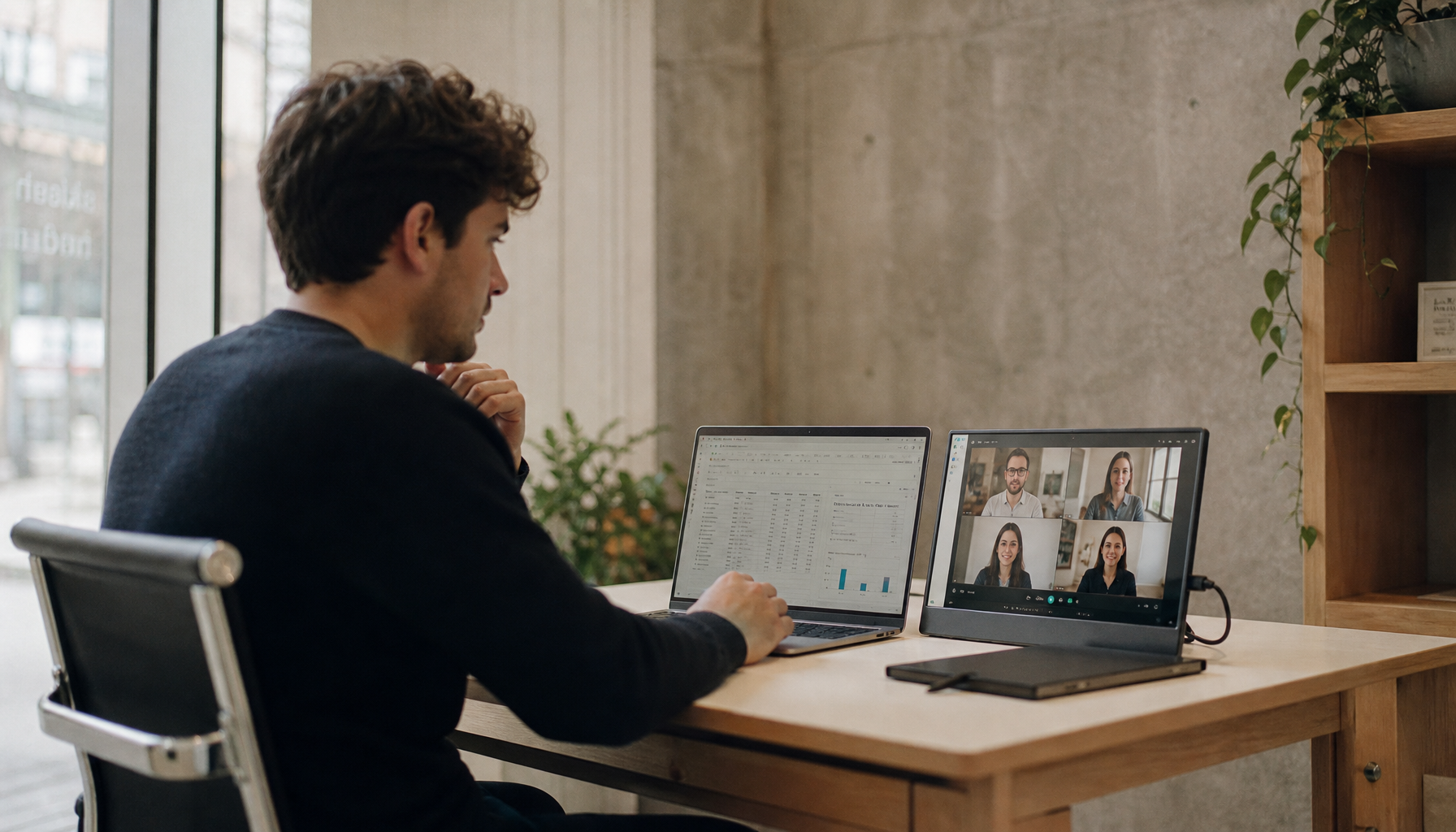
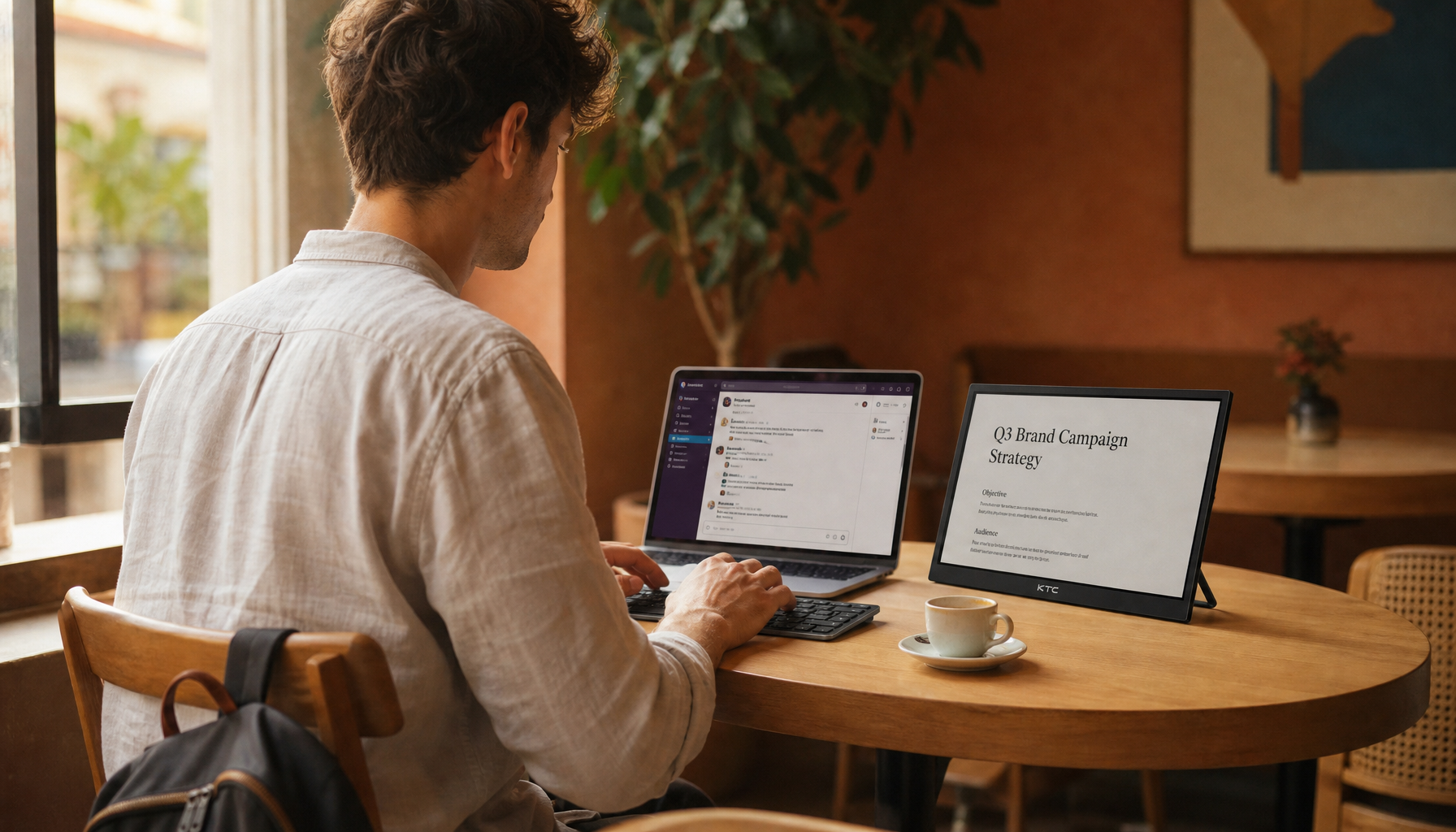
For most parked-car work sessions, place the portable monitor directly in front of you, about 20–30 inches from your eyes, with the screen center slightly below eye level and the panel tilted so your line of sight meets it nearly straight on.
Neck tight after answering email from the passenger seat, or squinting because the screen looks washed out every time sunlight shifts across the windshield? A practical setup can reduce the two biggest problems at once: awkward posture and off-axis image loss. You’ll get a clear angle target, a fast setup method, and the tradeoffs that matter when your “desk” is a car cabin.
The Best Viewing Angle in a Car

The optimal viewing angle is not one magic number. It is the position where your eyes, neck, screen tilt, and panel technology work together. In a car, the best starting point is a monitor centered in front of your torso, with the top edge just below eye level, the center of the screen roughly 15–20 degrees below your straight-ahead gaze, and the panel tilted until the screen surface faces your eyes squarely.
Ergonomic monitor guidance supports keeping the display around eye level and about an arm’s length away, with the center of the screen below the horizontal line of sight for more natural viewing display around eye level. In real car use, that usually means the portable monitor sits on a stable tray, console bridge, or passenger-seat desk rather than low on your lap. If it sits too low, you will crane your neck. If it sits too high on the dashboard, you may block visibility, create glare, or place a hard object in an unsafe zone.
For a 14- to 16-inch portable monitor, 20–30 inches is the practical sweet spot. At 20 inches, text is readable without leaning in. At 30 inches, the cabin feels less cramped, but you may need larger system scaling. A 15.6-inch 1080p display works well here because it gives enough workspace without demanding the longer viewing distance of a larger desktop panel.
Tilt Matters More Than People Expect

Portable monitor “viewing angle” can mean two different things. Your ergonomic viewing angle is the direction your eyes take toward the screen. The display’s technical viewing angle is how far off-center you can move before brightness, color, or contrast starts to degrade.
LCD viewing-angle performance is limited by the panel design, and image quality can shift when you move outside the display’s acceptable viewing cone LCD viewing-angle performance. That matters in a car because you rarely get a perfect desk posture. The seat reclines, the steering wheel or glove box changes your working position, and sunlight forces micro-adjustments.
A strong setup keeps the screen close to perpendicular to your face. If your eyes are looking slightly downward, tilt the monitor slightly backward so the panel meets your gaze. If the monitor is on a center-console tray and slightly below you, the top of the display may need to lean back. If it is on the passenger seat and you are sitting beside it, rotate the whole screen toward your chest instead of twisting your neck toward it.
A useful quick test is simple: open a white document and a dark spreadsheet, then move your head left, right, up, and down by a few inches. If the whites dim, blacks wash out, or gridlines lose contrast, your screen is outside its comfortable cone. Reposition the stand before increasing brightness.
Why Adjustability Beats a Fixed Angle
A study on touch-screen workstation angles found that users did not converge on one universal display angle; most preferred an adjustable range rather than a fixed position touch-screen workstation angles. The study was not about cars, but the lesson transfers well: body size, seat height, task type, and lighting all change the best angle.
That is why a portable monitor for car work should have a stand that adjusts tilt reliably. Magnetic folding covers are compact, but many allow only a few shallow positions. A rigid kickstand, hinged base, or compact folding stand gives better control on uneven surfaces. For car use, stable tilt is not a luxury feature; it is the difference between a productive 45-minute admin session and a display that slowly slides into glare.
If you are parked and using a laptop plus portable monitor, put the primary screen directly in front and use the second screen slightly to the side. For writing, coding, dashboards, or spreadsheets, a 16-inch 16:10 panel gives more vertical room than a standard 16:9 screen while staying backpack-friendly 16-inch 16:10 panel. If space is tight, a 14- or 15.6-inch 1080p display is easier to stabilize.
Panel Choice Changes the Safe Angle Range
IPS and similar wide-view panels are better for car cabins because you may view the display from slightly above, below, or beside center. TN-style budget panels can still work, but they punish poor angle choices faster. The first symptom is usually not total unreadability; it is softer contrast, gray-looking blacks, and colors that shift when your posture changes.
Portable monitor buying guidance often favors IPS for general use because it offers wider viewing angles than many cheaper alternatives, while brightness remains a separate spec to check wider viewing angles. In a car, brightness and viewing angle are inseparable. A dim but wide-angle screen may still struggle in daylight. A bright screen with poor off-axis behavior may look fine only when your head is locked in one position.
For office productivity from a parked car, the value target is a 14- to 16-inch IPS monitor, 1080p or 2K resolution, USB-C plus HDMI, a protective cover, and brightness near or above 250 nits. For design review or color-sensitive work, prioritize measured color performance and a stable stand over gimmicky touch features. For gaming or motion-heavy use, refresh rate matters, but it should not outrank visibility, power stability, and placement.
Glare Is the Hidden Angle Problem
The best screen angle can fail if the windshield, side window, or glossy dashboard throws light across the panel. Natural light should come from the side when possible, not straight into the display or directly behind it. In a car, that means parking so the sun is beside the vehicle rather than in front of the windshield, then rotating the monitor away from direct reflections.
Automotive photographers manage reflections by controlling angles and using polarizing filters, a reminder that car glass and glossy surfaces can make light behave unpredictably controlling angles. For monitor work, the equivalent is less dramatic: choose shade, reduce bright clothing reflections, avoid glossy screen protectors, and tilt the display until reflected light moves away from your eye line.
A matte panel helps, but matte is not a substitute for angle control. If the screen is readable only at maximum brightness, your setup is fighting the car environment. Move the vehicle, shift the monitor, or add a small sunshade before you drain your laptop and strain your eyes.
Safety Boundaries: Work Parked, Not While Driving
A portable monitor should never be positioned where it distracts the driver, blocks visibility, or interferes with airbags. The practical setup is for parked work, rear-seat work, or passenger use while someone else drives. Even then, avoid hard-mounted displays near airbag paths and avoid heavy monitor arms unless the vehicle is specifically equipped for them.
Temporary in-car monitor discussions often run into the same safety issue: mounting full-size monitors in front passenger areas creates visibility, legal, insurance, and airbag concerns. A laptop-style portable display is usually the better tool because it is lighter, removable, and easier to pack away. If the work requires multiple feeds, remote into a trunk-mounted or rear-mounted computer from a laptop instead of building a rigid monitor array in the cabin.
Power safety matters too. A car USB-C port may provide charging power, but it does not guarantee video output or enough wattage for a bright external display over USB-C. Test the exact monitor, cable, charger, and source device before relying on the setup. If the screen flickers or dims, reduce brightness first, then use a proper USB-C PD charger or power bank.
A Practical Setup Recipe

Start by parking in shade or with sunlight coming from the side. Sit in your working position before placing the monitor, because the seat angle changes everything. Put the monitor directly in front of your chest if it is the primary display, or just beside the laptop if it is secondary. Raise it until the top edge is slightly below eye level. Set the distance to about 20–30 inches, then tilt the panel until the image looks evenly bright from top to bottom.
Next, open the actual apps you will use. A spreadsheet exposes contrast problems. A document exposes text-size problems. A video call preview exposes angle and glare problems. If text feels small at the correct distance, increase scaling instead of leaning forward. If the top of the screen looks darker than the bottom, adjust tilt before changing brightness.
For a compact parked-car workstation, the best balance is usually a 15.6-inch IPS portable monitor at 1080p, running in extended mode, powered by a reliable USB-C path with HDMI available as backup. For longer sessions, a 16-inch 16:10 display is more comfortable for documents and dashboards, but only if your stand can hold it steadily.
Pros and Cons of Common Car Monitor Angles
Setup Position |
Best Use |
Main Advantage |
Main Tradeoff |
Slightly below eye level, tilted back |
Office work, email, spreadsheets |
Natural neck posture and strong readability |
Needs a stable stand or tray |
Low on lap or seat |
Quick checks |
Fast setup |
Neck strain and poor viewing angle |
High on dashboard |
Passenger reference only |
Easier line of sight |
Glare, visibility, and safety concerns |
Side-positioned next to laptop |
Dual-screen productivity |
Efficient extended workspace |
Can cause neck rotation if used as primary |
FAQ
Should a Portable Monitor Face Straight Up in a Car?
No. A screen lying flat forces a steep downward gaze and often catches reflections from windows. Keep it raised and tilted toward your face so your eyes meet the panel close to straight on.
Is a Wider Viewing Angle Always Better?
A wider technical viewing angle gives you more forgiveness, but it does not replace good placement. Even a high-quality IPS screen works best when centered, properly tilted, and protected from glare.
What Size Is Easiest to Use in a Car?
A 14- to 15.6-inch monitor is the easiest to stabilize in a passenger seat or rear-seat setup. A 16-inch 16:10 model is better for serious productivity if you have enough room and a rigid stand.
A car cabin rewards precision. Keep the monitor close to arm’s length, slightly below eye level, tilted toward your face, and out of glare. That setup gives you the clearest screen, the least posture penalty, and the most reliable portable workstation without turning the vehicle into a compromised desktop.