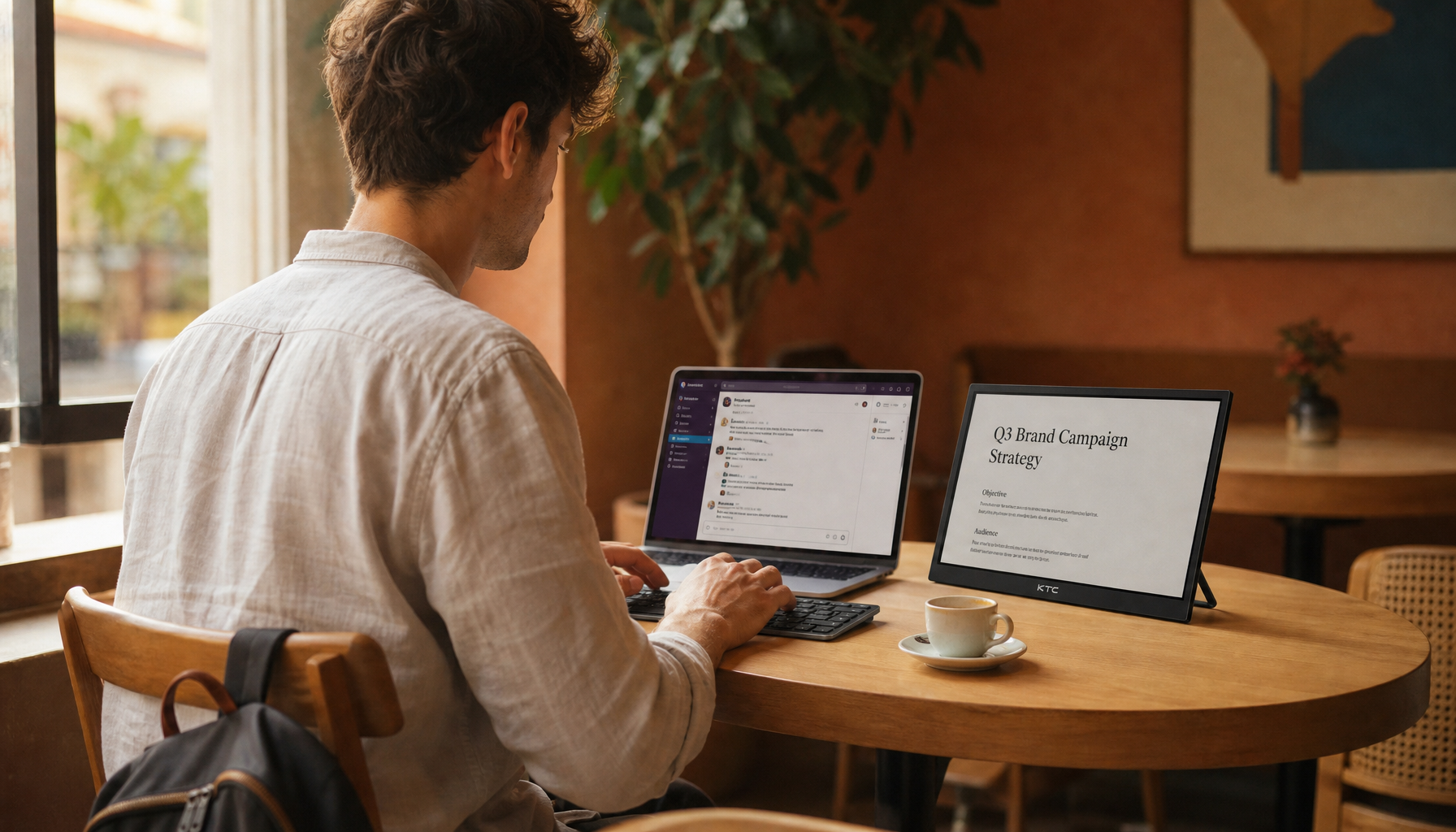
Event coordinators are choosing portable monitors because they turn a laptop, mini PC, or check-in station into a larger, clearer, more flexible guest-facing workflow than a tablet can usually provide. The result is faster visual confirmation, better staff ergonomics, cleaner branding, and fewer bottlenecks at busy entrances.
Is your check-in table slowing down because guests are leaning over a small screen while staff juggle names, badges, and last-minute changes? A portable monitor gives the team a larger shared display that can be placed, mirrored, extended, powered, and branded for the actual check-in flow. Here is how to decide when it beats a tablet, where it still has limits, and what specs matter on event day.
The Practical Difference: Tablet as Device, Portable Monitor as Workflow Surface
A tablet is a self-contained computer with a built-in screen, battery, operating system, and apps. A portable monitor is different: it is a slim external display that connects to another device, usually a laptop, mini PC, phone, or check-in terminal, to expand or mirror screen space. That distinction matters because event registration is rarely just “tap a name.” It often involves roster search, badge printing, payment verification, session changes, VIP handling, waiver review, and troubleshooting across multiple windows.
For coordinators, the core advantage is control. A tablet keeps the workflow inside one small device. A portable monitor lets the staff member use a full laptop interface while showing guests only the clean confirmation screen, QR scan result, schedule view, or waiver prompt. That is why portable monitors fit the same operational logic as portable displays, which are valued at events because they reduce setup complexity, transport burden, and dependence on specialized installation.
In a real check-in lane, that can look like a laptop behind the desk running the registration platform, a 15.6-inch monitor facing the attendee, and a badge printer to the side. Staff can keep admin notes private while the guest sees a readable “confirmed” screen, session selection, or name spelling check. That separation is much harder on a tablet unless the event app is designed well for both staff and guest use.
Why Portable Monitors Solve Check-In Friction
Larger Text Reduces Guesswork at the Desk
The first reason is simple: people can read the screen without crowding the operator. A 13-inch to 17-inch portable monitor gives far more visual room than many tablets, especially when the interface includes names, company fields, ticket types, and badge status. Portable monitor testing highlights models around 14 inches to 17.3 inches, with business-friendly specs such as 1080p or higher resolution, 300- to 400-nit brightness, and USB-C connectivity in several recommended displays, making portable monitors practical for mobile productivity rather than casual second-screen use.
For a registration table, the calculation is straightforward. If your staff member needs to confirm a six-field record, a small tablet may force scrolling or tiny text. A portable monitor can show the guest name, company, ticket tier, dietary flag, and badge status in one glance. That cuts the “Can you turn it toward me?” moment that slows a line.
Extended Mode Keeps Staff Data Private

A tablet usually shows one active app view. A portable monitor connected to a laptop can work in mirrored mode or extended mode. Mirrored mode is useful when the guest needs to see exactly what the staff member sees. Extended mode is stronger for professional check-in because the attendee-facing screen can show only the polished confirmation view while the laptop keeps admin tools, payment notes, CRM details, or exception handling out of sight.
This is the same reason portable monitors work well for small presentations and desk-side demos: they create a controlled guest-facing surface without forcing everyone around one device. One event-focused product page positions a portable monitor for expos, trainings, recruiting events, sporting events, parties, and conferences, with a claim that the unit can be ready in less than 90 seconds, reinforcing the event value of fast setup when teams need to move quickly.
At a sponsor breakfast, for example, a coordinator can keep the sponsor list and special seating notes on the laptop while the portable monitor shows only a welcome screen and badge confirmation. That protects sensitive data without adding a second full computer.
Better Ergonomics for Long Registration Windows
Check-in is repetitive work. Staff may spend three or four hours scanning codes, searching names, and solving exceptions. A tablet flat on a table encourages downward viewing and handoff behavior. A portable monitor on a rigid stand can sit closer to eye level, which helps staff maintain a more comfortable posture and makes the station feel more permanent.
The value is not just comfort. A more stable display reduces accidental taps, screen rotations, and table clutter. A 15.6-inch screen with a firm stand can stay guest-facing while the keyboard, scanner, and badge printer remain staff-facing. That layout is easier to train and easier to duplicate across multiple lanes.
Why Tablets Still Win in Some Event Jobs

Tablets are still excellent when the check-in role is mobile, lightweight, and app-driven. A roaming usher validating QR codes at a reception entrance may prefer a tablet because it has its own battery, camera, and touch interface. A volunteer moving through a line can use a tablet more naturally than carrying a laptop plus monitor. If the event software is built primarily for tablet-style operation, forcing it into a laptop-and-monitor setup may add complexity.
The trade-off is that tablets are often less flexible once the workflow expands. Badge printing, multiple browser tabs, spreadsheet exports, payment checks, and last-minute roster edits are usually easier from a laptop. Portable monitors do not replace tablets everywhere; they replace them at fixed or semi-fixed stations where visibility, speed, and operator control matter more than handheld mobility.
Check-In Need |
Tablet Fit |
Portable Monitor Fit |
Roaming QR scan |
Strong |
Weak |
Fixed registration desk |
Moderate |
Strong |
Guest-facing confirmation |
Limited by screen size |
Strong |
Badge printer workflow |
App-dependent |
Strong with laptop |
Staff privacy |
Limited |
Strong in extended mode |
Ultra-light setup |
Strong |
Moderate |
Branded desk presentation |
Moderate |
Strong |
Power and Connectivity Are the Real Decision Points

A portable monitor is only as reliable as its power and signal path. Many modern models can use USB-C for video and power, but the connector shape alone is not proof that the laptop, cable, and monitor will cooperate. Setup guidance notes that USB-C with DisplayPort Alternate Mode allows one cable to carry video, data, and power, while HDMI or Mini HDMI usually needs separate USB power because HDMI does not deliver power.
For event coordinators, that means the pre-show test matters more than the spec sheet headline. Connect the actual laptop, actual cable, actual monitor, scanner, and badge printer. Run the check-in app at event brightness for at least 20 minutes. If the screen flickers, dims, disconnects, or drains the laptop too quickly, fix the power chain before doors open.
Power needs vary by size and features. Power guidance for portable monitors explains that they can draw power from USB-C Power Delivery, an AC adapter, or a built-in battery, and that higher-demand features such as 4K resolution, touchscreens, high brightness, and high refresh rates increase energy use. For registration, a reliable 1080p display is usually smarter than an overbuilt screen, because portable monitors need electricity for both display and processing.
A practical kit should include the monitor, a rigid stand, a full-featured USB-C cable, an HDMI cable, a compact charger, an adapter hub, and a power strip. If the venue has unreliable outlets near the entrance, add a USB-C Power Delivery power bank large enough for your session length and test it under load.
The Event Branding Advantage

A tablet often looks like a personal device. A portable monitor can look like part of the event environment. It can sit beside signage, badge stock, sponsor graphics, or a welcome screen and create a more intentional first impression. Trade show display guidance notes that portable displays are built for quick setup, compact shipping, flexible layouts, and reuse across conferences, pop-ups, recruiting events, and corporate meetings, which mirrors the reason coordinators like portable trade show displays at the registration zone.
This matters because registration is the first operational touchpoint. A bright, readable attendee-facing screen can show the event logo, name confirmation, room assignment, QR status, or “badge printing” message. That removes ambiguity and gives the line a professional rhythm. When guests can see what is happening, they ask fewer status questions.
The same thinking applies to larger digital signage. Event display guidance describes LED screens as useful for dynamic content, product demos, sponsor messages, live streams, and interactive attendee experiences, and while a registration desk does not need a large LED wall, the principle of dynamic content applies at a smaller scale. The right screen gives coordinators a live communication surface, not just a device.
What to Buy for Registration and Check-In
For most fixed check-in stations, the sweet spot is a 15-inch to 16-inch portable monitor with 1080p or better resolution, at least 300 nits of brightness if the entrance is well lit, an IPS panel for wide viewing angles, USB-C video, HDMI backup, and a stand that does not collapse when the table is bumped. Touch can be useful for waiver signing or self-service lookup, but it should not outrank brightness, stand stability, and cable reliability.
Avoid buying solely for 4K, extreme refresh rate, or gaming features. Those specs can increase power demand without improving name search or check-in confirmation. Portable display guidance emphasizes easy setup, professional presentation, transportability, and clear, concise messaging, and those priorities transfer directly to a registration station where portable displays must stay readable and uncluttered.
If you run multiple events per month, standardize the kit. Use the same monitor model, same stand, same cables, and same hub for every lane. Label each cable. Pack one spare monitor or tablet fallback for every several stations. The goal is not to make the desk look more technical; it is to make the workflow repeatable under pressure.
Pros and Cons for Event Teams
Portable monitors are stronger than tablets when the station is fixed, the workflow involves a laptop, guests need a readable confirmation screen, staff need private admin space, or the brand experience matters at the entrance. They also scale well across sponsor check-in, VIP registration, speaker ready rooms, press desks, and volunteer coordination tables.
The downsides are real. A portable monitor needs a host device, dependable cables, a power plan, and more table space than a tablet. It is less useful for staff walking a line or scanning tickets away from the desk. It also adds one more piece of equipment that must be packed, protected, and tested.
That is the actual decision: choose tablets for movement and single-app simplicity; choose portable monitors for visibility, control, and professional fixed-station throughput.
Final Word
Event coordinators are not replacing tablets because tablets are weak; they are choosing portable monitors where the check-in job has outgrown a handheld screen. For high-traffic registration desks, a tested portable monitor setup gives staff a bigger canvas, guests a clearer experience, and the event team a more reliable first impression.