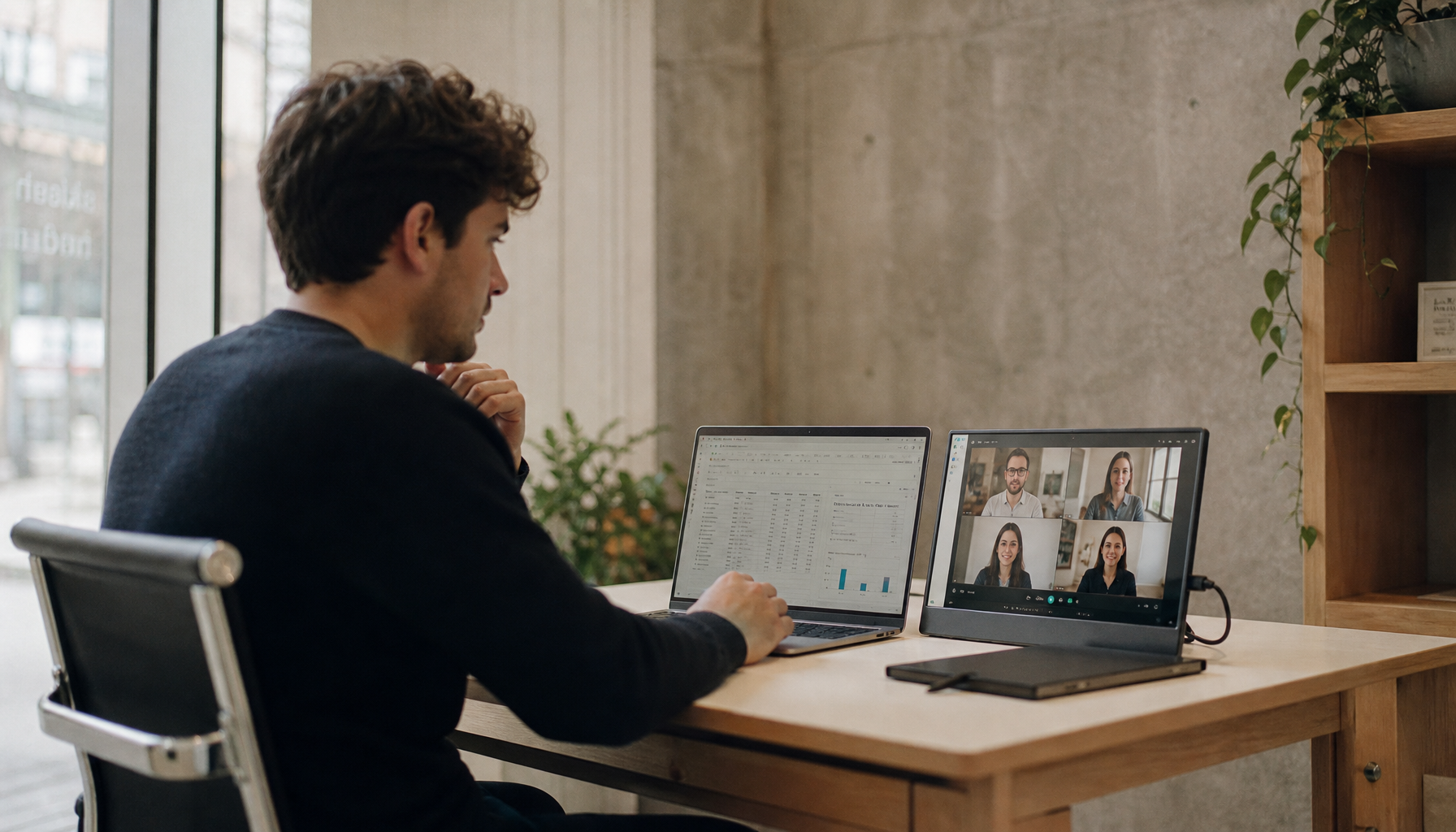
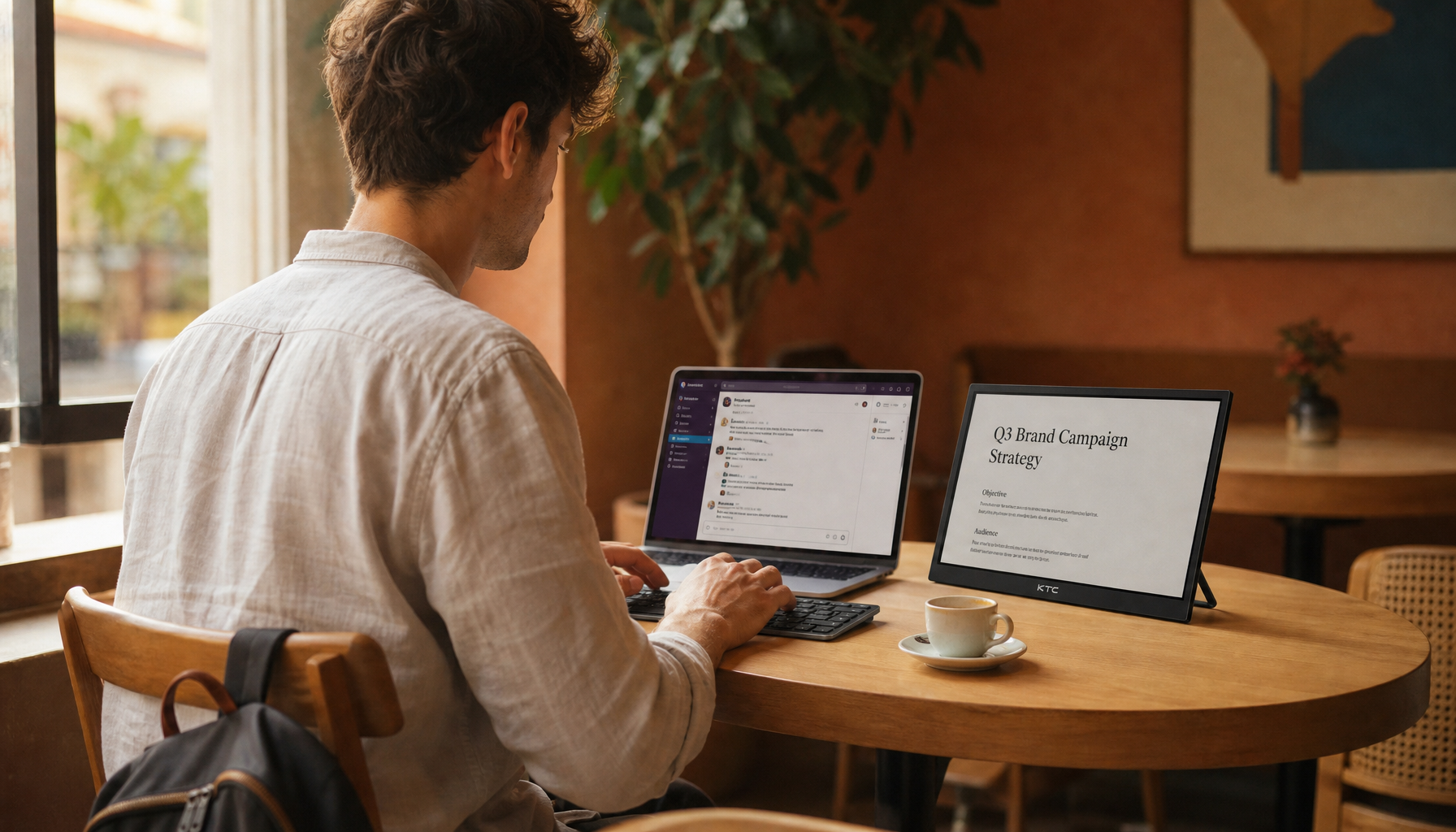
Place your main screen directly in front of you for solo focus, then use adjustable arms, display modes, and a slightly angled secondary screen so you can pivot into shared viewing without rebuilding the desk.
Does your desk feel perfect when you are deep in a spreadsheet, then awkward the moment a teammate pulls up a chair or you need to share a screen on a call? A practical monitor layout can reduce neck twisting, cut down on window shuffling, and make your setup faster to switch between private work and collaboration. Here is how to build a screen position that supports both modes without sacrificing comfort or performance.
Start With the Two Work Modes
Individual work rewards precision. Your primary monitor should be centered with your keyboard, mouse, chair, and body so your head stays neutral while you write, analyze, design, code, or game between meetings. The strongest baseline is simple: the screen you use most sits directly in front of your face, with the top edge or upper third near eye level and the panel about an arm’s length away.
Collaborative work rewards visibility and flexibility. That may mean a colleague looking at your secondary display, a laptop screen turned toward a small group, a duplicated presentation view, or a video call where chat, notes, and shared content need to stay visible at the same time. A multi-monitor setup works best when it reduces switching and resizing rather than just adding more screens to manage.
The mistake is treating one layout as permanent. A display system for mixed work should have a home position for deep focus and a share position for quick collaboration.
The Best Default Layout: Center Primary, Angled Secondary
For most hybrid workstations, use one primary monitor centered in front of you and one secondary monitor angled inward on the side. This keeps your solo work ergonomic while giving you a dedicated screen for chat, notes, dashboards, reference documents, or meeting controls.

The primary display should hold the task that demands the most accuracy: the document you are writing, the code editor, the design canvas, the spreadsheet model, or the game window. A primary screen centered at eye level reduces the constant micro-rotation that builds into neck and shoulder fatigue over long sessions.
The secondary screen should sit close enough that you can glance at it without turning your torso. If you use it often, angle it inward more aggressively. If it mostly holds team messaging, a calendar, or a reference document, keep it slightly off-axis so it supports your attention without hijacking it.
Setup |
Best For |
Main Advantage |
Tradeoff |
Center primary plus angled secondary |
Most office, creative, and gaming-adjacent work |
Strong solo ergonomics with easy reference access |
Side screen can still distract |
Two equal monitors with center seam |
Comparing documents or using both screens equally |
Balanced view across both displays |
Your face points at the bezel gap |
Ultrawide plus portrait side screen |
Focused production with long-form reference |
Immersive main view and clean secondary lane |
Requires more desk width |
Laptop plus external monitor |
Flexible offices and travel |
Fast setup with fewer accessories |
Laptop screen is often too low |
Height, Distance, and Tilt That Survive Both Modes
Your monitor height should follow your body, not your desk styling. Sit back in your chair with your feet supported, shoulders relaxed, and elbows near a comfortable typing angle. Then raise or lower the screen until the top edge or top third is around eye level. For larger displays, especially 32-inch and ultrawide panels, eye level near the upper third often feels better than forcing the very top edge to match your eyes.
A practical office range is about 20 to 30 inches for standard monitors and closer to 30 to 36 inches for large ultrawide or dual-monitor arrays. The top third of the screen should sit at or slightly below eye level, while the viewing distance should let you read text without leaning forward. If you cannot read comfortably, increase scaling or font size before dragging the monitor closer.
Tilt is a fine-tuning tool, not a rescue plan. A slight backward tilt can align the panel with your natural downward gaze, but it cannot fix a monitor that is too high, too low, or too far to the side. For people using progressive lenses, a slightly lower display often works better because it reduces chin lifting.
Build a Fast Collaboration Position
A shared screen should not require you to abandon good posture. If someone sits next to you, rotate the secondary monitor toward them while keeping your primary display centered for your own control. This is where an adjustable monitor arm earns its keep: it lets you pull a display forward, swivel it outward, or return it to your focus position in seconds.

For screen sharing on calls, your physical layout and software layout should match. Your operating system can identify and arrange displays to match your desk, then use Duplicate or Extend depending on the job. Extend spreads the desktop across screens for multitasking, while Duplicate shows the same content on more than one display for presentations or side-by-side viewing.
Use Extend for working sessions where you need notes, browser tabs, meeting controls, and a shared document visible at once. Use Duplicate when the other person needs to see exactly what you see, such as a walkthrough, demo, or client-facing review.
When Two Screens Are Not Enough
Three displays can be powerful when each has a clear role. A central screen can hold the active work, one side can hold reference material, and the other can hold communication or preview output. The productivity argument for three monitors as the sweet spot is that side displays act as glanceable surfaces while the middle remains the command center.
That said, more screens are not automatically more productive. If your side monitors become notification walls, you have built a distraction cockpit. A triple setup works when each display has a job and your chair still faces the primary task.
An ultrawide monitor can be the cleaner alternative. It keeps your head pointed forward, removes the center bezel problem, and gives you a wide workspace for timelines, spreadsheets, code, or multiple documents. The best compromise for many users is an ultrawide in the center with a portrait monitor on one side for notes, messaging, long documents, or bug logs. A curved ultrawide monitor paired with a vertical side display preserves immersion while keeping collaboration and reference work organized.

Use Hardware That Makes Switching Easy
If you switch modes frequently, prioritize adjustability over raw size. A fixed stand may be acceptable for a single-purpose desk, but mixed solo and collaborative work benefits from height, swivel, tilt, and depth control. Monitor arms also reclaim desk space, make cable routing cleaner, and let you position screens for different users or meeting angles.

Before buying arms, confirm VESA compatibility. Many mounts use 75x75 mm or 100x100 mm patterns, and some monitors need adapters. A dual monitor setup is easier to tune when both displays have similar size, resolution, and scaling, because cursor movement, text size, and window placement feel more consistent.
For laptop-heavy desks, a dock is often the difference between a polished workflow and cable chaos. USB-C docking can connect external displays, keyboard, mouse, power, and network through one cable, which makes it easier to move between focused desk work and meeting rooms.
A Practical Positioning Formula
Use this as your working baseline: sit in your normal posture, center the primary monitor with your body, place it roughly arm’s length away, set the upper third near eye level, then angle the secondary monitor inward until a glance feels natural. For shared work, swivel the secondary display toward the collaborator and use Duplicate only when both people need the same view.
A comfortable viewing distance is usually somewhere between 20 and 40 inches, but the real test is whether you can read, point, and discuss without leaning, squinting, or twisting. If the setup fails that test, adjust the screen before blaming your chair, your eyes, or your focus.
FAQ
Should both monitors be the same size?
Matching displays are smoother for cursor movement, scaling, color consistency, and visual comfort. Mixed monitors can still work well if the primary screen is clearly dominant and the secondary screen has a defined support role.
Is a vertical monitor useful for collaboration?
Yes, especially for meeting notes, chat, project briefs, code review, legal text, long documents, and browser-based research. It is less useful as a shared presentation display because portrait orientation is harder for two people to view side by side.
Should I duplicate or extend displays during meetings?
Use Extend when you need private notes, controls, or reference material. Use Duplicate when the person beside you or the room display needs to see exactly what is on your main screen.
A high-performance workstation should adapt faster than your attention breaks. Center the screen that earns your focus, keep collaboration on an adjustable side display, and let your monitor layout serve the work instead of forcing your body to chase the pixels.