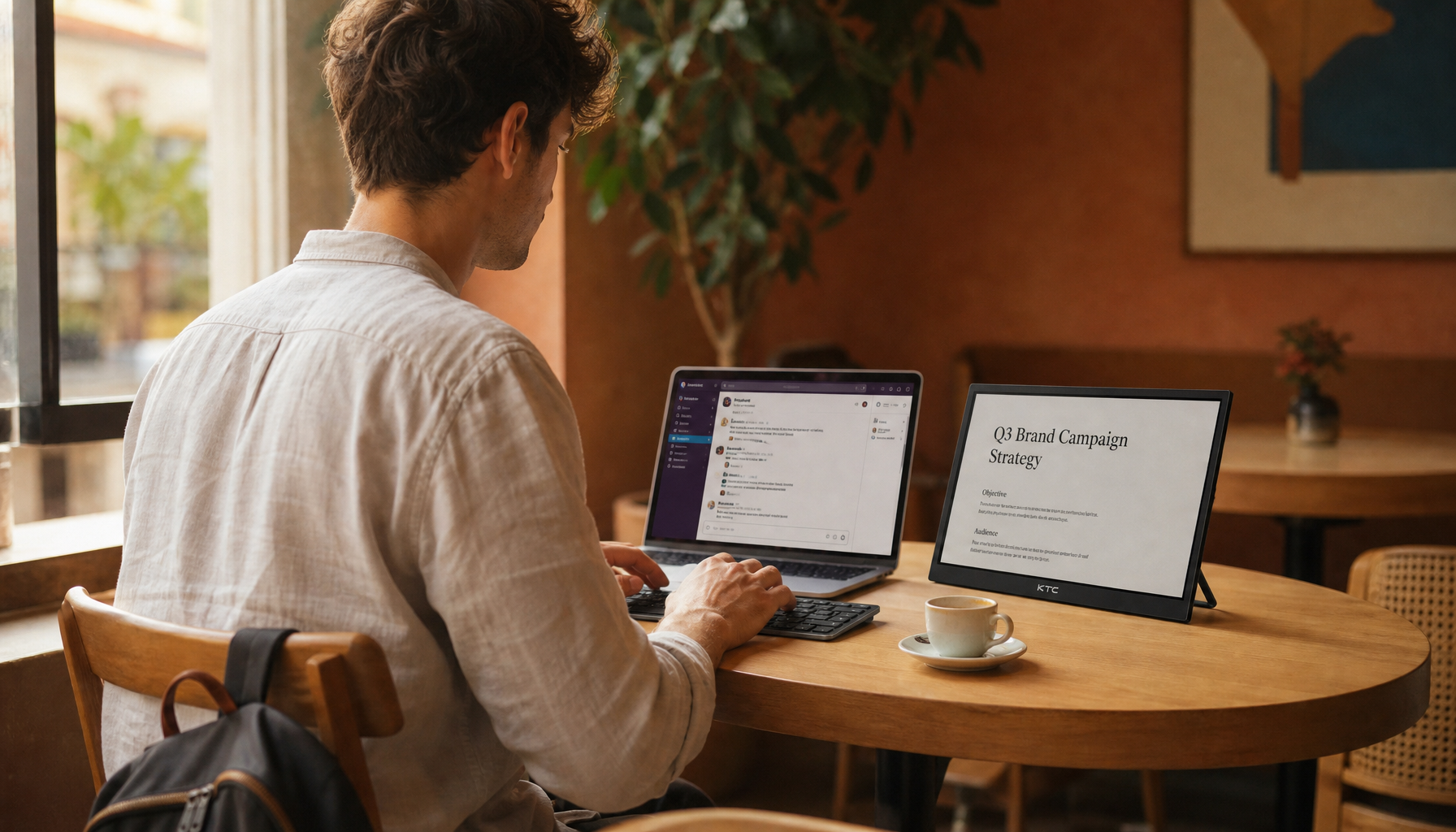
Raise the screen, bring the keyboard and mouse closer, and reset your wrists so your hands, forearms, shoulders, and eyes work in one neutral line instead of fighting your desk.
Do your wrists ache after a long spreadsheet session or ranked match review, especially when your chin is tucked down and your shoulders creep forward? A simple setup change can give you a testable win the same day: less reaching, less wrist bending, and a screen position that lets you sit tall without forcing your hands into strain. Here is how to rebuild the workstation from monitor height down to keyboard feel, with practical fixes that work for office displays, gaming monitors, ultrawides, laptops, and portable screens.
Why a Low Monitor Can Turn Into Wrist Pain
A monitor that sits too low does not hurt your wrist directly the way a hard desk edge can. The problem is the chain reaction: your eyes drop, your head follows, your upper back rounds, your shoulders roll forward, and your arms start reaching from a collapsed position. Once that happens, your wrists often bend upward or sideways to keep typing, clicking, or gaming.

That matters because neutral wrist posture keeps the wrist aligned with the forearm and reduces strain from typing and mouse use. When the wrist is extended upward, flexed downward, or angled to the side for hours, tendons and nerves have less room to tolerate repetition. The result can feel like aching, stiffness, tingling, numbness, weaker grip, or burning fatigue across the forearm.
Ergonomics is not about sitting perfectly still. It means arranging the display, chair, desk, keyboard, mouse, and movement habits so your body can work without unnecessary mechanical friction. For a productivity display or high-refresh gaming monitor, the screen should support your posture instead of training you to fold over the keyboard.
Start With the Monitor, Because Your Eyes Drive Your Posture
Your monitor should sit directly in front of your primary working position, with the top of the screen at or slightly below eye level. Ergonomics guidance also recommends placing the monitor about an arm’s length away, which gives your eyes and neck a more sustainable viewing angle.

A useful real-world test is simple: sit fully back in your chair, relax your shoulders, and look straight ahead. Your eyes should land near the upper third of the screen, then drift slightly downward toward the center. If you have to tuck your chin, lean forward, or look down at a laptop on the desk, the display is too low for sustained work.
For a 24-inch or 27-inch office monitor, an adjustable stand or monitor arm is usually the cleanest fix. A stable riser can work too, as long as it does not wobble and still leaves room for your keyboard and mouse. For a gaming monitor, height adjustment matters as much as refresh rate because performance is not just frame delivery; it is how well your body can stay precise after three hours of focus.
Laptop and Portable Screen Setups Need Separation
Laptops create an ergonomic tradeoff because the screen and keyboard are attached. If the keyboard is at a comfortable typing height, the screen is usually too low. If the screen is high enough, the keyboard is too high and too far away.
The practical fix is to treat the laptop like a display. Put it on a stand and use an external keyboard and mouse. Desk setup guidance emphasizes keeping the screen at or just below eye level while keeping the keyboard and mouse close together so the wrists stay straight. The same principle applies to portable smart screens: elevate the viewing panel, but keep the input devices low, close, and centered.
Reset the Keyboard and Mouse Around Your Elbows
Once the monitor is high enough, fix the inputs. Your keyboard should be directly in front of you, close enough that your elbows stay near your sides. Your forearms should be roughly parallel to the floor, and your hands should sit at or slightly below elbow height.

If your desk is high and your chair is low, you may shrug your shoulders and bend your wrists upward to reach the keys. If your keyboard is too far away, you may plant your palms on the desk edge and reach forward from the shoulders. Both patterns can add pressure and fatigue.
Wrist ergonomics advice highlights a straight wrist-and-hand line while typing, with elbows around 90 degrees and forearms parallel to the floor. In practice, your keyboard belongs close to the desk edge but not so close that the desk edge digs into your wrist. Your mouse should sit on the same surface and at the same height as the keyboard, close enough that you can move it from the elbow and shoulder instead of constantly flicking from the wrist.
Setup Element |
Better Position |
Why It Helps |
Monitor |
Top at or slightly below eye level |
Reduces hunching and forward head posture |
Keyboard |
Centered, close, at elbow height |
Keeps wrists aligned with forearms |
Mouse |
Same height as keyboard, close to body |
Reduces reaching and tight gripping |
Chair |
Feet flat, back supported, shoulders relaxed |
Gives the arms a stable base |
Wrist rest |
Used during pauses, not heavy typing |
Reduces contact pressure without pinning the wrists |
Use Wrist Supports Carefully
A wrist rest can help, but only if it supports pauses rather than becoming a pressure point during active typing. Pressing your wrist into a pad while your fingers move can keep the wrist fixed and increase compression in the exact area you are trying to calm down.
Workplace wrist guidance recommends keeping wrists floating while typing and using wrist rests mainly during pauses. That is a subtle but important distinction. Think of a wrist rest as a landing pad, not a brace for continuous force.
Ergonomic keyboards and mice can help when the standard setup keeps pulling you into strain. A low-profile keyboard may reduce wrist extension. A split keyboard may reduce forearm rotation. A vertical mouse or trackball may help if traditional mouse use causes gripping, twisting, or side-to-side wrist motion. The downside is adaptation time. A new device can feel slower for several days, and the wrong model can simply move discomfort from the wrist to the thumb, elbow, or shoulder. Test one change at a time so you can tell what actually helped.
Match Display Size to Desk Depth
A bigger screen can improve immersion and productivity, but only if your desk gives you enough distance. If a large monitor sits too close, you may lean back, crane your neck, or rotate your head repeatedly to scan the edges. If it sits too low, the size magnifies the posture problem.
For standard office work, a 24-inch to 27-inch display usually fits most desks well. For larger business displays, ultrawides, or multi-monitor setups, the winning layout is not “center every pixel.” It is “center the main task.” Put the window you use most directly in front of your nose, then place reference windows to the side.
Business monitor coverage shows how modern work displays now include ultrawide panels, USB-C hubs, webcams, KVM features, and high-refresh options. Those features are valuable, but ergonomic adjustability is the performance feature that keeps the rest usable. A stunning 34-inch conferencing monitor or 43-inch productivity screen loses its value if it forces you to hunch, twist, and type with bent wrists.
Build a Micro-Break System That Protects Hands and Eyes
Even a well-tuned setup cannot erase the load of uninterrupted repetition. Short breaks work because they interrupt static posture before discomfort escalates. The goal is not a dramatic stretch routine. It is frequent reset points that return your shoulders, eyes, and wrists to neutral.
Wrist pain exercise guidance notes that stretches and exercises are appropriate when pain is mild, around 3 or 4 out of 10 or lower, and that stronger or persistent pain should be evaluated by a healthcare provider. For mild discomfort, wrist flexor and extensor stretches, range-of-motion movements, tendon glides, and shoulder blade squeezes can be useful when done gently.
A practical screen-side rhythm is to pause every 20 to 30 minutes. Look away from the display, drop your shoulders, open and close your fingers, rotate the wrists gently, and reset your keyboard and mouse position if you have drifted forward. The 20-20-20 eye habit also fits naturally here: every 20 minutes, look 20 ft away for 20 seconds. That visual reset often reminds you to un-hunch before your wrists take the load.
Know When Wrist Pain Is More Than Setup Friction
Ergonomic changes are powerful, but they are not a diagnosis. Wrist pain can come from overuse, tendon irritation, sprains, arthritis, cysts, fractures, nerve compression, or carpal tunnel syndrome. If symptoms include numbness, tingling, swelling, bruising, reduced grip strength, nighttime pain, or trouble using the hand normally, the next step is medical evaluation rather than another accessory purchase.
Wrist pain treatment information explains that evaluation may include checking tenderness, swelling, range of motion, grip strength, imaging, ultrasound, or nerve testing, depending on the suspected cause. That does not mean every sore wrist needs advanced testing. It means persistent or worsening symptoms deserve a professional look, especially if you are losing function.
A Practical Setup Sequence for Today
Start by raising the monitor until your eyes rest near the top third of the screen while your head stays level. Then sit back in the chair, put your feet flat, relax your shoulders, and bring the keyboard and mouse close enough that your elbows stay near your sides. After that, check the wrists: they should form a straight line with the forearms, not bend upward to reach the keys.
If you use a laptop, elevate the screen and add an external keyboard and mouse. If you use a large monitor, move it far enough back that you can see your primary work area without leaning. If you use two displays, center the one you use most and angle the second toward you. If you use an ultrawide, center the active window rather than the whole panel.
The best display setup is not just sharper, faster, or larger. It lets you stay upright, keep your wrists neutral, and work or play longer without your body paying the bill. Raise the view, shorten the reach, lighten the grip, and let the screen support your performance instead of pulling you down.