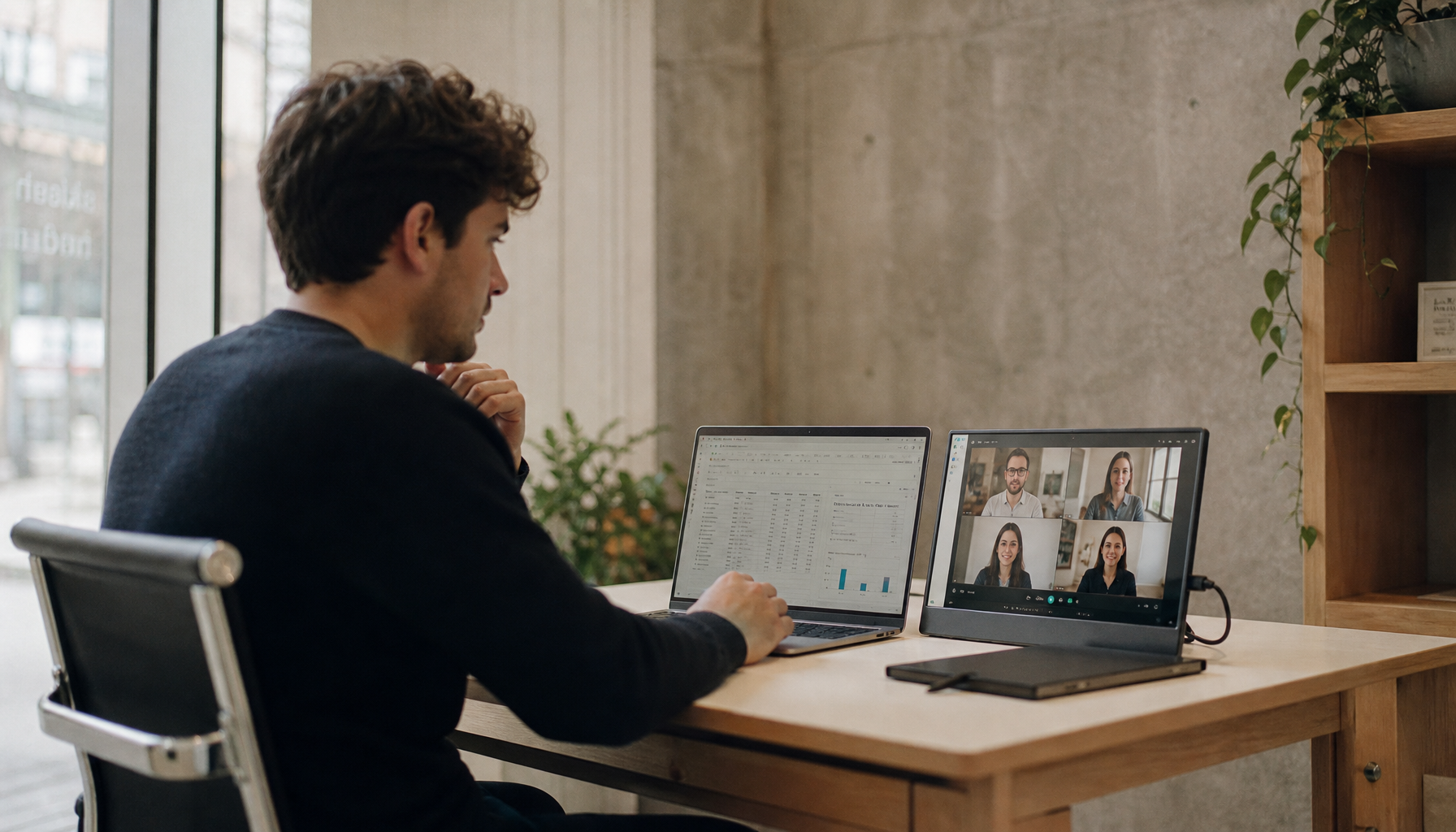
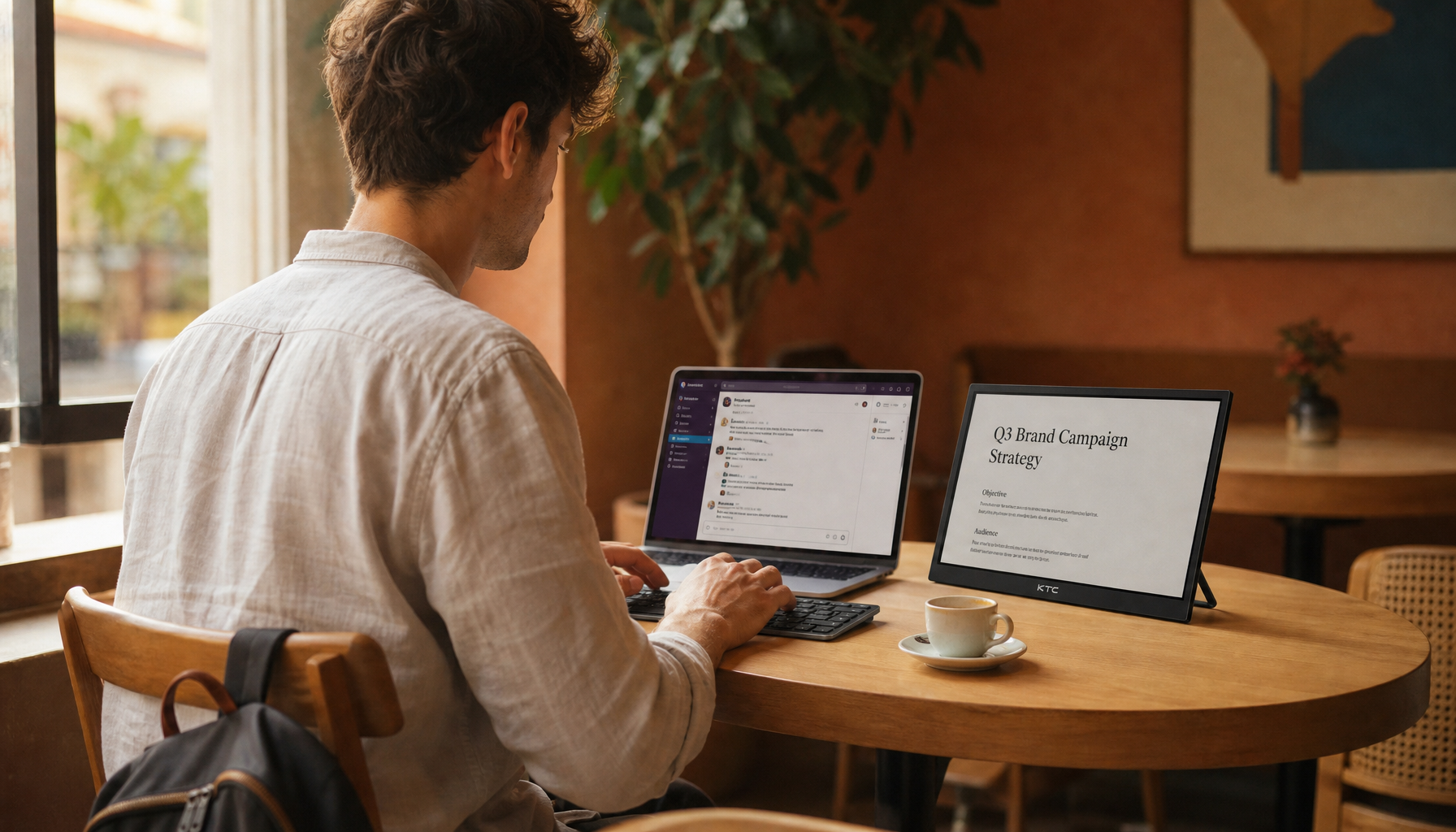
A smart display for hybrid work is worth considering when hot-desking needs faster handoff, less cable reset, and easier room-to-room movement. It is not the right answer for every office, but it can remove the friction that makes hybrid work feel clumsy.

Why Hot-Desking Needs a Different Display
Hot-desking changes the display job. A screen is no longer just a fixed personal monitor; it has to support quick handoff, minimal reset time, and movement between desks or rooms without slowing the day down.
That matters because hybrid workers still run into setup friction when they come into the office. Logitech reported that 63% of hybrid workers face technology issues when they go in, and 50% say they are frustrated by setup. The same report also says the average hybrid worker spends about 25 minutes getting situated at a shared desk, including finding a workspace and setting up technology. In practice, that is the difference between starting work and spending the first part of the morning untangling it.
For shared desks, multipurpose rooms, and ad hoc collaboration zones, the core question is not "Do we want a nicer monitor?" It is "How much time does each reset cost, and how often will the screen move?" If that answer is often, a rolling display for hot-desking becomes a workflow choice, not a luxury.
When Rolling Beats a Fixed Desk Monitor
Here is the simplest way to separate the formats: fixed monitors are for stable desks, portable monitors are for light travel or quick laptop expansion, and rolling displays are for shared spaces that need the screen to move repeatedly.
| Display Type | Best Fit | Strengths | Where It Breaks Down |
|---|---|---|---|
| Rolling display | Shared rooms, hot-desking, collaboration zones | Easier room-to-room movement, one screen can serve more than one area, less dependence on a permanent desk | Not as useful if it rarely moves or if the office has tight parking space |
| Fixed desk monitor | Permanent desks with one main user | Simple cable routing, stable ergonomics, low setup effort once installed | Slower to share, harder to reposition, poor fit when desks change users often |
| Portable monitor | Laptop expansion, travel, temporary second screen use | Light to carry, easy to store, good for individual mobility | Usually too small or too temporary for a shared office screen that stays in use all day |
A hot desking equipment planning note makes the same basic point: flexible desk models work better when monitors and power are ready at open spots, and they become frustrating when the equipment is not there. That is why mobile display planning is really a question about access and reset time, not just screen size.
Mobility also comes with its own responsibility. The UL 1678 standard for carts and stands covers stability and support requirements for audio/video carts and stands, so it is a useful reminder that a rolling display only helps if the room layout, path, and parking space support it.

What a Hybrid Office Display Must Do
For most buyers, the right checklist is smaller than the product pages make it look. Start with four questions: can the display move easily, does it reduce cable resets, does it help shared use, and does it match your office rules?
Mobility and Room-To-Room Movement
A display is only mobile if the office can actually move it. Hallway turns, door widths, storage space, and the path between rooms matter more than marketing language. If the screen can roll but not park safely, it will still feel awkward in daily use.
In real offices, the useful check is simple: can one person reposition the display without creating a second task for the next person? If not, the mobility benefit shrinks fast.
Cable Simplicity and Power Planning
The goal is fewer resets, not just fewer visible cables. A good hot-desking setup should make power access, input switching, and cable length part of the buying decision.
That is especially important when the display moves between a meeting room and an open desk. If every move requires finding a new outlet, reconnecting multiple cables, or hunting for the right adapter, the setup starts to defeat itself.
Shared-Use Features That Reduce Reset Time
Touch, battery power, Android, cameras, speakers, and wireless features can help some teams, but only when the workflow actually uses them. A display with these extras can be useful for quick meetings, shared annotations, or a room that doubles as a workstation.
That said, these are helpers, not automatic wins. If your team mostly docks laptops and uses standard meeting software, the extra features may matter less than a clean handoff process and reliable input connections.
Compatibility Checks Before Purchase
Before buying, check the login flow, device handoff process, app needs, network rules, and whether the office allows battery-powered equipment in the intended rooms. Those questions are model-specific and policy-specific, so they are better treated as verification steps than broad promises.
If you want a deeper setup reference, the MegPad hybrid mobility guide is a useful follow-up for room-to-room planning, and rolling display battery life helps you think through when plugged-in use is the safer default. For offices standardizing around shared-device routines, the hybrid desk and smart monitor setup guide is also worth a look.
Mapping the Megapad to Office Workflows
The KTC MEGAPAD 27-inch model is a natural example to examine because it is built for mobile touch use rather than a fixed desk. The KTC MEGAPAD 27-inch model includes built-in wheels, a 27-inch FHD touch display, Android 14, Google EDLA certification, a 9500mAh battery, an 8MP camera, 8GB RAM, 128GB storage, and a 12-month warranty.
For a hot-desking office, that combination makes sense when the display itself needs to move between users or rooms. It can fit shared meeting rooms, rotating desk use, and flexible collaboration zones where the screen is part of the shared workflow rather than tied to one employee.
The product page also notes wired projection from a laptop and everyday use cases like video calls, reading documents, and online classes. In office terms, that usually means it works best when the team wants a shared screen with touch interaction and simple room handoff, not when everyone already has a permanent monitor at a fixed desk.
The larger 32-inch MEGAPAD options are more of a conditional alternative than a universal upgrade. They offer more screen area and 4K resolution, which can help in larger shared rooms, but they also ask for more space and a more careful movement plan. If your office values a bigger shared canvas more than compact handling, the 32-inch 4K mobile touch display is the closer fit to review.
Where a fixed monitor still makes more sense is equally important. If each desk has a permanent occupant, the monitor rarely moves, or the office wants the simplest possible cable layout, a fixed desk screen is usually the cleaner choice. In that setup, mobility is solving a problem you do not really have.
Setup Checks Before You Buy
Use this checklist before you choose a rolling display for hot-desking:
- Confirm how often the display will move between desks or rooms.
- Measure the path it has to travel, including doorways, corners, and storage space.
- Check whether power is available where the display will be parked and used.
- Decide whether one screen will serve one team, one room, or many users in a day.
- Map the cable routine, including laptop connections, charging, and input switching.
- Verify the office policy for battery-powered equipment, touch use, and shared devices.
- Confirm whether the screen size fits the room without making movement awkward.
- Choose fixed or portable instead if the display will stay in one place most of the time.
A rolling display for hot-desking is the better choice when movement, handoff, and shared access matter more than desk-by-desk permanence. If the screen is mostly stationary, a fixed monitor is easier. If the screen needs to travel with one person more than one room, a portable monitor usually makes more sense.
FAQs
How Do I Know If a Rolling Display Fits a Hot-Desking Office?
Look at movement frequency first. If the screen changes users, desks, or rooms several times a day, a rolling display is more likely to pay off. If it stays parked most of the time, the added mobility may not justify the extra space and setup planning.
What Is the Main Difference Between a Rolling Display and a Portable Monitor?
A rolling display is built to stay large while moving around the office, which makes it better for shared rooms and collaboration zones. A portable monitor is usually better when one person needs a lighter second screen for travel or temporary desk expansion.
Can a Shared Display Reduce Cable Clutter in a Flexible Office?
Yes, but only if the office plans the connection routine around the display instead of adding more loose cables to the room. Power access, cable length, and input switching matter just as much as the screen itself. Otherwise, the clutter just moves to a different spot.
Why Does Touch Matter for Hybrid Work Displays?
Touch helps when teams want quick interaction, menu navigation, or simple collaboration without adding another device. It matters less when the office mostly uses laptops and standard conference apps. The feature is useful when it fits the workflow, not because it is present.
Can One Mobile Display Replace Both a Meeting Room Screen and a Desk Monitor?
Sometimes, yes. It works best when the room layout, screen size, and daily handoff process fit both jobs without awkward trade-offs. If either role starts feeling compromised, separate setups are usually easier to live with.
Final Takeaway
A rolling display for hot-desking makes sense when the office needs faster handoff, fewer reset steps, and a screen that can move between users or rooms without creating friction. If movement is rare, a fixed monitor is simpler. If one person needs a second screen on the go, a portable monitor is usually the better fit. Start with the workflow, then check the room layout before you buy.