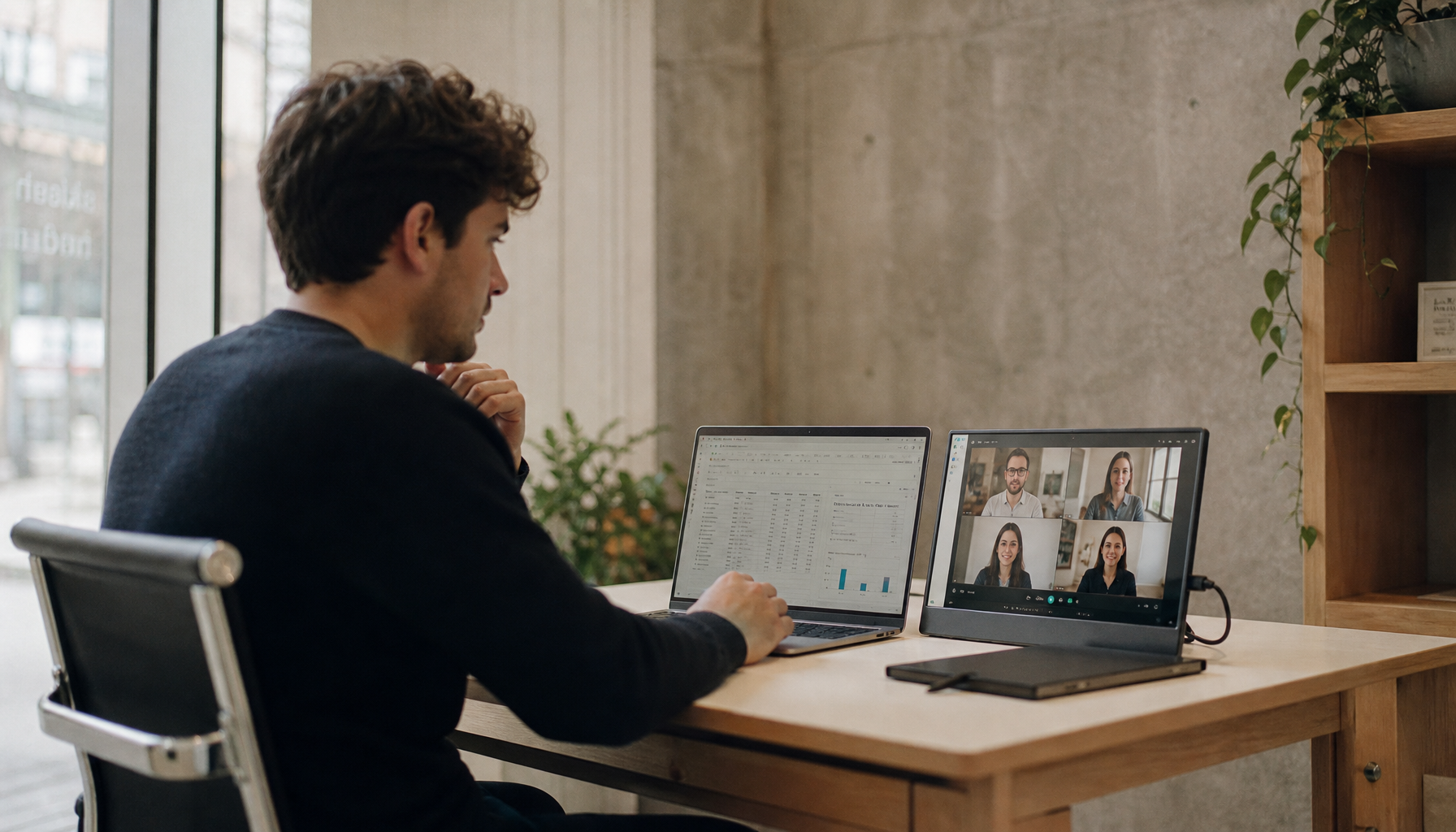
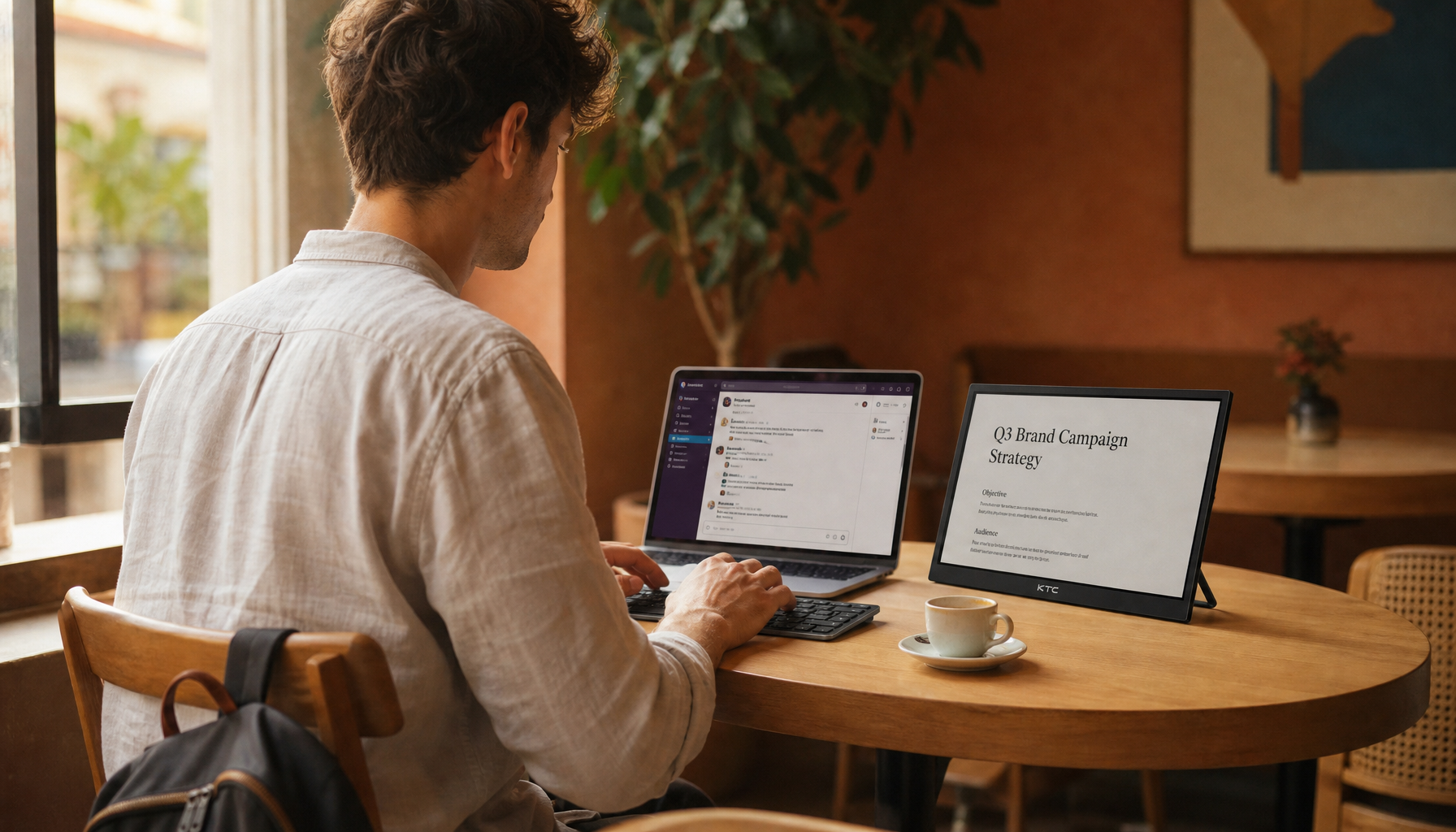
The best sit-stand monitor setup keeps the screen at eye-friendly height, about an arm’s length away, and easy to readjust when desk height changes.
If your neck tightens the moment you raise the desk, the display is usually the part that fell out of alignment. A sit-stand setup works best when monitor height, depth, and mounting move with you instead of staying frozen in a seated layout. You will leave with a practical way to tune single, dual, ultrawide, gaming, and portable monitors for both postures.
Build a Baseline That Works in Both Positions
Set height before anything else
Monitor placement can reduce eyestrain and neck or back pain when the screen is directly in front of you, at least 20 inches away, and the top line of the display sits at or slightly below eye level. For most monitors, that puts your natural gaze into the upper third of the panel rather than forcing you to look up. On larger gaming monitors and ultrawides, center the image area on your eyes, not just the plastic frame on the desk.

Match distance to panel size
A viewing distance of about an arm’s length is the right starting rule, but screen size changes the exact number. A 24-inch monitor usually feels comfortable around 20 to 28 inches away, while a 27-inch monitor often works better around 24 to 32 inches. If text feels too small on a sharp high-refresh or high-resolution display, increase scaling before pulling the monitor closer.
Use a slight tilt, not a dramatic lean
The screen should usually tilt about 10 to 20 degrees away from the body, stay aligned with your midline and keyboard, and sit where glare is controlled. That light adjustment matters more than people expect, especially on glossy gaming panels or bright portable monitors. If you are twisting your torso to face the screen, the setup is already wrong before you even switch to standing.
Adjust for the Standing Position Instead of Reusing the Seated Setup
Raise the desk to elbow height, then recheck the screen
Desk height works best when it follows standing elbow height, not the other way around. Once the desk rises, the monitor often needs its own second adjustment, because a good keyboard position does not guarantee a good eye line. That is why a setup can feel fine while seated and suddenly feel too low the moment you stand.
Expect depth to change too
Switching between sitting and standing changes height and depth needs, and many users read a screen more comfortably when it comes slightly closer in the standing position. That matters most with 27-inch gaming monitors, curved ultrawides, and mixed setups where a laptop pushes the main display too far back. If you lean forward to recover readability, move the monitor first rather than training yourself into a bad posture.
Alternate posture instead of chasing all-day standing
Alternating postures works better than trying to stand all day. A practical starting rhythm is to sit for about 1 hour, stand for about 5 minutes, and change sooner if your feet, lower back, or shoulders start to complain. The goal is not to prove that standing is better; it is to keep your monitor readable while your body keeps moving.
Choose Hardware That Can Actually Move With the Desk
A monitor arm solves the sit-stand problem faster
Monitor arms adjust height, depth, and angle for both postures and different users, which is exactly what a sit-stand desk asks the display to do. They also recover usable desk space, which matters when a deep stock stand eats into the viewing distance you need. A fixed stand can still work for a simple single-monitor setup, but only if you rarely change posture or the stand has enough range to keep the screen at eye level in both modes.

Desk size and depth limit what you can mount
Two standard 24-inch monitors usually need at least a 48-inch-wide desk and about 30 inches of depth to stay at a comfortable focal distance. That is a solid baseline for dual office displays, dual gaming monitors, or a main monitor plus a docked laptop. If your desk is shallower than that, the mount and monitor feet can force the screens too close even before you stand up.
Weight and stability matter more than most buyers expect
A full dual-monitor setup can reach roughly 35 lb or more once you add screens and accessories, so desk load and lift behavior matter, not just panel size. Electric sit-stand desks are usually smoother with heavier monitor setups, while free-standing arms can wobble or tip more easily during movement than desk-mounted arms. If you are buying for a multi-monitor or ultrawide setup, treat stability, weight support, and cable routing as first-tier specs.
Adapt the Layout to the Display You Use
Single and gaming monitors
A 24-inch monitor often works best around 20 to 28 inches away, while a 27-inch screen usually lands around 24 to 32 inches. That range works for productivity and for high-refresh-rate gaming monitors, where people often sit too close because motion looks good and the panel feels immersive. Keep the center of action straight ahead so you are moving your eyes more than your neck during long sessions.
Ultrawides need more depth and better task placement
Ultrawide monitors create extra neck rotation and eye travel unless the center third of the screen holds your primary task and the side zones stay reserved for lower-frequency content. For all-day use, 34-inch ultrawides are often easier to manage than very large panels, and a viewing distance around 24 to 31 inches is a practical target for many curved models. If your desk is only 24 inches deep, the base of a large ultrawide can become the real ergonomic bottleneck.
Portable side screens work well on moving desks
A 15.6-inch portable monitor mounted vertically can match the height of a 34-inch ultrawide surprisingly well. That makes portable monitors useful for chat, notes, dashboards, or reference docs without forcing you to look down at a laptop when you stand. Their light weight, frequent mounting support, and single cable also make them easier to manage on a moving desk than a full-size second display.

Fix the Problems That Show Up During Transitions
Fix neck strain before blaming standing
Looking slightly downward at the screen is the neutral target, so if your neck gets tight as soon as the desk rises, the monitor is probably still set for sitting. A quick check works well in practice: stand tall, relax your shoulders, and notice whether your eyes land naturally in the upper portion of the display without lifting your chin. If not, raise the screen rather than hunching yourself into it.
Reduce glare and readability problems
The screen is easiest to read when it sits perpendicular to windows and uses only a modest tilt. This shows up quickly on glossy gaming monitors and bright portable panels, where glare makes people lower the screen too far or lean in. Clean the panel, set sensible brightness, and increase text scaling before you change posture just to chase readability.
Stop wobble and cable drag at the source
Free-standing arms can tip during sit-stand movement, especially on manually adjusted desks. Desk-mounted arms, cleaner cable paths, and enough slack for the full lift range keep the display moving as one unit with the desk instead of tugging from behind. This is especially important when you mix an ultrawide, a second monitor, and a laptop dock on the same surface.

Practical Next Steps
Compare the common setup options
The right monitor strategy depends less on whether you are sitting or standing and more on screen count, desk depth, and how often you change posture. Use this table as a buying and setup shortcut.
Setup |
Typical desk needs |
Best mount choice |
Viewing distance target |
What matters most when standing |
Single 24-inch to 27-inch monitor |
24-inch to 30-inch depth |
Adjustable stand or arm |
20 to 32 inches, depending on size |
Recheck height so the top stays at or just below eye level |
48-inch width, 30-inch depth, about 35 lb total setup headroom |
Dual desk-mounted arm |
About an arm’s length |
Keep both screens at the same height and avoid pushing them too far forward |
|
34-inch ultrawide |
30-inch depth preferred |
Heavy-duty arm with mounting-standard support |
24 to 31 inches |
Keep the main task in the center third and preserve desk depth |
15.6-inch portable side monitor |
Minimal extra space, light load |
Small arm or compact stand |
Match the main screen’s eye line |
Use vertical orientation and simple cable routing |
Action checklist
- Set the desk first so your elbows stay close to 90 degrees in both sitting and standing.
- Put the top of the monitor at or slightly below eye level, with the screen directly in front of you.
- Start at an arm’s length, then fine-tune distance by screen size instead of guessing.
- Use a monitor arm if you switch posture often, share the desk, or run dual or ultrawide displays.
- Check desk width, depth, and weight capacity before adding a second monitor or a heavy gaming panel.
- Route cables with enough slack for the full height range so the desk can move without pulling the screens.
What a good result feels like
A good sit-stand monitor setup disappears while you work. You should be able to raise the desk, keep the screen readable, and continue typing or gaming without lifting your chin, leaning forward, or hunting for a better eye line.
FAQ
Q: Do I need to move the monitor every time I stand?
A: Switching between sitting and standing changes height and depth needs, so most people do need at least a small monitor adjustment unless the mount handles it automatically. If the screen stays fixed at seated height, standing usually turns into a downward-looking posture.
Q: Is a monitor arm worth it for one monitor?
A: Neither sitting nor standing alone is ideal, so if you change posture regularly, a monitor arm is often worth it even for one display. If you sit most of the day and the screen rarely moves, a good stand can still be enough.
Q: Are portable monitors a smart match for standing desks?
A: Portable monitors can work especially well as vertical side screens on moving desks. They are light, easy to place at eye level, and simpler to cable-manage than a second full-size display, which makes them useful for reference material, chat, or monitoring tools.
References
- a company, “Computer Workstations - Workstation Components - Monitors” — http://www.osha.gov/etools/computer-workstations/components/monitors
- a company, “Sitting to Standing Workstations” — https://www.osha.gov/etools/computer-workstations/positions
- a brand, “Multiple Monitors on a Standing Desk: Must Knows” — https://www.osha.gov/etools/computer-workstations/checklists/evaluation
- a brand, “What’s the Correct Distance to Sit from a Screen for Eye Safety?” — https://www.cdc.gov/niosh/blogs/2020/working-from-home.html
- a platform, “Best Standing Desks for Dual Monitors” — https://www.osha.gov/etools/computer-workstations/checklists/purchasing-guide
- a platform, “Best Standing Desks for Dual Monitors” —
- a brand, “Why You Need a Monitor Arm and Not a Monitor Stand” —
- a brand, “Ultra-Wide Monitor Ergonomics: A Guide to All-Day Comfort” — https://www.osha.gov/etools/computer-workstations/components/monitors
- a platform, “I added a portable monitor next to my main display and this inexpensive upgrade is a game changer” —
- a company, “What’s Better: Sitting or Standing at Your Computer Workstation?”