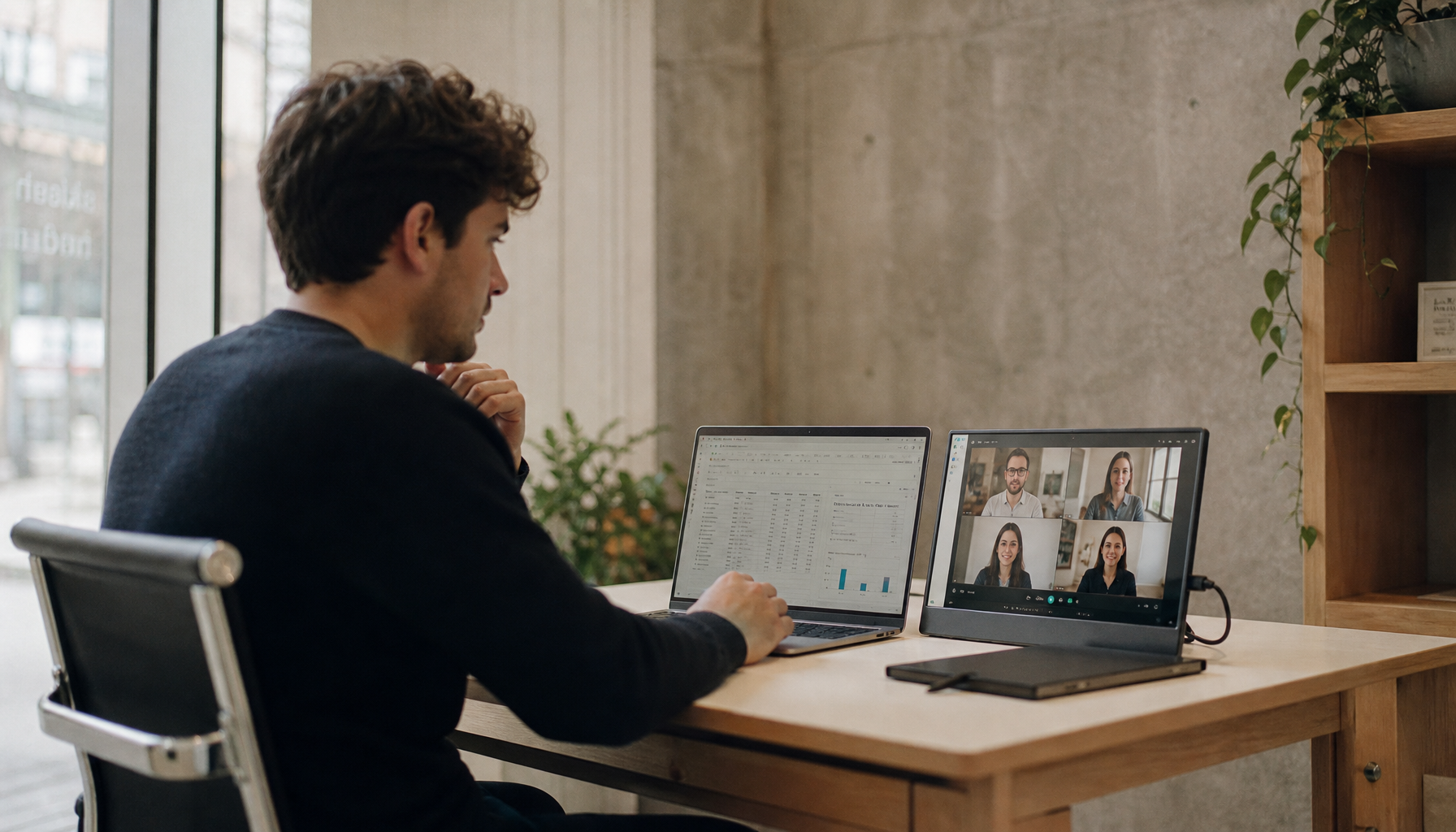
Ultrawide monitors do not inherently cause more eye or neck strain than standard 16:9 displays. Comfort depends far more on placement, viewing distance, lighting, and how you use the screen.
Ultrawide monitors do not automatically cause more eye or neck strain than standard 16:9 screens, but they expose a poor setup more quickly. The wider the panel, the more comfort depends on distance, screen height, desk depth, and keeping your main work centered.
If your eyes feel dry halfway through a gaming session or your neck tightens after hours of spreadsheet work, the biggest comfort gains usually come from adjusting position, lighting, and on-screen layout rather than abandoning ultrawide altogether. The key is figuring out whether the screen shape is actually the problem or whether the setup is.
The Short Answer: Aspect Ratio Is Not the Main Culprit
The clearest pattern across ergonomic guidance is that monitor placement and screen settings drive most eye fatigue and posture problems, not aspect ratio by itself. A well-positioned 34-inch ultrawide can feel easier to use than a poorly placed 27-inch standard display, while a very large ultrawide on a shallow desk can become uncomfortable quickly.

The same pattern appears in multi-monitor ergonomics. Large and dual-screen discomfort tends to show up when content falls outside comfortable viewing angles and users repeatedly rotate their heads instead of mostly moving their eyes. Width raises the stakes of the setup; it does not guarantee strain.
Why Ultrawides Can Feel More Tiring
Eye strain usually comes from focus, glare, and screen habits
Most digital eye strain is not caused by width alone. Eye strain guidance consistently points to long, uninterrupted screen time, reduced blinking, glare, poor contrast, and visual overwork as the main triggers. A wider screen can amplify those issues if it is too bright, too close, or forces you to scan small text across a broad area.
A practical example is a 34-inch ultrawide placed only about 20 inches from your face. That can look impressive on a desk, but it reduces your comfort margin because your eyes must refocus and travel farther across the panel while the edges sit deeper in your peripheral vision. Ergonomic monitor setup and monitor-positioning guidance point to the same starting rule: keep the display about an arm’s length away and let your gaze fall slightly downward rather than straight ahead or upward.
Lighting matters just as much. Balanced room lighting and reduced glare usually improve comfort more than blue-light accessories. If the room is dark and the monitor is extremely bright, your eyes have to adapt constantly between the panel and the surrounding space. That is why bias lighting, lower glare, and brightness matched to the room often feel better within a day.
Adaptation is real after a screen change
Switching from a standard monitor to an ultrawide can create temporary discomfort even when the setup is decent. The discussion of new-monitor eye strain reflects a familiar pattern for heavy screen users: a new size, new pixel density, new brightness profile, and new viewing distance can all create a short adjustment period. That does not prove ultrawides are harmful; it shows that your visual system notices change.
If symptoms last beyond that adjustment window, blaming the aspect ratio is usually the wrong conclusion. Monitor guidance recommends increasing display scaling or getting an eye exam if text is hard to read at a proper distance. Persistent strain often points to a setup problem or an outdated prescription.
Why Neck Strain Is More Sensitive to Width
Wider screens can increase head turning
The strongest case against very wide screens concerns the neck, not the eyes. Ergonomic screen size research indicates that large or ultrawide displays work best when the most-used content stays in the central viewing zone. Once your active work keeps drifting to the far left and right, head rotation increases and comfort drops.

That same pattern appears in dual-screen neck guidance and dual-screen ergonomics. Repetitive neck twisting, not screen count alone, is what usually causes trouble. A standard 16:9 monitor keeps everything inside a tighter field of view, so it is easier to use poorly without immediate consequences. An ultrawide rewards discipline and exposes sloppy placement.
A simple real-world test works well here. Keep your game HUD, primary document, editing timeline, or spreadsheet work in the center area of the screen for two full sessions. Move chat, music, dashboards, or reference windows to the edges. If the neck tightness fades, the real problem was not the width but the layout.
Desk depth often decides whether an ultrawide is comfortable
A wide display on a shallow desk is where many setups fail. Proper viewing distance should be about an arm’s length, and screen-size ergonomics research shows that comfortable viewing zones expand as distance increases. If your desk forces the screen too close, you will scan more aggressively, widen your eyes more often, and rotate your head more.

That is why monitor arms matter more with ultrawides than many buyers expect. Moving the panel back even a few inches can be the difference between eye-led scanning and full head turns. For office work, that adjustment often helps more than switching back to a standard monitor.
Ultrawide vs. Standard Monitor Comfort

Setup |
Comfort upside |
Main strain risk |
Best fit |
24-inch to 27-inch 16:9 |
Keeps most content in a compact field of view and is easy to position well |
Frequent app switching or awkward dual-monitor twisting if you add a second screen |
Competitive gaming, general office work, smaller desks |
34-inch 21:9 |
Wider workspace with less bezel interruption and usually manageable scanning distance |
Eye and neck fatigue if placed too close or filled with tiny side content |
Mixed gaming and productivity on a reasonably deep desk |
49-inch 32:9 |
Seamless replacement for dual monitors with strong immersion |
Greater head rotation and a stronger need for careful task zoning |
Heavy multitasking, simulation gaming, deep desks, precise arm mounting |
For many users, the sweet spot is not the biggest display they can afford but the widest display they can place correctly. Ultrawide comfort and screen-size ergonomics research both point in the same direction: moderate ultrawides are often easier to live with than super-ultrawides because they reduce head turning.
How to Set Up an Ultrawide So It Does Not Strain Your Eyes or Neck
Start with the screen directly in front of you, not off to one side. Monitor alignment guidance and monitor guidance agree that the top of the screen should sit at or slightly below eye level, with your natural gaze landing around the top third of the panel. If you use bifocals or progressives, lower it further, because a high screen often makes you tilt your head back.

Then fix the distance before changing anything else. An arm’s-length viewing distance is a practical starting point, and large screens often need all of that space. If text looks too small at the correct distance, increase interface scaling instead of leaning forward.
After that, tune the room and the panel together. Glare reduction and balanced lighting matter more than chasing a single magic setting. Keep windows to the side when possible, check reflections on a dark screen, lower brightness if the display feels harsh, and match contrast and color temperature to the room. For long sessions, the 20-20-20 rule remains one of the most useful habits you can adopt.
One nuance is worth keeping in mind: curved ultrawides may reduce edge refocusing and feel more natural, but the evidence is mixed because much of it comes from vendor material or secondary summaries. Curved-display comfort findings and curvature-focused ultrawide guidance suggest that the curve helps most when the monitor is wide enough for the edges to sit meaningfully farther away. A curve will not fix poor desk depth or a bad task layout.
When a Standard Monitor Is the Better Choice
A standard 16:9 display is often the better choice if you mostly play competitive shooters, work at a shallow desk, or spend your day reading dense text that needs to stay sharp from edge to edge. It is also easier to fit into a shared workspace, easier to use with complex progressive lenses, and less demanding if you do not want to manage window zones and monitor-arm positioning.
An ultrawide makes more sense when you genuinely use the extra width for timelines, dashboards, side-by-side documents, or immersive games and can keep the primary action centered. If your workflow is mostly one main window at a time, a standard monitor usually wins on simplicity.
The right screen should expand your workspace or field of view without disrupting your posture. If your neck keeps rotating and your eyes keep chasing the edges, the first fix is usually not to go narrower. It is to move the screen farther back, lower it slightly, center the main task, and make the panel work for you instead of against you.