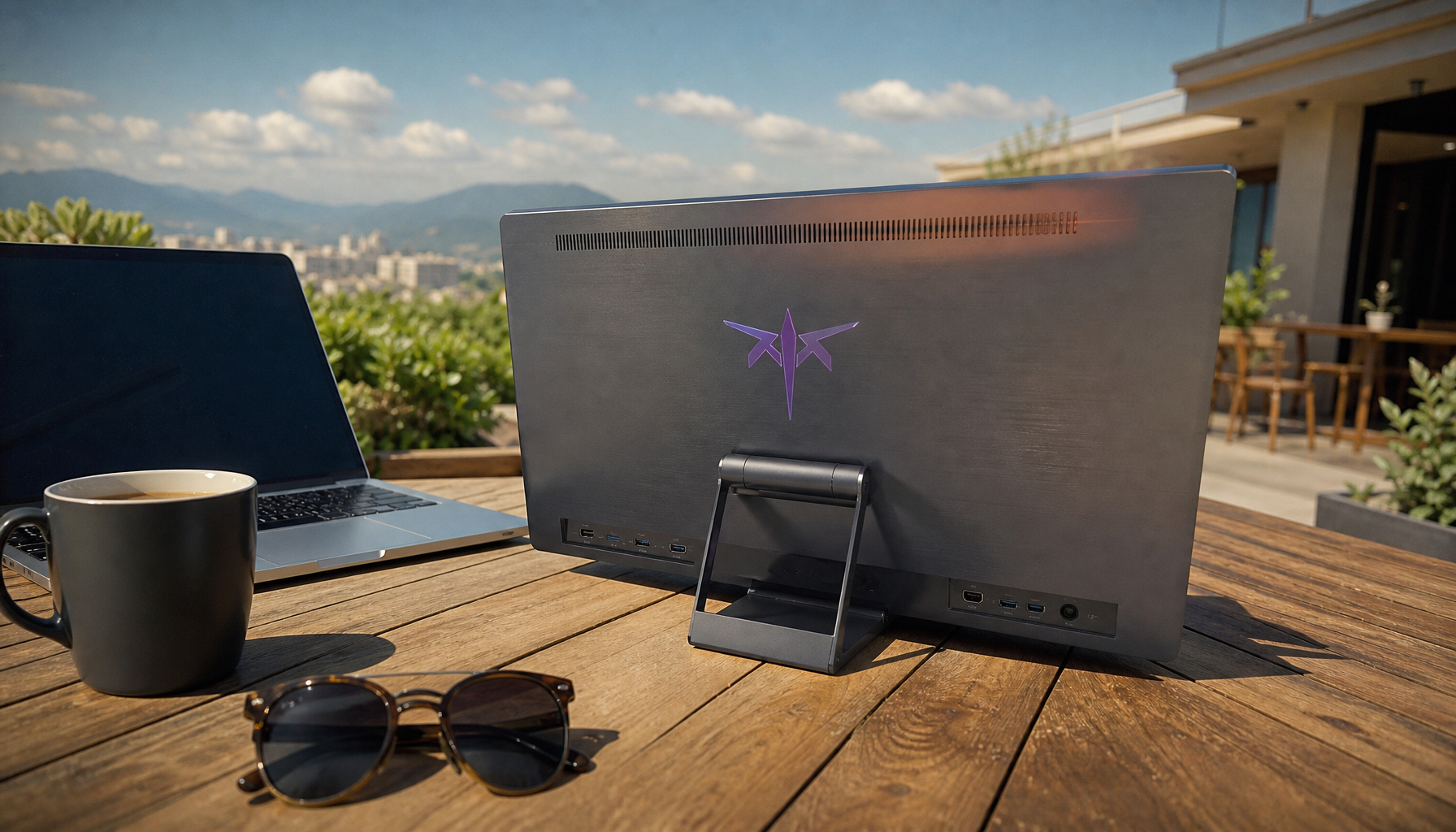
Yes, but only if the portable monitor supports USB-C Power Delivery passthrough or reverse charging, and the laptop accepts USB-C charging.
The Short Answer: Upstream Is Not Always Charging
On many portable monitors, the USB-C upstream port is designed to receive video and data from your laptop. In a single-cable setup, the laptop often powers the monitor, which is convenient but can drain your battery faster.
To charge the laptop through the monitor, you need a passthrough path: wall charger to monitor, then monitor to laptop. Some portable displays support this because USB-C Power Delivery can carry power along with display signals when the hardware is built for it.

The key phrase to look for is not just “USB-C upstream.” Look for “PD passthrough,” “reverse charging,” “USB-C PD input/output,” or a listed output wattage.
How Passthrough Charging Actually Works
A portable monitor uses some power for its own panel, backlight, speakers, touch layer, or high refresh rate. Whatever power remains may be sent to the laptop.
That means a 45W wall charger does not automatically give your laptop 45W. If the monitor consumes around 15W, and efficiency losses apply, your laptop may receive far less. Fast charging depends on the monitor, laptop, cable, and available input power all supporting compatible PD behavior through reverse charging.
For office laptops, 45W to 65W passthrough can be workable. For performance laptops, gaming laptops, and workstation-class machines, you may need 100W USB-C PD or the original charger.
A practical rule: use a charger rated higher than the laptop’s minimum need plus the monitor’s draw. If your laptop needs 65W and the monitor uses 10W to 15W, a 100W charger is the smarter match.
What Can Go Wrong
The most common failure is assuming every USB-C cable is equal. A cell phone charging cable may power a device but fail to carry video, negotiate enough wattage, or stay stable under load.

Typical symptoms include a laptop that says “plugged in” but still loses battery, a monitor that flickers or restarts when brightness rises, charging that works only when the laptop is asleep, a setup that drops to slow charging, or a “No Signal” message with the wrong cable or port.
This is where performance-minded buying matters. Portable monitors can support productivity, gaming, and travel, but connectivity is one of the real differentiators; dual USB-C with power delivery is a useful feature on some models.
How to Check Before You Buy or Connect
Start with the laptop. Confirm that its USB-C port supports charging, not just data. A power-symbol marking or support for high-speed USB-C standards is a good sign, but the spec sheet is better.

Then check the monitor. You want a listed PD input and PD output, ideally 65W or 100W passthrough for serious work. A battery-powered portable monitor may limit reverse charging to protect its own battery, so it may be fine for a phone but weak for a laptop.
Finally, use the right cable. For high-power display setups, choose a USB-C cable rated for video plus 60W or 100W PD. For gaming or high-refresh monitors, bandwidth matters as much as wattage.
Some monitors have two USB-C ports, but only one may support video, charging, or passthrough, so port labels matter.
Best Setup for Reliable Laptop Charging
For the cleanest mobile workstation, connect a 65W or 100W USB-C PD charger to the monitor’s PD input, then connect the monitor’s full-featured USB-C port to the laptop. This keeps one cable running to the laptop while the monitor handles display and power flow.

For a light 13-inch office laptop, 45W may be enough. For a 15-inch productivity laptop, target 65W. For gaming laptops or creator systems, treat passthrough as backup unless the monitor and charger clearly support the required wattage.
A portable monitor can charge your laptop through USB-C, but only when it is designed for PD passthrough or reverse charging. Buy for the power chain, not just the screen size.