Most default monitor stands miss ergonomic height targets because they are designed for packaging, cost, desk compatibility, and average-case stability, while your eye level, chair height, screen size, lens type, and workflow are highly personal.
Does your neck start tightening after a few ranked matches, spreadsheet hours, or a full day of video calls, even though the monitor looked “normal” out of the box? A practical height reset can reduce the need to crane, hunch, or lean, especially when you pair screen height with viewing distance and tilt. Here is how to understand the mismatch and turn a stock display into a performance-ready workstation.
The Ergonomic Target Is Personal, Not Factory Default
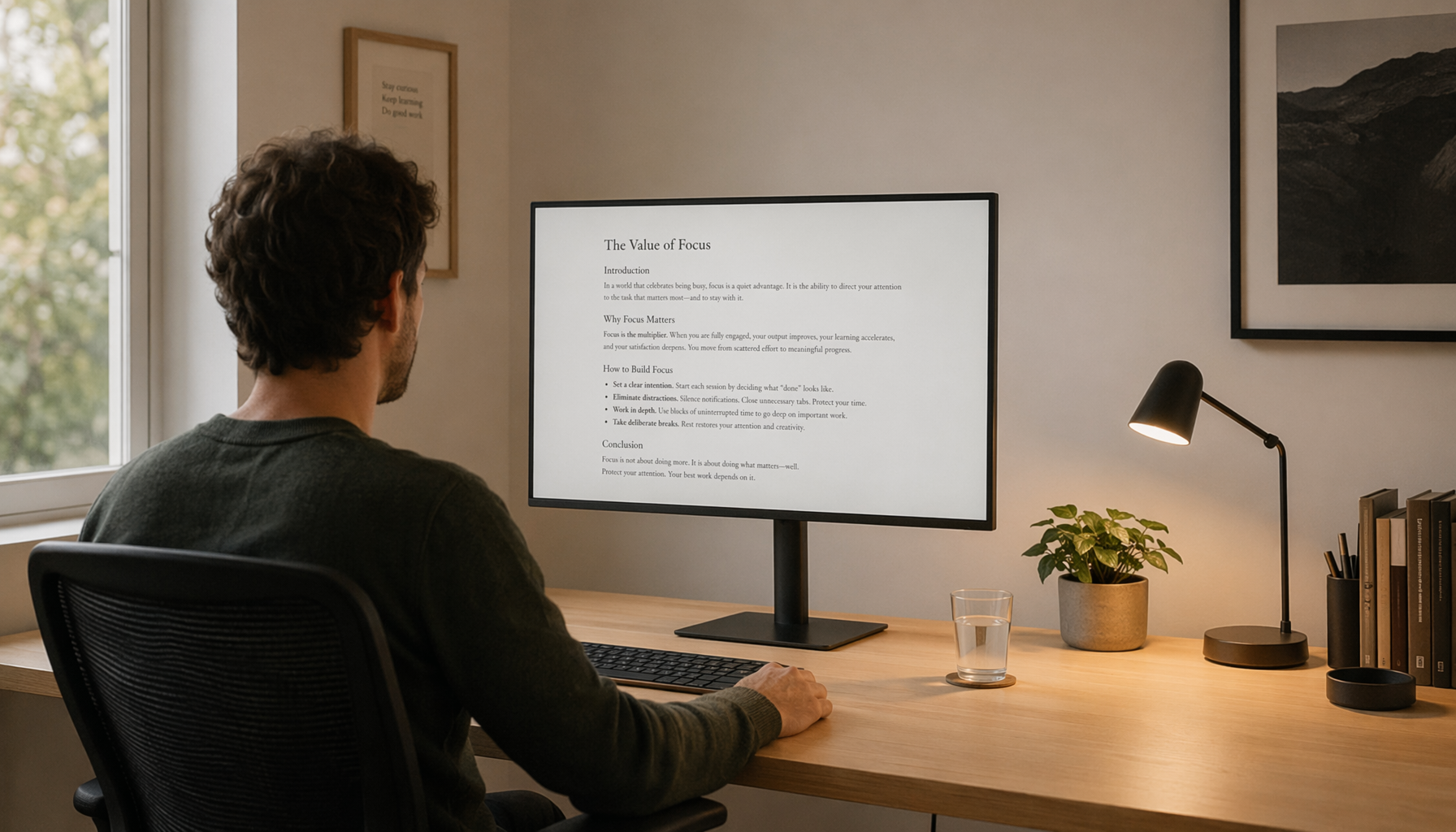
The common ergonomic benchmark is simple: the top of the screen should sit at or slightly below eye level, with the display about an arm’s length away. Monitor placement matters because a screen that is too high can strain the back and neck by encouraging upward head tilt.
That benchmark is a starting point, not a universal measurement. A 5 ft 4 in user in a low chair and a 6 ft 2 in user at a standing desk cannot be served well by the same fixed-height stand. Even two people of the same height may need different setups if one wears progressive lenses, one uses a deep desk, or one spends most of the day gaming on a 27-inch screen instead of writing on a 24-inch office display.
A good real-world check is this: sit fully back in your chair, relax your shoulders, and look straight ahead. Your gaze should naturally land near the upper third of the screen, not the center of the panel or the bottom bezel. If you need to lift your chin to read the top menu bar, the monitor is too high. If you fold your neck forward to read text, it is too low or too far away.

Why Default Stands Usually Miss the Mark
Monitor makers have to ship one stand that works for many desks, bodies, and markets. That pushes design toward stability, compact packaging, and a clean showroom profile. Ergonomics often becomes a range, and on budget monitors, that range may be tilt-only rather than true height adjustment.

A fixed stand also has to survive shipping and prevent tip-over with different panel sizes. A 32-inch productivity display needs a broader, heavier support than a 24-inch office monitor. Manufacturers often choose a conservative stand height that keeps the screen stable on a shallow desk, even if that means many users end up stacking books or buying an arm later.
The problem is more obvious with larger displays. The top third of a 24- to 27-inch monitor can often sit near eye level with a modest riser, but a 32-inch screen or ultrawide may need more distance and finer height control. If the panel is big and close, the default stand may place too much screen above your relaxed gaze, forcing repeated eye and neck movement.
Stand design priority |
Why manufacturers choose it |
Ergonomic tradeoff |
Low manufacturing cost |
Keeps the monitor price competitive |
Limited height range or tilt-only adjustment |
Compact packaging |
Reduces shipping volume and damage risk |
Shorter or simpler stand geometry |
Tip-over stability |
Supports larger panels safely |
Wider bases can limit keyboard and desk placement |
Visual symmetry |
Looks clean in product photos |
May not match your chair, desk, or eye level |
Universal compatibility |
Works acceptably for many users |
Rarely fits one user precisely |
Ergonomics Is More Than “Top Edge at Eye Level”
The top-edge rule is useful because it prevents most people from looking upward. The top of the monitor at or slightly below eye level helps reduce the tendency to bend or tilt the neck during long sessions.
But screen center matters too. Your eyes are usually more comfortable with a slightly downward gaze, especially during reading-heavy work. This is why many ergonomic discussions describe the screen center as sitting below eye level while the upper portion of the display remains easy to view. In practice, you should not raise a monitor until the center of the panel is directly in front of your eyes, particularly on larger displays.
For example, a 27-inch monitor has much more vertical screen area than a compact laptop panel. If you align the center of that monitor with your eyes, the top of the screen may sit high enough to make you lift your chin. For long office work, coding, and competitive gaming interface scanning, a better setup is often slightly lower: top edge at eye level or just below, screen center below eye level, and a small backward tilt.
Viewing Distance Changes the Height You Need
Height and distance are linked. Viewing distance is commonly described as about an arm’s length, adjusted for screen size, text size, and vision needs. If the monitor is too close, your eyes work harder and the panel fills too much of your field of view. If it is too far away, you may lean forward, which defeats the point of an ergonomic height adjustment.
For most desktop setups, a 24-inch display works well around 20 to 24 inches from your eyes. A 27-inch screen often feels better around 24 to 27 inches. Larger 32-inch and ultrawide monitors usually need more desk depth, often closer to 30 inches or more, so the full screen is visible without head scanning.

This is where default stands fail again. A stand may have enough height for a 24-inch monitor on a deep desk, but not enough for a 32-inch panel on a shallow one. The larger the screen, the more important it becomes to adjust both distance and height together. Moving the display back can make the same stand height feel more natural because your eyes see the whole panel with less vertical travel.
Sit-Stand Desks Expose the Biggest Stand Weakness
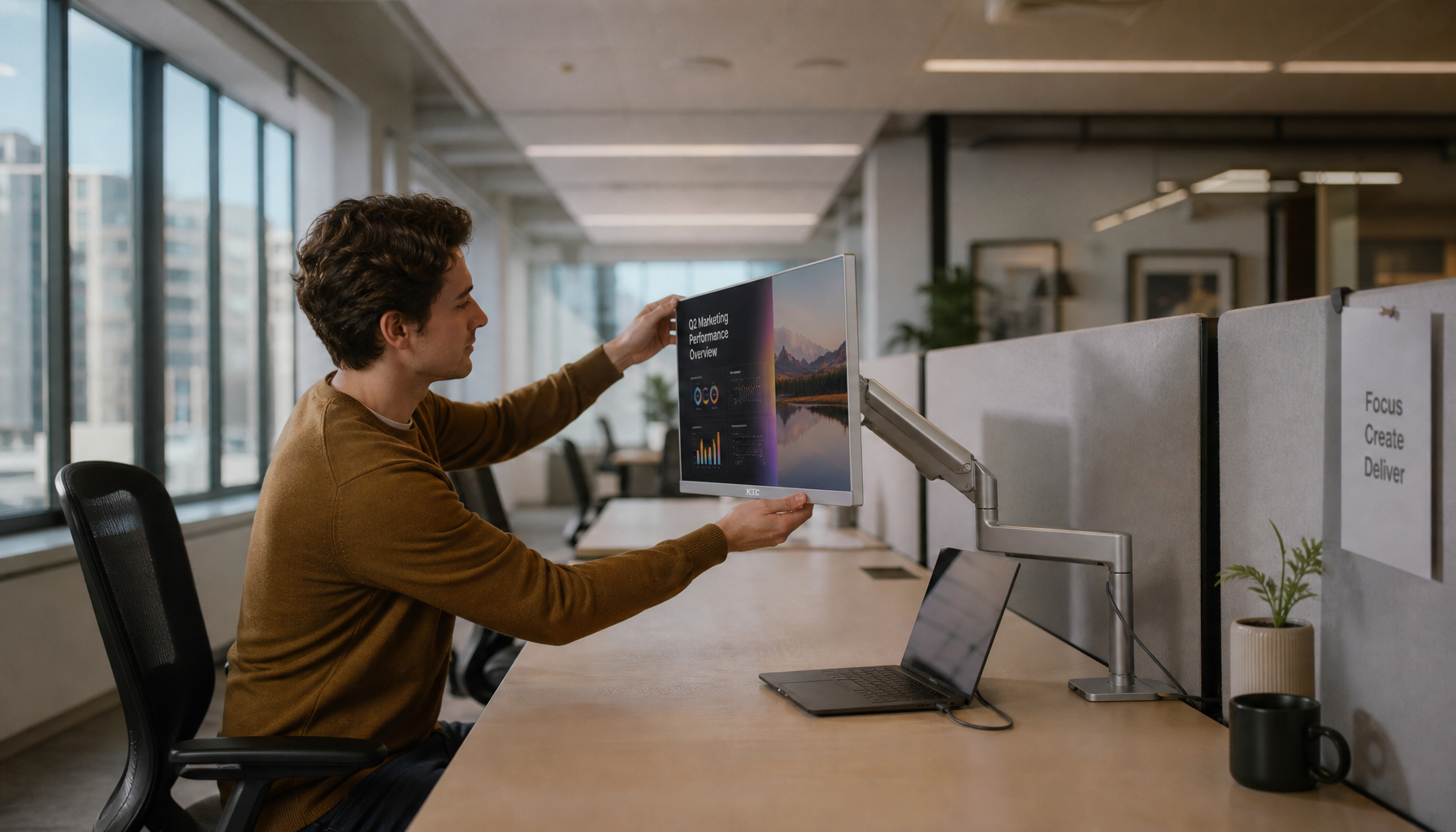
A monitor that feels decent while seated can become wrong the moment you stand. Sit-stand workstations need the screen adjusted to eye level in both positions, and a monitor arm often makes that practical.

The reason is simple: your eye height changes significantly when you move from sitting to standing. A stock stand sitting on the same desktop cannot follow that change unless the whole desk moves with it and your seated posture remains perfectly matched. Even then, many users shift stance, use anti-fatigue mats, or work from slightly different keyboard positions while standing.
For a standing setup, start with your feet supported, shoulders relaxed, and elbows near a right angle at the keyboard. Then bring the monitor to your eyes, not your eyes to the monitor. If you use a fixed stand and cannot raise the screen enough, the cost-effective fix is a stable riser. If you switch posture often, a standard mount-compatible monitor arm is usually the better performance upgrade.
Special Cases: Gaming, Ultrawide, Dual Screens, and Progressive Lenses
Gaming setups often run slightly closer than office setups because responsiveness and immersion matter. That does not mean the monitor should be high. For long sessions, the screen should still sit at or slightly below eye level, with the main action area comfortable to scan without lifting the chin. A 27-inch high-refresh display on a stock stand may need only a small riser, while a 32-inch curved panel may need both extra distance and a lower visual center.
Ultrawide displays add another layer. Your primary content should sit in the central band of the screen, not at the far edge. Dual-monitor setups work best when the primary display is directly in front and the secondary display is angled to reduce neck rotation. If you use two monitors equally, place them in a shallow arc so your body faces the midpoint. If one monitor is dominant, center that one and treat the second as a side tool, not a second primary display.
Progressive or bifocal lenses can change the rule. Progressive lenses often require the monitor to sit lower and tilt back slightly so the user does not crane the neck to read through the lower lens area. If you wear these lenses and feel neck tension even with the top edge at eye level, lower the screen by 1 or 2 inches and test again.
Fixed Stand, Riser, or Monitor Arm?
A fixed stand is acceptable when your monitor already lands near the right height, the base does not crowd your desk, and you rarely change posture. Its advantage is stability and simplicity. Its weakness is that it assumes your desk and body fit the manufacturer’s geometry.

A riser is the best value fix when the screen is only too low. It can raise the monitor, open storage space underneath, and keep the setup inexpensive. The limitation is that it cannot lower a too-high screen, and it usually cannot solve distance, rotation, or sit-stand changes.
A monitor arm is the most flexible option. Monitor stands and arms help fine-tune screen height, tilt, and position, especially when users alternate between tasks or postures. The tradeoff is cost, installation effort, and the need to confirm mounting compatibility and weight support before buying.
A Practical Calibration Method
Start with your chair, not the monitor. Sit back with your feet flat, shoulders relaxed, and keyboard close enough that your elbows are near a right angle. Then place the monitor directly in front of you, not offset to the side unless it is a secondary screen.
Set the screen about an arm’s length away. If you cannot read comfortably at that distance, increase font size before pulling the display much closer. Raise or lower the monitor until your relaxed gaze lands near the upper third of the screen. Add a slight backward tilt, usually enough to reduce glare and make the whole panel easy to view without bending your neck.
Test the setup for a few focused minutes. Read a document, scan a spreadsheet, play a short match, or run the exact workflow you bought the display for. If your chin lifts, lower the screen. If your shoulders round and your head drops forward, raise the screen or increase text size. If your eyes feel strained, check distance, brightness, glare, and ambient lighting before blaming the panel.
The Real Reason the Stand Feels Wrong
Your monitor stand is built for a product category. Your workstation is built around a body, a desk, a chair, a workflow, and a screen size. That is why the default height so often misses the ergonomic target.
Treat the included stand as a starting bracket, not the final setup. A few inches of adjustment can turn the same display from a neck-strain trigger into a sharper, calmer, more immersive workstation.