Put paper where your eyes already travel: close to the monitor, raised off the desk, and aligned with your primary screen. Then tune monitor height, distance, tilt, chair support, and break rhythm so your neck stays neutral instead of repeatedly dipping, twisting, and craning.
Does your neck feel tight after a morning of checking a screen, then looking down at printed bills, forms, scripts, or notes? A simple desk reset can deliver a testable benefit the same day: fewer deep head dips and less side-to-side twisting during document-heavy work. Here is how to build a workstation that keeps paper and pixels in the same comfortable visual zone.
Why Monitor-to-Paper Switching Strains Your Neck
The problem is not paper itself. The strain comes from repetition: your eyes move from a vertical glowing screen to a flat sheet on the desk, and your head follows. Over a full workday, that can mean hundreds of small neck flexions, rotations, and refocusing cycles.
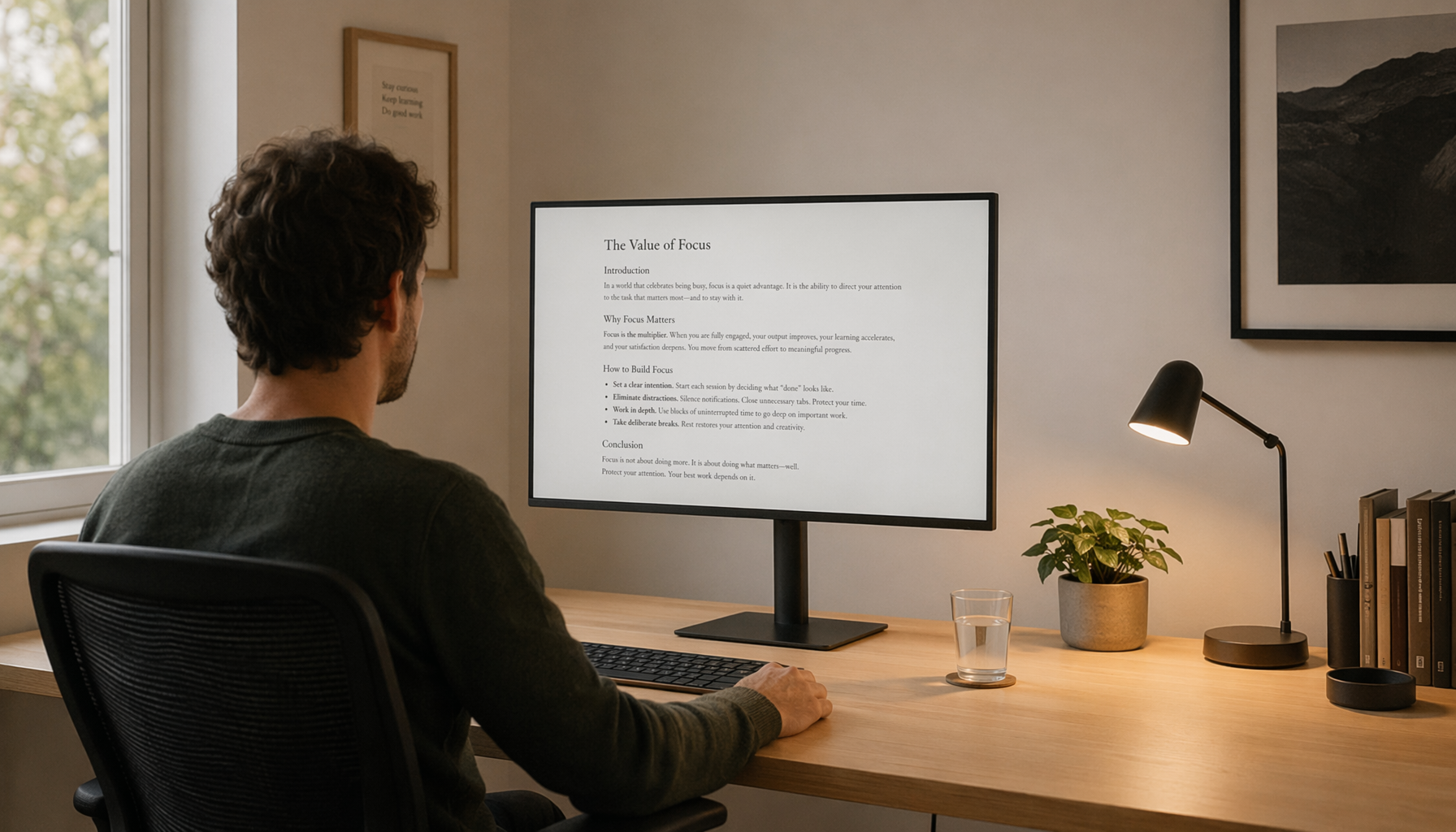
A good monitor setup starts with the basics: the top of the screen should sit approximately at eye level, and the display should be about an arm’s length away. That advice matters even more when documents enter the workflow, because paper placed flat between your keyboard and monitor pulls your gaze sharply downward. If you are reviewing a printed contract while entering data on-screen, every line item can become a small neck dip.
The natural line of sight tends to fall slightly below eye level, so the goal is not to stare straight ahead like a statue. The goal is to keep your head balanced over your shoulders while your eyes do most of the movement. When paper forces the chin toward the chest, your neck muscles have to stabilize more weight for longer periods.

Build a Shared Visual Zone for Paper and Screen
The most effective fix is a document holder, copy stand, or angled writing surface placed near the monitor. A flat sheet on the desk can be fine for a quick signature, but it is poor for sustained reading. Raise the document until it sits between the keyboard and monitor, or just beside the monitor at a similar distance from your eyes.

For screen work, a monitor about one arm’s length away is a reliable starting point. Apply the same thinking to paper. If your 27-inch monitor is about 24 to 27 inches from your eyes, do not park the document 12 inches from your torso and then lean down to read it. Place the paper where your eyes can shift with minimal head movement.
A vertical document holder works well for reading, checking, and typing from printed pages. An angled writing board is better if you need to mark up pages, sign forms, or compare a printed draft with a digital file. The tradeoff is simple: vertical holders reduce neck flexion best, while angled boards preserve handwriting comfort. For a real-world setup, place a copy holder between the keyboard and screen when entering data from a printed form, then move it to the dominant-eye side of the monitor when comparing a long printed report against a digital spreadsheet.
Tune Monitor Height, Distance, and Tilt
Your monitor should support the paper workflow, not fight it. If the screen is too high, you may tilt your head back. If it is too low, you may slump forward. If it is off-center, your neck rotates every time you return to the screen.
A practical monitor position is top edge at or slightly below eye level, with the display roughly 20 to 28 inches away depending on screen size and vision needs. A 10 to 20 degree backward tilt can help match a slight downward gaze and reduce glare. For a 24-inch office display, start around 20 to 24 inches away. For a 27-inch QHD productivity display, 24 to 27 inches often feels better because the screen fills your view without requiring head movement.
Progressive lens and bifocal users need a special adjustment. Ergonomic posture guidance notes that users with progressive lenses may need to lower the monitor and tilt it back slightly, because a standard eye-level setup can make them crane the neck to see through the correct lens zone. If you wear progressives and feel yourself lifting your chin to read the screen, lower the display by an inch or two and retest.
Setup Element |
Better Position |
Main Benefit |
Possible Tradeoff |
Monitor |
Top edge at or slightly below eye level |
Keeps neck closer to neutral |
May need lowering for progressive lenses |
Paper document |
Raised near screen height or angled between keyboard and monitor |
Reduces repeated downward head dips |
Vertical holders are less ideal for handwriting |
Viewing distance |
About arm’s length for screen and document |
Keeps focus shifts smaller |
Small text may need zoom or larger print |
Screen tilt |
Slightly backward |
Reduces glare and matches downward gaze |
Too much tilt can reflect overhead light |
Center the Primary Work, Not the Prettiest Device
If you switch between monitor and paper all day, the “primary” object is the one you reference most. For data entry from printed forms, the paper may deserve the central position and the monitor should sit directly behind it. For document review, the monitor may stay centered while the paper sits on a raised stand beside it.
A primary monitor positioned off-center can contribute to repeated neck twisting, especially during long sessions, and multiple monitors should be arranged around how often each screen is used. The same rule applies to paper. If you spend 70% of the task reading paper and 30% typing into a browser, center the paper holder. If you spend 70% editing on-screen and occasionally verifying printed notes, keep the monitor centered and place the paper close beside it.
For dual-monitor users, keep both displays at the same height and distance where possible. Research on dual-screen ergonomics points to productivity gains from multiple screens, but it also emphasizes that poor screen placement can drive neck pain. The useful nuance is that more display space only helps if it reduces tab hunting without adding head rotation. A paper holder outside the far edge of a dual-screen setup is usually a bad bargain.
Choose Display Gear That Supports the Workflow
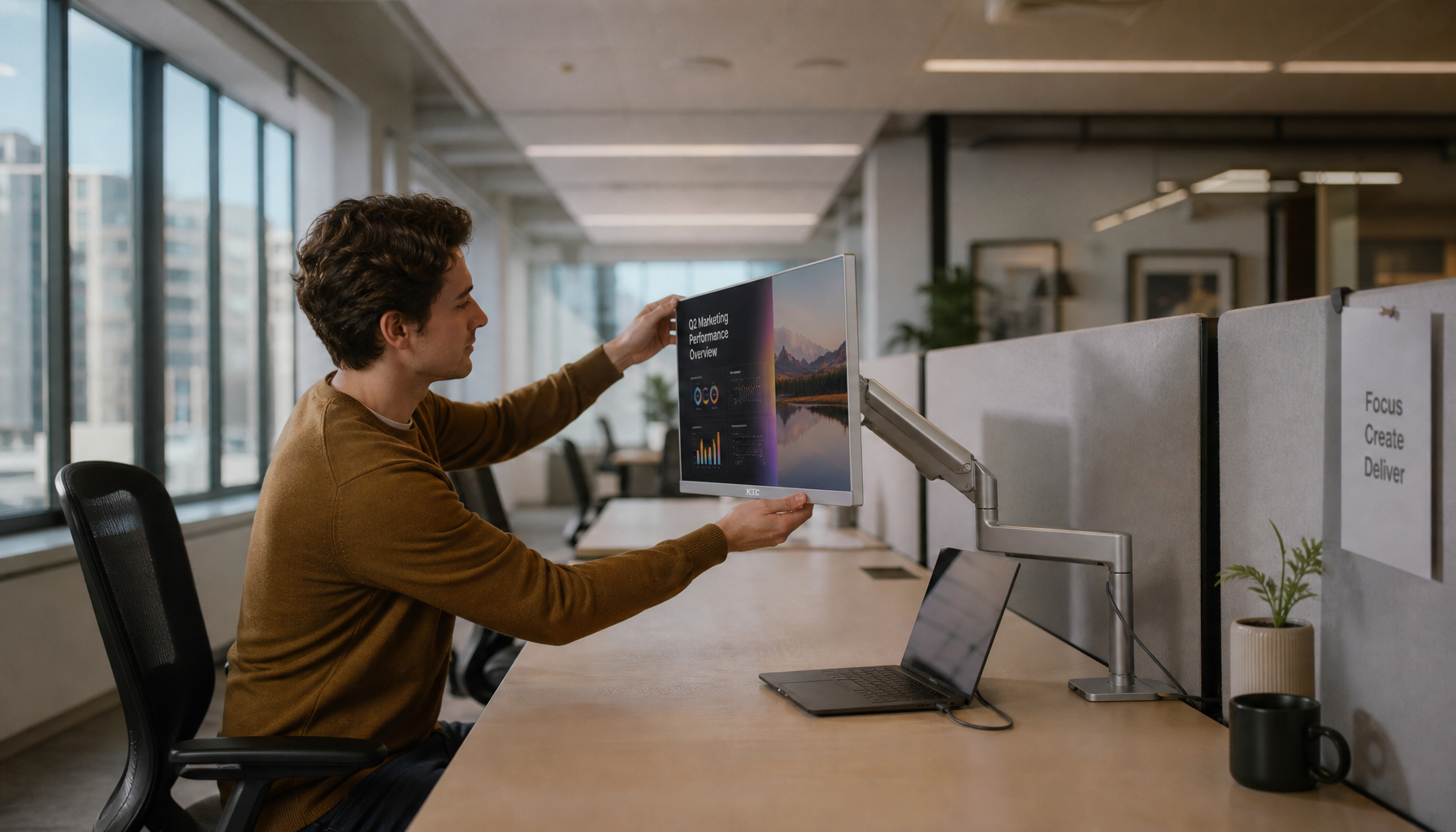
A monitor with height, tilt, swivel, and pivot adjustment is not a luxury feature for document-heavy work. It is the control system for your posture. If your current display only tilts, a monitor arm can let you raise, lower, and pull the screen into the same visual plane as your documents.
For most office productivity, 24- to 27-inch monitors remain the sweet spot because they balance readable text, desk space, and comfortable viewing distance. Larger screens and ultrawides can be powerful, especially for spreadsheets, coding, and document comparison, but they demand more careful placement. Ultrawide monitors can reduce window switching, yet the far edges can increase eye and neck travel if you sit too close or place reference paper outside the main visual field.
Resolution matters because sharper text reduces the urge to lean forward. A 27-inch QHD monitor is a strong value point for everyday productivity, while 4K and 5K displays can make dense text, PDFs, and design details cleaner. Business monitor testing also highlights USB-C and KVM features, webcams, and ergonomic stands because modern productivity is not only about panel specs; it is about reducing friction at the desk.
Gaming-monitor features can help, but choose them with discipline. A high refresh rate makes scrolling smoother, and adaptive sync can improve motion fluidity, but neither fixes a low screen, a flat document, or an unsupported chair. If the monitor has a fast panel but a weak stand, budget for an arm before chasing another spec.
Reset the Chair and Input Devices
Neck strain often starts below the neck. If your chair is too low, you may reach up to the keyboard and raise your shoulders. If the keyboard is too far away, you may lean forward and lose back support. If your feet are unsupported, your posture can drift even when the monitor is correct.
A stable workstation begins with feet flat on the floor, knees near 90 degrees, your back supported, and elbows resting close to the body at a relaxed angle. Chair posture recommendations often pair monitor placement with supported sitting because the screen cannot compensate for a collapsed torso. Once your chair is set, bring the keyboard and mouse close enough that you can work without reaching.
A headrest can help during pauses, but it should not push your head forward while typing. Think of it as a light alignment cue during brief rests, not a pillow you press into while working. If it encourages your chin forward, lower it, adjust the tilt, or stop relying on it during active tasks.
Use Micro-Breaks Without Breaking Flow
When you are deep in a document-review sprint, “take more breaks” can sound vague. Make it mechanical instead. Every 20 minutes, look at something about 20 feet away for 20 seconds. The 20-20-20 rule is simple enough to run in the background of a busy day and useful enough to reduce eye fatigue from repeated near-focus work.

Pair that eye reset with a posture reset. Stand while reading a short paper packet. Walk the document to a counter for a two-minute review. If you are comparing a printed draft and a digital file for an hour, alternate between seated editing and standing reading. Movement changes the load on the neck, shoulders, and back before discomfort becomes the signal.
A Fast Desk Test You Can Do Today
Sit in your normal working position with your hands on the keyboard. Look at the center of your monitor, then at the center of the paper, then back to the screen. If your chin drops hard, the paper is too low. If your head turns more than your eyes, the paper is too far to the side. If you lean forward to read either one, the text is too small, the display is too far away, or the document needs to be raised.
The best setup feels almost uneventful: your eyes shift, your neck barely moves, and your shoulders stay quiet. That is the performance win. Keep the monitor adjustable, keep paper in the same visual zone, and make the desk serve the task instead of making your body chase the work.