For most daytime office work, set your monitor bright enough that a white document looks similar to white paper on your desk, not like a light source. A practical starting point is about 100-150 nits indoors, or roughly 30%-50% brightness on many monitors, then adjust for daylight, glare, and panel type.
Ever finish a few hours of spreadsheets, email, or code and feel like your eyes are tired even though the screen looked “clear”? Small brightness changes can make a large difference during a seven-hour workday, especially when daylight shifts across the room. This guide gives you specific brightness ranges, quick tests, and monitor-specific adjustments for standard displays, gaming monitors, ultrawides, and portable monitors.
The Best Daytime Brightness Is Matched, Not Maxed
The right monitor brightness for daytime office work is the level that visually matches your workspace. A screen that is much brighter than your desk, keyboard, notebook, or wall forces your eyes to keep adapting between the monitor and the surrounding room; a screen that is too dim makes text look gray, low-contrast, or harder to scan. For typical indoor office lighting, 120-150 nits is a sensible starting range for productivity work.
That does not mean every office monitor should be locked to one number. A controlled office with blinds and diffuse overhead lighting may feel comfortable around 100-120 nits, while a bright room with uncovered windows may need 120-150 nits or more. A sunlit desk can make even a good 27-inch IPS monitor look washed out if reflections are hitting the panel, so the fix may be changing screen position before raising brightness.
Why Maximum Brightness Usually Feels Bad
Many monitors ship with bright factory presets because they are designed to stand out in retail lighting, not to sit 2-3 ft from your face for a full workday. Factory brightness can exceed 300 nits, and showroom lighting presets often combine high luminance with aggressive contrast or vivid color modes. That may make a gaming monitor look impressive on a shelf, but it can make white web pages, documents, and dashboards feel harsh in an office.
For normal daytime office tasks, peak brightness is headroom, not a target. A 400-nit or 600-nit display can be useful in a bright room, for HDR media, or when using a portable monitor near a window, but standard productivity work usually feels better at a moderate sustained level. Treat the monitor’s brightness rating like the top speed of a car: useful when needed, but not where you operate all day.
Practical Brightness Ranges for Daytime Office Setups
If your monitor does not show brightness in nits, start with percentages and fine-tune by eye. Many office users land around 30%-50% brightness in ordinary indoor lighting, while brighter rooms may need more. A moderate brightness target is usually more comfortable than 100% brightness for spreadsheets, documents, video calls, coding, research, and browser-based work.
Use the table below as a starting point, then adjust based on the white paper test in the next section. The exact percentage will vary because one monitor’s 40% setting may be another monitor’s 65%, especially across budget office monitors, high-brightness gaming displays, OLED panels, Mini-LED monitors, and portable USB-C screens.

Daytime Workspace |
Approximate Room Lighting |
Starting Monitor Brightness |
Typical OSD Setting |
Best For |
Watch For |
Dim office with blinds closed |
Under 50 lux |
80-100 nits |
20%-35% |
Writing, reading, admin work |
Screen glowing into the room |
Typical indoor office |
150-300 lux |
100-120 nits |
30%-50% |
Email, documents, spreadsheets, coding |
Text looking dull or whites looking harsh |
Bright office with daylight |
500+ lux |
120-150 nits |
45%-70% |
Shared offices, windowed rooms, multitasking |
Reflections causing washed-out contrast |
Very bright room or sunlit desk |
Near or above 1,000 lux |
150+ nits if needed |
60%-100% |
Temporary daylight exposure |
Glare, heat, and poor screen placement |
Color-sensitive work |
Controlled lighting |
Often 80-120 nits |
Calibrated setting |
Photo, video, design review |
Adaptive brightness changing results |
A very bright office above 1,000 lux can reduce comfort and focused visual performance, and phone apps can estimate lux well enough for a quick workspace check. You do not need a lab-grade meter to improve comfort. If your desk is reading like a bright showroom, reduce direct daylight, rotate the monitor, or add blinds before relying only on higher brightness.
A Real-World Starting Setup
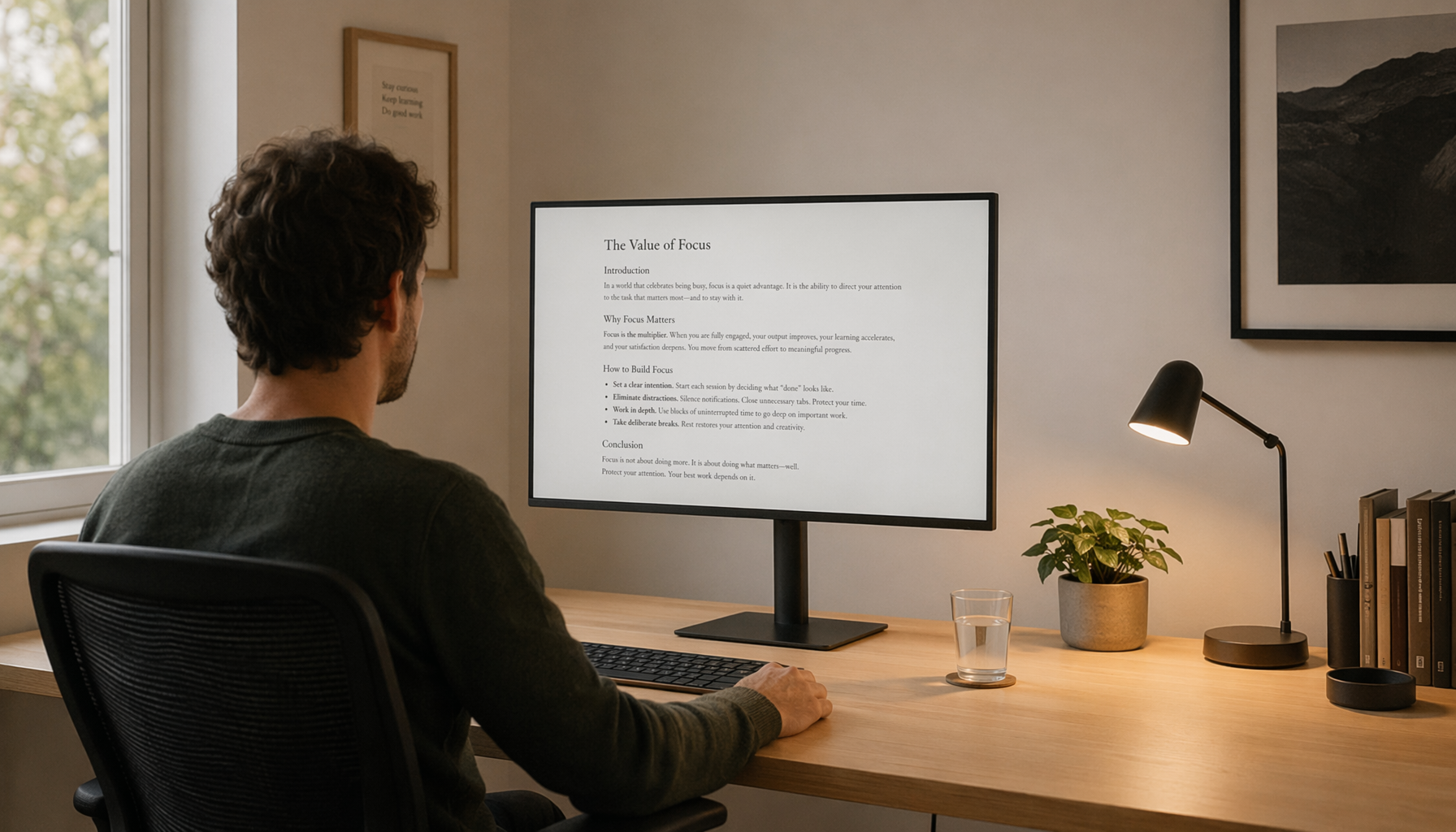
For a 27-inch 1440p office monitor in a room with side daylight and overhead lighting, start at 40% brightness, standard or sRGB picture mode, contrast around 65%, and refresh rate at the highest stable option. Open a blank document, place a sheet of white printer paper beside the keyboard, and compare them. If the screen looks like it is lighting the paper, lower brightness; if the document looks gray and weak, raise it.
For a 34-inch ultrawide, start slightly lower than you might expect because the larger bright surface fills more of your field of view. A 34-inch curved ultrawide at 150 nits can feel more intense than a 24-inch monitor at the same luminance because there is simply more bright area in front of you. For a portable 15.6-inch monitor near a window, you may need a higher percentage setting, but glare control matters more than raw brightness.
Use the White Paper Test Before Changing Everything Else
The fastest practical test is simple: open a blank white document or browser page and place a sheet of white printer paper on your desk under your normal daytime lighting. Your monitor is close when the white screen looks about as bright as the paper, and white screens do not appear to glow much brighter than the page. This test works because it compares the display to the actual light your eyes are adapting to in the room.

Do the test after your room lighting is set, not before. If you adjust brightness at 8:30 AM with blinds open, then continue working at 2:00 PM with direct sun on the desk, the earlier setting may no longer make sense. Repeat the test when daylight changes, after moving your monitor, or after switching from a dark app theme to large white documents.
What “Too Bright” Looks Like
Your monitor is probably too bright if white pages look like a lamp, your eyes feel tired after reading, or you keep squinting during email and document work. Digital eye strain can include tired eyes, red or itchy eyes, blurred vision, dryness, watery eyes, light sensitivity, headaches, and neck or shoulder discomfort; digital eye strain is also linked to prolonged screen focus. If the screen feels fine for five minutes but harsh after two hours, reduce brightness in small steps.
Also watch for blown-out whites and lost highlight detail. On a well-adjusted display, a white spreadsheet cell, a light gray sidebar, and a pale chart background should remain visually distinct. If every bright element merges into flat white, brightness, contrast, or a vivid preset may be too aggressive.
What “Too Dim” Looks Like
A monitor is probably too dim if text looks gray, you lean toward the screen, or dark UI elements blend together. Dark gradients should show subtle steps, and bright images should retain texture without crushed shadows or washed-out highlights. If your screen is technically “comfortable” but you are straining to read, raise brightness slightly or improve contrast.
This is common with portable monitors and matte office monitors in bright rooms. A matte coating diffuses reflections, which is useful, but strong daylight can still reduce perceived contrast. If increasing brightness does not restore clarity, move the screen so windows are not directly behind you or reflected in the panel.
Brightness, Contrast, and Refresh Rate Work Together
Brightness is only one part of visual comfort. Contrast that is too low makes text weak; contrast that is too high can make white backgrounds and dark borders feel harsh, especially in dim rooms. For general office work, a contrast setting around 60%-70% is a reasonable starting point, and contrast between 60% and 70% is commonly recommended for display comfort.
Refresh rate also matters, especially if you use a gaming monitor for office work. A high-refresh-rate display at 120 Hz, 144 Hz, or higher can make scrolling documents, moving windows, and cursor tracking feel smoother than 60 Hz. If your monitor supports it, use at least 70 Hz when available, and make sure a platform is actually set to the higher refresh rate rather than leaving the monitor at its default.
Recommended Office Settings
For most LCD monitors, start with the Standard, sRGB, or Custom preset instead of Vivid, Dynamic, FPS, RTS, or HDR mode. Set brightness using the paper test, contrast around 60%-70%, sharpness at the default or neutral value, and color temperature to a neutral white point if the monitor offers it. Warm modes can feel easier late in the day, but overly warm settings may make white documents look yellow during daytime work.
For OLED and Mini-LED monitors, be careful with sustained brightness, local dimming, and HDR mode during desktop use. Advanced panels can produce bright highlights, but office content often contains large white areas, which can trigger automatic brightness behavior or make the screen feel inconsistent. For desktop work, controlled highlights and lower sustained brightness are usually more comfortable than leaving HDR-like settings active all day.
When HDR Should Stay Off
HDR is valuable for HDR video, games, and creative review, but it is often unnecessary for email, documents, dashboards, and web apps. On many monitors, HDR mode changes tone mapping, local dimming, and brightness behavior in ways that make ordinary SDR content feel inconsistent. If white browser pages suddenly feel too bright, or dark app panels show halos, switch back to SDR for office work.
If you use a platform with HDR enabled, adjust the SDR content brightness slider instead of assuming the monitor’s OSD brightness alone will solve the issue. For color-sensitive work, a company notes that automatic brightness and contrast changes can be distracting when accuracy matters, and adaptive brightness can be adjusted or turned off on supported systems.
Control Daylight and Glare Before Raising Brightness
A brighter monitor is not always the best answer to a bright office. If a window is behind you, the screen may reflect the room; if a window is behind the monitor, your eyes may adapt to the bright background and make the display seem dim. High contrast between the screen and nearby surroundings can contribute to eye fatigue and headaches, and nearby surroundings matter as much as the brightness slider.
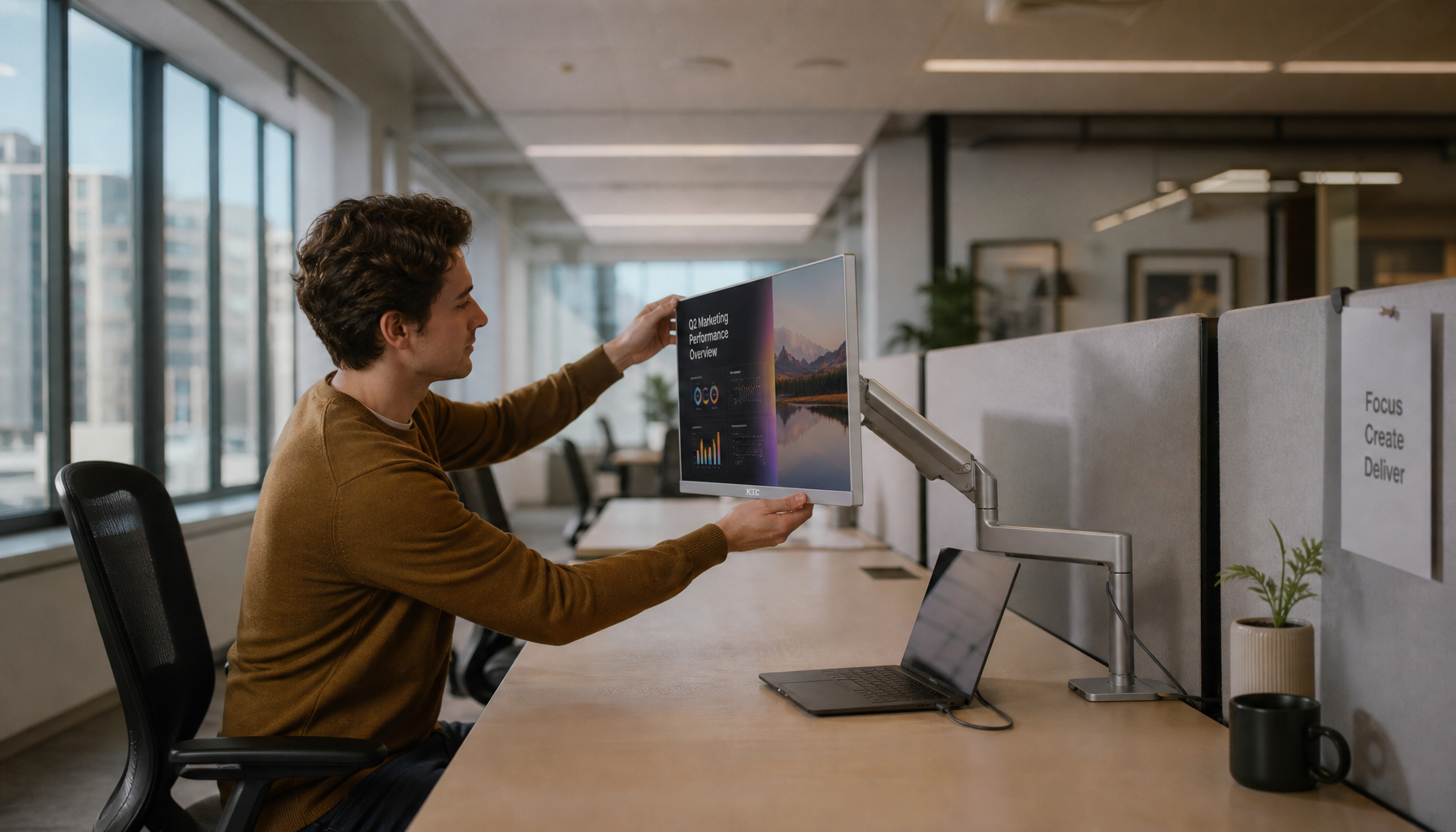
Place your monitor perpendicular to windows when possible. Use blinds, curtains, or a shade to soften direct sunlight, and avoid positioning glossy monitors where they reflect bright walls, lamps, or windows. If you use a dual-monitor setup, angle both displays so one is not significantly brighter or more reflective than the other.

Desk Lighting That Helps
Daytime office work is usually most comfortable with diffuse, even lighting. Overhead light should not shine directly into your eyes or onto the screen, and desk lamps should illuminate paper or the keyboard without creating a bright reflection on the panel. If you work before sunrise or after sunset, a soft bias light behind the monitor can reduce the brightness gap between the screen and the wall.
For large ultrawide monitors, bias lighting is especially useful because the display occupies more of your visual field. For portable monitors, a small change in tilt can remove a major reflection because the panel is often lower and closer to the desk surface. Before buying a brighter portable monitor, try raising it on a stand and rotating it away from window reflections.
Adjust Brightness by Monitor Type
A basic 24-inch or 27-inch office monitor usually has enough brightness for indoor daytime work, but it may need a better preset. Start with Standard or sRGB mode, disable dynamic contrast, and avoid blue-heavy vivid modes. If the monitor’s brightness control is buried in physical buttons, save a custom preset for daytime office work so you are not fighting the on-screen menu every morning.
Gaming monitors often have more brightness, higher refresh rates, and aggressive presets. Use the high refresh rate, but do not assume the gaming picture mode is best for office work. A 144 Hz or 240 Hz monitor can be excellent for productivity when set to a neutral preset, moderate brightness, and sane contrast; it becomes tiring when left in a saturated showroom mode at 80%-100% brightness.
Ultrawide Monitors
Ultrawides need special attention because they fill more horizontal vision and can show more brightness variation across the panel. A 34-inch or 49-inch display should be centered, slightly curved toward you if applicable, and positioned so both sides avoid window reflections. If the left side faces a window and the right side faces a darker wall, no single brightness setting will feel perfect.
For productivity, keep large white windows from filling the entire ultrawide all day. Use split layouts, darker side panels, or smaller document windows when possible. This is not about hiding from white backgrounds; it is about reducing the size of the bright field your eyes stare at for hours.
Portable Monitors
Portable monitors often run from USB-C power and may limit brightness to reduce power draw. On battery-powered laptops, a platform can also change display brightness to save energy, and manual brightness controls may differ between built-in screens and external monitors. If your portable monitor looks dim, check both the monitor’s own menu and the laptop’s power settings.
For a portable monitor in a bright office, prioritize anti-glare placement. Raise it closer to eye level, tilt it away from overhead lights, and keep it beside the main monitor at similar brightness. If one display is much brighter than the other, your eyes will keep adapting as you move between them.
Action Checklist for a Comfortable Daytime Monitor
Use this quick setup process when you start work, move desks, buy a new monitor, or switch from a laptop screen to an external display.
- Set the room first: close blinds partly, reduce direct reflections, and turn on diffuse office lighting.
- Choose a neutral preset: use Standard, sRGB, or Custom instead of Vivid, Dynamic, FPS, or HDR for office work.
- Start at a moderate level: try 30%-50% brightness, or 100-150 nits if your monitor reports luminance.
- Run the paper test: compare a blank white document with white printer paper on your desk.
- Tune contrast: start around 60%-70%, then adjust until text is crisp without harsh edges or crushed dark details.
- Match multiple screens: set laptop, external, ultrawide, and portable monitors so white windows look similar.
- Recheck during the day: adjust when daylight changes, especially near windows or in shared offices.
Do not chase a perfect universal number. The best brightness is the one that keeps text clear, whites controlled, shadows readable, and your eyes relaxed through the actual workday. If your monitor has automatic brightness, it can help, but still verify it with your eyes and workspace because automatic systems do not always understand glare, reflections, or color-sensitive tasks.
FAQ
Q: Should my monitor be brighter than the room during daytime work?
A: It should be bright enough to look clear, but not dramatically brighter than the room. A good rule is that a white screen should look similar to white paper on your desk. If it glows like a light source, lower brightness; if it looks gray or muddy, raise it.
Q: Is 100% monitor brightness bad for office work?
A: Not always, but it is usually unnecessary indoors. Some bright rooms or low-brightness portable monitors may need high settings, but many desktop monitors become uncomfortable at 100% because their factory brightness is designed for attention-grabbing display conditions rather than all-day productivity.
Q: Does a gaming monitor need different brightness for office work?
A: Yes, often. Gaming monitors may ship with vivid color, high contrast, HDR, or genre-specific modes that look intense during normal desktop use. For daytime office work, use the refresh rate advantage, but switch to a neutral preset and moderate brightness for documents, browsers, spreadsheets, and chat apps.
Key Takeaways
For daytime office work, the best monitor brightness is usually moderate and matched to the room. Start around 100-150 nits, or roughly 30%-50% brightness on many displays, then adjust based on daylight and the white paper test. Bright offices may need more luminance, but glare control, window placement, contrast, and preset choice often matter more than pushing the brightness slider to maximum.
If you use a gaming monitor, ultrawide, OLED, Mini-LED display, or portable monitor, treat the panel’s peak brightness as flexibility rather than a daily target. Keep whites comfortable, text crisp, reflections controlled, and multiple screens visually balanced. Your best setting is the one that still feels comfortable after several hours, not the one that looks most dramatic in the first 30 seconds.
References
- What Is Eye Strain? Symptoms, Causes & Treatments
- Ergonomic Brightness: Monitor Contrast for Eye Comfort
- Ergonomic Brightness: Monitor Contrast for Eye Comfort
- Ergonomic Brightness: Monitor Contrast for Eye Comfort
- Change Display Brightness and Color in Windows
- Right Monitor Brightness for Home Office: Reduce Eye Strain
- How to Match Monitor Brightness to Your Room Lighting