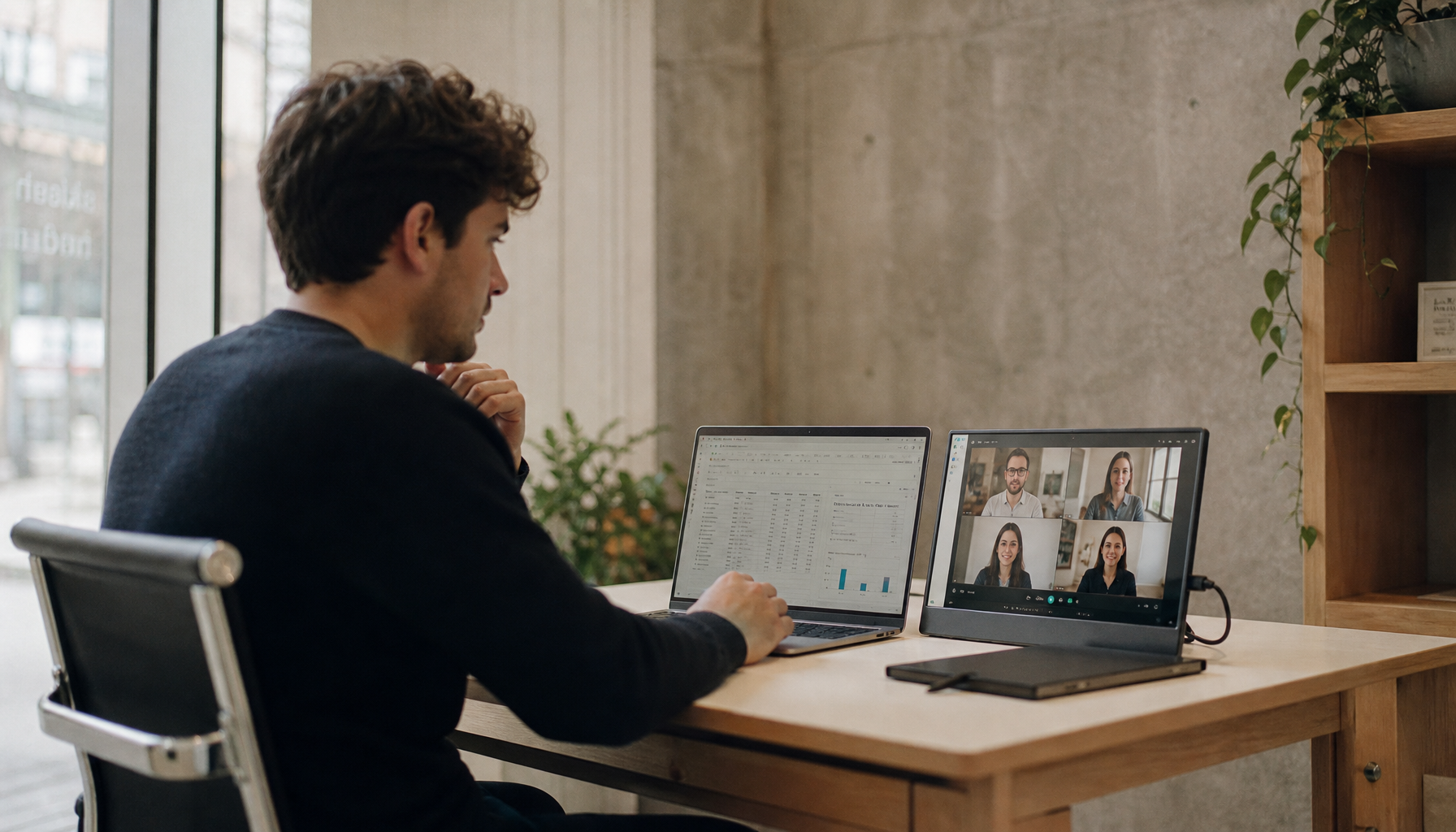
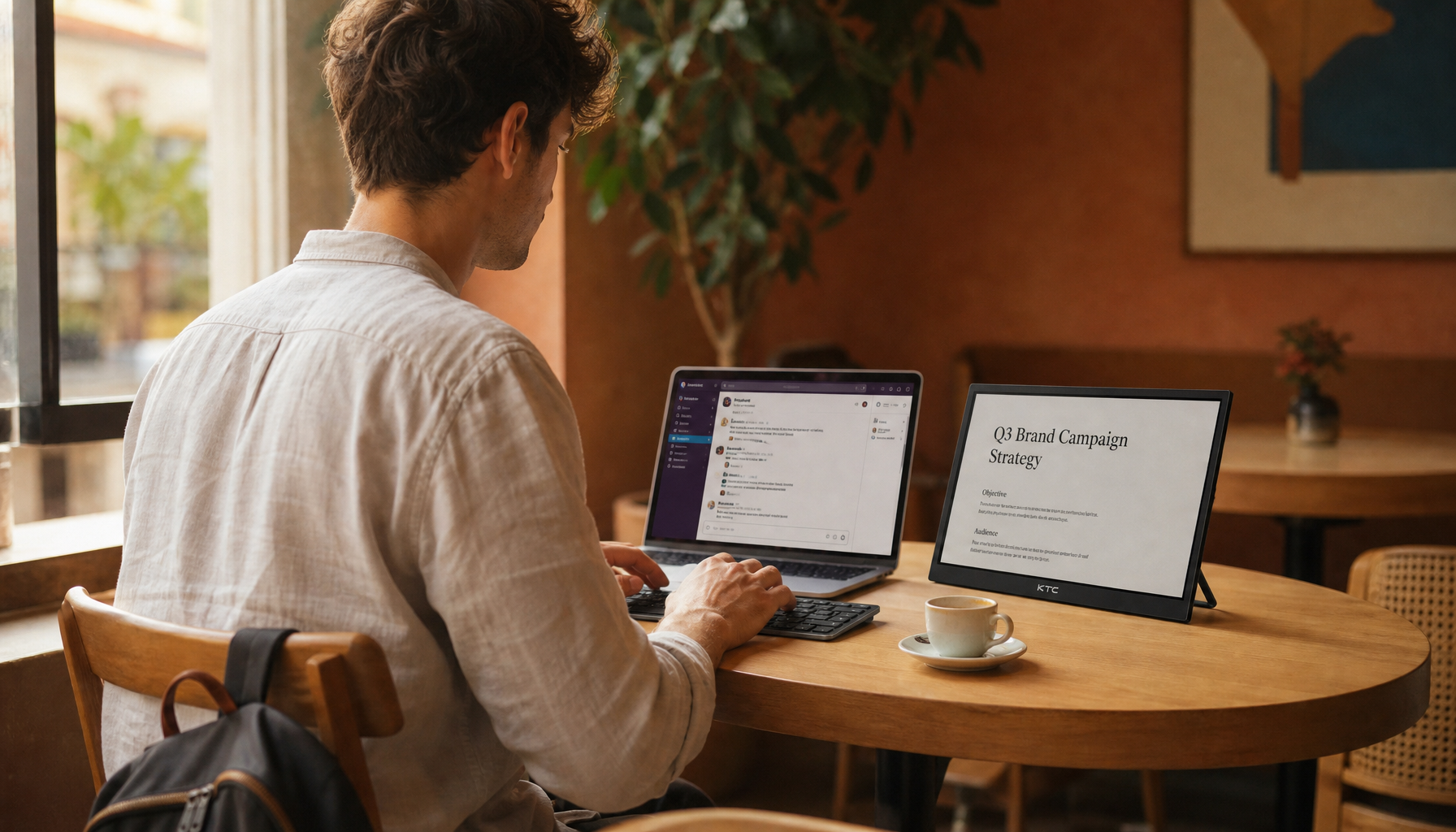
Ambient light sensor technology helps a home office monitor stay readable as daylight, lamps, and window glare change. It works best when it adjusts brightness smoothly, complements anti-glare hardware, and stays out of the way during productivity work.
Ever start the morning with a monitor that feels fine, then realize by late afternoon that the screen is either washed out by window light or too bright for a dim room? A practical comfort setup can keep a display closer to the brightness of the room, with some users running monitors as low as 25/100 brightness when paired with good ambient lighting. This guide explains how the feature works, when it helps, when it can annoy you, and what to look for when buying a home office monitor.
What an Ambient Light Sensor Does in a Monitor
An ambient light sensor is usually a small component near the monitor bezel that measures the brightness around the display, often in lux. In a monitor, the sensor does not simply “see light” and react instantly; it feeds a control loop where the display reads the room light, filters the reading, maps it to a brightness target, and then adjusts the backlight or panel drive through firmware-controlled steps. That process is why ambient light sensor technology can feel gradual instead of abrupt.

For a home office monitor, the practical goal is simple: brighten the screen when the room is bright, dim it when the room gets darker, and reduce the number of times you need to reach for the monitor’s on-screen display controls. This is especially useful with desks near windows, apartments with mixed daylight and lamp lighting, portable monitors moved between rooms, and ultrawide monitors used for long writing, coding, spreadsheets, or dashboard sessions.
Brightness Is the Main Adjustment
Most ambient-light-aware displays focus on luminance: the screen gets brighter or dimmer as the surrounding room changes. Some systems may also interact with color temperature, HDR brightness behavior, or power-saving logic, but the clearest comfort win usually comes from brightness matching. If your monitor is much brighter than the room at night, white documents and web pages can feel harsh; if it is too dim in daytime, text and UI edges can lose clarity.
An operating system can also participate in this behavior on compatible PCs. In a modern operating system, automatic brightness tied to lighting conditions may be available under display brightness settings, where the option is named “change brightness automatically when lighting changes” when the PC supports the feature. On many external desktop monitors, however, an operating system may not show a brightness slider, so the monitor’s own sensor, firmware, and physical controls matter more.
Smooth Adjustment Matters More Than Speed
A good ambient light sensor should not make the screen flicker brighter every time a cloud moves or your hand passes near the bezel. Monitor firmware often smooths brightness changes over time so the display does not visibly “pump” in response to shadows, lamps, keyboard lighting, or window reflections. For office work, that lag is usually a feature, not a flaw, because a stable document is more comfortable than a screen that constantly reacts.
That tradeoff is different for competitive gaming. If the monitor’s brightness algorithm changes the image while you are playing, it can feel distracting, especially on a high-refresh-rate gaming monitor where consistency and responsiveness matter. For hybrid productivity-and-gaming setups, it is worth choosing a monitor that lets you turn ambient sensing off per picture mode or profile.
Why Changing Room Light Causes Discomfort
The comfort problem is not only that a screen is “too bright” or “too dim.” The real issue is mismatch: a bright screen in a dark room forces your eyes to adapt between a glowing rectangle and a dim background, while a dim screen in a bright room makes text harder to resolve. A completely dark room can also be fatiguing when paired with a bright display because your eyes adapt to the overall scene, not just the document or game window in front of you.

Bias lighting addresses this mismatch from the room side instead of the monitor side. It places indirect light behind or around the display, reducing the contrast between the screen and the surrounding wall; bias lighting can be as simple as an inexpensive LED strip mounted behind the monitor. In a home office, that is often a better companion to automatic brightness than overhead lighting, which can reflect directly off glossy panels or appear as a bright object in your field of view.

A Realistic Home Office Scenario
Consider a 27-inch productivity monitor on a desk about 4 ft from a window. At 9:00 AM, the room is bright enough that a low brightness setting makes spreadsheet gridlines and small UI text feel faint. By 2:00 PM, cloud cover changes the light every few minutes. At 8:30 PM, the room is mostly lit by a desk lamp, and the same brightness setting that worked in daylight now makes a white document feel glaring.

With ambient sensing enabled, the monitor can raise luminance during the bright window period, ease it down as the room darkens, and reduce the number of manual brightness changes across the day. This is most useful for tasks where you stare at mostly static content: email, writing, research, coding, charts, calendars, documents, and browser-based tools.
The 25/100 Brightness Lesson
One practical benchmark from long-term monitor use is that a display often does not need to run anywhere near maximum brightness in a controlled room. A reported everyday setup used a monitor brightness setting of 25/100, with the argument that a display should not be brighter than a well-lit book for comfortable viewing. That number is not universal, but it is a useful sanity check: if your home office monitor sits at 80/100 all night in a dim room, automatic dimming or bias lighting may noticeably improve comfort.
For HDR monitors, OLED monitors, and high-brightness gaming displays, this point matters even more. A monitor capable of very high peak brightness can be excellent for HDR media and games, but desktop work is mostly sustained brightness across white or light gray areas. Comfort during an eight-hour workday often depends more on controlled everyday luminance than on the display’s maximum spec-sheet brightness.
When Ambient Light Sensing Helps Most
Ambient light sensing is most valuable when your room lighting changes during the day and your work depends on text clarity. A monitor beside a window, a laptop-plus-external-monitor setup, or a portable monitor used between a kitchen table and a dedicated desk can all benefit because the same fixed brightness setting rarely works everywhere. For these users, automatic brightness is less about luxury and more about reducing repeated micro-adjustments.
It also helps people who use large displays. On a 34-inch ultrawide or 49-inch super-ultrawide monitor, a bright desktop fills much more of your field of view than a small laptop screen. If that large panel remains too bright in the evening, the discomfort is more noticeable because the luminous area is bigger. Ambient sensing can make big-screen productivity feel less harsh as the room dims.
Best-Fit Use Cases
Ambient light sensing is a strong fit for home office tasks where visibility and steadiness matter more than split-second visual consistency. Writing, coding, email, project management tools, dashboards, spreadsheets, research, and video calls are all good matches. In these workloads, the benefit is not dramatic on any single click, but it adds up over long sessions.
It is also useful for mixed-use setups where the monitor doubles as a work display and casual entertainment screen. For example, a 4K monitor in a home office may need higher brightness for daytime video calls, moderate brightness for afternoon spreadsheet work, and lower brightness for late-night reading. A sensor can bridge those transitions without forcing you to open the monitor menu three or four times a day.
Less Useful for Fixed Lighting Rooms
If your office has controlled lighting, no direct window exposure, matte walls, and a consistent desk lamp setup, manual calibration may be enough. In that case, set brightness once for daytime work, optionally create a lower evening preset, and leave it alone. A stable lighting environment reduces the value of automatic adjustment.
For color-sensitive work, such as photo editing, print proofing, or brand design, automatic brightness can also be a problem if it changes the viewing condition mid-task. In those workflows, turn off automatic brightness while doing final color checks, use a known monitor preset, and keep room lighting stable.
Where the Technology Can Fall Short
Ambient light sensors can be fooled by local light sources. A bright mechanical keyboard, monitor light bar, desk lamp, window reflection, indicator LED, or even display backlight leakage near the sensor can affect the reading. The sensor may “think” the room is brighter or darker than it feels to your eyes, because it samples from one small location rather than the full visual environment.
Placement matters. If the sensor sits near the lower bezel and your keyboard lighting shines upward, the display may over-brighten. If the sensor is shadowed by a monitor hood, speaker, webcam mount, or your hand during note-taking, it may dim when the room itself has not changed. These small placement issues explain why two monitors with similar sensor specs can feel different in real use.
Watch for Brightness Lag
Brightness lag is the delay between a room-light change and the monitor’s automatic luminance adjustment. A little lag is helpful because it prevents flickering or sudden shifts, but too much lag can make the display feel out of sync when you open blinds, turn on a lamp, or move a portable monitor. HDR displays may also take more time to adjust automatic brightness behavior when ambient lighting changes on HDR displays.
The test is simple: change the room lighting and watch a white document or browser page for 30 seconds. A comfortable implementation should adjust gradually enough that it does not distract you, but clearly enough that the new brightness fits the room. If you notice the page pulsing while you work, the sensor behavior may be too aggressive for productivity.
Avoid Pairing It With Aggressive Dynamic Contrast
Ambient sensing and dynamic contrast are different features. Ambient sensing reacts to the room; dynamic contrast reacts to the image content. When both are aggressive, documents, websites, dashboards, or spreadsheets can brighten and dim in ways that feel unstable. For home office use, keep ambient sensing enabled if it helps, but disable dynamic contrast if white pages, dark sidebars, or dashboard panels cause visible luminance shifts.
This is especially important on gaming monitors with multiple enhancement modes. A “smart brightness” mode may be comfortable for email, while a game-oriented contrast enhancer may be distracting in a spreadsheet app or a browser. Save separate presets when possible: one for work, one for gaming, and one for media.
How It Compares With Other Monitor Comfort Features
Ambient light sensing is only one part of a comfortable home office display. It adjusts to the room, but it does not remove glare, fix flicker, make a glossy panel matte, or guarantee good ergonomics. The best results usually come from combining automatic brightness with the right panel surface, desk lighting, and monitor settings.

For buyers, the main question is not “Does this monitor have a sensor?” but “Can I control it, and does it work well with the rest of the display?” A monitor with a sensor, matte coating, flicker-free dimming, adjustable stand, and usable presets may be more comfortable than a brighter monitor with a poorly tuned automatic mode.
Feature or Option |
What It Improves |
Best For |
What to Check Before Buying |
Ambient light sensor |
Matches screen brightness to changing room light |
Window-facing home offices, portable monitors, long productivity sessions |
Can it be turned off or saved per preset? |
Keeps predictable luminance levels |
Fixed lighting rooms, color-sensitive work |
Are presets easy to access from the OSD or software? |
|
Bias lighting |
Reduces contrast between screen and room |
Evening work, dark walls, bright displays |
Use indirect rear lighting instead of a lamp shining at the screen |
Reduces reflections from windows and lamps |
Bright rooms, shared spaces, apartment offices |
Check whether the coating softens fine text too much |
|
Flicker-free dimming |
Reduces visible or invisible backlight flicker |
Long reading, coding, spreadsheet work |
Look for independent testing when available |
Low blue light or warm mode |
Makes evening viewing less harsh |
Night work, reading, document editing |
Confirm it does not make colors unsuitable for your task |
Adjustable color temperature |
Tunes white point for room lighting |
Mixed daylight and lamp setups |
Use warmer settings at night and neutral settings for daytime work |
Productivity Monitors
For a 24-inch to 32-inch office monitor, prioritize smooth automatic brightness, a matte surface, a height-adjustable stand, and easy access to manual brightness. A sensor is most valuable if you work near windows or switch between morning, afternoon, and evening sessions. If you mostly use documents and web apps, you do not need extreme peak brightness; you need readable text without glare or harsh white backgrounds.
Gaming and High-Refresh-Rate Monitors
For a gaming monitor, ambient sensing is useful during work hours but should be optional during games. Look for per-mode control so your 144 Hz, 240 Hz, or higher-refresh display can stay consistent in competitive titles. For story games or casual play in changing light, automatic brightness may be acceptable, but for esports-style gaming, fixed brightness is usually the safer choice.
Ultrawide and Portable Monitors
Ultrawide monitors benefit from comfort tuning because they occupy a wider field of view. If a 34-inch or 49-inch screen is too bright at night, it can dominate the room visually. A smooth sensor can help, but bias lighting behind the display is also valuable because it fills the wall around such a large panel.
Portable monitors have a different challenge: they move. A portable display used in a home office, bedroom, coffee-table setup, or travel workspace may face very different lighting conditions. Ambient sensing can be useful, but battery-powered setups should also consider power draw because higher brightness uses more energy.
Setup Checklist for a More Comfortable Home Office Monitor
A good setup takes less than 20 minutes and is easier to test with everyday work than with synthetic benchmarks. Use a white document, a dark-themed app, a web page, and a spreadsheet so you can see how the display behaves across common content. Make changes one at a time so you know what actually helped.

- Set the monitor to a normal work preset first, such as Standard, sRGB, Office, or Custom, instead of a vivid store-demo mode.
- Turn on ambient light sensing and watch a white document while changing room light with blinds or a lamp.
- Lower manual brightness until white pages feel closer to a well-lit book than a glowing sign.
- Add indirect bias lighting behind the monitor if you work at night or in a dim room.
- Turn off aggressive dynamic contrast if documents or dashboards visibly brighten and dim.
- Save separate presets for Work, Gaming, and Evening if the monitor supports profiles.
- Recheck the setup after one full workday, including morning daylight and evening lamp use.
A Quick Comfort Test
Start with your usual desk lighting at the time you work most often. Open a blank document, set the monitor brightness to a level that feels comfortable for five minutes, then turn on ambient sensing. If the monitor barely changes in stable light, that is a good sign; it means the sensor is not overreacting.
Next, change the environment. Open blinds, turn a lamp on or off, or move the portable monitor to another room. The display should adapt without making the page pulse. If the shift is distracting, reduce the sensitivity if the monitor allows it, use manual presets instead, or keep ambient sensing only for daytime work.
FAQ
Q: Does an ambient light sensor reduce eye strain?
A: It can reduce discomfort caused by brightness mismatch, especially when your home office light changes throughout the day. It is not a medical treatment and it will not fix every cause of eye fatigue, but it can make long monitor sessions easier by keeping the screen closer to the surrounding room brightness.
Q: Should I use automatic brightness on a gaming monitor?
A: Use it for work if it feels comfortable, but turn it off for competitive gaming unless the monitor’s implementation is very stable. High-refresh-rate displays are often bought for predictable motion and low distraction, so fixed brightness is usually better for fast games.
Q: Is bias lighting better than an ambient light sensor?
A: They solve related but different problems. Bias lighting improves the room environment around the monitor, while an ambient light sensor changes the monitor brightness. For evening work, the best result is often both: soft indirect light behind the display plus restrained automatic or manual brightness.
Practical Next Steps
For a home office monitor, ambient light sensor technology is worth prioritizing if your lighting changes, your desk is near a window, or you regularly work into the evening. It is less important in a controlled room where a single brightness setting already feels comfortable all day. The most comfortable setup is usually a balanced one: smooth automatic brightness, matte anti-glare hardware, indirect room lighting, and separate presets for work and play.
When shopping, do not stop at the feature list. Check whether the monitor lets you disable ambient sensing, tune brightness manually, save presets, and avoid aggressive dynamic contrast. For productivity, ultrawide, portable, and hybrid gaming setups, those controls matter more than the sensor’s mere presence.