


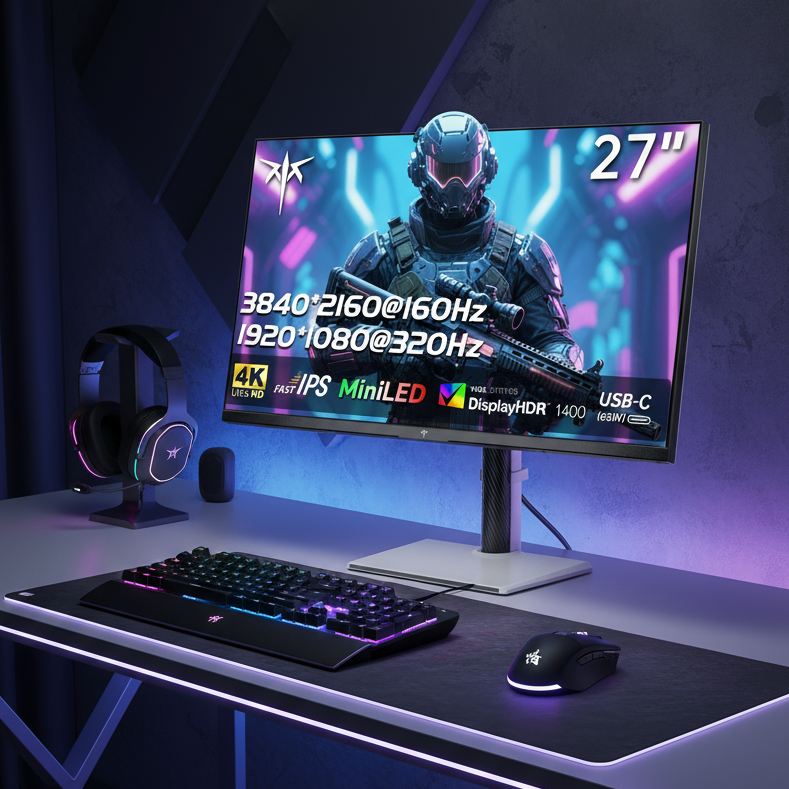
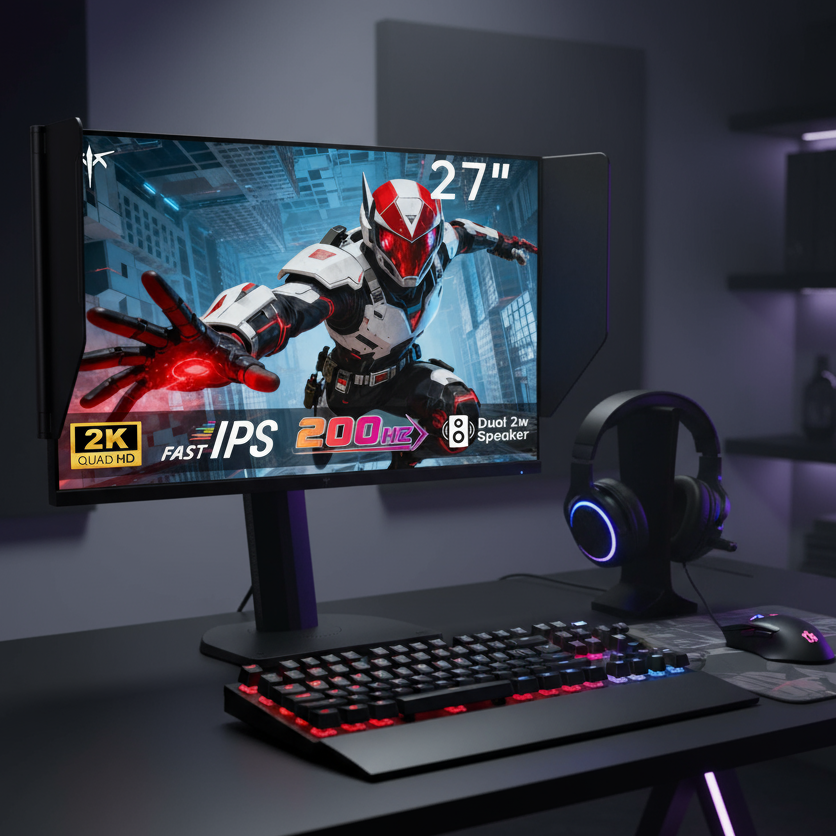
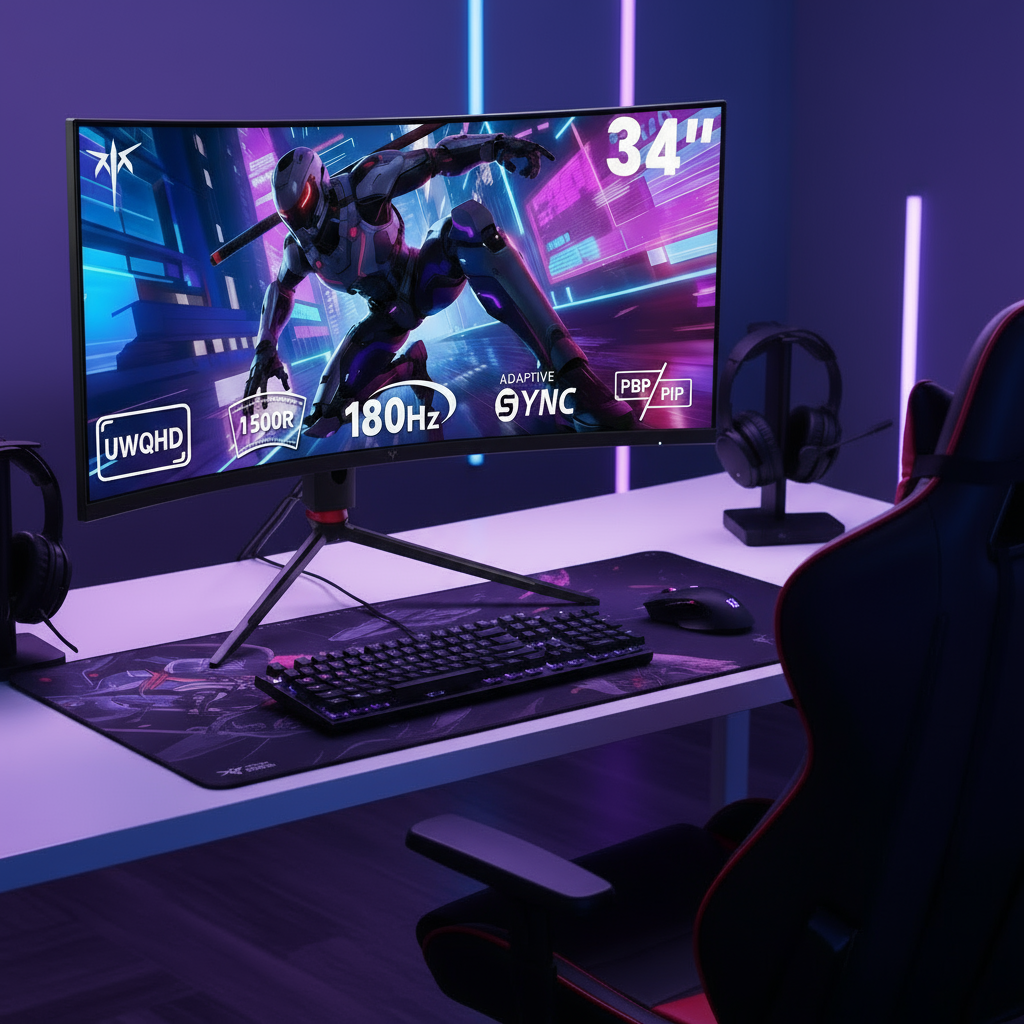


Response time controls how cleanly pixels change, while refresh rate controls how often new frames appear. Motion clarity is strongest when pixel transitions finish inside each refresh window without overdrive artifacts.
Does a fast flick shot leave a faint shadow behind the target, or does spreadsheet scrolling feel oddly smeared even on a high-Hz screen? A 240Hz panel gives each frame only about 4.17 ms to settle, while 120Hz gives about 8.33 ms, so the same pixel behavior can look clean at one setting and messy at another. This article explains how to read the specs, tune the monitor, and choose the right display for gaming, work, or portable use.
Response Time and Refresh Rate Are Partners, Not Rivals
Refresh rate is the number of times a display updates the image each second, and higher rates usually make motion look smoother when the PC, console, or device can feed enough frames. A monitor refresh rate of 144Hz can show up to 144 updates per second, while 240Hz can show up to 240.
Response time is different. It describes how quickly a pixel changes from one shade or color to another. Slow response creates ghosting, smearing, or dark trails; aggressive tuning can create inverse ghosting, where a bright or dark halo appears because the pixel overshoots the intended value. Buying advice often treats response time as a core gaming spec because slow response can cause ghosting, while lower times help fast motion stay readable.
The interaction is simple but unforgiving: every refresh rate has a frame window. If a pixel transition takes longer than that window, the next frame arrives before the previous transition has visually settled. That is why a 6 ms transition can look acceptable at 60Hz, where each frame lasts about 16.67 ms, but trail more visibly at 240Hz, where the frame window is only about 4.17 ms.
Refresh rate |
Time per frame |
Practical meaning |
60Hz |
16.67 ms |
Plenty of time for many LCD transitions, but more sample-and-hold blur |
120Hz |
8.33 ms |
Strong balance for work, console gaming, and smoother desktop motion |
144Hz |
6.94 ms |
Common baseline for serious PC gaming |
240Hz |
4.17 ms |
Demands very fast pixel response and strong GPU frame output |
360Hz |
2.78 ms |
Esports-focused; weak transitions become obvious |
Why Higher Hz Can Still Blur
A faster refresh rate reduces persistence blur because each frame stays on screen for less time. A TV motion explanation makes the key distinction clearly: higher refresh rates reduce persistence blur, but ghosting depends more heavily on response time.
This is where many buyers misread the box. A 240Hz LCD with slow dark transitions can look less clean than a 144Hz OLED in some scenes because the LCD pixels may not finish changing before the next refresh. OLED has a structural advantage because each pixel emits its own light and can transition extremely quickly; research notes describe OLED response as typically under 1 ms, while many LCD gaming panels sit closer to 5-10 ms and standard consumer LCDs may be slower.
Still, OLED is not magic. OLED and LCD both use sample-and-hold presentation in most normal modes, meaning each frame remains visible until the next one replaces it. Ultra-fast response time removes a major source of ghosting, but it does not eliminate all perceived motion blur. Higher refresh rates, black frame insertion, backlight strobing, or impulse-style driving can improve motion clarity, but they often trade away brightness, comfort, or battery life.
The Frame Window Test
The most useful practical test is to compare pixel transition time against frame time. A claimed 1 ms or 0.03 ms panel has enough headroom for 240Hz and beyond, assuming the number reflects real behavior and not only a best-case marketing transition. A 5 ms LCD transition fits comfortably inside 120Hz’s 8.33 ms window, but it is already longer than a 240Hz frame.
This does not mean you should always lower refresh rate to hide response limits. For esports, higher refresh still improves update frequency and can reduce perceived latency when your system sustains the frames. But if a budget VA or older IPS panel looks smeary at its maximum Hz, dropping from 165Hz to 120Hz and using a moderate overdrive mode can sometimes look cleaner because transitions have more time to finish.
A simple real-world example is a 165Hz monitor running a game between 70 and 90 FPS. Without variable refresh rate, pacing may feel uneven. With VRR enabled, or with the game capped closer to a stable range, motion often feels more consistent. The KTC notes make the same practical point: lowering refresh rate does not change native pixel speed, but it changes how much time each transition has before the next refresh.
Overdrive Is the Control That Connects Them
Overdrive pushes pixels harder so they reach the target shade faster. Used well, it reduces ghosting. Used poorly, it creates overshoot, which often looks worse than ordinary blur because the trail becomes a bright or dark outline around moving objects.

The key is that overdrive behavior changes with refresh rate. A monitor’s highest mode may look sharp at 240Hz but produce obvious inverse ghosting at 120Hz or 60Hz. For mixed gaming, desktop use, and VRR, the best setting is often a middle option, not the most aggressive label in the menu.
This matters for productivity too. A 120Hz office display can make cursor movement, window dragging, and document scrolling feel smoother without the heat, cost, and power draw of 240Hz. Refresh-rate guidance often frames 120Hz as a strong professional option for smoother task flow, while 144Hz and above move more clearly into gaming territory; the right refresh rate depends on the workload rather than the biggest number on the spec sheet.
LCD, OLED, VA, IPS, and TN: What Changes?
Panel type affects how response time behaves in the real world. OLED typically delivers the cleanest pixel transitions and excellent contrast, making it a premium choice for high-refresh gaming and immersive screens. Its tradeoffs are price, brightness management, and long-term image retention considerations.

IPS is often the best all-around LCD choice because it balances color, viewing angles, and modern gaming speed. A good fast IPS panel at 144Hz or 240Hz can be excellent for both competitive play and office work. TN can still be fast, but color and viewing angles are usually weaker. VA delivers strong contrast and deep blacks, which helps movies and atmospheric games, but dark transitions can smear more visibly, especially in fast scenes.
Gaming monitor advice often places panel type, refresh rate, response time, resolution, and adaptive sync together because gaming monitor choice is a system decision. A 1440p 240Hz monitor is not a motion upgrade if your graphics card only produces 80 FPS in the games you actually play.
Refresh Rate Needs Frame Rate
A display cannot invent true input updates your GPU never rendered. For the cleanest high-refresh experience, frame rate should match or exceed refresh rate as often as possible. High-refresh guidance emphasizes that a 240Hz monitor only pays off when the rest of the setup can deliver high frame rates.
This is especially important at higher resolutions. A 1080p 240Hz esports setup is realistic for many competitive titles. A 4K 240Hz setup is far more demanding, and even powerful GPUs may struggle to hold that level across modern games. For many buyers, 1440p at 144Hz or 165Hz is the more reliable value point because it improves motion and sharpness without demanding extreme hardware.
For console use, 120Hz is often the practical ceiling to target. For portable smart screens, 60Hz saves battery for static work, while 120Hz improves touch, scrolling, and light gaming. Maximum refresh should be reserved for situations where motion clarity matters more than power draw.
Practical Buying and Setup Advice
For competitive gaming, prioritize a monitor that can run at least 144Hz with genuinely fast response behavior and clean overdrive. A 1 ms-style claim is useful only if independent testing or real-world motion tests show low ghosting and low overshoot. If you play shooters, racing games, or fast MOBAs, 240Hz is worthwhile when your system can sustain high FPS.

For office productivity, 100Hz to 120Hz is the sweet spot. It makes scrolling and cursor movement feel calmer and more immediate, while avoiding the cost and power penalties of esports refresh rates. If the work is mostly documents, email, coding, and video calls, response time matters less than text clarity, ergonomics, brightness, and eye comfort.
For immersive single-player gaming, balance motion with contrast and resolution. A 144Hz OLED or fast IPS panel may feel better than a higher-Hz budget panel with smearing. A buying overview correctly treats refresh rate, response time, panel type, resolution, connectivity, size, and aspect ratio as connected choices rather than isolated specs.
Once the monitor is on your desk, confirm that your operating system or GPU control panel is actually set to the advertised Hz. Use the right high-bandwidth cable and port for high refresh at higher resolutions. Then test motion with your normal games or work apps, adjust overdrive, enable VRR if supported, and avoid the most aggressive settings unless the image stays clean across your real FPS range.
What the Research Says About Perception
A controlled visual neuroscience study using a 240Hz gaming monitor at 60Hz, 120Hz, and 240Hz found that higher refresh rates improved measured visual responses to motion stimuli. The authors reported that motion response intensity increased compared with 60Hz, and they recommended at least 120Hz for motion perception experiments, with 240Hz or higher for high-velocity motion; the refresh rate affects motion perception finding supports what skilled players and display testers often observe in practice.
The nuance is that the study measured visual evoked responses, not exact gaming performance or spreadsheet comfort. It still reinforces the core display principle: faster refresh helps the visual system receive cleaner motion information, but the panel must also change pixels fast enough and the source device must deliver frames consistently.
Closing
For motion clarity, buy and tune for the whole chain: frame rate, refresh rate, pixel response, overdrive, panel type, and VRR. The best display is not the one with the loudest Hz number; it is the one that keeps motion clean at the speed you actually use.


