Your monitor was likely tuned to look impressive under retail lighting, not to support eight hours of focused work in a real home office. The right brightness matches your room, reduces glare, and keeps text clear without forcing your eyes to readjust.
Factory Brightness Is Built to Sell, Not Work
Many displays ship with high brightness, boosted contrast, and vivid color modes because those settings stand out quickly. That does not mean they are comfortable for spreadsheets, video calls, code, or research in a spare bedroom.
A home office is usually more variable than a corporate workstation: daylight shifts, lamps move, blinds change, and wall colors affect perceived contrast. OSHA notes that high contrast between the screen and surrounding areas can contribute to eye fatigue and headaches.
For productivity, brightness is performance tuning. Too bright, and the screen feels like a light source. Too dim, and you squint, lean forward, or lose text clarity.
Match the Screen to the Room
A practical target for many home offices is not 100% brightness. It is often a moderate setting that visually matches the desk environment.
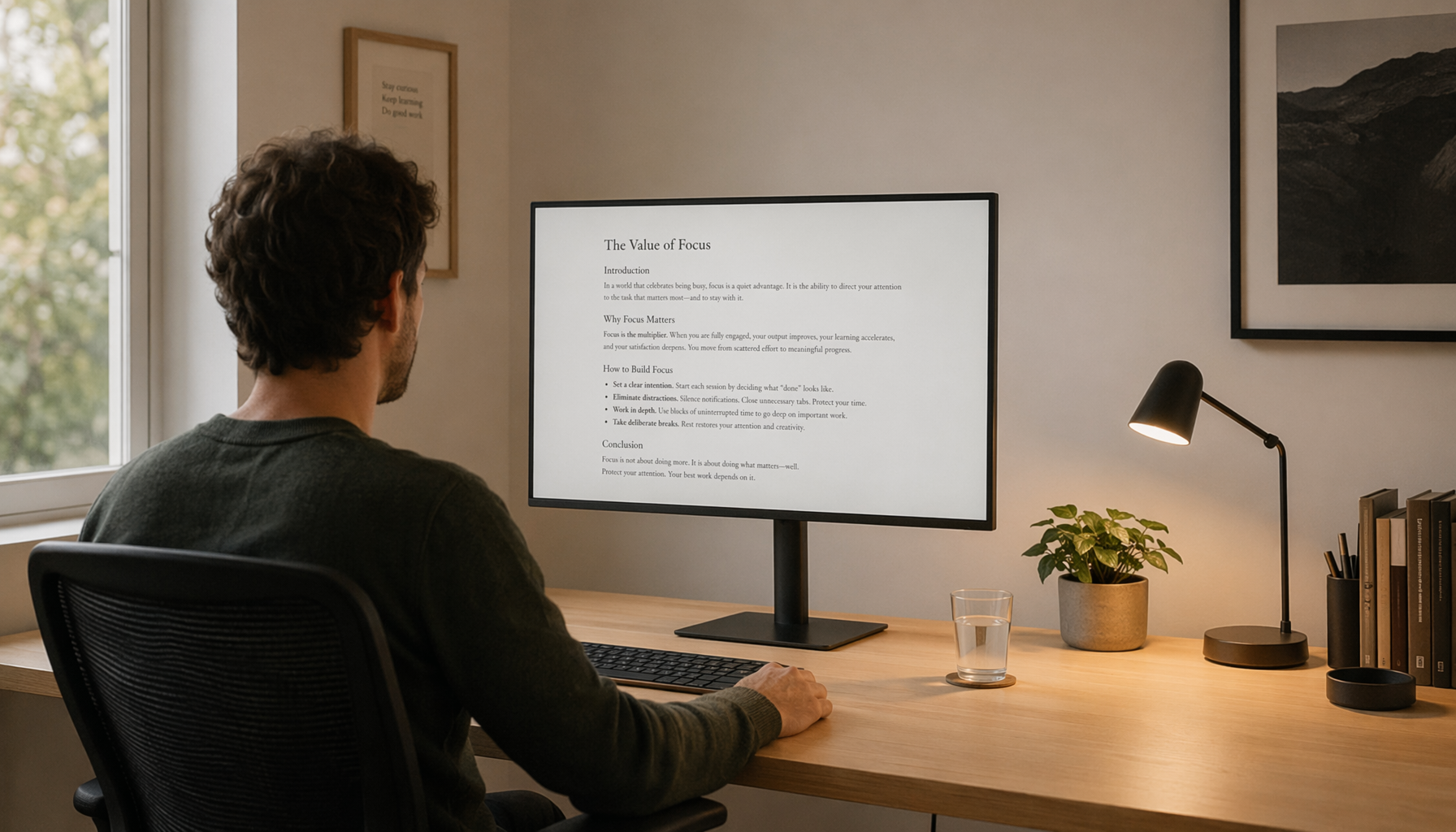
Try the paper test: open a white document, hold a sheet of white paper beside the screen, and lower brightness until the screen no longer looks dramatically brighter than the paper. This simple check works because your eyes respond to relative luminance, not the number shown in the monitor menu.

For a typical indoor office, many users land around 30% to 50% brightness, though bright rooms may need more. The key is balance: monitor luminance should rise as ambient light rises, especially when daylight cannot be controlled, a point echoed in monitor luminance should rise as ambient light rises.
Lighting Placement Beats Brightness Chasing
If sunlight or a lamp hits the panel, raising brightness is only a partial fix. You are fighting reflections, not solving visibility.
Place windows to the side of your desk when possible, not directly behind or in front of the monitor. Use blinds, curtains, or a diffused lamp so the screen is not competing with a bright hot spot.

For computer work, balanced room lighting matters as much as the display setting. OSHA recommends well-distributed, diffuse lighting and controlling window light so bright sources sit at a right angle to the screen rather than straight into your view or onto the panel.
A strong setup uses soft ambient room lighting instead of a dark room, a task light aimed at papers or the keyboard instead of the screen, blinds or curtains during harsh daylight, and soft bias lighting behind the monitor for evening work.

Brightness Is Different for SDR, HDR, and Gaming
For office work, sustained comfort matters more than peak brightness. A 400-nit monitor can still be uncomfortable if you run email and documents at full brightness in a dim room.
For HDR gaming or movies, higher peak brightness can improve highlights and immersion, but that does not mean your desktop should stay at HDR-style intensity. In normal productivity use, brightness should support readable text and steady focus, not maximum spectacle.
A fixed number like 120 nits can feel excellent in controlled lighting but too dark near a bright window. That is why home office tuning should start with the room, then the monitor.
A Fast Calibration Routine for Home Offices
Set your monitor to a neutral preset first: Standard, sRGB, or a similar non-vivid mode. Then adjust brightness after your room lighting is set, not before.
Use this quick routine:
- Morning: raise brightness only enough to keep whites clear, not glowing.
- Afternoon sun: close blinds before increasing brightness.
- Evening: lower brightness and use warmer room lighting.
- Dark room: add bias lighting instead of staring into a bright panel.
- Long sessions: follow the 20-20-20 rule by looking 20 ft away every 20 minutes.

Your monitor should disappear into the workflow. When brightness is tuned to your room, text feels stable, colors look more trustworthy, and your display becomes a tool for momentum instead of a source of visual drag.