Use two monitor presets, not one fixed brightness: one for daylight, one for evening, with glare control doing as much work as the OSD brightness slider.
Does your gaming monitor look washed out at 2:00 PM, then painfully bright after sunset? On real desks, the fastest fix is usually a better room-and-screen balance, not a more expensive panel. You’ll get a practical setup process, monitor buying guidance, and clear rules for gaming, ultrawide, and portable displays that have to handle changing light.
Start With the Room, Not the Slider
Screen comfort depends on how closely the monitor matches the room around it, not on a single “best” brightness number. A monitor that is too dim in daylight loses clarity and perceived contrast, while one that is too bright at night becomes the brightest object in the room and forces your eyes to keep re-adapting. That matters even more on large ultrawide monitors, where a wide bright canvas can dominate your field of view.
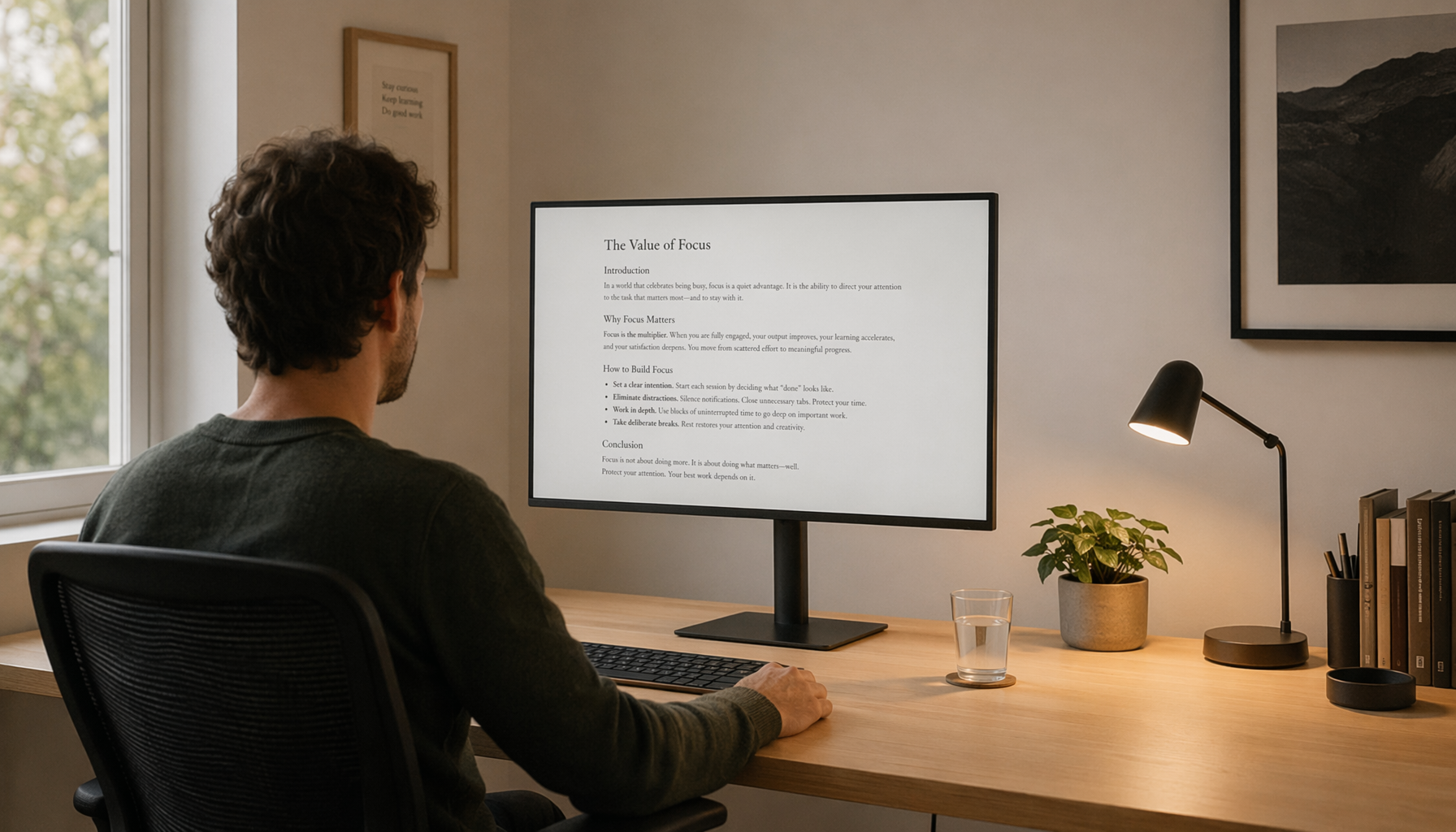
A white-screen-versus-white-paper check is one of the fastest ways to tune brightness. Open a blank document, place a sheet of white paper on your desk under your normal room light, and compare them. If the screen looks like a glowing sign, lower brightness or add soft room light; if the paper looks brighter, raise monitor brightness or reduce glare from windows or lamps. On a 34-inch ultrawide near a side window, this simple test is often more useful than chasing a factory preset name.

Brightness is the main comfort control, while contrast and gamma refine the image after brightness is close. In practice, that means you should set brightness first, verify that dark scenes still show shadow detail, and only then touch contrast, gamma, or color temperature. For gaming monitors and high-refresh-rate panels, this order keeps you from “fixing” a room-light problem with the wrong control.
Build Two Presets: Daylight and Evening
One fixed setting is rarely ideal when room light changes through the day. For controlled SDR desk use, 250 to 350 nits is usually enough, while rooms with stronger daylight or desks near windows benefit from 400+ nits of headroom. That does not mean you should run the monitor at maximum all day; it means the panel has enough reserve to stay usable when the room gets bright.
Evening use works better with a lower-brightness preset and soft ambient light behind or around the monitor. If you do color-sensitive work, a common cap is about 120 nits with even ambient lighting and no direct light on the screen. For a mixed-use setup that switches from spreadsheets to games to streaming, save one neutral daytime preset and one evening preset rather than constantly guessing with the slider.

Platform tools like Night light, Dark mode, and text scaling can reduce the need to over-brighten the panel at night. That is especially useful on portable monitors and laptop-plus-monitor setups, where smaller screens tempt people to crank brightness instead of improving readability. A warmer evening color tone and larger text are often better fixes than pushing white UI elements harder.
Quick Setup Checklist

- Put the monitor in a neutral or custom picture mode.
- Tune brightness in your normal daytime lighting with a white document and white paper test.
- Save that as your daylight preset.
- Lower brightness for evening until the screen no longer feels like the room’s light source.
- Add soft bias lighting or desk lighting instead of compensating with screen brightness alone.
- Recheck shadow detail with a dark image before saving your evening preset.
- Use the 20-20-20 rule: every 20 minutes, look 20 ft away for 20 seconds.
Why HDR Often Looks Dim in a Bright Room
HDR is designed to expand contrast and highlight detail, not to make the whole screen uniformly brighter. That is why a monitor advertised at 1,000 nits can still look underwhelming on a sunny afternoon: that number usually refers to small highlights, not full-screen brightness. In a bright room, ambient light raises the apparent black floor, so blacks look gray and the entire image loses depth.
Midtones and shadows are usually the first parts of the image to fall apart in bright conditions. You may still see a bright sky or specular highlight pop, while faces, dark clothing, and shadowed corners look muddy. Tone mapping can add to that effect when content is mastered brighter than the display can actually reproduce, because the monitor protects highlights by darkening other parts of the image.
Panel technology changes how well a monitor survives mixed lighting. OLED gives you true blacks in a dim room, but its full-screen brightness is usually lower; Mini-LED tends to hold up better in daylight and HDR, though blooming can show up; basic LCD HDR often lacks the contrast needed to look convincing once room light gets involved. If your gaming setup stays bright until evening, Mini-LED or a strong LCD can be the more forgiving choice than buying OLED for its best-case, lights-down performance.

Should You Trust Adaptive Brightness?
Adaptive brightness lag is usually caused by sensor polling, firmware smoothing, HDR processing, and backlight response time. The lag is often intentional, because instant reactions would make the monitor “pump” every time a cloud passes, a lamp flips on, or sunlight briefly hits the sensor. That makes auto-brightness reasonable for slow room changes, but frustrating when daylight drops quickly around sunset.
You can separate room-light behavior from content-based dimming with a simple two-part test. First, keep room light stable and switch between bright and dark apps; if brightness shifts, dynamic contrast, HDR, or content-aware processing is probably involved. Then keep the same image on screen and change the room light quickly; if the panel reacts late, the ambient-light system is the source of the delay.
A recent forum thread showed that a user trying to keep three monitors at similar brightness with room-light changes could not use a calibration tool for that job. If you run a gaming monitor beside a portable display or side screen, manual presets are usually more reliable than expecting software calibration tools to synchronize everything automatically.
What to Look for When Buying a Monitor for Variable Light
Brightness headroom matters more than peak-marketing language when your room changes all day. For a controlled desk setup, 250 to 350 nits is often enough. For daylight-heavy rooms, window-side desks, or HDR use, 400+ nits gives you more usable range before the image starts looking flat. Static contrast still matters too; around 1000:1 is a sensible floor for general use, and better contrast helps the picture hold together as ambient light rises.
Practical features beat flashy specs for gaming, ultrawide, and portable monitors in changing light. Prioritize easy preset switching, stable SDR performance, and brightness controls that let you move quickly between day and night. Adaptive brightness is a nice extra for gradual changes, but for fast daylight-to-evening shifts, HDR troubleshooting, esports, and repeatable calibration, manual control is still the safer bet.
Setup or Room Condition |
What Matters Most |
Practical Guidance |
Controlled home office, SDR |
250 to 350 nits, 1000:1+ static contrast |
Save separate day and evening presets |
Desk near windows or strong daylight |
400+ nits headroom |
|
HDR gaming in mixed light |
Strong full-screen brightness, good local dimming |
Expect highlight pop, not a uniformly brighter picture |
OLED gaming monitor used day and night |
Excellent blacks, lower full-screen brightness |
Best when the room can be dimmed in the evening |
Fast manual brightness access |
Use manual presets instead of relying on slow auto-adjustment |
FAQ
Q: What brightness level should I use during the day?
A: In a controlled room, 250 to 350 nits is usually enough. If your desk gets strong daylight or sits near windows, a monitor with 400+ nits gives you more usable headroom, but you should still reduce glare before pushing brightness higher.
Q: Why does my HDR game look darker than SDR in the afternoon?
A: HDR protects highlight detail instead of lifting the whole image equally. In a bright room, the raised black floor and tone mapping can make midtones and shadows look dull even when highlights still pop.
Q: Is auto-brightness worth using on a gaming monitor?
A: It can help with slow room-light changes, but it often lags by design. For fast-changing daylight, competitive gaming, or any setup where you want repeatable image settings, manual day and evening presets are usually better.
Practical Next Steps
If your room shifts from daylight to evening, the best setup is usually simple: control reflections, save two presets, and stop treating peak HDR brightness as the same thing as everyday usability. A high-refresh-rate gaming monitor, an ultrawide work display, and a portable side screen all become easier to live with when the panel is only as bright as the room requires.
Buy for brightness range and control, not just the biggest nit number on the box. Then tune the monitor where you actually use it, at the times you actually use it, because daylight at 2:00 PM and a desk lamp at 8:00 PM are not the same workload for a display.
References
- https://us.ktcplay.com/blogs/technology-hub/why-hdr-looks-dim-in-bright-room?srsltid=AfmBOoq57J86nhiA1q7TiKdAGpnLO3SpBWMwvDcW57enst0LSHd6yH43
- https://us.ktcplay.com/blogs/technology-hub/why-hdr-looks-dim-in-bright-room?srsltid=AfmBOoq57J86nhiA1q7TiKdAGpnLO3SpBWMwvDcW57enst0LSHd6yH43
- https://www.lenovo.com/us/en/knowledgebase/why-monitor-brightness-and-contrast-ratios-are-key-to-display-quality/?srsltid=AfmBOopc-GCF2IoWdliIdzxbaQlRNsTPHnr9ThbdFzKNCrhXlioLORyS
- https://us.ktcplay.com/blogs/technology-hub/why-hdr-looks-dim-in-bright-room?srsltid=AfmBOoq57J86nhiA1q7TiKdAGpnLO3SpBWMwvDcW57enst0LSHd6yH43
- https://windowsforum.com/threads/ultimate-guide-to-reducing-eye-strain-on-windows-10-11.365250/
- https://www.rrc.ca/accessibility/2023/06/08/visual-ergonomics/
- https://hub.displaycal.net/forums/topic/adjust-monitor-brightness-automatically-with-ambient-light/