A smart monitor becomes a daily planning hub when you keep calendar, email, tasks, and reminders visible on the same screen you already use for work. The best setup is simple: sync your core accounts, choose a glanceable layout, review email for action items, and keep the display positioned where your next decision is easy to see.
Is your morning split between a laptop, a cell phone, and a sticky note you stopped trusting yesterday? A well-set smart display can turn scattered reminders into one always-on command view, especially when calendar and email stay open beside your work windows. Here is how to build a planning routine that feels fast, reliable, and worth the desk space.
What a Smart Monitor Adds to Daily Planning
A smart monitor or smart screen is more than a passive panel when it can run apps, connect to Wi-Fi, respond to touch, and show information without depending entirely on a laptop. Smart screens are connected display devices that provide access to information and respond to user commands, often through touch and sometimes voice, which is exactly what makes calendar and email apps useful as a planning layer instead of another hidden browser tab.
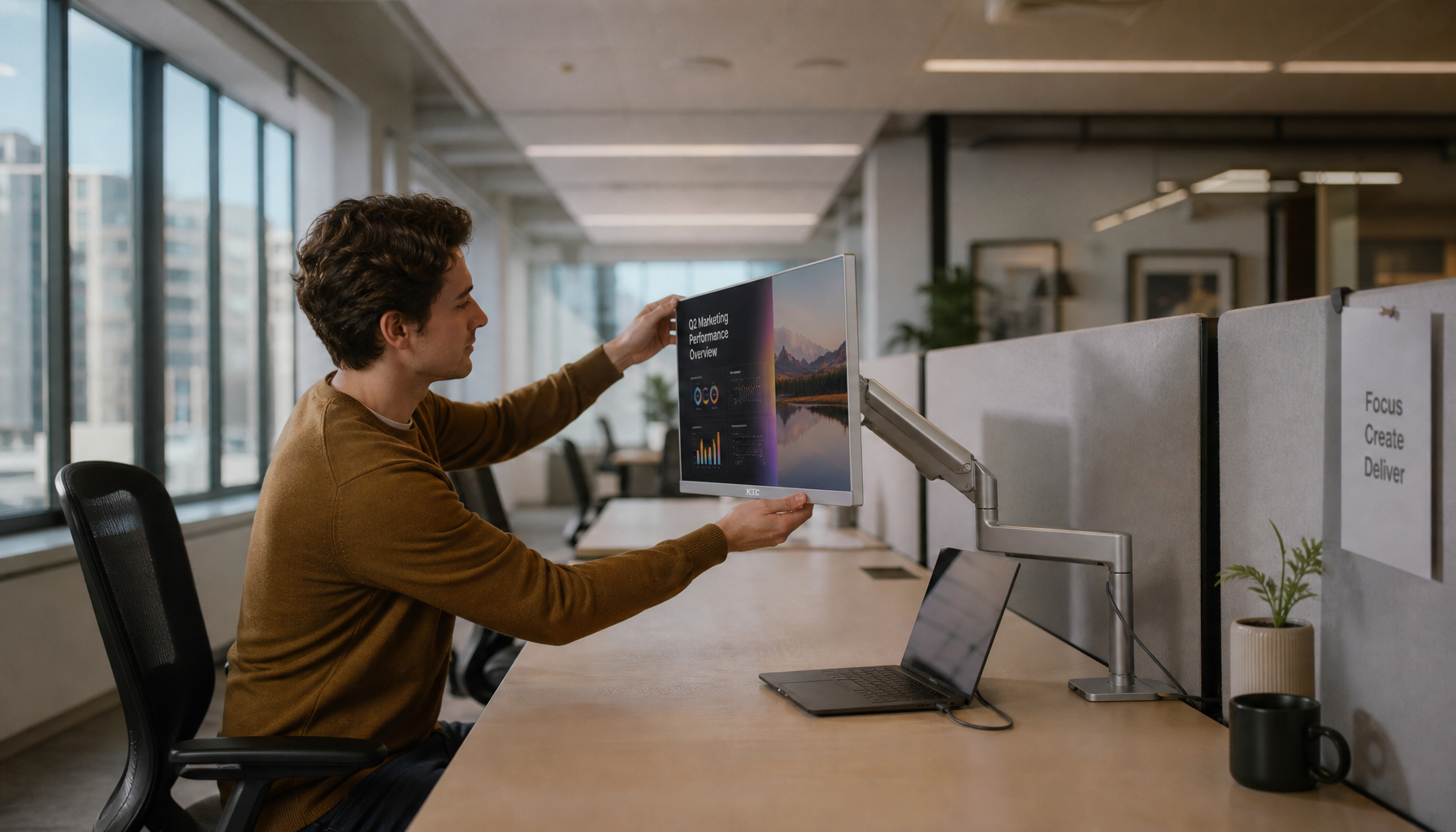
The planning advantage is visibility. A phone calendar is powerful, but it disappears into your pocket. A laptop calendar competes with documents, spreadsheets, and calls. A smart monitor can keep the day’s agenda, unread priority email, meeting links, and task widgets visible at the edge of your main workflow. In practice, that means fewer context switches and fewer missed changes between meetings.
For office productivity, screen real estate matters. Productivity monitors with QHD, 4K UHD, or ultrawide resolutions give you more usable workspace, sharper text, and room for side-by-side applications. If your monitor is 27 inches or larger, you can often keep a calendar column open while drafting email, reviewing a spreadsheet, or running a video call.
Set Up Calendar Sync First
Start by connecting the calendar account that already runs your life, whether that is your work calendar, personal calendar, family calendar, or shared scheduling service. The goal is not to create a new planning system on the monitor. The goal is to make your existing system visible, current, and easier to act on.
A digital calendar display works best when it automatically updates from the accounts you already use. Digital calendar displays can combine calendars, tasks, weather, meal planning, photos, and other widgets into one shared view, which is useful because daily planning rarely lives in a calendar alone. Your schedule tells you when things happen; your email tells you what changed; your task list tells you what still needs doing.
Use one main calendar view for the day and one secondary view for the week. The day view should show meetings, deadlines, travel buffers, and focus blocks. The week view should catch larger planning pressure, like a Friday deliverable that needs work on Tuesday. On a 15-inch or smaller smart display, keep the layout tight and text-first. On a 27-inch smart monitor or larger display, dedicate a side region to the week so you can spot conflicts without opening another window.
Build a Morning Planning View

The most effective morning layout is a three-zone screen. Put today’s calendar in the largest area, unread or flagged email in a narrower column, and tasks or notes in the remaining space. If your built-in apps allow widgets, keep weather and commute status small; they are useful, but they should not compete with meetings and decisions.
A simple example works like this. At 8:15 AM, your monitor shows a 9:00 AM sales call, an 11:30 AM design review, and a 3:00 PM deadline. Your email column shows a client message that moved the review assets from 11:00 AM to 10:00 AM. Instead of discovering that change inside your inbox at 10:25 AM, you adjust the calendar during your first planning pass.
Use Email as an Input, Not the Plan

Email is where plans get negotiated, but it should not be the place where plans live. Treat the smart monitor’s email app as an intake lane. When a message contains a meeting, deadline, document request, shipping update, bill, or decision point, convert it into a calendar event or task. If you leave the action buried in the inbox, the monitor only displays anxiety in high resolution.
Smart display ecosystems vary in how deeply they handle email and calendars. Smart displays can show reminders, control smart home devices, make video calls, stream media, and provide visual information, but ecosystem fit matters. A voice-assistant-centered display may be smoother for household reminders and smart home controls, while a work-account-oriented display may fit better if your calendar, video calls, and shared documents already live in the same service.
Use flags sparingly. A flagged inbox with 80 messages is not a planning system; it is a backlog wearing a red badge. A stronger rule is to flag only messages that need action today or tomorrow. Everything else should become a dated task, a calendar block, or an archived reference.
Turn Messages Into Time Blocks
When an email says, “Can you send the updated deck by Thursday?” do not just star it. Create a work block on Wednesday from 2:00 PM to 3:30 PM, then add a short task named “Send updated deck.” When an email includes a meeting link, add it to the calendar entry. When a message has a document to review, attach or link it in the event notes if your app supports it.
This is where a larger monitor earns its keep. Business monitors increasingly emphasize productivity features such as ultrawide layouts, conferencing hardware, USB-C docking, Ethernet, and window management. Those features reduce friction when you need to drag an email into a calendar event, join a call, and keep notes visible without rearranging your entire desktop.
Choose the Right Display Layout for Your Desk

A smart monitor’s planning value depends heavily on size, resolution, and placement. A small smart display is excellent for glanceable reminders, but it is limited for real email triage. A 27-inch QHD or 4K monitor is more comfortable for mixed office work because calendar blocks, message previews, and task panes remain readable at normal desk distance.
Resolution affects text clarity. 4K has over twice as many pixels as 1440p, which can make calendar text, email previews, and dense dashboards sharper. For daily planning, that difference matters most if you keep multiple panes open or sit close to the screen for long writing sessions. A 1440p display can still be a strong value choice at 24 to 27 inches, especially if your workflow is mostly email, documents, and light multitasking.
Setup |
Best Use |
Tradeoff |
Compact smart display |
Kitchen, entryway, bedside planning |
Great for glanceable events, weak for inbox work |
27-inch QHD smart monitor |
Daily office planning and email triage |
Balanced cost and workspace, less sharp than 4K |
27-inch or 32-inch 4K monitor |
Dense calendar, email, documents, creative work |
Sharper text, higher price and more scaling choices |
Ultrawide monitor |
Calendar, inbox, browser, and notes side by side |
Requires more desk width and careful window layout |
Ergonomics are not optional. Keep the calendar area near eye level, especially if you glance at it dozens of times a day. A monitor with height, tilt, swivel, or pivot adjustment reduces neck movement, and USB-C with power delivery can cut cable clutter when you pair the screen with a laptop.
Make the Monitor a Planning Dashboard

A strong planning dashboard answers three questions at a glance: what is next, what changed, and what needs action before the day ends. A central smart home dashboard works best when it is tailored to real routines and priorities, and the same principle applies to a smart monitor used for work. Do not fill the screen with every possible widget. Fill it with the information that changes your next move.
For a home office, the highest-value dashboard usually includes today’s calendar, tomorrow’s first appointment, flagged email, active tasks, and a small clock. If your smart monitor sits in a shared family space, add household events and meal planning only if they reduce coordination friction. If the screen sits at your main desk, keep personal widgets minimal during work hours so they do not dilute attention.
Review the dashboard three times: once before work, once after lunch, and once before shutting down. The morning review sets the plan. The midday review catches changes from email and meetings. The end-of-day review moves unfinished tasks into tomorrow’s calendar instead of leaving them loose.
Use Automation Carefully
Some calendar systems can import events from emails, PDFs, or messages, and that can save time when school schedules, travel confirmations, or appointment notices arrive in messy formats. Use those features as assistants, not authorities. Check the date, time zone, location, and participant list before relying on an auto-created event.
This is especially important for recurring meetings and travel. A smart monitor can make a wrong event highly visible, but visibility does not make it accurate. Build a habit of confirming imported events during your morning or end-of-day review.
Pros and Cons of Planning on a Smart Monitor
The biggest benefit is reduced friction. Your agenda becomes ambient without being buried, and your email becomes a stream of decisions instead of a swamp. A smart monitor also supports a cleaner desk when USB-C, built-in apps, speakers, and conferencing features reduce the number of devices you need to manage.
The tradeoffs are real. Built-in apps may not match full web or desktop apps. Some smart displays are optimized for voice assistants and home controls rather than deep office workflows. Privacy also deserves attention because calendars and email can expose sensitive client names, health appointments, bills, travel plans, and family schedules. Use strong unique passwords, enable two-factor authentication where available, and avoid leaving a shared screen unlocked in a visible area.
There is also the cost question. If you already own a capable monitor and only need occasional calendar visibility, a tablet stand or browser dashboard may be enough. If you want an always-on planning surface that also improves productivity, conferencing, and desk ergonomics, a smart monitor or larger smart display becomes easier to justify.
A Practical Daily Workflow
Begin the day by opening the calendar app full screen and checking every event through the end of tomorrow. Then open email and process only messages that affect time, priority, or commitments. Convert those messages into calendar blocks or tasks immediately, then return the monitor to your dashboard layout.
During work, keep the next meeting and flagged email visible in a side pane. When a new message changes the plan, update the calendar before replying. At the end of the day, clear today’s action flags, move unfinished work into a real time block, and leave tomorrow’s first two commitments visible before the screen goes idle.
The monitor should not become another place to hoard information. It should be the surface where your day gets translated into action.
FAQ
Can a smart monitor replace a laptop for calendar and email planning?
For planning, yes, if the built-in apps support your accounts well. For heavy email writing, file attachments, spreadsheet work, or advanced calendar rules, a laptop or desktop app is still usually faster.
Is 4K necessary for calendar and email apps?
No, but it helps when you keep multiple panes open. A 1440p monitor is often enough for a 27-inch setup, while 4K is stronger for sharper text, larger screens, and dense multitasking.
Where should I place a smart monitor used for planning?
Place it where your decisions happen. At a desk, keep it near eye level and within your normal viewing angle. In a shared household space, mount or place it where people naturally pass before leaving, eating, or starting homework.
A smart monitor is at its best when it turns planning into a visible, repeatable system. Keep the layout clean, let email feed the calendar, and make the screen earn its space by helping you decide what happens next.