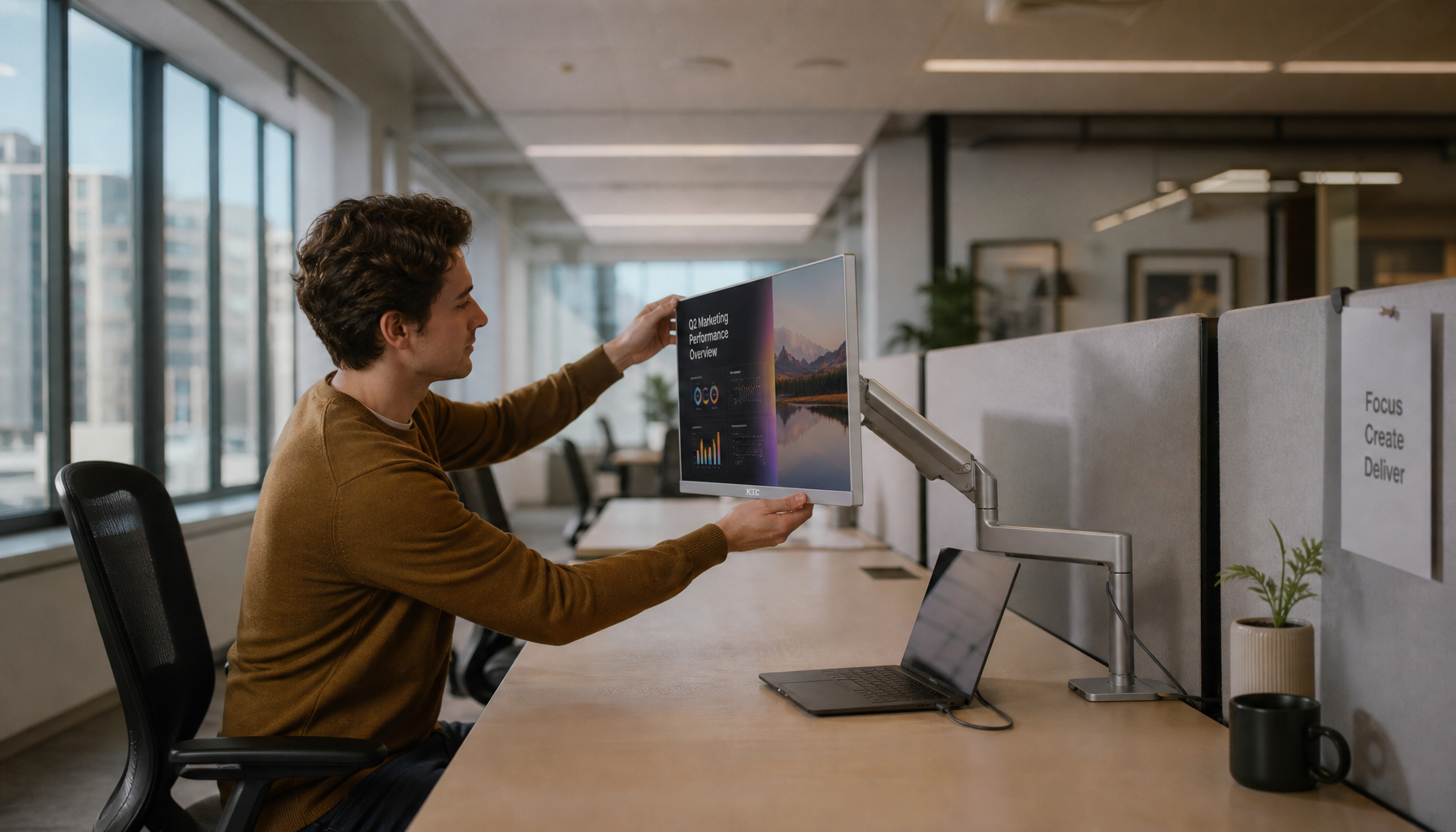
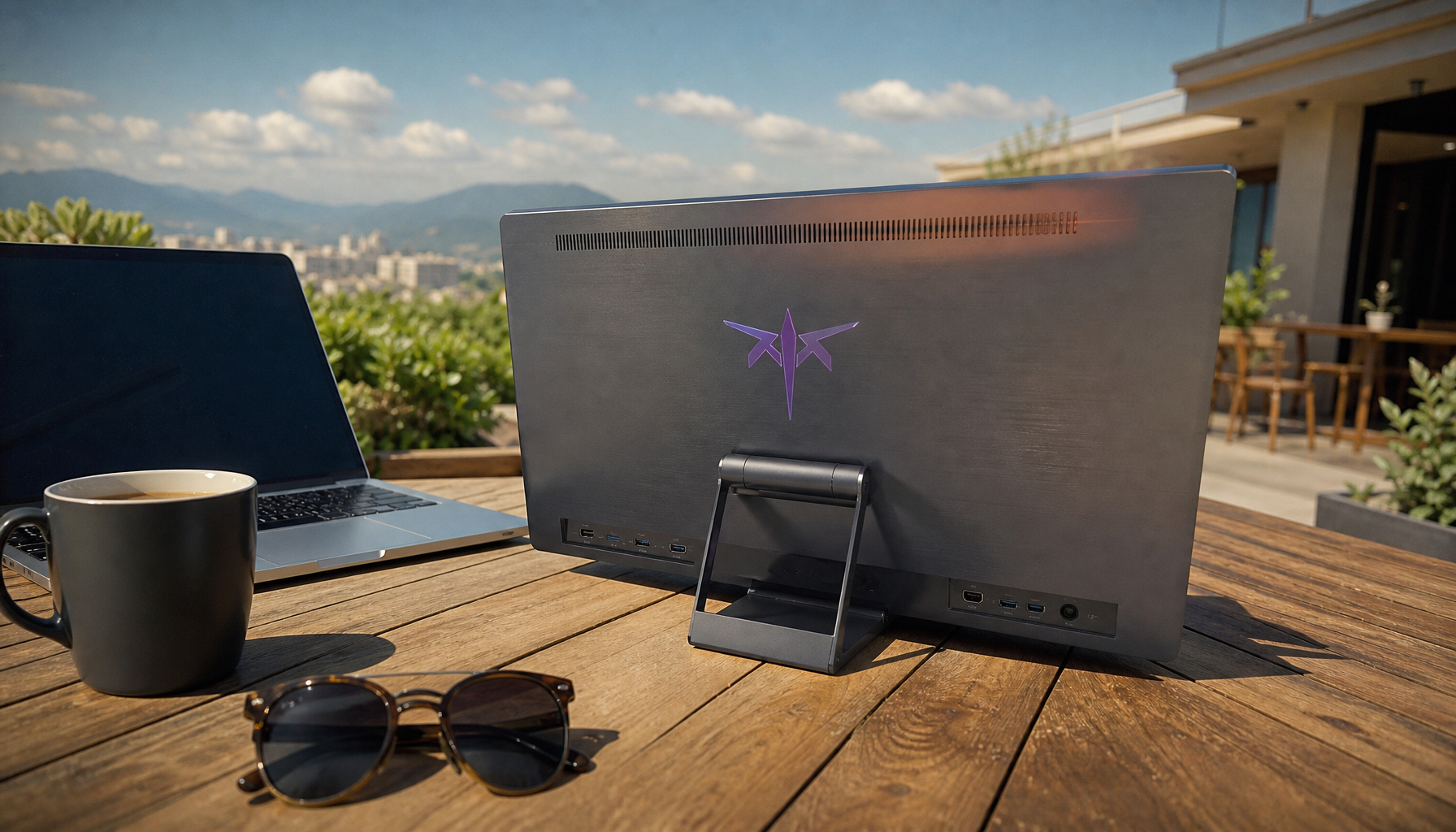
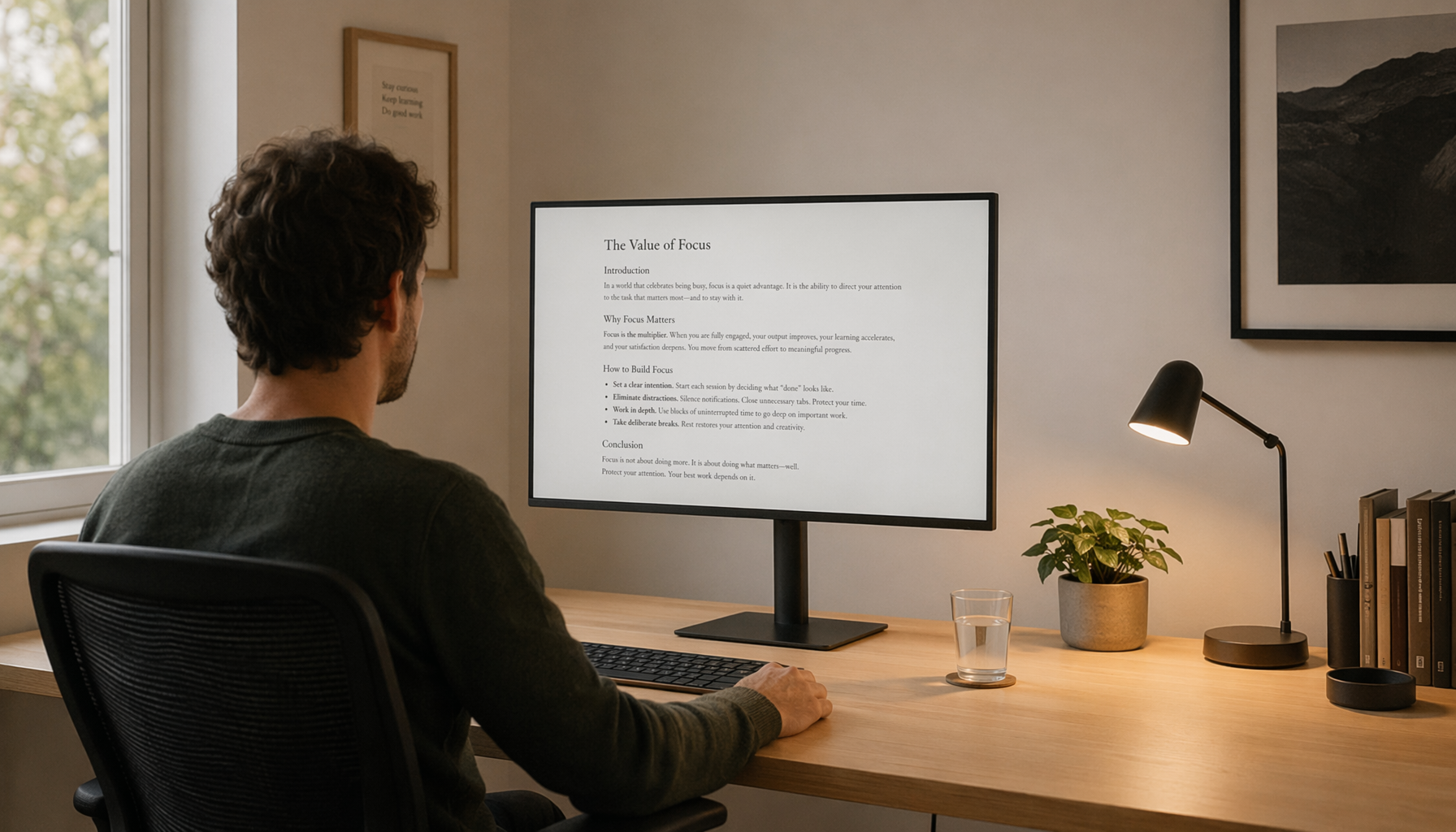
A slight upward screen angle can reduce slouching when your monitor sits too low or your eyes naturally land below the top third of the display. It works best as a fine adjustment, not as a substitute for proper height, distance, chair support, lighting, and regular movement.
Do you catch yourself folding toward the screen during a ranked match, a long spreadsheet session, or an afternoon of video calls? A simple upward tilt can make the screen easier to meet with your eyes while keeping your chest open and your head stacked over your shoulders. Here is a practical setup method for testing the angle, knowing when it helps, and avoiding monitor positions that quietly pull you forward.
The Short Answer: Tilt Helps, But Height Leads
Angling your monitor slightly upward can help if your slouching starts because the screen is too low, too flat, or hard to read from a relaxed seated position. Ergonomic monitor guidance commonly recommends keeping the top of the screen at or slightly below eye level, with the display positioned about an arm’s length away and tilted slightly backward when needed for visibility and glare control; screen angle matters because it changes whether your neck stays neutral or starts chasing the display.
The key distinction is this: upward tilt is a finishing adjustment. If the whole monitor is several inches too low, tilting it upward may make the image easier to see, but your body may still collapse forward to meet it. In hands-on desk setup work, the more reliable sequence is chair first, keyboard and mouse second, monitor height and distance third, then tilt. That order keeps the monitor from becoming a patch for a chair or desk mismatch.
What “Slightly Upward” Actually Means

For most desktop monitors, “slightly upward” means the screen face leans back so the top edge moves away from you and the lower edge sits a little closer. Several ergonomics sources describe this as a slight backward tilt, often around 10 to 20 degrees, which helps the display meet your natural downward gaze without making you lift your chin; slight backward tilt is the practical version of that advice.
The goal is not to make the screen look like a tablet lying on a desk. The goal is to reduce the temptation to crane forward. If your eyes land comfortably near the upper third of the screen while your shoulders stay relaxed, you are in the useful range. If you feel your chin floating upward or your lower back leaving the chair, the angle is working against you.
Why Slouching Happens at a Monitor

Slouching is often a response to a visual problem, not only a posture habit. When text is small, contrast is weak, glare is present, or the screen is too far away, your body moves forward to improve the image. That is why monitor distance and viewing angle are treated as core ergonomic variables: a practical starting distance is about an arm’s length, commonly around 20 to 30 inches depending on screen size, eyesight, and task detail; viewing distance can either support upright posture or invite leaning.
There is also a load problem. When your head drifts forward, your neck and upper back carry more strain than they do in a neutral position. The display does not need to be dramatically wrong to trigger that pattern; a monitor that is a little too low can encourage a rounded upper back during long gaming, coding, editing, or spreadsheet sessions.
The Best Setup for Slouchers

Start with your body instead of the screen. Sit fully back, keep your feet supported, relax your shoulders, and place your keyboard and mouse close enough that your elbows are near a right angle without reaching. University posture guidance emphasizes supported sitting, neutral arms, and monitor placement around eye level and arm’s length; monitor placement should fit that posture rather than force you to abandon it.
Once your chair and desk position are stable, bring the monitor directly in front of you. For a typical 24- to 27-inch office or gaming display, a good starting point is an arm’s length away, with the top edge at or slightly below eye level. Then tilt the screen slightly upward until the center of the screen feels easy to view through a relaxed gaze. For a 32-inch monitor or an ultrawide, you may need a deeper desk or monitor arm so the screen can sit farther back while still staying readable.
Setup Factor |
Practical Starting Point |
Slouching Signal |
Height |
Top edge at or slightly below eye level |
Chin drops, shoulders round forward |
Distance |
About arm’s length, adjusted for screen size |
You lean in to read text |
Tilt |
Slight backward tilt, often 10 to 20 degrees |
Chin lifts or glare increases |
Alignment |
Primary screen centered in front of you |
Neck turns or one shoulder creeps forward |
When Upward Tilt Works Well
A slight upward tilt works especially well when the monitor is a little below ideal height but still close to your natural line of sight. It is also useful when reflections force you to shift posture, because glare can make users unconsciously duck, lean, or twist. Workspace guidance ties poor monitor placement to chin tilting, forward bending, sideways posture, and visual symptoms such as eye irritation and headaches; incorrect monitor placement is rarely just a comfort issue.
For example, imagine a productivity setup with a 27-inch display on a fixed stand. Your eyes hit the lower half of the screen, and by late afternoon you are leaning toward the toolbar. Raising the monitor one or two inches with a stand or arm, then adding a modest upward tilt, usually works better than tilt alone. The height correction brings the screen into the right zone; the tilt refines the viewing surface.
When Upward Tilt Is the Wrong Fix
If you wear progressive lenses or bifocals, the standard “top at eye level” rule often needs adjustment. Many ergonomics sources recommend placing the monitor slightly lower and tilting it back so you can view the screen through the correct lens area without tipping your head backward. Progressive lenses change what a comfortable monitor position looks like.
Upward tilt can also backfire on low-quality panels with narrow viewing angles. Some TN-style gaming monitors lose contrast or color accuracy when viewed from above or below, so excessive tilt may make the image worse and push you back into posture compensation. IPS, OLED, and many modern VA panels are more forgiving, but the ergonomic test is still the same: can you read the screen clearly while staying relaxed against the chair?
Curved, Ultrawide, and Gaming Displays
Curved monitors can reduce some of the posture pressure created by wide flat displays because the edges sit at a more consistent viewing distance from your eyes. Research cited in monitor ergonomics discussions includes a Harvard Medical School study of 27 participants that found fewer reports of eye strain, focusing difficulty, and blurred vision on curved displays compared with flat displays; curved displays may be helpful for long sessions where peripheral viewing matters.
For gaming and immersive work, the mistake is often placing a large screen too close, then slouching to scan the minimap, timeline, or side panels. A curved 34-inch ultrawide usually feels better when it sits farther back than a 24-inch monitor, with the central active area slightly below eye level and the side edges angled naturally by the curve. You still want the primary action zone directly in front of you, not off to one side.
A Simple Five-Minute Test

Sit in your normal working posture with your back supported and your hands on the keyboard and mouse. Without stretching your neck, notice where your eyes land on the screen. If your gaze falls near the middle or lower half and your shoulders start rounding, raise the monitor slightly before increasing the tilt. If your eyes land near the upper third but glare or readability still makes you lean, add a small upward tilt and retest.
After each change, work for three to five minutes on a real task: read email, edit a document, scan a spreadsheet, or play a practice round. The correct position is the one that lets you stay back in the chair while reading comfortably. If text is still difficult, increase font scaling before pulling the monitor closer, because leaning in solves readability at the cost of posture.
Pros and Cons of Upward Monitor Tilt
Benefit |
Why It Helps |
Less forward lean |
The screen meets your gaze instead of making you chase it |
Better glare control |
A small angle change can redirect reflections |
More natural viewing |
The display can align with a relaxed downward gaze |
Useful for lower screens |
It helps when a stand has limited height adjustment |
Limitation |
What to Do Instead |
Cannot fix a screen that is too low |
Raise the monitor with an arm, riser, or better stand |
Can cause chin lift if overdone |
Reduce tilt and lower the screen for lens comfort |
May worsen image quality on narrow-viewing-angle panels |
Keep the panel more square to your eyes |
Does not replace movement |
Take short breaks and change posture regularly |
Don’t Forget Movement and Eye Recovery
Even a perfectly adjusted monitor cannot make static posture healthy all day. Small movement breaks reduce accumulated physical tension, and stretching guidance commonly recommends leaving fixed positions every 30 to 40 minutes; small movement breaks matter because your body is built for variation, not eight hours of frozen precision.
For eyes, the 20-20-20 rule remains one of the simplest habits: every 20 minutes, look about 20 feet away for 20 seconds. That pause gives your eyes a chance to refocus and can reduce the tendency to creep toward the display as fatigue builds. Pair that with brightness that matches the room, reduced glare, and readable text size, and the monitor stops becoming something your body has to fight.
FAQ
Should I tilt my monitor upward if I use a laptop?
Yes, but only after treating the laptop like a desktop. Raise the laptop screen so it supports your eye line, then use an external keyboard and mouse so your hands stay at desk height. A laptop alone usually forces a compromise between good viewing height and good typing posture.
Is a monitor arm worth it for slouching?
A monitor arm is often worth it if your current stand cannot raise, lower, tilt, or move the screen far enough back. It is especially useful for sit-stand desks, shared workstations, ultrawides, and dual-monitor setups where fixed stands make precise positioning difficult.
How do I know if my monitor is too high?
Your monitor is probably too high if you lift your chin, feel tension at the base of your neck, or notice your eyes aiming upward for normal content. A comfortable setup usually keeps the main viewing area slightly below horizontal eye level, not above it.
A slight upward monitor angle can help you stop slouching when it supports a relaxed gaze, but the winning setup is height, distance, tilt, lighting, and movement working together. Tune the display like performance gear: small adjustments, real-task testing, and no tolerance for a posture that makes your body pay for the screen.