A USB-C monitor can make a laptop work harder because one cable may carry video, charging, USB accessories, and dock traffic. HDMI usually carries only video and audio, so it often creates less heat.
Does your laptop stay quiet on HDMI, then spin up the moment you plug in a USB-C monitor or dock? In real troubleshooting, changing one variable at a time can quickly reveal whether the heat comes from charging, display bandwidth, airflow, or dock behavior. The goal is to quiet the setup without giving up the sharp, immersive screen you bought.
The Short Answer: USB-C Is Doing More Than HDMI

HDMI is usually a straightforward display connection. It sends video, often audio, and little else. USB-C can be a full workstation connection: display signal, laptop charging, USB accessories, Ethernet, storage, webcam, keyboard, mouse, and sometimes multiple monitors through a dock.
That difference matters because every extra task can add heat. When a laptop gets hotter, the fan curve reacts. A fan curve is the system’s programmed response that raises fan speed as temperature rises. So the louder fan usually does not mean USB-C is bad; it means the laptop is responding to a heavier combined workload.
A key detail is that USB-C is only a connector shape, not a guarantee that every port or cable supports the same display, charging, and data capabilities. That is why two setups that look identical on the desk can behave very differently thermally.
Why USB-C Can Make the Fan Ramp Up
USB-C May Add Charging Heat

Many USB-C monitors deliver power to the laptop while also carrying the display signal. That is convenient, but charging is not thermally free. Power conversion inside the laptop creates heat, and if the monitor or dock provides less wattage than the laptop expects, the system may juggle charging, battery use, and performance limits.
One high-performance laptop user described fan noise and battery drain while using a dock with an external display and USB-C charging, while the standard wall charger behaved better. The useful takeaway is not that one laptop model is uniquely flawed; it is that USB-C Power Delivery can change how the laptop manages power. A gaming or workstation laptop that normally ships with a large power brick may not behave the same way on an 85W or 100W dock.
Here is a simple desk test. Plug in the USB-C monitor as usual, then connect the laptop’s wall charger at the same time if your laptop supports that safely. If fan noise drops, charging load or power negotiation was likely part of the heat problem. One monitor user reported that using the laptop’s separate power supply stopped the electrical noise tied to the monitor’s USB-C power delivery connection, which reinforces the value of isolating power from display.
External Displays Can Wake the More Powerful GPU
Many laptops have both integrated graphics and a discrete GPU. The integrated GPU is efficient and fine for office work. The discrete GPU is faster and hotter. Some external monitor paths, especially high-resolution or high-refresh outputs, can cause the laptop to use the more power-hungry graphics hardware even when you are only browsing or editing documents.
This explains a frustrating symptom: GPU usage may look low, yet the laptop still runs hot. In one community report, an affected user saw fan noise and high temperature while connected to an external display, with CPU temperature reaching about 198°F and GPU utilization reportedly only 4%. The exact cause can vary, but external-monitor use can increase graphics and display-output overhead even when a simple utilization number looks harmless.
A practical example: a 4K monitor at 60Hz asks the laptop to push about four times as many pixels as 1080p at 60Hz. Move to 4K at 144Hz, and the display pipeline has to sustain far more data. Even when the desktop looks still, the laptop is scanning out frames continuously.
Some Docks Add Their Own Overhead
Not all USB-C monitor setups use the laptop’s native display output. Some docks rely on USB-based display technology that compresses and transports display data through a USB connection. That can be useful for multi-monitor office setups, but it may add CPU work, driver dependency, and wake-from-sleep quirks.
One forum user described a USB-C dock running three external 1080p monitors with occasional stutter, lag-like behavior, and disconnects. The post does not prove a universal fan-noise cause, but it highlights the real operating cost of complex USB display chains: the laptop is managing more than one clean video stream. If your fan only gets loud through a dock but not through direct USB-C or HDMI, the dock is a prime suspect.
USB-C vs HDMI: Pros and Cons for Heat, Noise, and Performance
Connection |
Strengths |
Tradeoffs |
HDMI |
Simple, widely compatible, and often cooler because it mainly carries video and audio |
May be limited by the laptop’s HDMI capabilities; older HDMI ports may cap ultrawide or high-refresh modes |
Direct USB-C DisplayPort Alt Mode |
Clean one-cable video path and often supports high resolution and refresh rate |
Can also trigger charging heat or higher GPU activity depending on laptop design |
USB-C Monitor With Power Delivery |
Best desk convenience because one cable can charge and display |
Power negotiation and charging heat can raise fan speed |
USB-C Dock |
Strong for multi-monitor productivity and peripherals |
Adds dock electronics, drivers, USB traffic, and possible CPU overhead |
The performance-driven choice is not always the newest port. It is the connection that gives your monitor the needed resolution and refresh rate while keeping the laptop inside a comfortable thermal range.
Cable and Port Limits Can Make the Laptop Work Harder
A weak USB-C cable can create flicker, blanking, lower refresh options, or unreliable charging. It can also push the setup into fallback modes that feel unstable. For a productivity display, that may look like 4K stuck at 30Hz. For a gaming monitor, it may mean 144Hz or 240Hz options disappear.
USB-C display output usually depends on DisplayPort Alternate Mode, USB4, or a similar display-capable implementation. If the laptop’s USB-C port is data-only, a USB-C monitor may not work at all. If the cable is charge-only or low bandwidth, the monitor may connect but behave poorly. A cable with a high wattage rating is not automatically a good display cable, because power rating and video bandwidth are separate capabilities.
For high-performance screens, use a short, certified USB4 or full-featured USB-C cable that explicitly supports video. If your setup includes a dock, test the monitor directly from the laptop first. That single comparison often separates a laptop thermal issue from a dock or cable issue.
Clamshell Mode Can Trap Heat

Lid-closed use looks clean, especially with a large external display, keyboard, and mouse. The problem is that some laptops dissipate heat partly through the keyboard deck or rely on intake and exhaust paths that work better with the lid open. Closing the laptop can change airflow and increase surface temperature.
Community users have discussed fan ramping almost immediately after connecting an external monitor, with lid-open use making idle heat and fan noise slightly better for one user. That does not mean every laptop must stay open, but it is a fast diagnostic step. If your laptop gets quieter with the lid open and raised on a stand, airflow is part of the answer.
Fan noise itself is also shaped by obstruction. Airflow obstructions create turbulence and can make a cooling system sound louder than the heat level alone would suggest. A laptop pushed against a monitor stand, wall, notebook pile, or soft desk mat may sound worse because the fan is fighting its environment.
Why the Same Monitor Feels Fine on HDMI
HDMI may be quieter because it avoids several USB-C side effects. It usually does not charge the laptop. It often bypasses USB hub traffic. It may avoid dock drivers. It may also run at a lower refresh rate or color format without you noticing right away.
That last point matters. If HDMI is running your ultrawide at 40Hz or your 4K screen at 30Hz, it can feel cooler because it is delivering a lighter signal. The tradeoff is reduced smoothness, worse mouse motion, and less responsive gaming. Motion clarity is heavily tied to refresh rate; sample-and-hold displays show about 16.67 ms frame persistence at 60Hz, about 8.33 ms at 120Hz, and about 4.16 ms at 240Hz. Lower refresh can reduce load, but it also leaves performance on the table.
For office work, HDMI at 60Hz may be perfectly acceptable. For esports, creative timelines, or high-refresh ultrawide productivity, the USB-C or DisplayPort path may be worth tuning rather than abandoning.
A Practical Troubleshooting Sequence
Start by comparing like with like. Set USB-C and HDMI to the same resolution, refresh rate, brightness, HDR state, and scaling if possible. If USB-C is running 4K 144Hz with HDR while HDMI is running 4K 60Hz without HDR, the fan comparison is not fair.
Next, separate display from charging. Use the USB-C monitor for video but connect the laptop’s wall charger if your device supports that setup. If the fan quiets down, the USB-C Power Delivery path is contributing heat or power-management stress.
Then bypass the dock. Connect the monitor directly to the laptop with a certified short cable. If the fan improves, the dock may be adding CPU overhead, power negotiation issues, or USB device load. If nothing changes, the laptop’s own display pipeline or GPU behavior is more likely.
After that, test lid position and airflow. Run the same workload with the lid open, the laptop on a hard stand, and vents unobstructed. A temperature drop of even a few degrees can keep the fan below an annoying step in the fan curve.
Finally, check software load. Use Task Manager on Windows or Activity Monitor on macOS to look for high CPU, browser, video, sync, or indexing activity right after connecting the monitor. External display use can trigger background behavior that looks unrelated until you catch it in the process list.
Settings That Often Reduce Fan Noise Without Ruining the Screen

For a gaming monitor, try stepping down from 240Hz to 144Hz during office work, then switch back for competitive play. The desktop will still feel fluid, but the display pipeline may run cooler. For a 4K productivity display, test SDR instead of HDR when writing, browsing, or using spreadsheets. HDR and high brightness can raise monitor heat, and high-end displays with active cooling may become louder under heavy brightness or refresh demands.
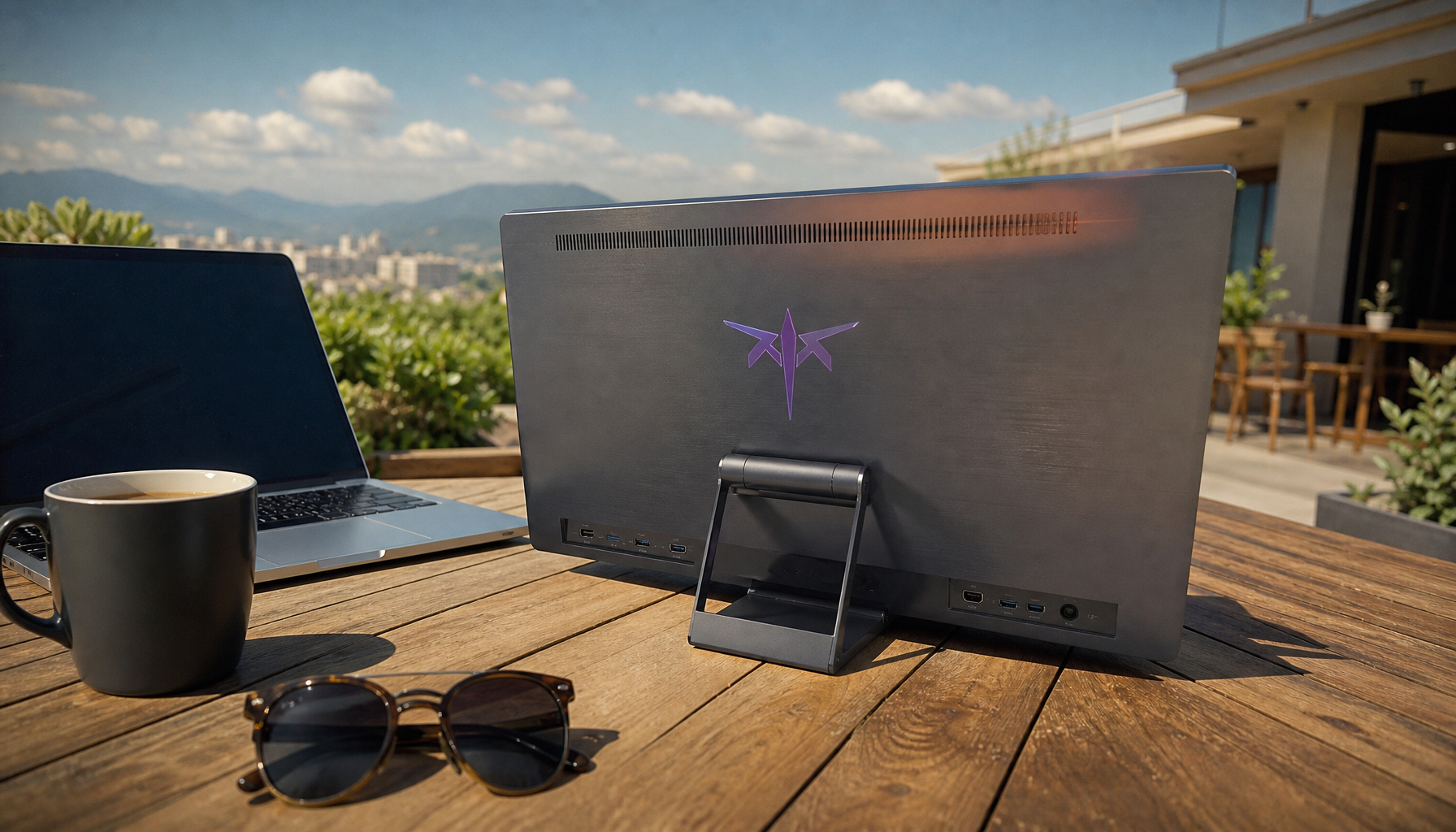
Monitor-side fan noise is a separate possibility. Most office monitors are fanless, but some OLED, mini-LED, HDR, and elite gaming displays use active cooling. High brightness and high refresh rates can increase thermal demand inside the display itself. If the sound comes from behind the panel rather than the laptop keyboard deck, lower brightness, disable peak HDR modes, and move the monitor away from walls or shelves to improve airflow.
For laptops, balanced power mode is often the best daily setting. It keeps the machine responsive while avoiding unnecessary boost behavior during low-value tasks. On some systems, enabling automatic graphics switching or low-power mode during office hours can also help, especially when the external display does not need maximum refresh.
When Loud Fans Are Normal and When They Are a Warning
A smooth rush of air during gaming, rendering, or running a 4K multi-monitor desk is usually normal. A sudden grinding, rattling, buzzing, or sharp pitch change is different. That can point to dust, bearing wear, vibration, coil noise, or a hardware problem.
Heat deserves attention if the laptop becomes uncomfortable to touch, performance drops, the battery drains while charging, or the fan runs near maximum at idle. One discussion around a 16-inch laptop and external 4K monitor reported fan speeds around 5,800 RPM, about 45 dB, and temperatures around 167°F during external-display use. Those figures are not a universal danger line, but they show why users reasonably worry when an external monitor turns a quiet laptop into a hot desk machine.
The best display setup should feel fast, clear, and controlled. If USB-C gives you the sharpest image and cleanest desk, keep it, but tune the power path, cable, dock, refresh rate, and airflow. If HDMI delivers the same visual result with less heat, it is the smarter daily connection. The right answer is the one that protects performance without making your workspace sound like a stress test.