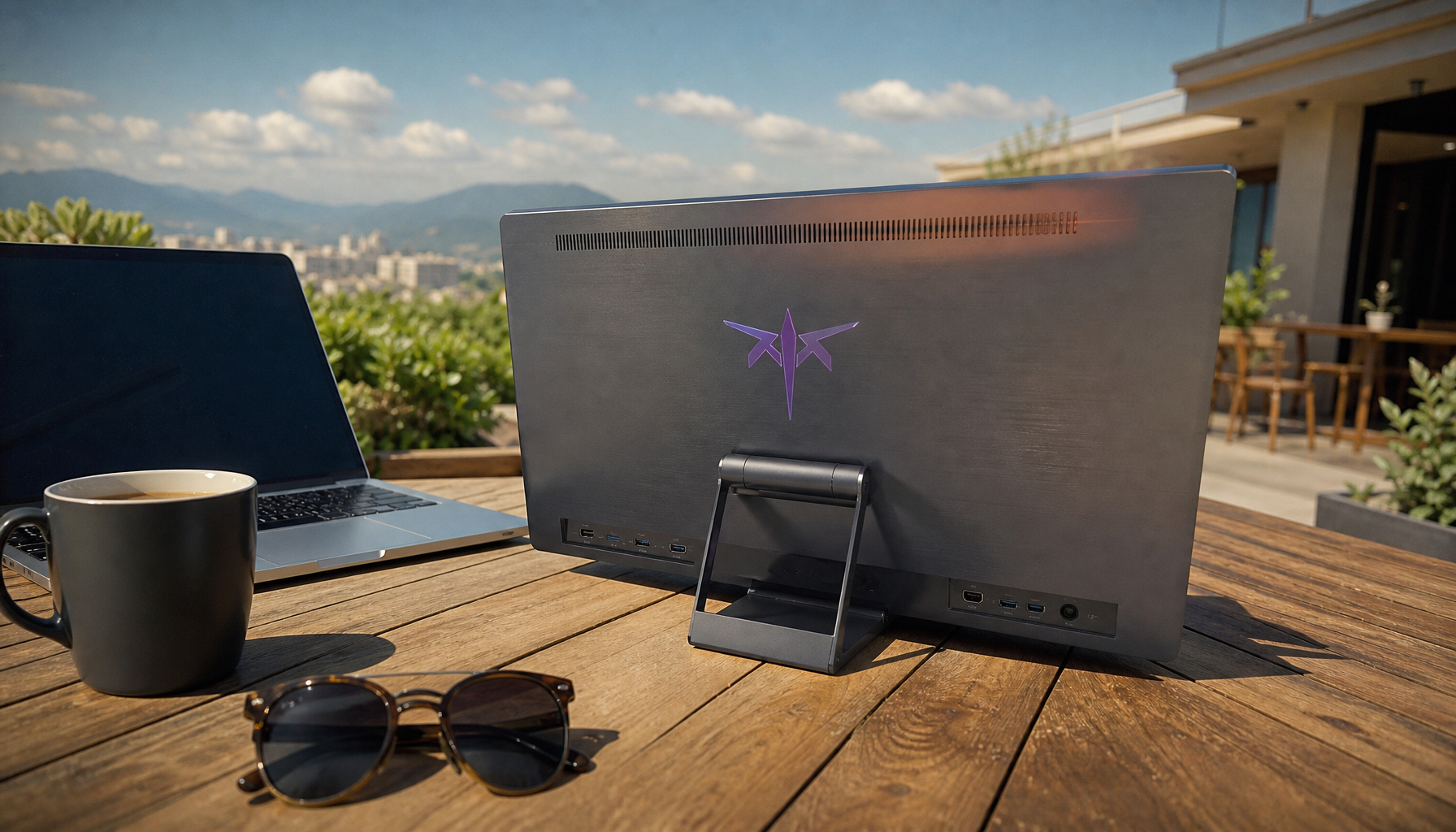
Use the Thunderbolt port first for the most reliable single-cable setup for video, charging, and peripherals. Use the regular USB-C port only after confirming it supports DisplayPort Alt Mode and enough Power Delivery for your laptop.
Is your laptop showing “display connection may be limited,” or does the monitor charge your laptop but refuse to show a picture? A quick port-and-cable check can usually separate a bad setup from a simple compatibility mismatch before you buy another adapter. Here is how to connect the monitor correctly, choose the right port, and avoid the most common USB-C and Thunderbolt traps.
USB-C and Thunderbolt Are Not the Same Thing
The confusing part is physical: both ports may look identical. USB-C describes the small reversible connector, while Thunderbolt describes a higher-performance standard that can use that same connector. That means a cable can fit perfectly and still fail to carry video, charge at full speed, or support a monitor hub.

A standard USB-C monitor connection usually depends on DisplayPort Alternate Mode, often shortened to DisplayPort Alt Mode. This feature lets a USB-C port carry a display signal like a DisplayPort cable. USB-C monitors can act as a display input, USB hub, and charging dock, but buyers need to check laptop and monitor specs because USB-C bandwidth can limit resolution, refresh rate, or simultaneous USB data performance.
Thunderbolt is more predictable. Thunderbolt 3 and Thunderbolt 4 can provide up to 40 Gbps of bidirectional bandwidth, while USB-C speeds vary by implementation. In plain terms, Thunderbolt gives you a better shot at one cable doing everything well: display, charging, USB hub, external storage, Ethernet through a dock, and sometimes multiple monitors.
Which Port Should You Use First?
If your laptop has both a plain USB-C port and a Thunderbolt port, plug the USB-C monitor into the Thunderbolt port first. Thunderbolt ports are generally backward compatible with USB-C devices, so a USB-C monitor should work through Thunderbolt as long as the monitor, cable, and laptop settings are sound.

That does not mean the regular USB-C port is useless. For a single 1080p or 1440p office monitor, a USB-C port with DisplayPort Alt Mode and 65W Power Delivery can be excellent. USB-C monitors can support cleaner workspaces because video, data, and device charging can pass through one cable, with model-dependent charging from low wattage up to 90W in listed productivity lines.
The difference becomes obvious in demanding setups. A 27-inch 1440p 100Hz USB-C monitor with 65W charging is a practical fit for a thin productivity laptop. A 34-inch ultrawide at 144Hz, a 4K creative display, or a docked workstation with storage and Ethernet benefits more from Thunderbolt because the bandwidth headroom reduces compromises.
Check These Specs Before Connecting
Confirm DisplayPort Alt Mode
The most important laptop-side question is whether the USB-C port supports video output. A common failure pattern is simple: HDMI is already used for one external monitor, a USB-C hub is added for a second HDMI screen, and the operating system reports that the display connection may be limited. The likely cause is frustrating but common: not every USB-C port carries video.
A passive USB-C-to-HDMI adapter or hub cannot create a video signal if the laptop’s USB-C port does not support DisplayPort Alt Mode, Thunderbolt, or another video-capable standard. In that case, the adapter may power on, USB devices may work, and the display may still stay blank.
Match Power Delivery to Your Laptop
Power Delivery is the charging side of the single-cable promise. A monitor with 65W Power Delivery may be enough for many slim laptops, but a performance laptop may slowly drain under load if it expects 90W, 100W, or more. Many USB-C monitors commonly provide 65W to 90W, while some premium models go higher.
A simple real-world check helps: if your laptop’s original charger is 65W and your monitor provides 65W, the setup should be reasonable for office work. If your laptop shipped with a 140W or 180W adapter, a 65W monitor can still display video, but it may not keep the battery full during gaming, rendering, or heavy multitasking.
Use the Right Cable
The cable matters as much as the port. A charge-only USB-C cable may power a device but carry no video. A basic USB-C cable may support video but not the full refresh rate, hub speed, or charging level. For Thunderbolt performance, use certified Thunderbolt cables because ordinary USB-C cables may not support full 40 Gbps behavior, high-resolution display output, or complete feature compatibility.

For a desk setup, use the cable that came with the monitor first. If you need a replacement, buy a cable explicitly rated for USB-C video or Thunderbolt, with the charging wattage your laptop requires.
Practical Setup for Common Laptop Operating Systems
Start with the laptop powered on and the monitor plugged into wall power. Connect the monitor’s upstream USB-C port to the laptop’s Thunderbolt port using the monitor’s included USB-C cable. Then set the monitor’s input to USB-C, because many displays do not automatically switch inputs when HDMI or DisplayPort devices are also connected.
In display settings, choose whether to extend or duplicate the desktop. If the screen is detected but looks blurry, check resolution and refresh rate. A 27-inch 1440p display should usually run at 2560 x 1440, while a 4K display should run at 3840 x 2160. For gaming monitors, also check advanced display settings so a 144Hz or 165Hz panel is not stuck at 60Hz.
On laptops with Thunderbolt-focused display settings, confirm arrangement, scaling, and refresh rate. Thunderbolt-equipped laptops often handle USB-C monitors cleanly, but multi-display behavior can vary by model. Thunderbolt is generally better suited for professional multi-display workflows because it has more predictable bandwidth and daisy-chain behavior, while regular USB-C depends more heavily on DisplayPort Alt Mode and monitor support.
USB-C Monitor vs Thunderbolt Monitor
Setup Choice |
Best For |
Main Advantage |
Main Tradeoff |
USB-C monitor on USB-C port |
Everyday office work, portable screens, single-monitor setups |
Lower cost and cleaner cable management |
Port must support DisplayPort Alt Mode |
USB-C monitor on Thunderbolt port |
Most laptop users with both port types |
Better compatibility headroom for one-cable use |
Uses your highest-value port |
Thunderbolt monitor on Thunderbolt port |
Pro workflows, docks, multiple displays, fast storage |
Highest bandwidth and strongest docking potential |
Usually more expensive |
USB graphics adapter |
Laptops without USB-C video output |
Can add a display over regular USB with drivers |
Not ideal for gaming or color-critical motion work |
When Gaming Changes the Decision
For gaming, USB-C is convenient, but performance still comes from resolution, refresh rate, adaptive sync, and GPU horsepower. Choose by resolution and aspect ratio first, then verify refresh rate, USB-C charging wattage, VRR support, panel behavior, ergonomics, and extras like KVM.

A 1440p 144Hz or 165Hz monitor is often the performance sweet spot for laptop gaming because it is sharper than 1080p without demanding as much GPU power as 4K. Ultra-high refresh displays only pay off when the CPU and GPU can actually push frame rates near the monitor’s ceiling, so a 500Hz esports screen is wasted on hardware that rarely clears 160 fps.
USB-C gaming monitors also carry tradeoffs. USB-C is useful for fewer cables and easier laptop integration, but USB-C models may cost more, and not every cable or device supports the same functions. For a gaming laptop, keep the original power brick nearby if the monitor’s USB-C charging is below the laptop’s full power requirement.
When Office Productivity Changes the Decision
For office work, the best USB-C monitor is often the one that behaves like a compact dock. A good setup lets you plug your keyboard, mouse, webcam, headset, and Ethernet into the monitor, then connect the laptop with one cable. Productivity models with USB-C or Thunderbolt, webcams, microphones, USB hubs, and Ethernet can reduce daily friction more than a flashy spec sheet.

A practical example is a home-office laptop used at a desk and on the couch. With a USB-C monitor that provides 65W charging and a USB hub, you can leave the power adapter in your bag and connect everything through one cable. If your laptop needs more power or you run dual high-resolution monitors, Thunderbolt becomes the cleaner long-term choice.
When Portable Screens Change the Decision
Portable USB-C monitors are the easiest case when the laptop port supports video and power. A 15.6-inch 1080p portable display can often run from a single USB-C connection, making it useful for travel, presentations, and compact gaming setups. A typical 15.6-inch Full HD IPS portable monitor with USB-C and HDMI offers flexible inputs, a slim design, and simple laptop compatibility when the source port supports video.
The catch is power. Some portable displays draw power from the laptop, which shortens battery life. If the monitor supports separate power input, use it for longer sessions, especially during gaming or video calls.
Troubleshooting a USB-C Monitor That Does Not Work
If the screen stays black, first move the cable from the regular USB-C port to the Thunderbolt port. If it works there, the original USB-C port may lack video output or may have lower bandwidth. If neither port works, try the original monitor cable, set the monitor input manually to USB-C, and test a direct connection with no hub.
If the operating system shows “display connection may be limited,” treat that as a compatibility clue rather than a random warning. It usually points to a missing video-capable port, an underpowered hub, a cable that cannot carry display data, or a monitor input mode issue. If the laptop’s USB-C port does not support video at all, a USB graphics adapter can be a workaround for office screens, but it requires drivers and is not the first choice for gaming, fast motion, or color-critical work.
FAQ
Can I plug a USB-C monitor into a Thunderbolt port?
Yes. A Thunderbolt port that uses the USB-C connector is generally backward compatible with USB-C monitors. The monitor’s resolution, refresh rate, charging, and hub features still depend on the monitor, cable, and laptop implementation.
Should I buy a Thunderbolt monitor instead of a USB-C monitor?
Buy Thunderbolt if you need high-bandwidth docking, multiple high-resolution displays, fast external storage, or a premium workstation setup. Buy USB-C if you mainly want one clean cable for a single monitor, laptop charging, and basic peripherals.
Why does charging work but video does not?
Because USB-C features are independent. A port or cable may support power but not DisplayPort Alt Mode. That is why the connector shape alone is never enough proof of display compatibility.
The Cleanest Setup
Use the Thunderbolt port first, pair it with a certified or monitor-supplied cable, and verify DisplayPort Alt Mode plus Power Delivery before blaming the display. A USB-C monitor can turn a laptop into a sharp, uncluttered workstation or gaming station, but only when the port, cable, wattage, and refresh-rate target are all aligned.