Yes, but the experience depends on the smart monitor’s operating system, app support, browser quality, and input options. For serious document work, a smart monitor can handle light writing and cloud editing, while a PC, laptop, tablet, or remote desktop remains more reliable for complex formatting and file-heavy workflows.
Tired of powering up a laptop just to edit a resume, clean up meeting notes, or finish a shared document on the big screen? With the right smart monitor, keyboard, and cloud workflow, you can turn a display into a lean writing station without building a full desk setup. Here is how to tell when PC-free productivity works, where it breaks down, and what setup gives you the least friction.
What “Running Word Processors on a Smart Monitor” Really Means
A word processor is software used to create, edit, format, save, and print text documents. That definition matters because “running a word processor” can mean several different things on a smart monitor: opening a browser-based document editor, installing an official app, accessing a remote PC, or mirroring a phone or laptop.
A smart monitor is not automatically a full computer. It is usually a display with Wi-Fi, speakers, a remote, streaming apps, and some PC-free features. Some models add web browsers, office app shortcuts, remote access, cloud workspace portals, or casting. That can be enough for drafting, reviewing, and light editing, but it does not guarantee desktop-level app freedom.
The Short Answer: Yes, for Light Productivity; Maybe, for Full Office Work
If your goal is to write plain text, edit a shared cloud document, review a PDF, update a simple spreadsheet, or type meeting notes, a smart monitor can be practical without a PC. The most reliable setup is a smart monitor with a decent browser, official productivity app support, wireless keyboard and mouse compatibility, and cloud storage access.
If your goal is legal formatting, advanced templates, tracked changes across large documents, macros, offline file management, or precise export control, the smart monitor is more of a convenience layer than a primary workstation. Mobile writing workflows show the same pattern: simple apps work well for drafts, while fuller document tools are better when formatting and export options matter, as shown in mobile word-processing comparisons.
Task |
PC-Free Smart Monitor Fit |
Best Practical Route |
Drafting notes or short documents |
Strong |
Browser editor or built-in notes app |
Editing cloud documents |
Good if browser is stable |
Web app plus keyboard and mouse |
Formatting resumes, reports, or proposals |
Mixed |
Cloud editor for light work, PC for final polish |
Track changes, comments, templates, macros |
Weak to mixed |
Remote PC or laptop connection |
Offline writing with local file control |
Weak |
Tablet, laptop, mini PC, or external device |
The Three Ways Smart Monitors Handle Productivity Apps

Browser-Based Apps
The cleanest PC-free method is using the smart monitor’s web browser to open cloud document editors, web-based office suites, collaborative workspaces, or email-based document systems. This works best when your files already live in the cloud and your editing needs are straightforward.
The catch is browser quality. Some smart monitor browsers are designed for casual web access, not heavy office sessions with multiple tabs, extensions, document uploads, and large files. If the browser refreshes aggressively, lacks download controls, or struggles with keyboard shortcuts, it can turn a quick edit into a stop-start session.
Official App Store Apps
Some smart monitors offer productivity apps through a built-in app store. This is more convenient than browser work when the app is optimized for the platform, but app availability is not universal. It can depend on the monitor maker, region, operating system, firmware version, account restrictions, and whether the app developer has certified that exact platform.
This is where buyers often overestimate “smart.” A monitor may share an ecosystem with smart TVs or TV-style operating systems, but that does not mean every app will install or behave the same way. Before buying, write down the exact three apps you need, then confirm support on the exact monitor model, not just the product family.
Remote PC, Casting, and External Devices
Remote access is the performance-driven workaround. If the smart monitor supports remote PC features, cloud desktops, or screen mirroring, you can use the monitor as the front end while the real computing happens somewhere else. That gives you better compatibility for full desktop word processors, desktop browsers, file systems, and company software.
Casting from a phone or tablet can work for reviewing documents, but it is weaker for long writing sessions unless keyboard and pointer input are handled cleanly. A small mini PC, laptop dock, tablet, or streaming-style productivity device often gives better long-term flexibility than relying only on the monitor’s app store.
What You Need for a Usable PC-Free Writing Setup

The first requirement is a real keyboard and pointing device. Touch remotes and on-screen keyboards are fine for passwords, not paragraphs. Accessibility-focused tablet testing found that a student typing about 90 words per minute needed a wireless keyboard to make word processing practical, and document tools became more useful when formatting and export mattered through screen-reader-compatible workflows.
The second requirement is cloud storage discipline. PC-free monitors are strongest when files live in cloud storage or a workplace portal. If you depend on USB drives, local folders, custom fonts, or desktop-only templates, test those paths before trusting the setup for real work.
The third requirement is screen quality. Productivity is not only about whether an app opens; it is also about whether text is comfortable for hours. Home-office testing emphasizes sharp text, ergonomic stands, USB-C connectivity, laptop charging, and usable image quality as core work-display traits in home office monitors.
Display Specs Still Matter, Even Without a PC

A smart monitor that runs apps poorly is frustrating, but a smart monitor with weak text clarity is worse. For document work, 1080p can be acceptable at smaller sizes, 1440p is a strong everyday baseline, and 4K is noticeably cleaner for dense text, spreadsheets, and side-by-side reference windows. On a 27-inch display, 4K gives crisp letterforms that reduce squinting when you are editing paragraphs or comparing two documents.
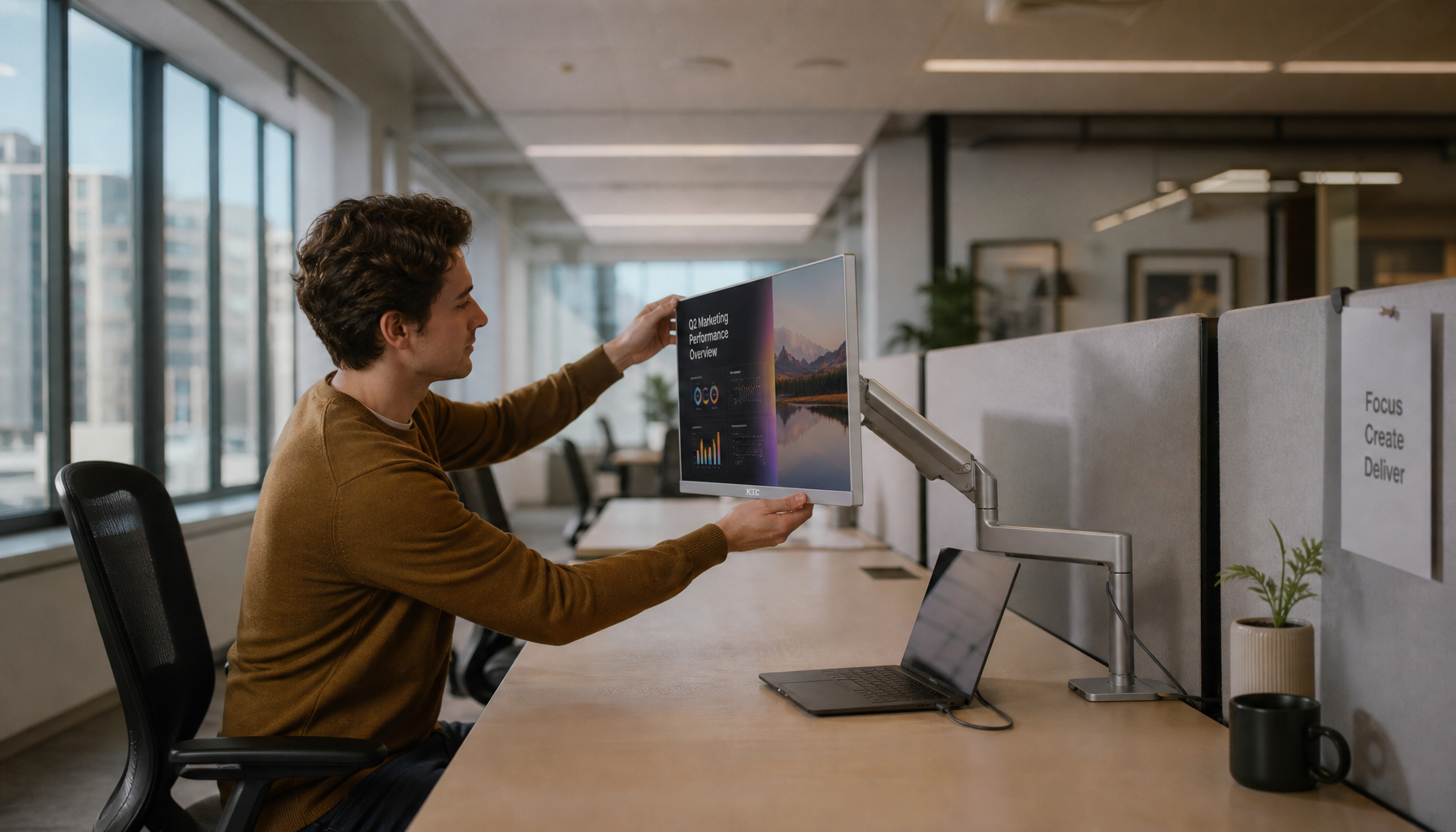
Ergonomics matter just as much. If the monitor is used for most of your work, place it directly in front of you, keep it about an arm’s length away, and set the top of the screen at or slightly below eye level. KTC’s monitor setup guidance puts typical viewing distance around 20 to 28 inches and recommends matching display arrangement to the physical desk layout for consistent workflows through specific monitor assignment.
Pros of Using a Smart Monitor Without a PC
The biggest benefit is simplicity. You can sit down, wake the display, open a cloud document, and start typing without a laptop fan, dock, charger, or cable chain. For shared spaces, dorm rooms, kitchen counters, reception desks, and lightweight home offices, that lower setup friction has real value.
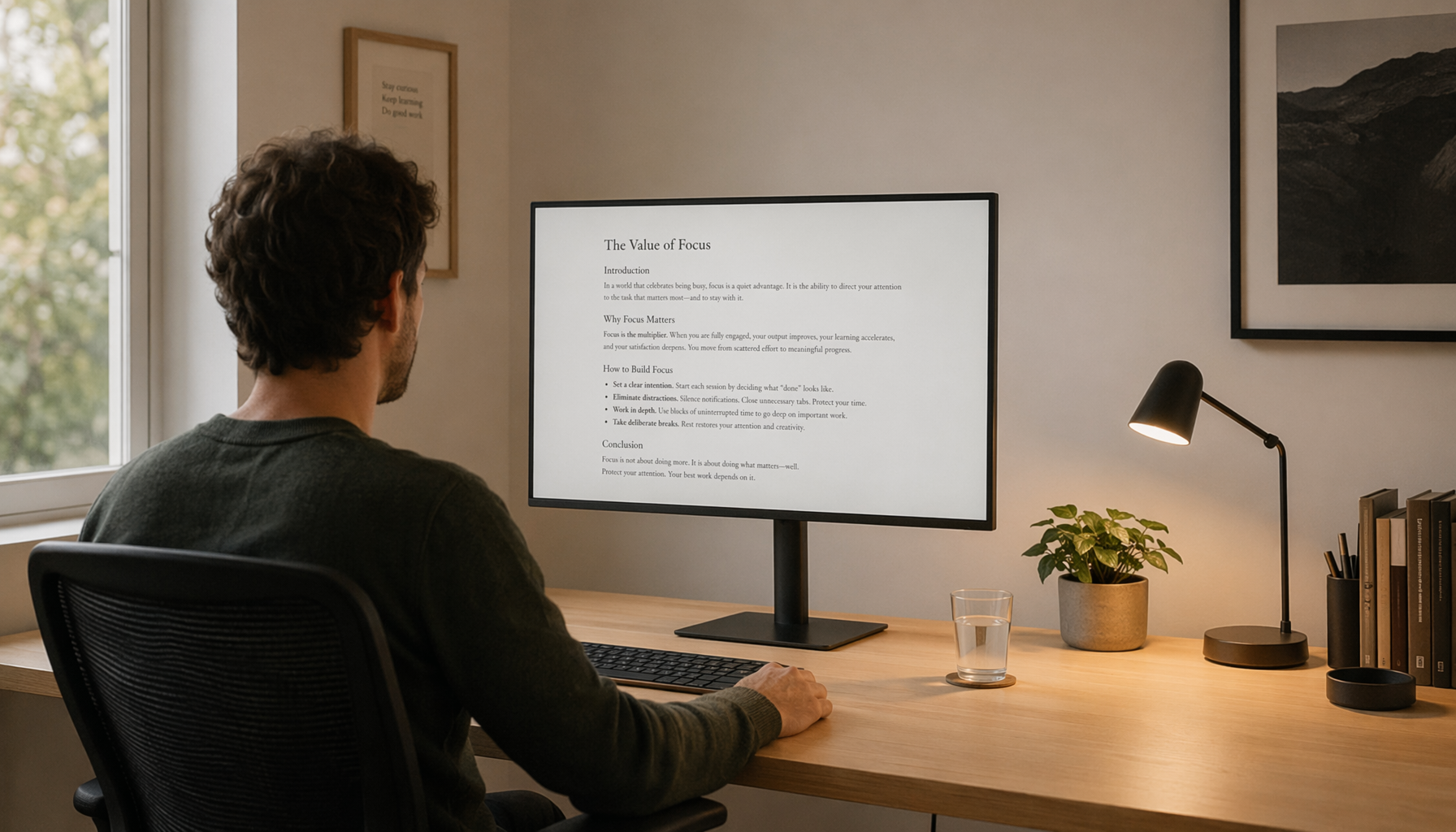
A second advantage is focus. A smart monitor with only a few work apps can become a low-distraction writing station. Mobile productivity research often points to intentional app placement and reduced app switching as a practical way to avoid attention traps, and the same idea applies here: fewer tools can mean fewer detours.
A third advantage is cost control. If you already need a monitor for streaming, console gaming, or occasional office work, smart features may reduce the need for a secondary device. The value case is strongest when your workload is browser-first and cloud-first.
Cons and Limits You Should Not Ignore
The biggest drawback is app uncertainty. A laptop can install a huge range of desktop software; a smart monitor may only support approved apps. Unofficial sideloading, when possible, is rarely something to build a work routine around because updates, account restrictions, and platform changes can break it.
The second drawback is reduced document control. Advanced formatting, comments, tracked changes, offline editing, file conversion, font handling, and template fidelity may be weaker than on a desktop-class word processor. Mobile writing tools show this split clearly: simple apps are useful for drafts, while more complete tools are needed for formatted documents and dependable export paths.
The third drawback is performance. Large documents, many browser tabs, video calls plus document editing, and heavy web apps can expose the limits of a monitor’s processor and memory. If your workday includes a document editor, spreadsheet, email, chat, calendar, and browser research at the same time, a smart monitor alone may feel boxed in.
Buying Advice: Choose the Panel First, Then the Smart Layer

Do not buy a smart monitor only because it has an app store. Buy it because it is a good monitor that also has useful smart features. For productivity, prioritize readable resolution, comfortable size, matte or low-glare behavior, height adjustment, USB-C, wireless input support, and enough ports for a fallback device.
For a compact desk, a 24-inch 1080p or 27-inch 1440p display can be enough for writing and email. For heavier multitasking, a 27-inch 4K screen or a 34-inch ultrawide gives you more room for a document, browser, and reference material without constant window switching. If the monitor will also serve gaming or media, then refresh rate, response time, HDR behavior, and input switching become more important.
The practical rule is simple: if your must-have apps are cloud-based and officially supported, a smart monitor can be a clean PC-free productivity station. If your app needs are specific, regulated, file-heavy, or desktop-only, buy the better panel and plan for a laptop, mini PC, tablet, or remote desktop connection.
FAQ
Can I use a full word processor on a smart monitor without a PC?
Sometimes. If the monitor’s browser supports web-based office apps well, you can edit documents online. A native app is less certain and depends on the monitor platform. For full desktop features, use remote PC access or connect a computer.
Can I use a cloud document editor on a smart monitor?
Usually, if the built-in browser is capable and your keyboard and mouse work properly. Test copy, paste, file upload, comments, and export before relying on it for important documents.
Do I need a keyboard and mouse?
For real productivity, yes. A remote control is not a writing tool. A wireless keyboard and mouse turn the smart monitor from a media display into a usable document station.
Is a smart monitor better than a laptop for office work?
Not for full office work. It can be better for quick cloud edits, shared-space writing, and distraction-light drafting. A laptop is still better for complex files, multitasking, offline access, and app compatibility.
A smart monitor can run productivity workflows without a PC when the job is cloud-first, keyboard-driven, and light enough for the platform. Treat the smart layer as a fast-access workspace, not a guaranteed desktop replacement, and you will know exactly when it is enough and when to bring in real computing power.