




On large curved monitors, a 1000R panel usually keeps edge text at a more similar angle and distance for a close, centered viewer, while an 1800R panel often feels flatter and more natural for mixed office work. Neither curve magically sharpens text; the real difference is how your eyes meet the screen at the far left and right edges.
If the outer columns of a spreadsheet, the sidebars in a code editor, or the minimap in a game feel slightly less comfortable than the center of the screen, the curve may be part of the reason. This shows up fastest on ultrawide and high-refresh-rate monitors used up close, especially when you split the screen into multiple windows. The breakdown below will help you decide when 1000R is worth it, when 1800R is easier to live with, and which other specs matter more than curve radius.

1000R and 1800R Change Screen Geometry, Not Font Quality
Radius and your seating position
A 1000R curve is tighter than 1800R, which means the screen wraps more around a viewer sitting close and centered. A brand’s buying guidance also ties curve radius to ideal seating distance, so 1000R aligns with roughly 3.3 ft and 1800R with roughly 5.9 ft.
On a wide desktop monitor, that geometry matters because the left and right edges are no longer as far from your eyes as they would be on a flatter display. A curved monitor’s more constant viewing distance is one reason buyers often describe edge content as more comfortable on curved ultrawides than on similarly sized flat panels.
Why ultrawides make the issue easier to notice
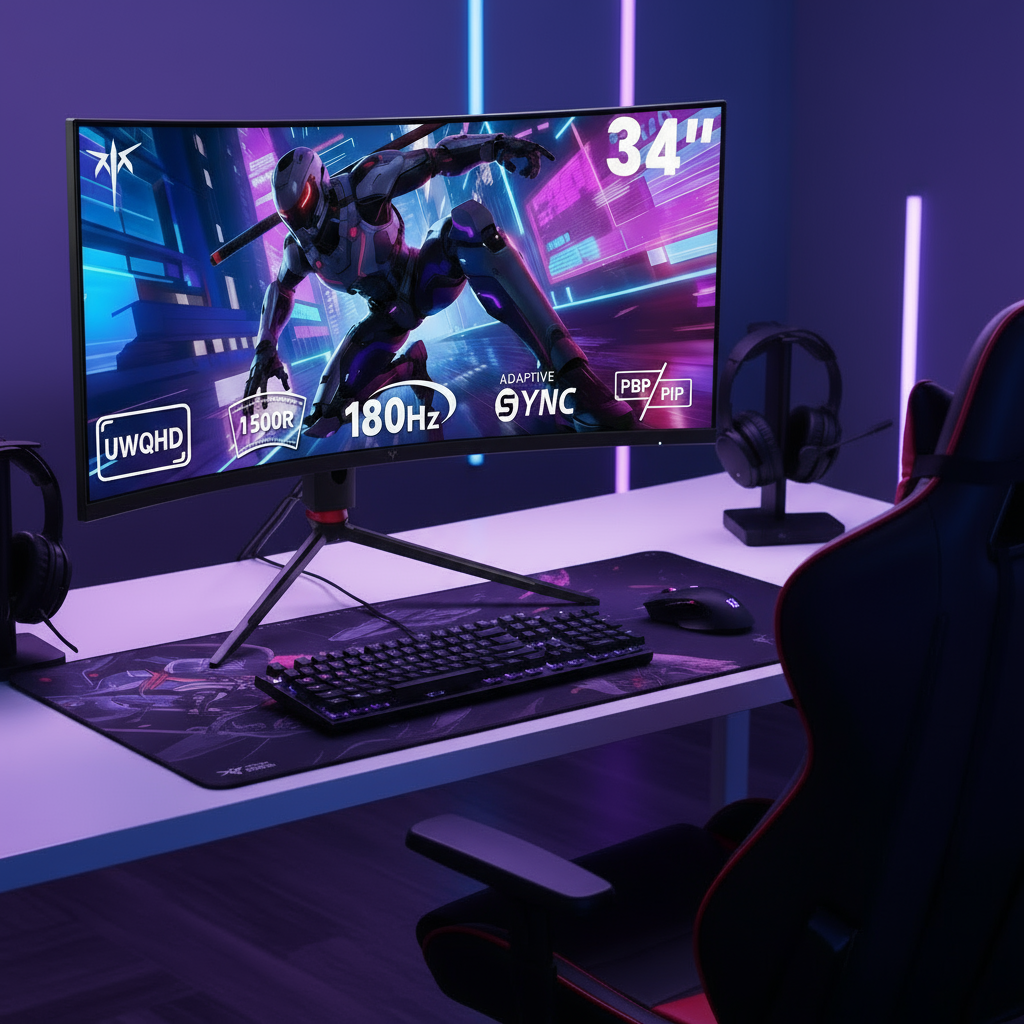
A platform discussion frames the problem in practical terms: if you sit close enough for the curve to matter, the curve can reduce edge and corner distortion compared with a flat screen. That is exactly the situation many buyers create with 34-inch, 38-inch, 45-inch, and even 57-inch ultrawides parked at normal desk depth.
The current curved monitor field is full of large desktop displays built for that close-up use, from productivity models like a 45-inch monitor from a brand to gaming-focused ultrawides and super-ultrawides. The wider the screen, the more likely you are to notice whether edge text feels equally easy to read.
Why Edge Text Can Look Different Even at the Same Resolution
Viewing angle changes across the screen
The best simple explanation is angular, not magical: on a flat display, equal chunks of your field of view can cover more pixels at the edges than in the center. From the sweet spot of a curved monitor, each pixel can occupy a more similar angular width, so letters and interface elements at the edges can feel more proportionate.
That does not mean the monitor is creating better text. A curved screen does not change intrinsic text clarity; it changes how the page, window, or HUD meets your eyes. For reading-heavy work, people often interpret that geometry shift as “clearer” or “stranger” depending on whether they value edge uniformity or straight-looking page layouts.
Your brain also notices layout shape
A brand curved-monitor explanation points out that straight lines on webpages and documents can appear curved on a curved display. If you spend all day in spreadsheets, browser tabs, PDFs, or code editors, that can matter as much as raw sharpness because the page itself may feel slightly bowed near the edges.
The same platform answer also notes that the difference is often hard to notice until the monitor covers more than about 60 degrees of your field of view. That is why many buyers barely notice it on smaller screens, but immediately notice it on a deep, desk-filling ultrawide.
When 1000R Usually Helps More Than 1800R
Close, centered gaming and HUD-heavy use
A tighter curve is better matched to close, centered viewing, which is why 1000R often makes the most sense on gaming monitors used from one consistent seat. If your eyes stay near the center and you rely on edge HUD elements such as maps, cooldown bars, side chat, or racing mirrors, reducing edge angle mismatch can make those elements feel easier to check without moving your head as much.

That advantage is strongest when the monitor is both wide and immersive. A curved ultrawide is often sold as helping peripheral vision, and in real desktop use that mostly translates into how naturally the edges stay within your visual field. On a high-refresh-rate gaming monitor, that can feel more coherent than a looser 1800R bend.
Large split-screen setups at normal desk depth
The 45-inch monitor from a brand is described as a substitute for two QHD monitors, and that is a useful buying scenario. If you keep one document on the left and another on the right, a 1000R-style geometry can help those outer paragraphs or tool palettes stay closer to the same focus distance as the center of the display.
A curved sweet spot also benefits UI and text more than many buyers expect because fixed-size interface elements do not adapt to screen angle on their own. If your workflow keeps small text pinned near the outer thirds of the panel, the tighter curve can be a real usability gain.
When 1800R Often Feels Easier for Mixed Work
Straighter-looking pages and windows
A less aggressive curve usually feels more natural when you spend most of the day reading long documents, editing photos with straight reference lines, or arranging several rectangular windows. You give up some edge-wrapping effect, but you also reduce the sensation that browser columns or spreadsheet grids are bending around you.
This is why 1800R is often the safer middle ground for buyers who want one monitor for both work and play. The range of curved productivity monitors now on the market shows that many office-oriented models still favor moderate curves rather than maximum wraparound, especially when the goal is dual-purpose use instead of pure immersion.
Better tolerance for moving around
A more aggressive curve becomes less ideal off-center, because it is designed around a centered viewer. If you lean back, slide side to side, share the screen with someone else, or switch constantly between typing posture and reclined posture, 1800R is usually less demanding.

Reflections can also change the experience. The same curvature guidance notes that tighter curves compress reflected light more toward the center, while looser curves spread it out more. In a bright office, that can alter whether edge text feels calm or distracting even before sharpness enters the discussion.
The Specs That Often Matter More Than Curve Radius
Resolution, scaling, and panel behavior
A 34-inch 3440 x 1440 curved example such as a brand’s monitor shows the first rule of buying: curve does not rescue weak text fundamentals. If text already feels too small, too soft, or too coarse at your normal scaling, changing from 1800R to 1000R will not solve the main problem.
The text-clarity factors used in monitor evaluation include native resolution, scaling, screen coating, rendering behavior, and subpixel layout. That is why two curved monitors with the same size and radius can still produce very different reading experiences, especially on OLED-adjacent layouts where text fringing can become part of the story.
Viewing angles and the total monitor package
A curved screen can also reduce edge washout on narrower-angle panels, because the edges point at you more directly. That matters more on some VA-style gaming monitors than on buyers who assume curve alone explains everything they are seeing.
The way experienced reviewers test monitors is a useful reminder to shop the whole package: brightness, contrast, lag, menu usability, ports, adjustability, and value all affect day-to-day readability and comfort. For many buyers, the best edge-text experience comes from the right size, resolution, and seating distance first, and the right curve second.
1000R vs 1800R at a Glance
A buying-distance rule tied to curve radius makes the comparison clearer: 1000R is the closer, more immersive option, while 1800R is the milder, more flexible option. The table below is the practical version of that rule for monitor shoppers.
A real-world edge-distortion explanation supports the main pattern: the wider the screen and the closer you sit, the more 1000R can help edge uniformity. If your setup is less extreme, the gap between 1000R and 1800R shrinks.
Factor |
1000R |
1800R |
What it means for edge text |
Ideal seating style |
Close and centered |
Moderate distance and more relaxed posture |
1000R usually keeps edge text more uniform when you stay in the sweet spot |
Best use case |
Immersive gaming, fixed desk position, very wide ultrawides |
Mixed work, browsing, coding, general productivity |
1800R often feels more natural for straight page layouts |
Edge viewing angle |
More direct at the far left and right |
Less wrapped toward the viewer |
1000R can reduce the “outer edge feels farther away” effect |
Split-screen documents |
Better when windows live at the far edges |
Better when you dislike visible page curvature |
Choice depends on whether geometry or flatter layout bothers you more |
Off-center viewing |
Less forgiving |
More forgiving |
1800R is easier if you move around or share the screen |
Reflections |
More concentrated toward center |
More spread across the panel |
Office lighting can change which option feels cleaner |
Risk if other specs are weak |
Curve cannot fix soft text |
Curve cannot fix soft text |
Resolution, scaling, coating, and panel behavior still matter more |
FAQ
Q: Is 1000R always better for reading text near the edges?
A: No. A 1000R curve is usually better only when you sit close and centered on a wide monitor. If you read long documents, move around a lot, or dislike curved-looking page lines, 1800R can feel easier even if edge geometry is less uniform.
Q: Does curve radius change actual sharpness?
A: A curved monitor does not change intrinsic text clarity. Sharpness still comes from resolution, scaling, rendering, coating, and panel characteristics, which is why two monitors with the same curve can look very different in desktop work.
Q: What screen sizes make the difference easiest to notice?
A: The largest curved desktop monitors make the difference easiest to spot, especially 34-inch and larger ultrawides used at normal desk depth. The platform explanation also suggests the effect becomes harder to ignore once the display covers a large chunk of your field of view.
Practical Next Steps
A practical buying rule is simple: choose 1000R if you want a close-seat ultrawide for immersive gaming or fixed-position split-screen work, and choose 1800R if you want a gentler all-purpose curve for reading, coding, and general desktop use. If you are comparing two specific monitors, treat curve as a comfort feature, not as a substitute for good text fundamentals.
A curved-monitor market full of large desktop options makes it tempting to shop by radius alone, but that usually leads to the wrong purchase. Match the curve to your seating distance, then verify size, resolution, panel type, and text behavior.
- Sit at your normal desk distance and decide whether you are actually a close, centered user or a move-around user.
- Favor 1000R if you use a large ultrawide mainly for gaming, fixed-position multitasking, or edge-heavy HUDs.
- Favor 1800R if you read long documents, code for hours, or want windows and pages to feel flatter.
- Check resolution and scaling before anything else; curve cannot fix text that already looks too soft or too small.
- Pay attention to panel behavior, coating, and rendering quirks if text clarity is a top priority.
- If possible, test the exact monitor with side-by-side documents or browser windows placed near the far edges.


