


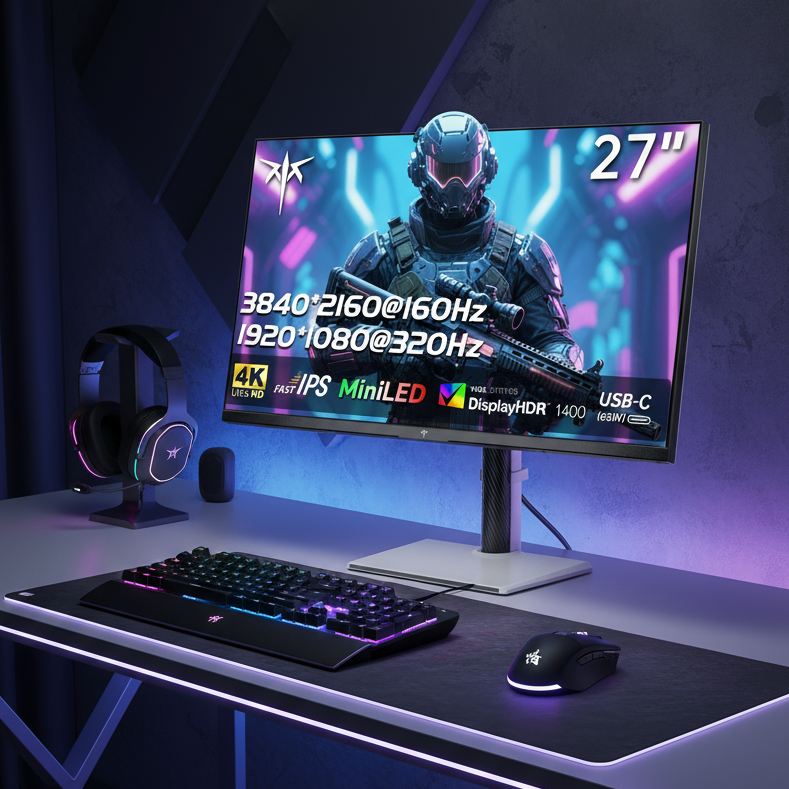
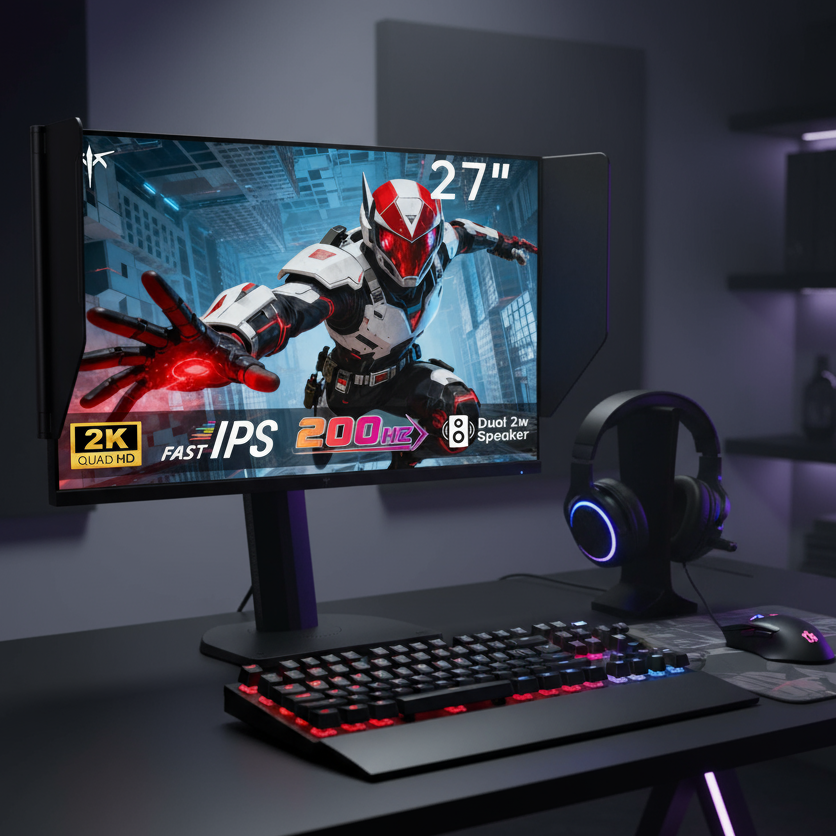
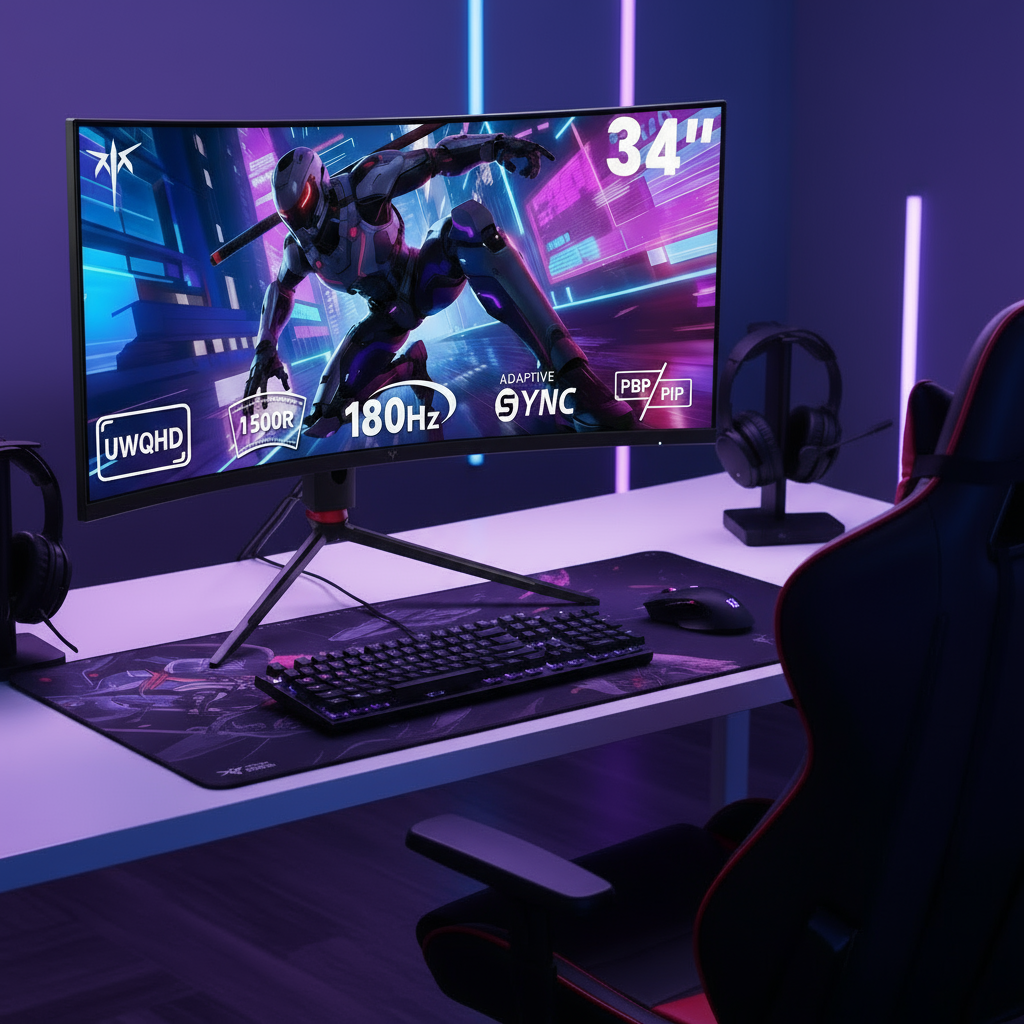


A 240Hz gaming monitor can still feel different from a 165Hz model because the display gets more chances each second to show the newest frame, and that changes both latency perception and motion clarity.
You notice it when the game counter looks fine, but fast flicks, strafes, or camera pans still feel a little cleaner on one screen than the other. The hard part is that the gap is small on paper, just 4.17 ms between refreshes at 240Hz versus 6.06 ms at 165Hz, yet that timing change stacks with panel response behavior in ways you can feel. What follows is the practical buying answer: when 240Hz is meaningfully better, when 165Hz is already enough, and what monitor specs matter more than the headline Hz number.
The timing gap is small, but it is real
Refresh rate and frame rate are not the same thing
Refresh rate is how many times a monitor updates each second, while frame rate is how many new frames your GPU actually produces. That distinction matters in gaming monitors, because a higher-Hz panel cannot invent real game frames, but it can show newly delivered frames sooner and with less waiting between updates.
A 240Hz panel has only 4.17 ms between refreshes, compared with 6.06 ms at 165Hz by simple math. That means the screen gets another opportunity to present new information about 1.89 ms sooner each cycle, which is why mouse movement and camera motion can feel more immediate even before you start talking about response times or overdrive tuning.
In practical terms, this is easiest to see in a fast shooter running around 180 fps to 220 fps on a 27-inch 1440p gaming monitor. At that point, 240Hz has enough headroom to display more of what the GPU is already rendering, while 165Hz has to repeat or skip some refresh opportunities.

Motion clarity is about persistence, not just raw FPS
Why fast pans look different on two monitors showing the same game
Display motion blur on modern LCD and OLED screens is heavily tied to sample-and-hold behavior, where each frame stays visible long enough for your eyes to smear it during smooth tracking. That is why motion can look blurrier than the frame counter suggests, especially when you follow a moving enemy or pan across a racing track.
A review platform notes that persistence blur drops as refresh rate and frame rate rise, because the image is held for less time before the next update. On a desk, the difference shows up most clearly in repeatable tests like an aim trainer flick, a side-to-side strafe in a competitive FPS, or a long panning replay in a racing game where fine details stay more readable at the higher refresh.

The classic explanation is simple: a 60Hz display showing motion in 120 steps over 2 seconds creates large positional jumps and longer frame persistence. Moving from 165Hz to 240Hz does not erase blur, but it does shorten the hold time enough that edges, crosshairs, and distant targets can look steadier during motion.
The feel difference is latency plus pixel behavior
Higher Hz helps, but it does not guarantee a better panel
Higher refresh rates can reduce input lag and improve responsiveness, which is one reason 240Hz gaming monitors often feel more “connected” in fast games. That benefit is real, but it is only one piece of the chain between your mouse click and the image your eyes receive.
Input lag and response time are separate measurements. A monitor can refresh quickly but still smear transitions if pixel response is slow, and a review platform explicitly notes that refresh rate alone does not determine response time. That is why a well-tuned 165Hz OLED or very fast IPS panel can feel cleaner than a mediocre 240Hz LCD with visible ghosting.
A company’s monitor guidance treats low response time and low input lag as separate priorities for gaming. For buyers, the practical lesson is straightforward: after 165Hz, the next upgrade that often changes perceived quality is not just more Hz, but better pixel transitions, better overdrive, and lower measured input lag.
“Same FPS” does not always mean the same result
When 240Hz clearly helps
A monitor can only show as many distinct frames as the system produces, so the biggest jump happens when your real frame rate lands above 165 fps. If your PC is outputting 200 fps, a 240Hz monitor can present all 200 frames, while a 165Hz display cannot. That is the cleanest reason two monitors can feel different even with the same game and the same PC.

Variable refresh rate updates the screen when a new frame is ready, so the story changes if both monitors are running a locked 120 fps with VRR active. In that case, the refresh-rate advantage shrinks a lot because both displays are effectively updating around 120 times per second. The remaining difference is usually panel tuning, input lag, and response behavior rather than the 240Hz label by itself.
A review platform also points out that a higher refresh rate makes lower input lag possible, but does not guarantee it. That is the key nuance most monitor buyers miss: 240Hz is not magic at every identical fps target, but it becomes much easier to feel when your game frequently lives between roughly 170 fps and 240 fps, or when the 240Hz model also has better measured latency.
Which gaming monitor buyers should actually pay for 240Hz
165Hz vs 240Hz at a glance
A company’s buying guidance places 144Hz to 200Hz in the sweet spot for most gamers, with 240Hz and above aimed more at competitive players. That lines up with real buying behavior: for mixed-use gaming monitors, 165Hz is often the value point, while 240Hz makes the most sense when the rest of the setup is optimized to exploit it.
Use case |
165Hz gaming monitor |
240Hz gaming monitor |
Smarter choice |
120 fps locked game with VRR |
Very close to optimal |
Only a small gain unless latency is also better |
Usually 165Hz |
180 fps competitive shooter |
Starts leaving performance on the table |
Can show all 180 frames |
Usually 240Hz |
200 fps to 240 fps esports play |
Cannot display every rendered frame |
Can present most or all rendered frames |
240Hz |
1440p mixed AAA and multiplayer |
Better value in many setups |
Best if GPU headroom is strong |
Depends on GPU |
34-inch ultrawide gaming |
Easier to drive at native resolution |
Harder to feed consistently |
Often 165Hz |
Portable monitor with gaming laptop |
More efficient and practical |
Only worth it with strong mobile GPU |
Usually 165Hz |
Ultrawide monitors raise the rendering load enough that very high refresh targets get harder to sustain. If you are shopping for a 34-inch 3440x1440 panel, a strong 165Hz ultrawide often makes more sense than chasing 240Hz you will rarely feed. The same logic applies to portable monitors paired with laptops, where power draw and GPU limits matter more and a company notes that lower refresh settings can also help battery life.
FAQ
Q: Will 240Hz help if my game only runs at 120 fps?
A: Sometimes, but not by much if VRR is working properly. At a locked 120 fps, both monitors can end up updating around 120 times per second, so the remaining difference is usually monitor input lag, response time, and overdrive quality.
Q: Is the 240Hz upgrade mostly about latency or motion clarity?
A: Both, but not equally in every game. Fast shooters make the latency benefit easier to notice, while panning scenes, tracking aim, and racing games make the motion-clarity benefit easier to spot.
Q: Should I buy 240Hz IPS or 165Hz OLED?
A: Compare real measurements, not just the spec sheet. A fast OLED can feel exceptionally clean because of near-instant pixel response, while a 240Hz IPS can still win if you need the extra refresh headroom and the panel also has low input lag.
Final Takeaway
A 240Hz monitor feels different from 165Hz because the display refreshes sooner, can show more of the frames your PC already rendered, and usually reduces persistence blur during fast motion. That said, the upgrade is easiest to justify on gaming monitors used for competitive titles, high-FPS 1080p or 1440p play, and systems that can actually live above 165 fps for long stretches.
Action checklist:
- Verify your actual refresh rate in your operating system display settings.
- Turn on VRR or Adaptive-Sync if your monitor and GPU support it.
- Compare monitors by measured input lag and response time, not Hz alone.
- Test your favorite game at the frame rates you really sustain, especially 120 fps, 165 fps, 180 fps, and 200 fps plus.
- For ultrawide or portable monitor setups, prioritize realistic GPU headroom before paying extra for 240Hz.
- If you mainly play esports shooters, 240Hz is usually worth serious consideration; if you play mixed AAA titles, 165Hz is often the smarter value buy.


