




The 1000Hz Verdict: A Quick Summary for Decision Makers
Before diving into the technical nuances, here is the current reality of 1000Hz display technology:
- Who Benefits Most: Professional esports athletes and "motion clarity purists" who play titles like CS2, Valorant, or Overwatch 2 at extremely high frame rates.
- Who Should Wait: Most casual and ranked players already using 240Hz–540Hz displays. The jump to 1000Hz offers diminishing returns compared to the massive leap from 60Hz to 144Hz.
- The Essential Requirements: To see a benefit, you typically need a PC capable of sustaining 1000 FPS, a DisplayPort 2.1 connection, and a panel with sub-1ms GtG (Gray-to-Gray) response times to avoid "smearing" the high refresh rate.
The Physics of Motion Clarity: Why 1000Hz is a Theoretical Milestone
The core motivation for chasing a 1000Hz gaming monitor lies in addressing sample-and-hold blur. On most modern LCD or OLED panels, each frame is held on screen for its full duration, causing the eye to perceive motion as smeared when objects move quickly across the display. Higher refresh rates shorten that hold time, but the benefit is only fully realized when paired with sufficiently fast pixel response.
Blur Busters Law frames 1ms of persistence as a practical target for "blurless" sample-and-hold motion. At 1000Hz, each frame lasts exactly 1ms, which can theoretically minimize traditional motion blur without relying on brightness-robbing backlight strobing (BFI). While this milestone is often cited as the next logical step for competitive esports, it remains a high-bar technical target rather than a guaranteed visual outcome for all users.
Simply increasing the refresh rate does not automatically remove blur. Pixel response time (gray-to-gray) must stay well below 1ms, or the panel cannot fully transition before the next frame arrives. A common pattern in early ultra-high-refresh monitors is visible smearing in fast-motion tests because the pixels can't keep up with the refresh cycle. For a deeper look at the underlying mechanism, see our guide to What Is Sample-and-Hold Blur and Why Higher Refresh Rates Don't Eliminate It?.
Hardware Bottlenecks: Can Your PC Actually Drive 1000Hz?
Driving a 1000Hz display at full speed demands extreme bandwidth and compute power. According to the official VESA DisplayPort 2.1 specification, UHBR20 mode delivers a maximum payload of 77.37 Gbps. Even at 1080p, sustaining 1000Hz with 8-bit color pushes close to this ceiling; higher resolutions or color depths typically require Display Stream Compression (DSC) or force the monitor into lower-resolution modes.
On the GPU and CPU side, the challenge is even steeper. Maintaining 1000 frames per second in modern titles remains unrealistic for most systems outside of lightweight esports games running on flagship hardware. If the frame rate drops significantly below 1000fps, the monitor may introduce stutter or overdrive artifacts that can, in some cases, look less fluid than a lower-refresh panel with better frame pacing.
Pixel response time remains the final gatekeeper. Even the fastest IPS panels struggle to guarantee sub-1ms GTG across all transitions. If the panel cannot clear each frame in time, the theoretical clarity of 1000Hz evaporates. Our article on What Happens When Your GPU Can't Keep Up With Your Monitor's Refresh Rate? explains the resulting mismatch and how features like VRR help mitigate it in practice.
Refresh-Rate Returns vs Bandwidth Fit Zones
Shows the main decision split: the biggest gains arrive from 60 to 120 Hz, while gains flatten in the 240 to 1000 Hz band and become more scenario-dependent as bandwidth and resolution demands rise.
View chart data
| Category | Decision relevance |
|---|---|
| 60→120 Hz | 5.0 |
| 120→240 Hz | 4.0 |
| 240→1000 Hz | 2.0 |
| DP 2.1 UHBR20 bandwidth fit | 5.0 |
| Dual-mode / higher-resolution trade-off | 4.0 |
| Phantom-array reduction | 3.0 |
1000Hz vs. 540Hz: A Direct Comparison
For players currently using 360Hz or 540Hz displays, the jump to 1000Hz represents a significant technical leap, but one with diminishing perceptual returns for the average user.
| Feature | 540Hz (Current High-End) | 1000Hz (The Frontier) |
|---|---|---|
| Persistence (Hold Time) | ~1.85ms | 1.0ms |
| Hardware Demand | High (Modern high-end GPUs) | Extreme (Flagship GPUs + top-tier CPUs) |
| Resolution/Color | Native 1080p/1440p common | Often requires Dual-Mode or lower resolution |
| Perceptual Gain | Significant over 240Hz | Subtle; targets "analog" smoothness |
| Typical Use Case | Competitive Ranked / Semi-Pro | Professional Esports / Tech Enthusiasts |
The Human Perception Limit: Can You See Beyond 540Hz?
The question of whether the human eye can perceive benefits beyond 540Hz is more nuanced than a simple “yes” or “no.” Research indicates that the eye’s ability to track motion improves with higher refresh rates, but the gains follow a logarithmic curve. The jump from 60Hz to 120Hz delivers a far more noticeable improvement in smoothness than the entire leap from 240Hz to 1000Hz for most people.
One key artifact that persists at 540Hz is the phantom array effect (stroboscopic stepping). When the eye tracks a fast-moving object across a high-contrast background, the brain can perceive discrete “steps” rather than continuous motion. Higher refresh rates reduce the spacing of those steps. Theoretical models suggest that 1000Hz may be more effective at minimizing this effect on screens larger than 27 inches, where the physical distance between "steps" is more pronounced to the viewer.
The primary benefit, therefore, is not necessarily a massive boost in reaction time but potentially lower visual noise and reduced cognitive load during prolonged tracking. This is especially relevant for professional esports athletes who spend hours practicing precise movements. For the average competitive player, 360Hz–540Hz already captures the majority of the ergonomic improvement. Our guide Which Refresh Rate Is Best for Gaming: 60Hz, 144Hz, or 240Hz? explores how these earlier milestones delivered the bulk of the practical gains.
Myth vs Reality: The 1000Hz Threshold
- Myth: 1000Hz will automatically improve your K/D ratio.
- Reality: It primarily delivers “retina-like” motion clarity and reduces phantom arrays. The advantage is in visual ergonomics rather than raw reaction speed.
- Note: Larger screens (27–32 inches) may amplify the visibility of stepping artifacts, making ultra-high refresh rates more relevant for these form factors than for smaller 24-inch panels.
Dual-Mode Displays: How 1000Hz Becomes Practical
Pure 4K at 1000Hz remains beyond current uncompressed bandwidth limits, which is why manufacturers have adopted dual-mode designs. These panels let users switch between a high-fidelity 4K mode for productivity or single-player games and a high-speed 1080p or 1440p/1000Hz mode optimized for competitive titles.
Dual-mode solves the bandwidth problem by lowering resolution and often color depth when entering the 1000Hz profile. This trade-off keeps the data rate inside DisplayPort 2.1 limits but means you sacrifice sharpness during peak esports use. Overdrive tuning also becomes critical: aggressive settings optimized for 1000Hz can produce overshoot (ghosting) if the frame rate drops significantly below the refresh target.
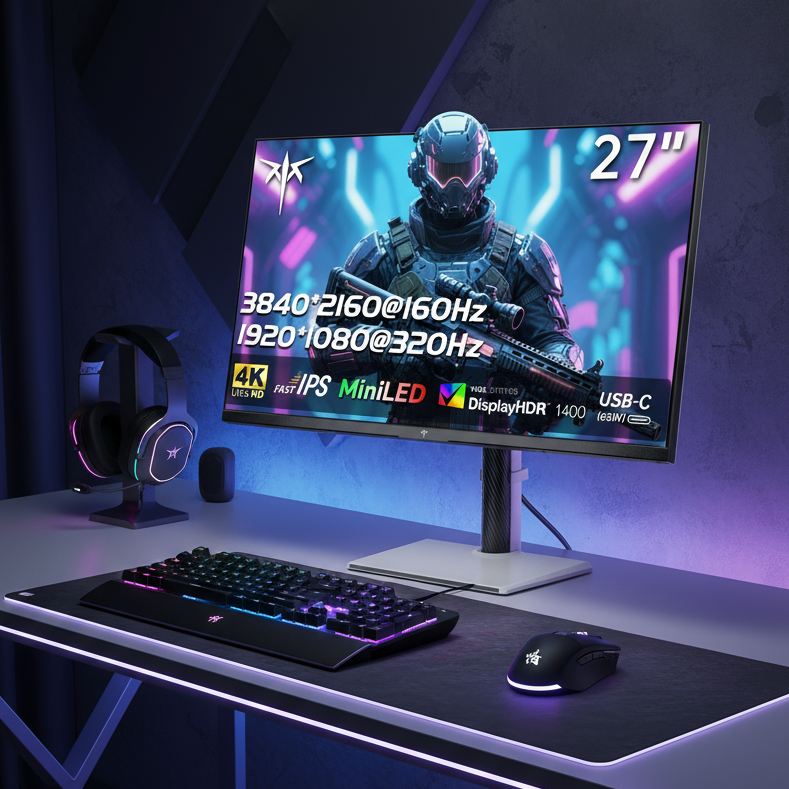
This coverage of early dual-mode prototypes illustrates how the approach turns 1000Hz from a laboratory curiosity into a switchable feature. KTC’s own dual-mode models, such as the KTC 27" 4K 160Hz/320Hz 90W Gaming Monitor | H27P6, already give users this flexibility today, letting them toggle between crisp productivity and high-refresh gaming.
For competitive players wondering about resolution priorities, our analysis of 4K for Competitive Gaming: A Performance Advantage or Disadvantage? shows that many pros still prefer lower resolutions precisely to maximize frame rates and motion clarity.

Is 1000Hz Right for You? A Tiered Guide
Deciding whether a 1000Hz gaming monitor is worth it depends on your specific player profile:
- The Elite Competitor: If you play at a professional level and your system consistently hits 800-1000 FPS in your main title, 1000Hz is the ultimate tool for minimizing visual noise.
- The High-Ranked Enthusiast: If you are currently on 240Hz or 360Hz, a jump to 540Hz or a high-quality OLED (which has superior motion clarity due to near-instant response times) may offer a better balance of cost and performance than 1000Hz.
- The General Gamer: For those playing a mix of AAA titles and occasional shooters, a 144Hz–240Hz 4K or 1440p monitor remains the "sweet spot." The hardware investment required for 1000Hz is likely better spent on a stronger GPU or a high-quality IPS/OLED panel.
When comparing 1000Hz LCDs with 480Hz–540Hz OLEDs, consider that OLED’s near-instantaneous pixel response often produces cleaner motion in real gameplay despite the lower refresh rate. For now, treat 1000Hz as a specialized esports instrument. If your current setup already runs a KTC 24.5 inch 360Hz/400Hz OC Fast IPS FHD Gaming Monitor HDR 400 | H25X7, the upgrade path is narrow unless you specifically require the absolute lowest persistence on a large panel.
FAQs
Are 1000Hz monitors worth it for casual or ranked competitive play?
For most ranked players, the incremental gain over a well-tuned 360Hz–540Hz monitor is small relative to the hardware cost. 1000Hz shines most for professionals in titles that can reliably sustain near-1000fps. Most players see bigger returns from optimizing system latency or upgrading to a high-quality 360Hz panel first.
What hardware is realistically required to run a 1000Hz monitor effectively?
You need a GPU capable of delivering sustained 1000fps (usually limited to lightweight esports titles), a high-end CPU to avoid frame pacing bottlenecks, and a DisplayPort 2.1 connection. Dual-mode operation at reduced resolution is typically necessary to stay within bandwidth limits.
Can the human eye actually tell the difference between 540Hz and 1000Hz?
The eye can detect reduced stroboscopic stepping and smoother tracking, especially on larger screens, but the improvement is smaller than earlier jumps from 60Hz to 120Hz. The benefit is more about visual comfort and reduced cognitive load during fast motion.
How do dual-mode 1000Hz monitors work in practice?
They allow the same panel to run in a high-resolution mode (e.g., 4K at 160Hz) for general use and switch to a lower-resolution, maximum-refresh mode (e.g., 1080p at 1000Hz) for competitive play. This keeps data rates within cable limits but requires accepting reduced sharpness in high-speed mode.
Does 1000Hz eliminate all motion blur?
It significantly reduces sample-and-hold blur when the system maintains 1000fps and pixel response is fast enough. However, any mismatch between frame rate and refresh rate, or slow pixel transitions, can still reintroduce artifacts. It is a major step toward "blurless" motion but remains dependent on the entire hardware chain.


