









High-refresh-rate monitors often still show blur during fast motion because of sample-and-hold persistence, not slow pixel response. Black Frame Insertion (BFI) and strobe backlights address this by shortening the time each frame stays visible, giving competitive players clearer tracking without relying solely on higher refresh rates.

What is Black Frame Insertion (BFI) and How Does It Reduce Blur?
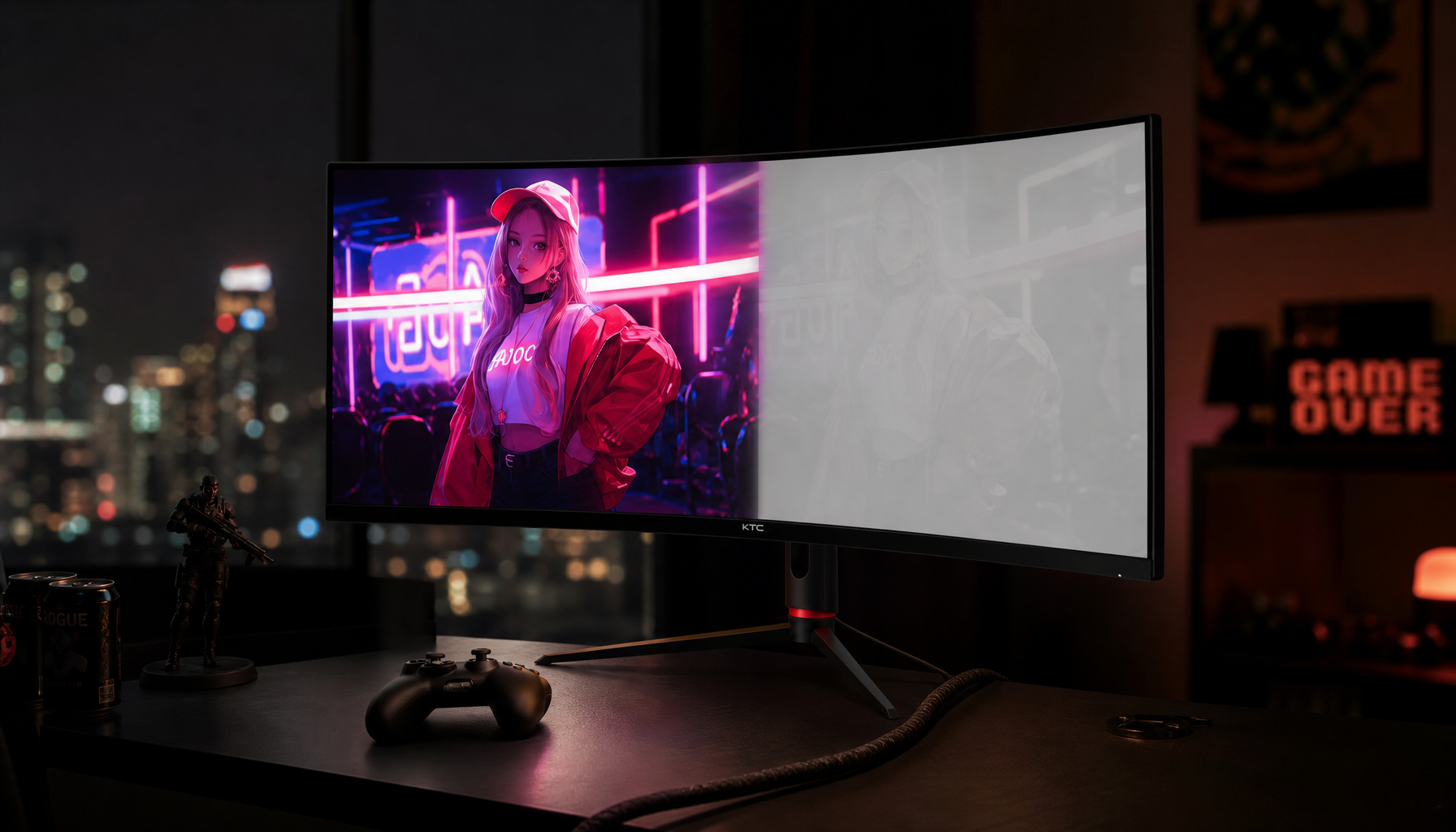
Black Frame Insertion works by turning the backlight off between frames, effectively resetting what the eye sees and cutting the trailing that occurs when a bright frame lingers on screen. This approach bypasses the sample-and-hold behavior of modern LCD and OLED panels, where each frame remains visible for the full refresh cycle.
As this official motion blur reduction guide explains, the technique mimics older CRT displays that naturally produced brief light pulses. The result is reduced persistence blur during rapid on-screen movement, which is especially noticeable in fast-paced FPS titles.
Most gamers notice the difference most clearly when their framerate is locked to the monitor’s refresh rate and other variables like overdrive are already tuned.
What Is Sample-and-Hold Blur and Why Higher Refresh Rates Don’t Eliminate It?
MPRT vs. GtG: Why Your 1ms Monitor Still Looks Blurry
Gray-to-Gray (GtG) measures how quickly a pixel can change color, yet Moving Picture Response Time (MPRT) measures how long that pixel stays visible to the eye. A panel can advertise 1 ms GtG while still delivering 6.9 ms of persistence at 144 Hz because the backlight stays on for the entire refresh interval.

Higher refresh rates shorten this persistence window naturally: 240 Hz drops it to roughly 4.2 ms, and 360–400 Hz panels push it even lower. Only when manufacturers add strobing can they reach true 1 ms MPRT targets on LCDs.
How Important is 1ms GTG for Your FPS Gaming? and Gaming Monitor Response Time: GtG vs. MPRT Explained
The Mechanics of Strobe Backlights: How KTC Monitors Eliminate Ghosting
KTC monitors activate motion blur reduction through the MPRT setting in the OSD. This triggers precise backlight strobing synchronized to the refresh rate. Adjustable parameters such as strobe length and phase let users balance clarity against brightness and crosstalk.
Models like the H25X7 reach 360 Hz native (400 Hz overclock) and can reduce persistence without strobing at all, giving users an alternative path to motion clarity.
Brightness vs. Motion Clarity Trade-off
Typical SDR brightness on 144–240 Hz IPS panels with MPRT enabled (bounded ranges based on common panel measurements)
Show table
| Refresh Rate | Native Brightness (nits) | MPRT Brightness (nits) | Typical Drop |
|---|---|---|---|
| 144 Hz | 380–420 | 160–200 | ~50–55% |
| 240 Hz | 400–440 | 180–220 | ~50% |
| 360 Hz | 420–460 | 200–240 | ~45–50% |
What Is Monitor Ghosting and How Do You Eliminate It?
The Trade-offs: Why You Might Not Want to Enable MPRT Mode
Enabling strobing typically cuts SDR brightness by 30–60 % because the backlight is dark for most of each cycle. This forces a direct choice between maximum motion clarity and usable luminance, especially in bright rooms.
Strobe crosstalk can appear when pixel transitions do not finish before the backlight flashes, creating double-image artifacts that look worse than the original blur. Most KTC monitors also require VRR (FreeSync or G-Sync) and local dimming to be disabled before MPRT activates.
Flicker-sensitive users may experience eye strain or headaches at certain refresh rates, making the feature less suitable for long sessions.
Why Does My 240Hz Monitor Feel Slower Than My Friend’s 165Hz Display?
VESA ClearMR: The New Gold Standard for Motion Clarity
VESA ClearMR rates motion clarity by measuring the ratio of clear pixels to blurry pixels rather than relying on marketing MPRT numbers. Tiers range from ClearMR 3000 to ClearMR 21000 and give buyers an objective way to compare panels across technologies.
High-refresh-rate models such as the H25X7 at 400 Hz overclock tend to land in the higher ClearMR brackets even without strobing, showing that refresh rate alone can deliver strong real-world clarity.
When to Use BFI: Recommended Settings for Competitive Play
Use MPRT when you play competitive FPS titles at a locked high framerate, your room is not brightly lit, and you can accept lower brightness. Disable it for cinematic or HDR content where local dimming and VRR matter more.
Players who want native motion clarity without brightness loss often prefer the G27P6 OLED at 240 Hz. Those chasing maximum refresh rate without strobing gravitate toward the H25X7 400 Hz IPS.
Quick checklist: lock framerate to refresh rate, disable VRR and local dimming, then fine-tune strobe length for acceptable brightness.
Gaming Monitor | 240Hz-400Hz Monitors | KTC OLED 27" 2K 240Hz/0.03ms USB-C Gaming Monitor | G27P6 | KTC 24.5 inch 360Hz/400Hz OC Fast IPS FHD Gaming Monitor HDR 400 | H25X7


%20and%20strobe%20backlight%20technologies,%20including%20how%20they%20reduce%20persistence%20blur,%20the%20brightness%20and%20compatibility%20trade-offs,%20and%20practical%20settings...
)