




Black levels can look different in Picture-in-Picture because the main image and inset image may use different signal ranges, picture modes, brightness handling, panel processing, or input paths.
Does the small PIP window look gray while the main game or spreadsheet looks clean and deep? A simple source-and-monitor settings check can often restore consistent blacks without buying a new display. Here is how to identify whether the issue is signal range, panel behavior, HDR, or the PIP feature itself.
Why PIP Changes the Way Black Looks
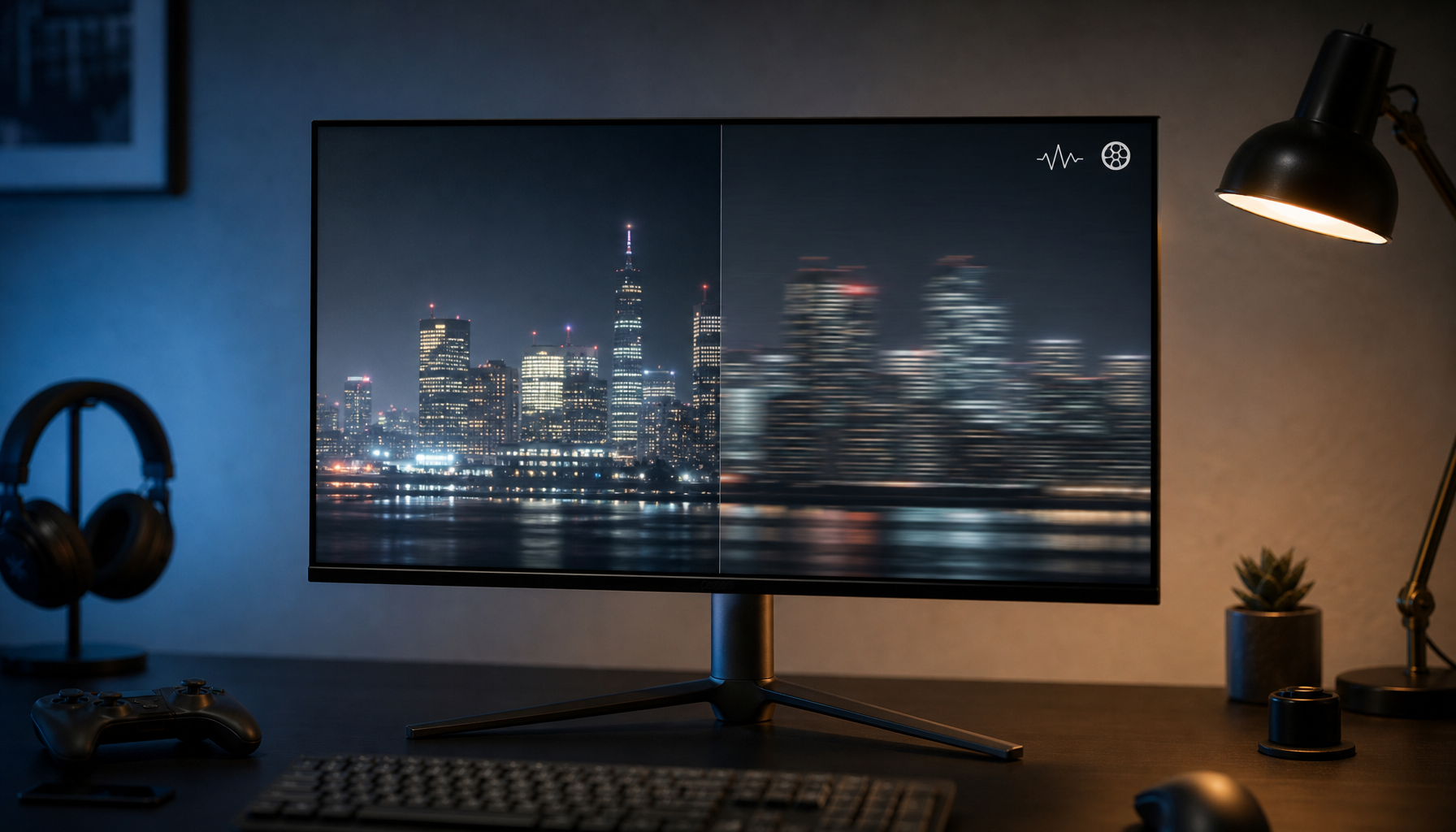
Picture-in-Picture is not just two images on one screen. Your monitor is receiving two sources, processing them through separate input paths, and then compositing one over the other. That means the main image and the PIP image may not share the same brightness curve, color range, HDR mode, sharpness processing, or black-level setting.
This is especially noticeable on gaming monitors, office ultrawides, and portable smart screens because they often mix very different devices. A desktop PC may output full-range RGB over DisplayPort, while a console, laptop, capture device, or streaming stick may send a video-style limited-range signal over HDMI. When those assumptions do not match, blacks can turn into lifted gray shadows or crushed dark detail.
A real-world example is easy to spot. If your main PC desktop looks normal but your console in the PIP window looks foggy, the monitor may be interpreting the console’s black floor differently. If the PIP window looks darker than expected, the opposite may be happening: dark tones may be compressed until shadow detail disappears.
The Core Cause: Black Level Is a Signal Mapping Problem
“Black level” describes how the darkest parts of the image are mapped from the source device to the display. The practical issue is not whether a screen can show black in theory; it is whether the source and monitor agree on what “black” means.
In one black-level setting discussion, a user describes the classic symptom: a “Low” setting produced deeper blacks, while “High” made the image look gray, hazy, and washed out. That kind of shift is exactly what PIP can expose, because each input may trigger or preserve different black-level behavior.
For a PC monitor, full-range output is usually the cleanest match for desktop use. For video devices, limited-range output may be more common. The trouble starts when the source sends one range and the display expects another. Full sent to limited can crush dark detail. Limited sent to full can raise blacks and make the image look milky.
Why the Main Window and PIP Window May Disagree
PIP can make this mismatch more visible because the two images sit side by side. Your eye compares the black taskbar, a dark game scene, or a letterboxed video in the main image against the same kind of tone in the inset. Even a small difference becomes obvious.
The monitor may also lock certain controls while PIP is active. Some displays disable local dimming, HDR, dynamic contrast, or per-input picture presets when showing two sources. Others keep the main input in the selected picture mode but apply a simplified mode to the inset window. That can make the PIP image look flatter even when the source is configured correctly.
Panel Type Sets the Ceiling for Black Performance
PIP does not override the physical limits of your panel. It reveals them. IPS, VA, OLED, and Mini LED LCD displays handle dark scenes differently, so the same PIP behavior can look mild on one monitor and dramatic on another.
IPS panels are valued for color consistency and wide viewing angles; IPS monitors can maintain consistent color from side positions, which is why they remain popular for design and productivity. The tradeoff is that IPS panels generally do not produce the deepest LCD blacks, especially in dark rooms or when viewed off-axis.
VA panels usually produce stronger native contrast than IPS, so black differences in PIP can look less washed out. OLED goes further because each pixel can dim independently, creating extremely deep blacks. General monitor guidance notes that OLED can produce true blacks, while IPS and VA remain LCD technologies with backlight behavior to manage.
Display Type |
Black-Level Strength |
PIP Risk |
IPS LCD |
Stable color, weaker dark-room blacks |
Gray-looking inset if range or brightness is off |
VA LCD |
Stronger native contrast |
Better depth, but dark detail can still crush |
OLED |
Per-pixel black control |
Best contrast, but static desktop use needs care |
Mini LED LCD |
Strong HDR potential with dimming zones |
PIP may reduce or alter dimming behavior |
For a workday example, imagine a 27-inch IPS monitor running a code editor as the main screen and a security camera feed in PIP. The editor’s black theme may look acceptable because your eyes adapt to the full screen, but the camera feed may look cloudy because the inset image sits against a cleaner desktop background. That does not automatically mean the camera is bad; it may mean the PIP path is using different processing.
HDR, Brightness, and Room Lighting Can Exaggerate the Difference
HDR can make black-level differences more obvious because it changes how brightness and shadow detail are represented. If the main input is running HDR while the PIP source is SDR, the two images may not share the same tone mapping. The result can be a main image with punchy highlights and an inset that looks dim, gray, or oddly contrasty.
Brightness also matters. Display guidance often ties proper monitor brightness to the room environment and the work being done. In practical terms, if your monitor is set very bright in a dim room, IPS glow and raised blacks become more noticeable, especially in a PIP window surrounded by darker content.
For office productivity, SDR is usually the more reliable default. Keep HDR reserved for HDR games, movies, or creative review. If your PIP window is for chat, a laptop desktop, a dashboard, or a video call, SDR consistency matters more than peak brightness.

Input and Cable Choices Matter More Than People Expect
PIP problems often start with input differences. HDMI, DisplayPort, and USB-C can all carry clean video, but the source device, cable version, and monitor firmware decide which modes are available. Monitor buying guidance commonly recommends verifying connectivity because high-resolution and high-refresh displays may need matching HDMI or DisplayPort capabilities to perform as advertised.
A common PIP setup is DisplayPort for the gaming PC and HDMI for a console or laptop. That is convenient, but it also means the monitor may expose different color-range options on each input. Some monitors label these as Black Level, HDMI Black Level, RGB Range, Full, Limited, Low, High, Normal, or Enhanced. The names vary, which is why the correct choice is the one that matches the source, not the one that sounds better.
Portable smart screens add another twist. USB-C can carry video, power, and touch data, but only when the laptop port supports the right mode; USB-C with DisplayPort Alt Mode is the cleaner one-cable path for many portable displays. If you switch one source to mini HDMI as a backup, the picture profile may change, including black-level handling.
How to Fix Different Black Levels in PIP
Start by checking the source output range. On a PC, look in the GPU control panel for RGB range, output color format, or dynamic range. For a console, check video output settings and whether the console is set to automatic, full, or limited. If the monitor has a matching black-level option for that input, set both sides to agree.
Next, test with a simple dark image or a black-level test pattern on both sources. Put the same image on the main screen and in PIP if possible. If the PIP image looks gray, try changing the source range or monitor black-level setting for that input. If shadow boxes disappear into one blob, the blacks are likely crushed.
Then disable extra processing temporarily. Turn off dynamic contrast, black equalizer, HDR, local dimming, eco brightness, and game-specific shadow boosters. Once the two inputs look closer, add features back one at a time. This is slower than guessing, but it tells you which feature is changing the image.
Finally, save per-input presets if your monitor supports them. A reliable setup might use DisplayPort with full-range RGB and an SDR productivity mode for the main PC, while HDMI uses the correct video range for a console or media device. For PIP-heavy work, consistency usually beats maximum punch.
Pros and Cons of Using PIP Despite Black-Level Differences
PIP is still powerful. For productivity, it lets you monitor a second computer, camera feed, live stream, console, or reference device without adding another full-size screen. For gaming, it can keep chat, capture preview, or system monitoring visible without alt-tabbing. For portable screens, it can turn a compact setup into a flexible control surface.

The downside is that PIP often gives you less control than a true dual-monitor setup. You may not get independent calibration, identical HDR behavior, full local dimming, or separate brightness control for both images. If color and contrast matching are mission-critical, a calibrated second display is more predictable than PIP.
That tradeoff is similar to choosing between ultrawide and dual monitors. Ultrawides simplify the desk and improve immersion, while dual displays give you more independent control. PIP sits between those approaches: cleaner than extra hardware, but less exact than two fully tuned screens.
When the Problem Is the Monitor, Not Your Settings
If you have matched the source and display range, disabled extra processing, and tested both inputs, but the PIP window still looks different, the monitor’s PIP implementation may be the limitation. Some displays simply process the inset image with a reduced pipeline. That can mean lower sharpness, altered gamma, weaker contrast, or disabled HDR.
This is where buying priorities matter. If PIP is central to your workflow, check the manual before purchase for supported input combinations, PIP size options, HDR limitations, USB-C behavior, and whether picture modes apply independently. For gaming and creative use, prioritize models with strong contrast, clear per-input controls, and reliable SDR performance before chasing headline brightness specs.
For a practical desk setup, a 27-inch 1440p or 4K monitor can work well for productivity PIP, while a larger 32-inch or ultrawide panel gives the inset more breathing room. Just remember that larger screens need deeper desks; monitor guidance consistently ties screen size to viewing distance, comfort, and whether you can see the full display without constantly turning your head.
FAQ
Does PIP reduce black quality by itself?
Sometimes. PIP does not automatically make blacks worse, but the monitor may use simplified processing for the inset image or disable certain contrast features while showing two inputs.
Should Black Level be set to Low or High?
Use the setting that matches the source. “Low” often looks deeper, but if it crushes shadow detail, it is not correct. “High” may be right for some limited-range sources, but if it makes blacks gray, the source and display are probably mismatched.
Is OLED better for PIP black levels?
OLED has the strongest black performance because pixels can turn off individually, so differences are often less about backlight leakage and more about signal handling. Still, PIP can look inconsistent if one source uses different HDR, range, or color settings.
Can a cable cause washed-out PIP blacks?
A cable usually does not change black levels by itself, but the input path can. Switching from DisplayPort to HDMI or USB-C to mini HDMI may trigger different output modes, refresh limits, or monitor presets.
Black-level differences in PIP are usually solvable once you stop treating the inset as a smaller copy of the main image. Match the signal range, simplify the picture modes, control HDR deliberately, and choose a panel whose contrast behavior fits how you actually work and play.


%20often%20look%20different%20due%20to%20mismatched%20signal%20ranges%20or%20processing.%20Get%20consistent%20blacks%20by%20checking%20source%20and%20monitor%20settings.
)