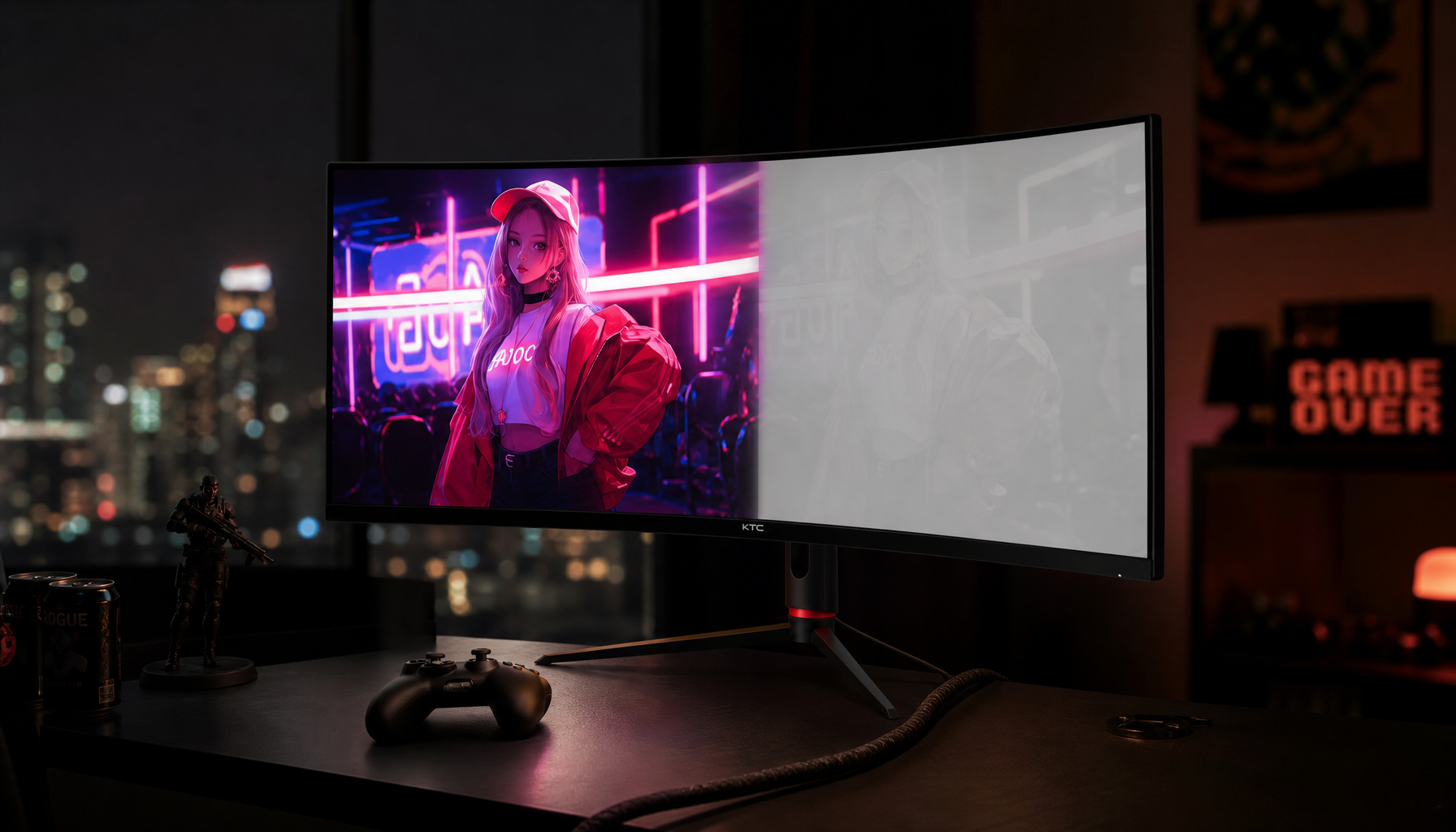
Chroma subsampling lowers color detail, not the monitor’s native pixel count, so it changes perceived sharpness more than advertised resolution. On computer monitors, 4:4:4 is usually the target because text, UI, and colored edges expose color loss much faster than movies do.
If a new 4K 144Hz monitor or ultrawide looks crisp in one mode and slightly smeared in another, the panel may not be the problem. Thin fonts, HUD labels, and browser tabs are often the first things to look soft when a high-refresh or HDR setting pushes the connection too hard. You will leave with a practical way to judge when this matters and how to avoid it when buying or setting up a display.
Chroma Subsampling in Monitor Terms
Why the panel can stay 4K while the image looks less precise
A bandwidth-saving method called chroma subsampling keeps full brightness detail while reducing color detail, because human vision is more sensitive to luminance than chrominance. That is why formats such as 4:4:4, 4:2:2, and 4:2:0 can preserve the basic shape of an image while still changing how sharp it feels on a monitor.
The important monitor-buying point is that this does not reduce the panel’s native resolution in the usual sense. A 3840 × 2160 gaming monitor is still 3840 × 2160, but lower chroma formats make colored edges share data across neighboring pixels, which reduces effective color precision. That is why perceived resolution drops first on red or blue text, desktop icons, browser tabs, and game HUD elements rather than on broad bright shapes.
Format |
Color detail kept |
Relative data load |
Typical monitor result |
Best fit |
RGB / YCbCr 4:4:4 |
Full color per pixel |
100% |
Sharpest text and UI |
Desktop work, mixed-use gaming monitors, ultrawides |
YCbCr 4:2:2 |
Half horizontal chroma |
About 67% |
Mild to obvious softness on colored text |
Temporary compromise for high refresh or limited links |
YCbCr 4:2:0 |
One-quarter chroma across a 2 × 2 area |
50% |
Fuzzy small text, weakest desktop clarity |
Video playback or severe bandwidth limits |
What the numbers actually mean
The notation is based on a 4-pixel-wide by 2-pixel-high sample block. In full 4:4:4 sampling, every pixel keeps its own color sample, while 4:2:2 shares color between adjacent pixels and 4:2:0 shares even more aggressively. For monitor users, that translates into one practical rule: the smaller and more colorful the detail, the easier it is to see the loss.
Why 4:4:4 Matters More for Desktop Text Than for Movies
Text and UI expose color loss quickly
For computer use, text on flat colors is where chroma subsampling becomes obvious. 4:2:2 can look acceptable from a distance in motion, but it often makes standard desktop text look soft, and 4:2:0 can make small letters partly unreadable. That is why full desktop clarity usually means RGB or YCbCr 4:4:4, not just “4K resolution” on the spec sheet.

This matters on gaming monitors more than many buyers expect because a monitor is rarely used for games alone. A text-clarity breakdown for gaming displays points to thin fonts, HUD labels, browser tabs, and colored UI edges as the most common failure points. If you use the same panel for chat, web browsing, maps, inventory screens, strategy titles, or streaming controls, 4:4:4 is doing real work even when the game itself looks mostly fine.
Fast-moving video is far more forgiving
For movies and TV playback, 4:2:0 is normal, and most viewers do not notice the loss because motion and viewing distance hide it well. That is also why vendors sometimes downplay chroma format in entertainment-focused displays: a streaming app or disc video source is already built around those compromises.
Gaming sits in the middle. A longstanding summary of computer use versus video use notes that subsampling has little impact on typical video viewing and only minor impact on many game scenes, but desktop-style content is different. If your “gaming monitor” is also your work display, then perceived sharpness is not just about frames per second; it is also about whether small text remains clean at arm’s length.
When High Refresh, HDR, and 10-Bit Color Trigger Subsampling
Bandwidth is usually the reason
The main cause is simple: high resolution, high refresh rate, HDR, and higher bit depth all compete for link bandwidth. A practical bandwidth example shows that a display interface standard carries 25.92 Gbit/s, while uncompressed 4K 120Hz 10-bit needs about 32.27 Gbit/s; dropping to 4:2:0 lowers that to about 21.52 Gbit/s. That is why a display can look perfect at 60 Hz and softer at 120 Hz or 144 Hz without the panel itself changing.
The monitor industry has been dealing with this tradeoff for years. A report on early 4K 144Hz monitors described 4:2:2 operation at 144 Hz, with fine text becoming softer and blurrier even on premium gaming models. In buying terms, “4K 144Hz” is not enough information by itself; the same caution applies to newer 27-inch 4K 160Hz HDR400 models such as the a brand 27” 4K 160Hz/1ms HDR400 Gaming Monitor, where buyers should still verify that their preferred port, HDR mode, and bit-depth settings can maintain full 4:4:4.
TV-style settings can also change the result
Mode selection matters too. A TV example used as a display reported 4K @ 60 Hz in computer mode as 4:4:4, while non-computer modes fell back to 4:2:2 at 30 Hz and 4:2:0 at 60 Hz. That is a useful reminder for large-format gaming displays and TV-sized monitors: a single input label or picture mode can change perceived sharpness more than a panel spec can.
The cleaner solution, when available, is often DSC rather than subsampling. The same monitor-focused explanation presents display stream compression as a visually lossless way to keep high refresh and full chroma, which is why newer high-refresh monitors and GPUs rely on it so heavily.
Ultrawide and Portable Monitor Setups Need Extra Scrutiny
Ultrawide softness is not always chroma
Ultrawide buyers should avoid assuming every blurry desktop is a chroma issue. In a real ultrawide text-blur case, a 38-inch 3840 × 1600 display looked soft enough that the user eventually moved to a 34-inch 5120 × 2160 model with about 30% higher pixel density for better clarity. That discussion also points to a separate cause: LoDPI versus HiDPI scaling, which can make text look worse even when the signal format is fine.
That distinction matters because perceived resolution is cumulative. A lower-PPI panel, a scaled desktop mode, aggressive sharpening, or an OLED subpixel layout can all mimic the “soft text” people blame on subsampling. On ultrawides especially, you need to separate panel density problems from transport-format problems before deciding the monitor is defective.
Portable monitors and adapters can be the weak link
Portable monitors add another layer because the signal path often includes a multipurpose display-capable port, a dock, a hub, or an adapter. A buying-guide warning about the full signal chain recommends testing the exact resolution, refresh rate, HDR mode, cable, and port you intend to use, not just the monitor in isolation. That advice is especially relevant for thin portable displays where users often assume “one multipurpose port is the same as another.”

An operating system user report on a complex video-interface path reached 4K 120Hz VRR HDR RGB/4:4:4 through a graphics card and a video-signal converter, but the same discussion also noted that driver APIs do not always expose the active chroma format or current bit depth clearly. In practice, that means the cable, adapter, and firmware stack can be just as important as the monitor’s own spec sheet.
How to Check and Fix It Before You Blame the Panel
A reliable test routine
The most practical method is still a visual one. A recommended verification process is to use a chroma test pattern at 100% scaling with your exact resolution, refresh rate, HDR setting, cable, and port. Then compare the result at the problem mode versus a safer mode such as 60 Hz or lower bit depth. If thin red or blue text suddenly cleans up, you have likely found a signal-format bottleneck rather than a bad panel.

Do not rely only on what the operating system reports. A driver-level discussion notes that current APIs may provide limited visibility into chroma format and bit depth, which is why screenshot checks and on-screen pattern tests remain common advice. For buyers, that means a hands-on return-window test is more useful than a marketing bullet.
Fixes that usually work
The first fixes are straightforward: set the display input to computer mode when available, force RGB or YCbCr 4:4:4 in the GPU control panel, swap to a higher-bandwidth port, and remove weak links such as older docks or adapters. If the monitor still falls back, reduce one load factor at a time: turn off HDR, lower refresh rate, or drop from 10-bit to 8-bit output if your workflow allows it.
This is also where monitor buying guidance becomes concrete. If you want a high-refresh display for both games and daily desktop work, prioritize models and connection standards that can hold full 4:4:4 at your target settings. If the screen is mainly for couch gaming or video playback, subsampling is less urgent than response time, VRR behavior, and HDR quality.
FAQ
These are the monitor-buying questions that usually matter most once you start comparing real display setups instead of spec-sheet slogans.
Q: Does chroma subsampling lower the monitor’s actual resolution?
A: No. The panel still uses its full pixel grid, but color information is shared across pixels, so perceived sharpness drops on colored edges, small text, and UI details.
Q: Is 4:4:4 necessary for every gaming monitor?
A: Not for every use case. It matters most when the monitor also handles desktop work, web browsing, chat, HUD-heavy games, maps, or streaming controls. It matters less for video playback and some couch-style gaming at longer viewing distances.
Q: Can modern display interfaces guarantee full 4:4:4?
A: No. The final result still depends on resolution, refresh rate, HDR, bit depth, DSC support, cable quality, adapters, firmware, and whether the display is in a computer-oriented mode.
Practical Next Steps
If you sit close to the screen and care about text clarity, treat 4:4:4 as a baseline feature, not a luxury. That is especially true for 4K 120Hz and 144Hz gaming monitors, large TV-style displays used as monitors, ultrawides with lots of desktop real estate, and portable monitors connected through docks or adapters.
Before you buy or keep a display, use this checklist:
- Confirm the monitor can run your target resolution and refresh rate at RGB or YCbCr 4:4:4.
- Check whether HDR or 10-bit output forces a fallback to 4:2:2 or 4:2:0.
- Test a chroma pattern at 100% scaling with the exact cable, port, and adapter chain you will use.
- Separate chroma issues from PPI, scaling, subpixel layout, and sharpening problems.
- If the monitor is mainly for movies or console-style play from farther away, prioritize overall image quality and motion handling over perfect chroma.
References
- What is Chroma Subsampling?
- a company: What is Chroma Subsampling?
- Chroma Subsampling 4:4:4 vs 4:2:2 vs 4:2:0
- Fool proof way to check flat panel for 4:4:4 chroma support
- 4K, 144Hz monitors reportedly use chroma subsampling at 144Hz
- KTC Play: Chroma Subsampling and Text Clarity on Gaming Monitors
- How to check if I’m using RGB/4:4:4 chroma
- a platform discussion: Blurry text on a brand ultrawide
- Chroma Subsampling 4:4:4 vs 4:2:2 vs 4:2:0
- 4:4:4 / Chroma Subsampling