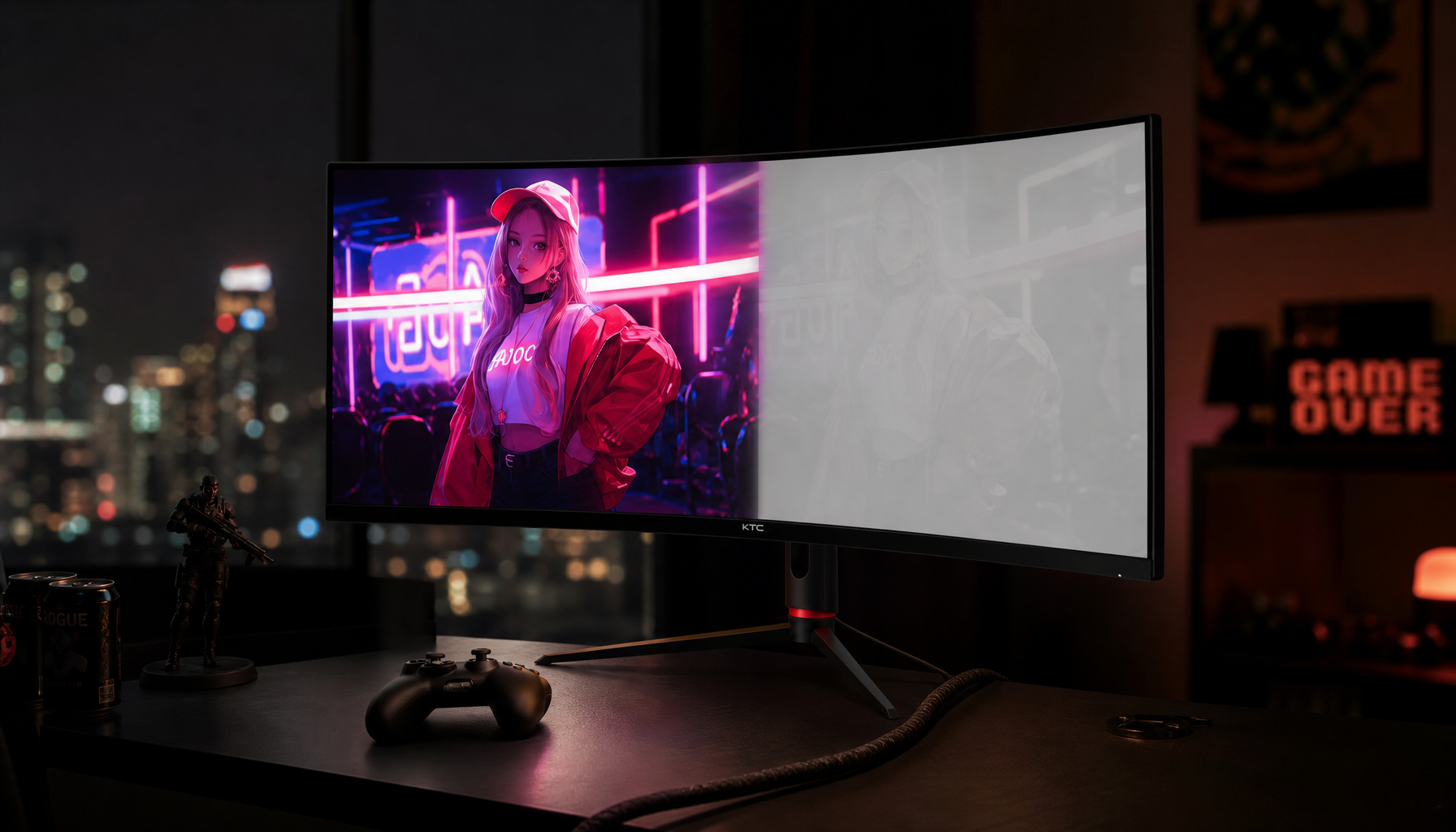
Color banding turns smooth gradients in your designs into visible stripes or steps, ruining the professional look of sky transitions, skin tones, and shadows. For graphic designers and photo editors working with complex tonal work in 2026, a 10-bit-class display—whether native or 8-bit with Frame Rate Control (FRC)—can eliminate most visible banding when your entire pipeline supports it, though results depend on whether your content is photographic or synthetic and whether software and drivers are correctly configured.

The Gradient Nightmare: Why Color Banding Ruins Professional Design
Color banding, also known as posterization, occurs when a display or file cannot render enough distinct shades to create a seamless blend, so smooth transitions break into distinct blocks or stripes. Designers notice it immediately in real-world projects because subtle sky gradients, shadow roll-off in product shots, and natural skin tones are the first elements to show these steps, making client deliverables look amateurish or inconsistent between screen and print.
The issue is not always the monitor. File banding often stems from low-quality JPEG exports or 8-bit source images that lack the data for smooth tones, while display banding appears when the hardware cannot output enough shades per color channel. Distinguishing these early prevents chasing the wrong fix.
In practice, many prosumer designers upgrading from standard office monitors encounter this when retouching high-dynamic-range photos or creating brand UI mockups. The frustration peaks during client reviews, where what looks perfect in software suddenly shows artifacts on the final display.
The Math of Smoothness: 8-bit vs. 10-bit-Class Color Depth
An 8-bit display offers 256 shades per red, green, and blue channel for roughly 16.7 million total colors. A 10-bit-class display jumps to 1,024 shades per channel, delivering 1.07 billion colors. This fourfold increase in granularity per channel fills the mathematical gaps that cause visible steps in gradients.
As this bit-depth explainer details, the massive expansion in color volume directly reduces the places where banding can hide, making tonal transitions appear continuous in design software. The term “10-bit-class” covers both native 10-bit panels and 8-bit panels that use FRC to simulate the extra shades.
For creative work, this difference matters most with organic content. A soft vignette or skin retouch that looks stepped on an 8-bit screen often renders cleanly on a 10-bit-class panel, improving both on-screen judgment and final exported files.

8-bit + FRC vs. Native 10-bit: Can You Actually See the Difference?
Frame Rate Control (FRC) is a temporal dithering technique that rapidly cycles a pixel between two nearby colors so the human eye perceives an intermediate shade. This lets an 8-bit panel behave like a 10-bit-class display for many gradients at far lower manufacturing cost.
For photographic and organic content such as retouching skies, shadows, or skin tones, high-quality FRC is virtually indistinguishable from native 10-bit at normal desk distances. Natural textures mask the rapid flickering, delivering the smoothness designers need without the premium price of true 10-bit panels.
The picture changes with synthetic work. Flat gray gradients common in dark-mode UI design or precise vector illustrations can reveal subtle shimmering or crawling on FRC panels because the temporal effect becomes noticeable on static, pixel-perfect elements. In these cases, native 10-bit panels avoid the temporal noise entirely.
The prosumer sweet spot therefore depends on your dominant workflow. If most of your time involves photography or illustration with natural textures, a well-implemented 8-bit + FRC monitor typically provides 95 % of the visible benefit at roughly half the cost of native 10-bit hardware. Pure synthetic UI designers or those working at very close range may prefer native 10-bit to eliminate any risk of shimmer.
The 10-Bit Chain of Trust: Diagnosing Your Design Pipeline
Banding visible on a 10-bit-class monitor is usually not the panel’s fault. More often a link in the chain—from source file to software setting to GPU output to cable—remains limited to 8-bit, so the monitor never receives the full signal.
A practical self-check begins with the “16-bit gradient test.” Create a 16-bit document in your editing software and draw a large, soft black-to-white ramp. If banding appears, the problem lies earlier in the pipeline rather than the display.
In Adobe Photoshop, true 10-bit output requires enabling the “30-bit Display” option under Performance preferences, as confirmed in Adobe’s official GPU FAQ. Without this setting, Photoshop down-samples to 8-bit regardless of your monitor’s capability.
GPU drivers matter equally. NVIDIA Studio drivers provide the stable 10-bit OpenGL support needed for creative applications, whereas Game Ready drivers can default to 8-bit in some scenarios. Lowering your refresh rate temporarily can sometimes unlock the 10-bit option if cable bandwidth is the bottleneck.
Finally, verify your connection. HDMI 2.0 or older DisplayPort cables may force 8-bit at high resolutions or refresh rates. Switching to a certified high-bandwidth cable often restores the full 10-bit pipeline. Running these checks first prevents the common regret of returning an otherwise capable monitor.
Selecting the Right Canvas for Your Creative Workflow
Choosing a 10-bit-class monitor becomes straightforward once you know whether your work is mostly organic or synthetic and whether your pipeline is clean. Start by matching panel density and color gamut to your primary tasks rather than chasing the highest advertised bit depth.
For Mac-based designers and photographers who rely on high pixel density to hide any potential FRC artifacts, the KTC H27P3 27" 5K Office Monitor offers 5K resolution paired with 99 % DCI-P3 coverage and factory ΔE<2 accuracy. The extra pixels make temporal dithering far less perceptible at standard viewing distances, and the wide gamut supports consistent print-to-screen matching.
Video editors and HDR content creators often benefit from the contrast and brightness of Mini-LED technology. The KTC M27P6 27" 4K Mini-LED Gaming Monitor combines HDR1400 capability, 98 % DCI-P3, and strong local dimming with 10-bit-class color processing. Its 1152-zone backlight helps shadow transitions stay smooth without the haloing that can distract during color-critical review.
Look for DCI-P3 coverage above 95 % alongside bit-depth claims; gamut volume matters as much as raw shade count for accurate gradients. If your budget is tighter or your work mixes light gaming with design, consider models that let you toggle local dimming off for pure creative sessions to avoid any blooming in flat UI areas.
A 10-bit-class display is not necessary if your projects stay in 8-bit sRGB files or if you primarily handle vector work without subtle tonal blends. Conversely, if you regularly critique client photography or prepare assets for both screen and print, the upgrade pays for itself in reduced revision time once the full pipeline is verified.
For deeper background on bit-depth fundamentals, see our guide What Does Bit Depth Mean, and How Does 8-bit Differ From 10-bit Display?. Understanding color accuracy metrics also helps when comparing panels—review What Delta E Values Actually Mean for Your Creative Work before finalizing a purchase.
How Can I Tell Whether Banding Is Caused by My Monitor or the Source File?
Run the 16-bit gradient test described above. If the test ramp shows clean transitions on a calibrated 10-bit-class monitor but your working file still bands, the source is likely an 8-bit image, incorrect export settings, or missing color profile. Convert the file to 16-bit and re-import to isolate the difference.
Is 8-bit + FRC Sufficient for Most Graphic Designers?
For photographic retouching, skin-tone work, and natural gradients, current FRC implementations on high-quality panels are sufficient for the large majority of prosumer and mid-level professional workflows. The temporal dithering is rarely noticeable at typical desk distances on 4K or 5K screens. Only designers working exclusively on synthetic flat-color UI elements at close range or requiring absolute pixel-level precision for print proofing may need native 10-bit panels.
Does Monitor Calibration Eliminate Color Banding?
Calibration improves overall color accuracy and neutrality but cannot add missing color shades. If the display is limited to 8-bit output or the source file lacks tonal data, calibration will not remove visible steps. It remains essential, however, because an uncalibrated panel can exaggerate banding through incorrect gamma or white-point shifts. Always calibrate after confirming the full 10-bit pipeline is active.
When Should I Upgrade to a 10-bit-Class Monitor for Design Work?
Upgrade when you regularly see banding in client deliverables, spend significant time on photographic or HDR retouching, or need reliable screen-to-print matching. Skip the upgrade if your projects remain in standard sRGB 8-bit files or if budget constraints force trade-offs in resolution or gamut that would hurt sharpness more than banding affects smoothness. Verify your software and GPU settings first—many users discover the monitor was never the limiting factor.