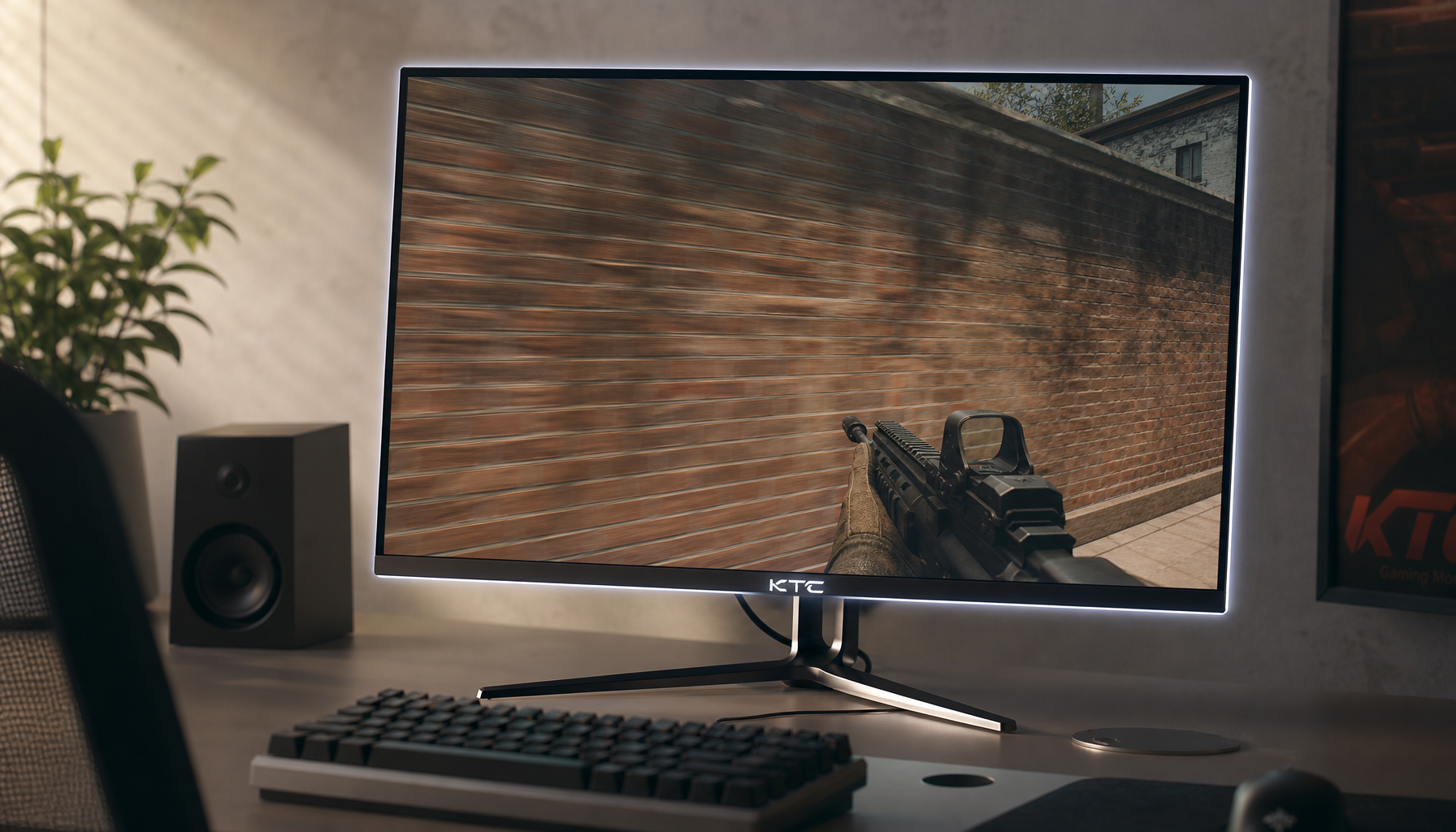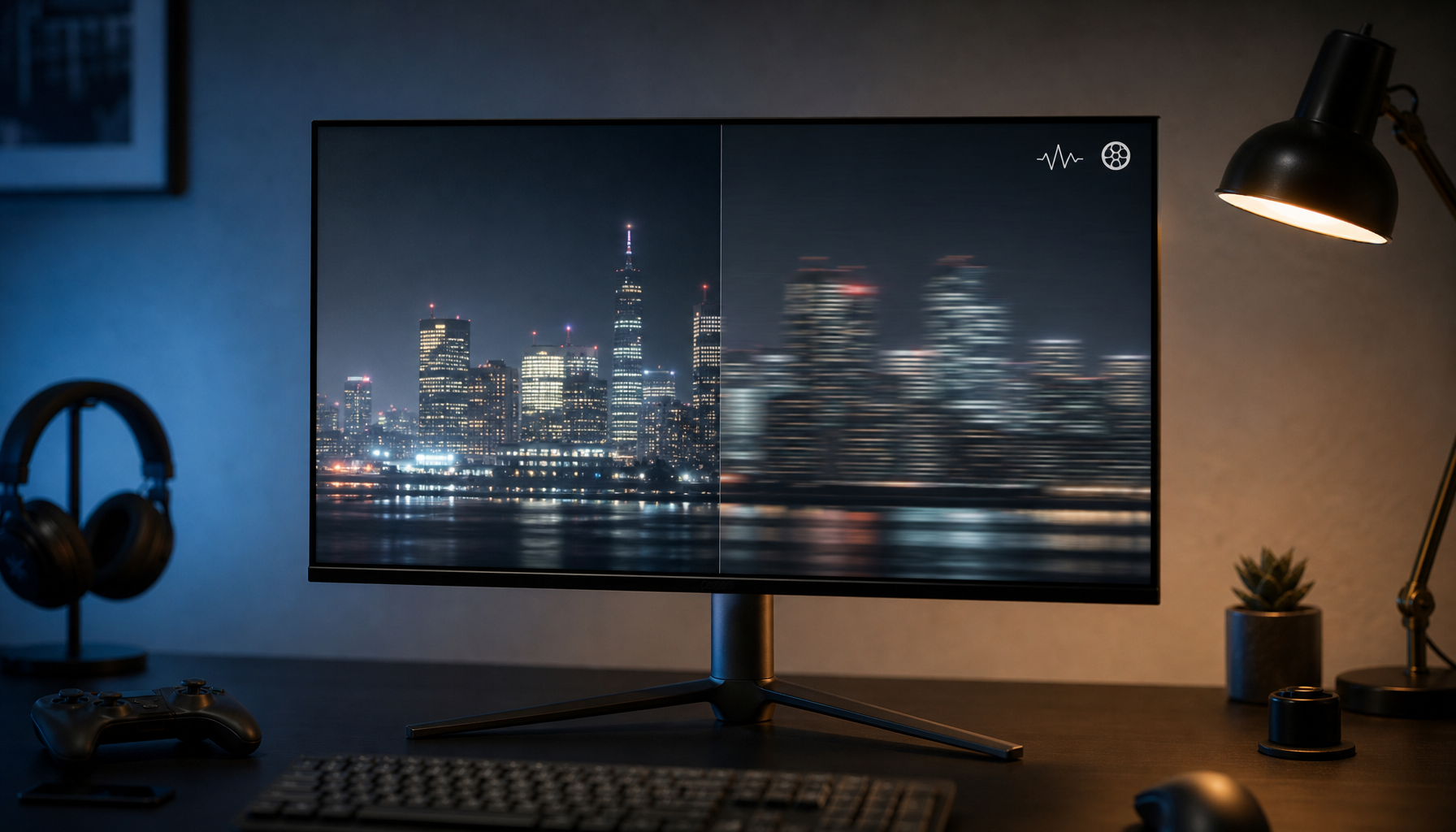


Many gamers buy an HDR-capable monitor expecting smooth, cinematic gradients in dark skies or shadowy corridors, yet still notice ugly color banding. The culprit is often color depth. Higher color depth, especially true or effective 10-bit, provides the fine luminance steps the HDR PQ curve demands. Without it, even bright, high-contrast panels can show visible stepping that breaks immersion.

The HDR Banding Mystery: Why Your High-End Monitor Looks Blocky
HDR gaming promises rich, lifelike visuals with deep blacks and bright highlights. Yet many players encounter obvious contouring—blocky lines in what should be smooth gradients—especially in night skies, fog, or dark sci-fi environments. This banding often stems from insufficient color depth rather than a defective panel.
The mismatch occurs because HDR content uses an absolute luminance scale that stretches across a much wider range than SDR. A monitor marketed as “HDR” may still rely on 8-bit color processing, which lacks the precision needed for seamless tonal transitions. The result is visible stepping that no amount of brightness alone can fully hide. Understanding color depth helps you diagnose whether your current setup is delivering genuine HDR quality or just an approximation.
Decoding Bit Depth: 8-Bit, 10-Bit, and the FRC 'Cheat Code'
Color depth determines how many distinct shades a display can produce per channel. An 8-bit panel offers 256 shades per red, green, and blue channel for roughly 16.7 million total colors. A 10-bit panel quadruples that precision with 1,024 shades per channel, yielding over 1.07 billion colors. This extra granularity is critical for HDR because it reduces the size of each luminance step.

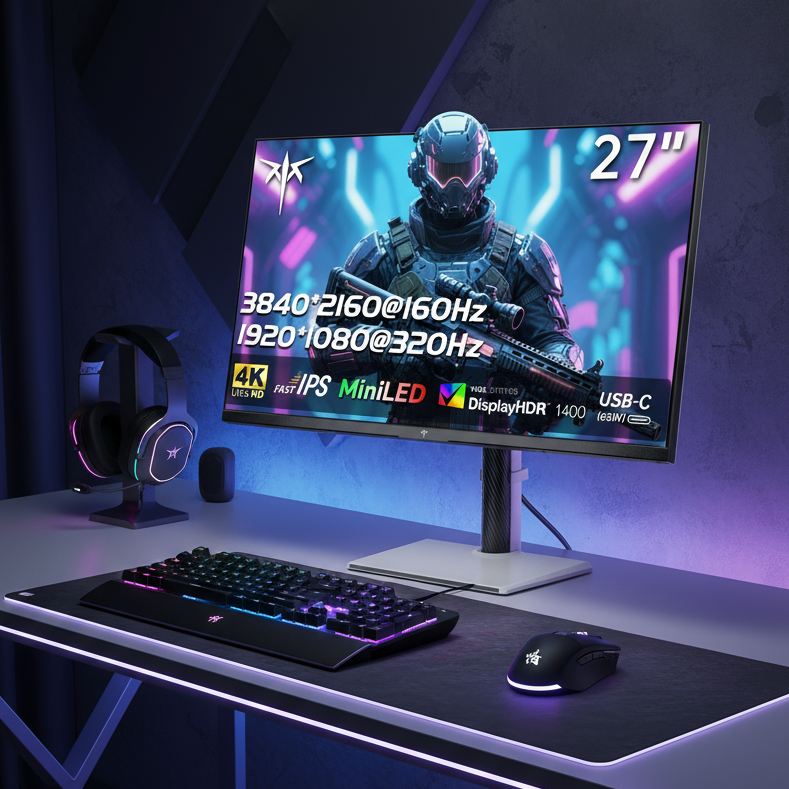
Many cost-effective gaming monitors use 8-bit panels with Frame Rate Control (FRC). FRC is a temporal dithering technique that rapidly alternates between two nearby colors to simulate intermediate shades. At refresh rates of 144Hz and above, this switching typically exceeds the human flicker fusion threshold, making the simulation perceptually stable for gaming. KTC’s M27P6 Mini-LED and G27P6 OLED models implement high-quality FRC that meets VESA DisplayHDR criteria while preserving fast refresh rates.
As this official VESA DisplayHDR performance guide explains, higher certification tiers emphasize 10-bit image processing to handle the complex gradients of bright, high-contrast scenes.
For most gamers, 8-bit + FRC delivers the 1.07 billion colors HDR content expects without the silicon cost of native 10-bit panels. The perceptual difference is negligible in fast-paced titles, though native 10-bit can offer a slight edge in color-critical creative work.
The Math of Immersion: How the PQ Curve Demands 10-Bit Precision
SDR uses a relative gamma curve that distributes tones based on the display’s maximum brightness. HDR10 relies on the ST.2084 Perceptual Quantizer (PQ) curve, an absolute scale that maps luminance from near-black up to 10,000 nits. This massive range compresses far more steps into the dark and mid-tone regions where human vision is most sensitive.
With only 256 steps, 8-bit encoding often produces jumps larger than the Just Noticeable Difference (JND) in those critical dark areas, resulting in visible banding. Ten-bit encoding cuts those steps to roughly one-quarter the size, keeping most transitions below the JND threshold and preserving shadow detail in horror games or space simulators.
Why 8-bit Works in SDR but Fails in HDR Darks
In SDR, gamma encoding usually keeps 8-bit steps within a visible-safe band for most tones. In HDR, PQ places much finer demands in the dark range, so the same 8-bit step size typically exceeds the just-noticeable-difference boundary and can reveal banding in shadow detail.
View chart data
| Category | SDR Gamma: 8-bit step vs JND band | HDR PQ: 8-bit step vs JND band |
|---|---|---|
| Dark range | 0.3 | 0.8 |
| Midtones | 0.2 | 0.6 |
| Bright highlights | 0.4 | 0.5 |
The ITU-R BT.2100 recommendation that underpins modern HDR standards therefore specifies a minimum 10-bit depth. This requirement is not marketing—it is the mathematical foundation that prevents the PQ curve from exposing banding in real games.
Beyond Bit Depth: Why Brightness and Contrast Still Rule HDR
Color depth prevents banding, but it cannot create the “HDR pop” by itself. Peak brightness, contrast ratio, and local dimming (or self-emissive OLED pixels) determine how convincingly bright highlights and deep blacks coexist on screen.
A 10-bit panel running at only HDR 400 certification will still look flat compared with a well-implemented HDR 1000 or HDR 1400 display. Conversely, an 8-bit + FRC panel paired with Mini-LED local dimming and high peak luminance can deliver more convincing HDR than a native 10-bit panel with weak contrast.
KTC’s Mini-LED models such as the M27P6 combine effective 10-bit color with 1152 dimming zones and HDR1400 brightness. The G27P6 OLED uses self-emissive pixels that achieve perfect blacks alongside 10-bit precision. These pairings illustrate why color depth should be evaluated together with contrast technology rather than in isolation.
Our guide on native versus emulated HDR explores how local dimming and OLED pixels interact with bit depth to create convincing high-dynamic-range images.
The 10-Bit Setup Checklist: Cables, Ports, and Windows Settings
Even a 10-bit capable monitor will not deliver its full potential if the signal chain forces 8-bit output. Bandwidth limitations often trigger this fallback.
4K at 160Hz with 10-bit color typically exceeds the raw capacity of HDMI 2.0 or older DisplayPort cables, forcing the system to use Display Stream Compression (DSC) or drop to 8-bit. Use certified HDMI 2.1 or high-quality DP 1.4 cables to maintain the full signal.
Verification is straightforward:
- In Windows, go to Settings > System > Display > HDR and ensure “Use HDR” is enabled. Check the Advanced display settings for 10-bit output.
- Open the NVIDIA or AMD control panel and confirm the output color depth is set to 10 bpc.
- Test with a gradient pattern; visible banding that disappears after toggling settings usually indicates an output-depth problem rather than a panel limitation.
Multi-monitor setups or older cables are common culprits that silently revert the desktop to 8-bit. The official Microsoft HDR settings page provides step-by-step instructions for confirming your configuration.
Choosing Your Spec: Competitive Esports vs. Cinematic HDR
Your playstyle should dictate how much you prioritize color depth.
Competitive esports titles played at 240Hz or 300Hz on 1080p or 1440p panels often benefit more from raw speed than from perfect gradients. In these scenarios, 8-bit panels paired with high refresh rates deliver responsive gameplay where minor banding in non-critical areas rarely affects performance. Models like the H27E6 or H25X7 prioritize frame rate and motion clarity over maximum bit depth.
Cinematic AAA games in dark or high-contrast scenes reward higher color precision. Here, 10-bit or high-quality 8-bit + FRC on Mini-LED or OLED panels significantly reduces banding and preserves shadow detail. The M27P6 and G27P6 are strong choices for players who value visual fidelity and immersion.
Our comparison of Mini-LED versus OLED gaming monitors helps clarify which panel technology best matches your preferred balance of speed, contrast, and color depth.
If you primarily play fast-paced competitive titles, check first whether your current monitor already supports 144Hz+ with FRC; upgrading may deliver less visible benefit. For rich single-player experiences, prioritize monitors with effective 10-bit output, strong local dimming or OLED contrast, and verified HDR1000+ certification. This combination future-proofs your setup as game engines continue to push HDR boundaries.
Is 8-Bit + FRC Enough for HDR Gaming?
Is 10-bit color depth necessary for all HDR gaming?
No. For competitive esports at high refresh rates, 8-bit + FRC is often sufficient and perceptually stable. Cinematic or story-driven games in dark environments benefit more noticeably from native or high-quality emulated 10-bit, but brightness and contrast remain equally important factors.
Does FRC introduce visible flicker in gaming?
At 144Hz and above, FRC dithering usually exceeds the human flicker fusion threshold, making it imperceptible during normal play. At lower frame rates or with VRR, some users report subtle artifacts; test your specific setup with gradient patterns.
Can I enable 10-bit output if my monitor only advertises 8-bit + FRC?
Many monitors internally support 10-bit signal processing even when the panel is 8-bit + FRC. Verify in Windows HDR settings and your GPU control panel. If the option is available and gradients improve, the monitor is successfully handling the higher bit depth.
Why do some HDR games still show banding on my new monitor?
Banding can originate from the game’s tone-mapping, incorrect Windows HDR calibration, or source content mastered at lower precision. Confirm your output is truly 10-bit, calibrate HDR in Windows, and test with known high-quality gradient scenes before assuming a panel limitation.
Should I choose a Mini-LED or OLED monitor for the best HDR color performance?
Both technologies excel when paired with 10-bit or effective FRC. OLED offers perfect per-pixel blacks and instant response, while Mini-LED provides higher sustained brightness and more dimming zones. Match the panel type to your room lighting and preference for motion clarity versus contrast purity.