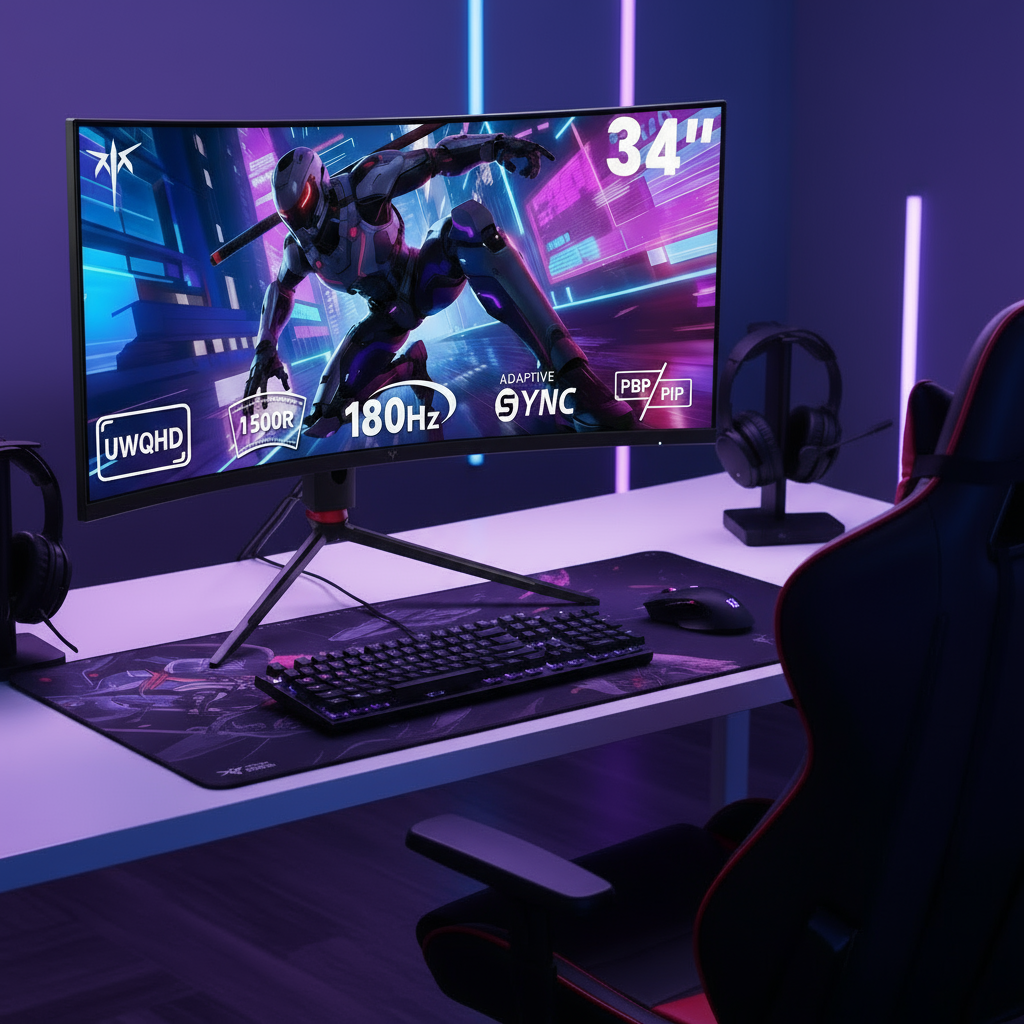




Refresh rate still matters, but it is not the whole story. Competitive feel depends on how quickly your setup samples input, delivers frames, and finishes drawing them on the screen.
Ever buy a fast gaming monitor, load into a match, and still feel like your crosshair is arriving a beat late? In real use, a jump from 240Hz to 360Hz can feel much smaller if the input side is under-sampled, while higher polling can preserve more of that upgrade on the same class of display. You will leave with a practical way to judge gaming monitors, high-refresh displays, ultrawide options, and even portable screens beyond the headline Hz number.

Refresh Rate Is Only One Part of the Timing Chain
What each spec actually controls
Refresh rate tells you how many times per second a monitor can update the image. That helps reduce motion blur, tearing, and visible latency, but it does not tell you how quickly your mouse reports movement, how much delay the monitor adds before drawing a frame, or how fast the pixels finish changing.
Mouse polling rate is how often the mouse sends position and button data to the PC. At 125Hz, it reports every 8 milliseconds; at 1,000Hz, it reports every 1 millisecond. That matters more once you move to a 144Hz, 240Hz, or 360Hz gaming monitor, because a faster display exposes timing gaps that a slower office monitor can hide.
Input lag and response time are separate monitor traits again. Input lag is the delay from your action to the on-screen result, while response time is how quickly pixels change color. A company notes that standard monitors can sit around 10-30 milliseconds of input lag, while gaming-focused panels aim for much less and often target about 1 millisecond response time for fast motion.
Why Two 240Hz Monitors Can Feel Different
Same Hz does not mean same latency
Tested input-lag floors usually drop as refresh rate rises, with figures around 8.33 milliseconds at 60Hz, 4.17 milliseconds at 120Hz, 2.09 milliseconds at 240Hz, and 1.39 milliseconds at 360Hz. The important catch is that those are floors, not guarantees. A monitor can advertise 240Hz and still feel slower because of signal processing, weaker gaming modes, or extra image handling.
Gaming monitor buying factors include response time, panel type, and connectivity alongside refresh rate. That is why one 240Hz IPS or OLED panel with clean overdrive and low lag can feel sharper in motion than another 240Hz screen that smears transitions or adds a little more processing delay.

Frame delivery changes perceived smoothness
Frame-rate mismatch is another reason same-Hz monitors can feel different. If your GPU is not delivering frames in a way the monitor can present cleanly, you can get tearing or uneven motion even on a very fast panel. Adaptive sync usually helps more than traditional sync because it cuts tearing without the same latency penalty.
That makes monitor shopping less about the biggest number on the box and more about the whole path from GPU output to visible image. A 240Hz monitor with solid VRR behavior and low lag often feels better in live matches than a higher-Hz screen that your system cannot feed consistently.
Where Polling Rate Actually Shows Up in Competitive Gaming
Oversampling usually matters more than perfect matching
A specialist platform’s guidance is useful here because it separates headline refresh upgrades from actual “upgrade feel.” In fixed-Hz esports setups running with sync disabled, matching polling rate to refresh rate is less useful than simply oversampling enough to avoid mouse microstutter. Their rule of thumb is roughly 4x-6x oversampling, with about 6x preferred.
That leads to practical pairings for monitor buyers. The same platform suggests 1,000Hz+ for 144-165Hz displays, 2,000Hz+ for 240-360Hz displays, and 4,000Hz+ for 480-720Hz displays. They also note that 1,000Hz is too low to fully support 360Hz if your goal is maximum smoothness, because it gives only about 3x oversampling, yet a 240Hz monitor is still a meaningful upgrade even if your mouse tops out at 1,000Hz.
Higher polling has limits, but high-refresh screens expose the difference
Competitive games like tactical shooters and battle royale titles benefit the most from higher polling because they reward small aim corrections and fast flicks. Multiple companies make the broader point that 1,000Hz is generally enough for many players, but the benefits above that become more visible when you also have a high-refresh gaming monitor and care about top-end responsiveness.
Very high polling rates also carry tradeoffs. They can increase USB traffic, raise CPU usage slightly, shave a little FPS in some games, and reduce battery life on wireless mice. For most buyers, that means extra polling only makes sense when the rest of the display chain is already strong enough to reveal it.
Buying Guidance for Different Monitor Types
Match the display class to the kind of competitive play you actually do
The best Hz for gaming depends on game type, GPU output, budget, and whether you value pure speed more than resolution or color. For most serious players, 144Hz is the baseline, 240Hz is the strong competitive tier, and 360Hz is where the rest of the setup has to be carefully tuned or the gain starts shrinking.
Setup |
Refresh target |
Input polling target |
What to prioritize |
Main tradeoff |
Mainstream competitive monitor |
144-165Hz |
1,000Hz+ |
Low input lag, solid 1-5 ms response, VRR |
Less headroom for top-tier esports |
Ranked FPS monitor |
240Hz |
2,000Hz+ preferred |
Low lag, fast pixel transitions, a high-bandwidth display connection, stable VRR |
Bigger GPU demand |
Tournament-focused display |
360Hz+ |
2,000Hz-8,000Hz depending on device |
Lowest lag path, clean overdrive, strong FPS consistency |
Diminishing returns and higher cost |
Ultrawide gaming monitor |
165-240Hz |
1,000Hz+ |
VRR, GPU headroom, response time, aspect ratio fit for your games |
Harder to sustain very high FPS |
Verify actual supported mode |
Match your mouse and laptop limits |
Confirm true refresh in the operating system, low-lag behavior, cable support |
Convenience often beats outright speed |
Resolution and panel choice change the buying decision as much as refresh rate does. QHD is a popular middle ground, 1080p still makes sense for maximum frame rate in esports, ultrawide panels add immersion but raise GPU load, and OLED or fast IPS panels usually give cleaner motion than slower alternatives at the same Hz.
Portable and ultrawide buyers need to verify more, not less
Advanced display settings in the operating system are especially important for ultrawide and portable monitors because the available refresh options can change with cable type, resolution, or VRR support. Some modes only appear at lower resolutions, and some systems expose fewer refresh choices over one connection type than they do over another display connection.
For a primary competitive setup, a desktop gaming monitor with known low input lag is still the safer bet. Portable monitors are useful for travel or practice, but you should treat the Hz claim as unverified until the operating system and real testing confirm what the screen is actually doing.
How to Test the Setup You Already Own
Start with software checks
Advanced display settings in the operating system show your current resolution, current refresh rate, and whether VRR is supported. That should be your first stop, because some monitors only hit their top refresh rate at a specific resolution or over a specific cable.
Polling-rate checks can tell you whether your mouse is actually running at the setting you think it is. A company recommends testing with vendor software or dedicated tools because browser-based checks can read low or unstable, which matters if you are trying to validate a 1,000Hz, 2,000Hz, or higher input path for a high-refresh display.
Then verify the monitor itself
A reference-display test is a practical home method. Put a low-lag reference screen, such as a laptop display, in clone mode next to the monitor, run a millisecond clock on both, and photograph them together. The gap between the two gives you a usable estimate of monitor lag, although slow pixel response can smear the digits.

Dedicated lag testers are more direct if you want cleaner numbers. The examples listed include several dedicated lag testers. Those measure the display itself rather than the full PC-to-display chain, so the most useful workflow is to combine direct display testing with real gameplay checks and confirmed refresh settings.
FAQ
Q: Is display polling rate the same as refresh rate?
A: No. Refresh rate is how often the monitor can update the image, while polling rate usually refers to how often a mouse reports input to the PC. Competitive feel comes from both of those plus monitor input lag, response time, and frame delivery.
Q: Should I match mouse polling rate to monitor refresh rate?
A: Usually not for fixed-Hz esports play with sync disabled. A specialist platform says oversampling by about 4x-6x is generally more useful, while exact matching makes more sense in narrower VRR cases where FPS is intentionally capped to divisors such as 125, 250, or 500.
Q: Is 1,000Hz enough for a 240Hz or 360Hz monitor?
A: It is enough for many players, and a 240Hz monitor is still a real upgrade with a 1,000Hz mouse. On 360Hz and above, though, higher polling can preserve more of the display’s smoothness and reduce input microstutter if your system can handle the extra load.
Final Takeaway
Competitive responsiveness comes from the full chain, not from refresh rate alone. The best gaming monitor is the one whose Hz, lag, response time, VRR behavior, and input path all line up with the frame rates your PC can actually sustain.
- Confirm your real refresh rate and VRR status in Settings > System > Display > Advanced display.
- Pair 144-165Hz monitors with at least 1,000Hz mouse polling, and look at 2,000Hz+ if you are buying 240-360Hz for competitive FPS.
- Prioritize low input lag and fast pixel response over a small Hz increase on paper.
- Use the highest-bandwidth connection your monitor supports when chasing top refresh modes.
- Test both the mouse polling path and the monitor itself before deciding whether an upgrade actually improved competitive feel.
References
- A specialist forum: polling rate vs refresh rate
- A company guide: what mouse polling rate means
- A company guide: monitor response times and input lag
- An operating-system support article: changing refresh rate
- A retailer guide: what to know before buying a gaming monitor
- A company guide: does polling rate affect gaming
- A forum discussion: polling rate, FPS, and screen refresh
- A review site: 60Hz vs 144Hz vs 240Hz
- A community Q&A: measuring monitor input lag
- A testing tool: mouse polling rate checker
- A company guide: understanding the best Hz for gaming monitors