


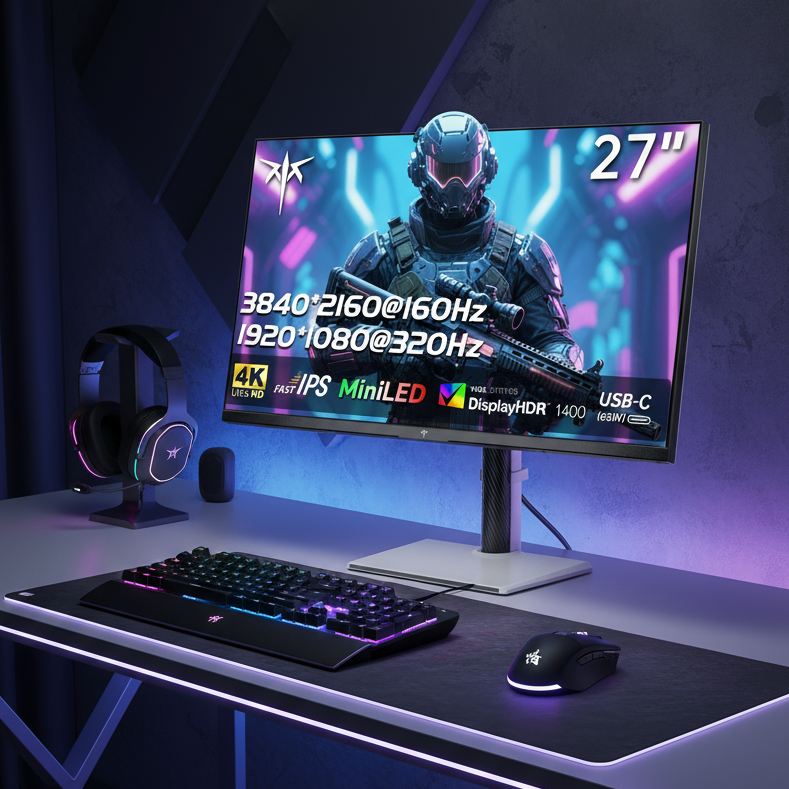


For most editors, a 27- to 32-inch 4K monitor is the practical sweet spot for 4K video editing. For 8K editing, an 8K display helps with pixel-level review, but a high-quality 4K or 5K monitor with proxies is still sufficient for many real-world workflows.
Start With the Footage, Not the Spec Sheet
Resolution is the number of pixels shown across the width and height of an image; higher resolution can reveal more detail, but it also increases storage, GPU, and playback demands.
4K UHD is 3840 x 2160, or about 8.3 million pixels. 8K UHD is 7680 x 4320, or about 33 million pixels, meaning 8K carries four times the pixel load of 4K.
That jump matters in editing. A 4K screen can show 4K footage at native resolution, but timeline panels, scopes, bins, and controls still need room. That is why many professional editors prefer a 27- to 32-inch 4K monitor or step up to 5K or ultrawide displays for more workspace.

For 4K Editing: 4K Is Enough, 5K Is Comfortable
A 4K monitor is the sensible baseline for serious 4K work because 4K capture is now common across cameras and cell phones; a 4K monitor lets you judge focus, compression artifacts, titles, and fine detail without guessing.
For most creators, 27 inches at 4K feels sharp and efficient. At 32 inches, 4K gives more physical space while keeping interface elements readable, which helps long editing sessions feel less cramped.
A 5K display is not mandatory, but it is useful for productivity. It can show a full 4K image while leaving extra pixels for editing controls, so you spend less time resizing panels and more time making decisions.

Key takeaways:
- Casual 4K cuts: 1440p can work, but expect compromises.
- Serious 4K editing: choose a 27- to 32-inch 4K monitor.
- Color and timeline-heavy work: consider 5K or dual displays.
- Budget workflow: use proxies before buying a higher-resolution screen.
For 8K Editing: 8K Helps, But It Is Not Always Required
8K editing is different because the display cannot be treated as the whole workflow. You need the screen, but you also need the GPU, storage, ports, cables, codec support, and playback performance to keep up.

An 8K panel is best when you need to inspect native 8K footage at 1:1 scale, check fine texture, crop aggressively, or deliver to large-format screens. Because 8K resolution gives editors room to crop or enlarge while preserving 4K output, it is especially valuable for reframing, stabilization, VFX review, and premium commercial work.
Still, many 8K projects can be edited well on 4K monitors using proxies. You can cut smoothly in a lower-resolution proxy timeline, then relink to full-resolution media for final rendering and quality control.
If your final delivery is 4K, an 8K monitor may improve review precision, but it will not automatically improve the delivered image.
Do Not Ignore Color, Panel Quality, and Connectivity
For editing, resolution is only one part of what makes a monitor sufficient. A sharp monitor with weak color is a poor grading tool.

Look for strong Rec.709 coverage for standard video, DCI-P3 coverage for wider-gamut work, and factory calibration if you need reliable color out of the box. A 10-bit panel is preferable for serious grading because it reduces banding and gives smoother tonal transitions.
Connectivity matters too. 4K at 60Hz is widely supported over HDMI 2.0 or DisplayPort, while 8K workflows usually demand newer, higher-bandwidth connections. HDMI 2.1 is commonly associated with higher-resolution, higher-refresh display output, but the full signal chain must support it.
The Practical Buying Answer
For 4K video editing, buy a color-accurate 4K monitor before chasing 8K. A 27-inch model is compact and sharp; a 32-inch model is better for immersive timelines and detailed review.
For 8K video editing, choose 8K only if you regularly inspect native 8K, crop heavily, master for large screens, or need maximum long-term flexibility. Otherwise, a high-grade 4K or 5K display, proxy workflow, fast storage, and accurate color will deliver better value.
The performance-driven choice is not always the biggest pixel count. It is the display that lets you see the truth of your footage, move quickly, and finish with confidence.


