









Display Stream Compression lets modern gaming monitors hit demanding modes like 4K 240 Hz without an obvious image-quality penalty for most players. It is lossy in a technical sense, but it is built to look effectively identical to the original signal in normal use.
If you have ever connected a new high-refresh monitor and wondered whether the compressed signal is making games look softer or feel slower, that concern is reasonable. One published monitor test measured 4.714 ms of lag with the feature on and 4.718 ms with it off at 165 Hz, which is the kind of gap players cannot separate in real play. The real question is when DSC is simply doing its job and when it becomes something worth checking before you buy.
Why Modern Monitors Use DSC
The bandwidth problem
Display Stream Compression is an industry video compression standard for common display interfaces, created so monitors can run higher resolutions, faster refresh rates, and higher color depth than an uncompressed link would normally allow. In monitor terms, it is the technology that helps a single cable carry ambitious modes that would otherwise exceed the port’s usable bandwidth.
Monitor bandwidth is higher than raw pixel math suggests, because the signal includes timing data in addition to the visible image. That is why a spec jump from 1440p to 4K, or from 144 Hz to 240 Hz, can push a gaming monitor past the practical ceiling of the connection even when the numbers look close on paper.
How DSC stays practical for gaming
DSC works as a low-delay predictive codec, with an encoder in the source device and a decoder in the monitor. It also splits frames into slices so they can be processed in parallel, which is part of why it fits interactive display use better than heavy video compression designed for movies or streaming.
Does DSC Make Games Look Worse?
Visually lossless does not mean mathematically identical
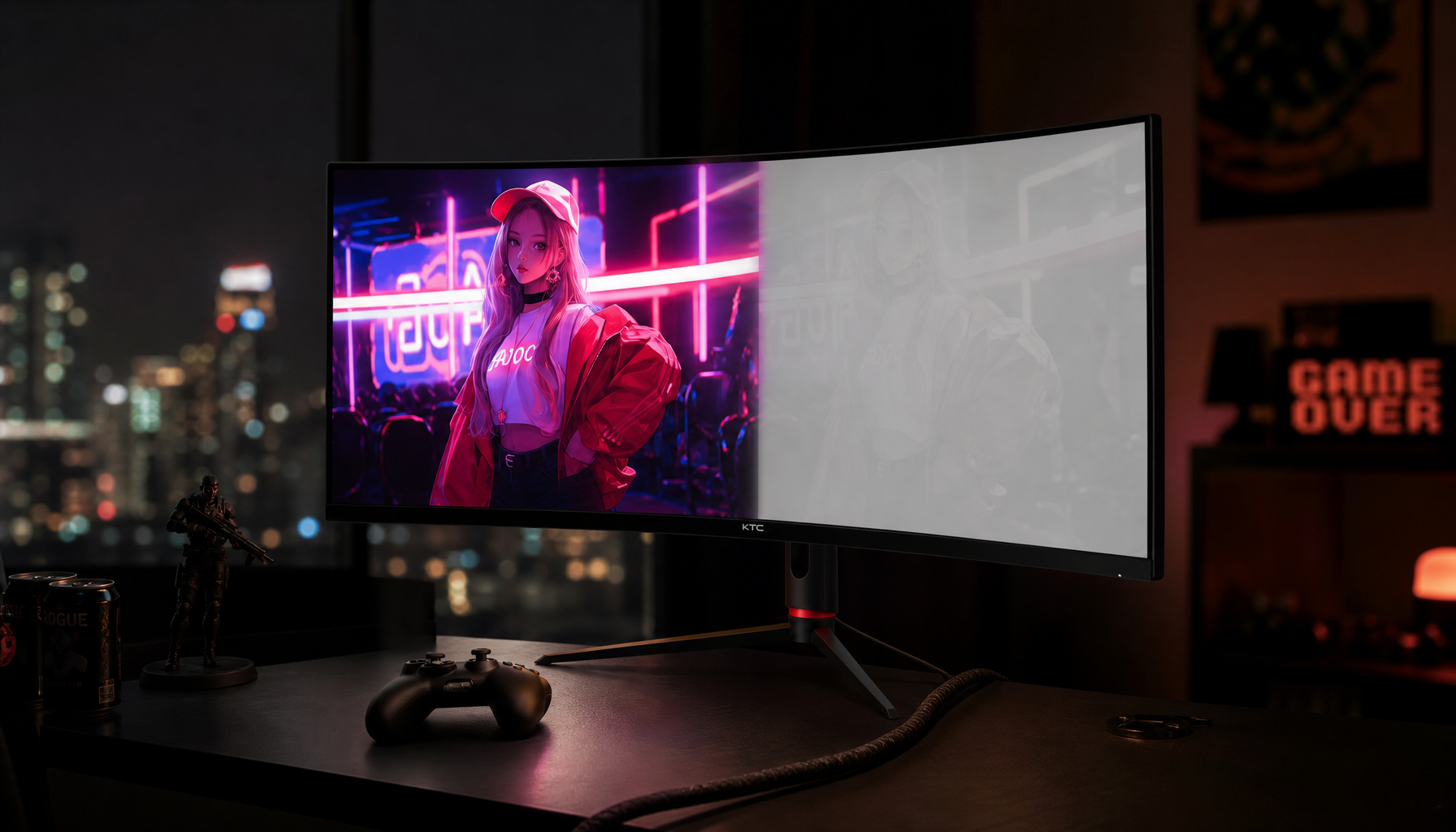
DSC is not mathematically lossless, but it was designed to meet a visually lossless target, meaning most users should not reliably tell compressed output from the original image. That distinction matters for monitor buyers: the image is not bit-for-bit identical, yet the goal is that you should not notice the difference during normal play.
The edge cases are real, though. Compression artifacts are more likely to show up around sharp text, UI edges, and certain scene transitions, especially when a display path also uses reduced-color output such as 4:2:2 or 4:2:0. On a desktop monitor, that kind of issue is easier to spot in a browser tab, a game HUD, or small white text on a colored background than in a fast-moving action scene.

Where buyers actually notice differences
Most gaming-monitor DSC implementations target up to a 3:1 ratio, which is far less alarming than the worst-case examples people imagine when they hear the word compression. In practice, the buyers most likely to scrutinize DSC are the ones using a monitor for both play and close-up desktop work, where fine text and flat-color UI make tiny flaws easier to catch.
Does DSC Add Input Lag?
The design target is low latency
DSC uses an intra-frame, line-based path built for low encode and decode delay. That is why monitor makers use it for high-refresh displays in the first place: if compression added a meaningful delay, it would undermine the reason people buy 165 Hz, 240 Hz, and faster panels.
One published monitor test found essentially no lag gap with DSC enabled: 4.714 ms with DSC on versus 4.718 ms with DSC off at 165 Hz. Another source also cites the added delay as roughly 0.001 ms, which is so small that it sits far below the normal variation introduced by the display pipeline, refresh timing, and the game engine itself.
Why some users still report a problem
Latency complaints tend to come from system-level edge cases, where frame pacing, variable refresh behavior, driver handling, or aggressive compression choices interact badly with a specific setup. That does not mean every complaint is imaginary; it means the compression step is usually only one small part of a much larger chain.
When You Should Care About DSC as a Monitor Buyer
The setups where DSC matters most
DSC is what makes modes like 4K 240 Hz and 8K 60 Hz practical on many links, so it matters most when you are shopping for premium gaming monitors rather than ordinary midrange panels. If your goal is a high-refresh 1440p display, DSC may never affect your decision. If your goal is 4K 240 Hz, a high-end ultrawide, or heavy HDR use at maximum refresh, it becomes part of the monitor’s normal operating path. The same check can apply to 4K 160Hz-class options such as the a brand 27” 4K 160Hz/320Hz 90W Gaming Monitor, where buyers should confirm whether the top refresh mode they plan to use depends on DSC over their intended cable and GPU output.
DSC is usually enabled automatically when the source, cable, and monitor all support it. That is convenient for a single high-end gaming monitor, but it can make very wide multi-monitor desktops or unusual refresh-and-HDR combinations harder to troubleshoot because there is often no simple on/off switch in the monitor menu.
Mixed-use buyers should pay closer attention
A current console without DSC support can fall back to reduced-color output at 4K 120 Hz on some displays, which makes DSC more important for buyers who split time between PC gaming and console gaming. A PC-only buyer may never notice the issue; a cross-platform buyer may care a lot about whether the monitor can keep full-quality color at the desired mode.

Setup |
How likely DSC is involved |
Why it matters |
What to check |
1440p high-refresh esports monitor |
Low to medium |
Often runs fine without DSC unless HDR or color depth pushes bandwidth |
Confirm the exact max mode you want |
4K 240 Hz gaming monitor |
High |
DSC is commonly part of reaching the advertised refresh rate |
|
3440x1440 ultrawide high refresh |
Medium |
Refresh rate, HDR, and bit depth can push the link harder than expected |
Look for artifact reports tied to mode switching |
8K 60 Hz or 4K 240 Hz HDR |
Very high |
DSC is part of the intended transport path |
Verify source, cable, and port support |
Console plus DSC-dependent monitor |
Medium to high |
Some sources may drop to reduced chroma or a lower mode |
Check 4K 120 Hz behavior before buying |
Troubleshooting DSC Issues Without Guesswork
Start with compatibility, not fear
A DSC link only works when both ends support it, and that support is negotiated during link training before the compressed stream starts. For buyers, that means the checklist is straightforward: the source must support DSC, the monitor input must support DSC, and the target mode must be available over that exact port.
Real-world issues are usually messy, not universal
Ultrawide artifact reports after fullscreen and window-mode changes suggest that some issues blamed on DSC are really handshake problems, application bugs, or display-state glitches. In that thread, users reported that toggling fullscreen cleared the problem about 70% of the time, which is a strong clue that the failure was not simple permanent image degradation.
A separate 4K 240 Hz user report described black screens that improved after a firmware update. That is only anecdotal evidence, but it lines up with a practical lesson monitor buyers should remember: update firmware, test another cable, and check operating-system behavior before deciding that DSC itself is the root cause.

FAQ
Q: Can you turn DSC off on a gaming monitor?
A: Most DSC monitor paths switch on automatically when the link needs it, so many monitors and drivers do not offer a clean manual toggle.
Q: Is DSC better than dropping to 4:2:2 or 4:2:0 on a monitor?
A: Reduced-color modes are more likely to show artifacts on small text and sharp UI edges, so DSC is usually the cleaner compromise for a PC monitor used at close range.
Q: Should DSC stop me from buying a 4K 240 Hz monitor?
A: A 4K 240 Hz mode often exists because of DSC, so the better question is whether that specific monitor-source combination is stable in your setup, not whether DSC is present at all.
Final Takeaway
DSC is a normal part of modern high-end display design: it exists to unlock monitor modes that common display links cannot carry uncompressed, and in most gaming use it does that without visible harm or meaningful lag. The buyers who should care most are the ones chasing maximum specs, mixing PC and console use, or relying on a monitor for both fast games and close-up text work.
- Match the exact mode you want: resolution, refresh rate, HDR, and bit depth.
- Confirm DSC support on the specific port used on both the source and the monitor.
- If you also use a console, verify how the display handles 4K 120 Hz and chroma.
- Update monitor firmware and graphics drivers before judging stability.
- Test fullscreen swaps, VRR on and off, and long sessions instead of only a quick desktop check.
- If text clarity matters for work, inspect a browser window and game HUDs, not just cinematic scenes.


%20enables%20modes%20like%204K%20240Hz%20on%20gaming%20monitors.%20See%20how%20this%20visually%20lossless%20tech%20works%20without%20adding%20input%20lag%20or%20degrading%20your%20image%20quality.
)