

Creative agencies in 2026 can scale high-performance monitor fleets without the traditional 30-50% brand markup by sourcing factory-direct OEM hardware. This 'Manufacturing Insurgent' approach shifts the focus from single premium purchases to building resilient fleets with built-in redundancy, freeing capital for talent, software, and compute while meeting Mini-LED and 5K demands for color-critical design work.

The 'Manufacturing Insurgent' Strategy: Why Factory-Direct Wins in 2026
Many creative directors still evaluate monitors as individual premium units from established brands. The insurgent mindset instead treats display procurement as vertical integration arbitrage: agencies buy professional-grade panels directly from manufacturers, bypassing the brand tax that often adds 30-50% to costs.
This strategy works because display manufacturing is heavily vertically integrated. OEM suppliers produce the core panels, backlights, and electronics that power both budget and premium models. By procuring at the factory level, agencies capture savings that can fund additional units or other studio upgrades.
For agencies equipping new studios or refreshing multi-seat fleets, the math favors this model once fleet size reaches five or more units. Savings compound through standardized specs, on-site spares, and reduced dependency on vendor SLAs. The result is enterprise-grade infrastructure without the enterprise price tag, provided agencies manage the operational differences proactively.
2026 Decision Criteria: Mini-LED, 5K, and Fleet Standardization
Professional creative workstations in 2026 require more than basic 4K resolution. A 5K panel delivering 5120 x 2880 pixels provides roughly 77% more pixels than standard 4K, according to resolution analysis for professional workflows. This higher pixel density (around 218 PPI on a 27-inch display) supports native macOS Retina scaling without artifacts, letting designers inspect fine typography, UI details, and photo retouching at 1:1 while maintaining ample workspace.
Mini-LED backlighting has become the resilient production workhorse for most agency roles. As VESA DisplayHDR performance criteria outline, high-tier Mini-LED implementations achieve sustained peak brightness and HDR performance suitable for video grading and motion graphics. Unlike OLED, Mini-LED avoids permanent burn-in risk during the long hours when toolbars, timelines, and palettes remain static—an important consideration for UI/UX, video editing, and Figma-heavy teams.
VESA DisplayHDR 1400 or 1000 certification signals meaningful real-world HDR capability, with strict requirements for peak luminance, contrast, and black levels. For agencies handling client deliverables, these tiers help ensure consistent output across the fleet.
The optimal deployment splits by duty cycle. Standardize Mini-LED for daily production workstations where UI elements stay fixed for 8-10 hours. Reserve OLED panels for dedicated color-grading and final-review suites where content variance is high and deep blacks drive the decision. This tiered approach avoids the OLED TCO trap: a 20% image-quality gain can be erased by earlier replacement due to ghosting in static UI environments.
For deeper context on color metrics that matter in creative work, see our guide to what Delta E values actually mean for your creative work. Teams weighing backlight technology upgrades may also consult Mini-LED IPS vs. Standard IPS: Is the Advanced Backlight Worth the Upgrade?.
Break-Even Threshold for Hot Spares vs Premium SLA
Shows the discount range where buying OEM units plus 15% hot spares can move ahead of premium-brand SLAs. The chart uses conservative tiers to highlight the break-even region rather than exact measured savings.
View chart data
| Category | Premium SLA | OEM + Hot Spares |
|---|---|---|
| 5 units | 0.0 | 0.0 |
| 10 units | 0.0 | 15.0 |
| 20 units | 0.0 | 25.0 |
Procurement Strategy: The 'Spare Buffer' Threshold
Premium brands often advertise next-day or on-site replacement. OEM options typically rely on mail-in RMAs that can take days. Rather than chasing faster vendor support, successful agencies calculate whether the 40-60% OEM discount allows them to self-insure with a local hot-spare inventory.
The practical rule of thumb is the 15% buffer: when the discount reaches 40% or more, agencies can purchase 15% extra units as spares and still realize approximately 25% net savings versus premium equivalents. For a 10-monitor fleet, the brand tax often equals the cost of 4-6 additional OEM units. Unless the agency faces an unrealistic simultaneous failure rate above 50%, the OEM path delivers better uptime.
On-site spares reduce downtime from 24 hours (typical premium SLA) to roughly 15 minutes (internal swap). This makes the seemingly “riskier” OEM route more reliable for client deadlines. The strategy scales best at fleets of five or more units, where spare pooling becomes statistically effective.
Agencies should model their own failure history and lead times before committing. The threshold chart above visualizes the pattern: savings accelerate as fleet size and discount depth increase.
Deployment: Calibration, Consistency, and the 'Toggle Tax'
OEM monitors rarely ship with factory Delta-E below 1. Agencies must invest in professional calibration hardware, such as a colorimeter, and establish standardized protocols to maintain fleet-wide consistency. Without these steps, color drift can appear over months of use, undermining client deliverables.
The “toggle tax” captures several hidden operational costs. First-hour setup—including manual calibration and third-party utilities for macOS brightness and color-profile management—can require $150 in internal labor per unit. Quarterly recalibration may add four hours of IT time per year across the fleet. Designers also lose 5-10 seconds per context switch when adjusting settings without native OS integration, an effect that accumulates across a 260-day work year.
These frictions matter most for lean teams or high-billable-rate environments. For studios where screen real estate outweighs perfect out-of-box accuracy, the trade-offs remain acceptable. Third-party DDC/CI tools have improved, yet they remain workarounds rather than seamless enterprise solutions.
Successful deployments begin with a pilot fleet of three to five units. Measure real calibration time, utility stability, and designer feedback before scaling. Cloud-based color-management platforms can reduce manual oversight once the fleet grows. For practical verification steps, review how to verify your display calibration is actually working. Teams focused on client-facing color accuracy may also explore what drives the growing demand for creator-to-consumer color matching tools?.

Risk Control: Avoiding Common OEM Sourcing Mistakes
Not every factory-direct model delivers identical firmware stability or panel quality. Agencies should verify specific panel lots, request batch consistency guarantees where possible, and avoid “QA roulette” by sticking to proven SKUs rather than chasing the lowest price.
Start with a pilot fleet to surface integration issues before full rollout. Document calibration procedures, spare inventory policy, and utility configurations so new hires or contractors can maintain standards. Track total cost of ownership—including calibration labor, recalibration frequency, and downtime—rather than unit price alone.
Warranty coverage remains a managed risk rather than a direct equivalent to premium enterprise SLAs. The hot-spare strategy mitigates this by keeping replacement hardware on-site. Agencies should also confirm regional return policies and lead times before committing large orders.
Executing the Fleet Transition in 2026
Begin the transition with a clear audit of current workstations: record resolution, color coverage, age, and failure patterns. Identify which roles need 5K sharpness versus which benefit most from Mini-LED brightness and longevity. Calculate the 15% hot-spare buffer based on your fleet size and expected discount.
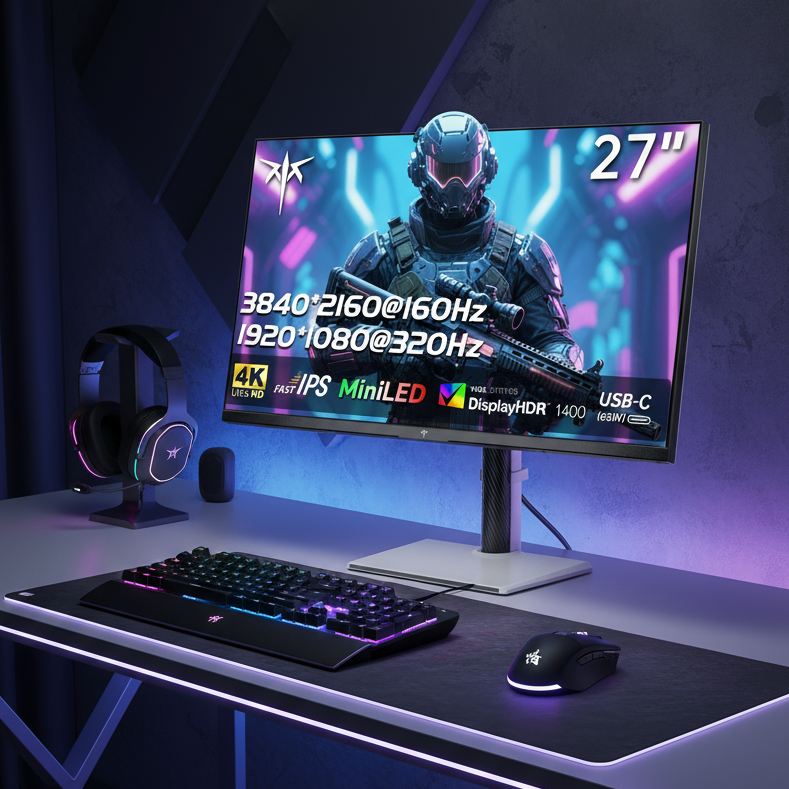
Select a pilot group using models that match your dominant workflows. The KTC 27" 5K@60Hz 2K@120Hz Home&Office Monitor | H27P3 suits Mac-heavy design and text-critical tasks with its high pixel density and strong color volume. For production workstations requiring sustained HDR and high brightness, the KTC Mini LED 27" 4K 160Hz HDR1400 Gaming Monitor | M27P6 provides Mini-LED performance within a realistic budget.
Standardize cabling, calibration targets, and utility profiles across the pilot. Measure actual deployment time, color consistency after 30 days, and any macOS integration friction. Once validated, expand using the spare-buffer model and schedule recurring calibration cycles.
The core value remains enterprise performance without the brand tax. Agencies that treat OEM hardware as a fleet system—complete with internal redundancy, standardized processes, and measured TCO—consistently report lower hardware spend and faster iteration. Those expecting plug-and-play perfection similar to premium ecosystems will encounter friction. The insurgent path rewards preparation, redundancy planning, and a willingness to manage calibration in-house.
How Much Can Creative Agencies Realistically Save with OEM Monitors?
Savings typically range from 30-50% per unit compared with equivalent premium-brand specifications, but net savings depend on the hot-spare buffer and operational costs. For fleets of 10 or more, the model often delivers 20-30% lower five-year TCO when calibration labor and spares are factored in. Smaller teams or those requiring extensive custom integration may see lower net gains.
Is OEM Hardware Suitable for Color-Critical Client Deliverables?
Yes, provided agencies implement standardized calibration protocols and periodic verification. OEM panels can achieve professional color accuracy with agency-side tools, but they do not match the out-of-box factory calibration of some premium reference displays. A pilot program measuring Delta-E consistency across units is recommended before full commitment.
How Does Mini-LED Compare to OLED for Agency Production Work?
Mini-LED is generally the safer choice for UI-heavy production roles because it avoids burn-in risk during extended static toolbar and timeline use while delivering strong sustained brightness. OLED remains preferable for dedicated grading suites where maximum contrast and black levels are the priority and content changes frequently.
What Are the Main Hidden Costs When Deploying an OEM Fleet?
Primary hidden costs include initial calibration labor, ongoing recalibration time, investment in color-measurement hardware, and productivity loss from non-native brightness and profile controls (the “toggle tax”). These can add $150–$300 per unit in the first year but decline with standardization and fleet-management tools.
When Does the Hot-Spare Strategy Stop Making Sense?
The strategy weakens when expected simultaneous failure rates exceed roughly 50% of the spare buffer or when the agency cannot store and rotate spares effectively. It also becomes less compelling for very small fleets (under five units) where pooling benefits are limited. In those cases, premium support contracts may justify their cost.
How Should Agencies Handle Warranty and Support Differences?
Treat OEM warranties as a risk to manage through redundancy rather than a direct substitute for enterprise SLAs. Maintain a 15% hot-spare inventory, document RMA processes, and verify regional service capabilities. Most agencies find that on-site swaps more than offset slower vendor turnaround for deadline-driven creative work.