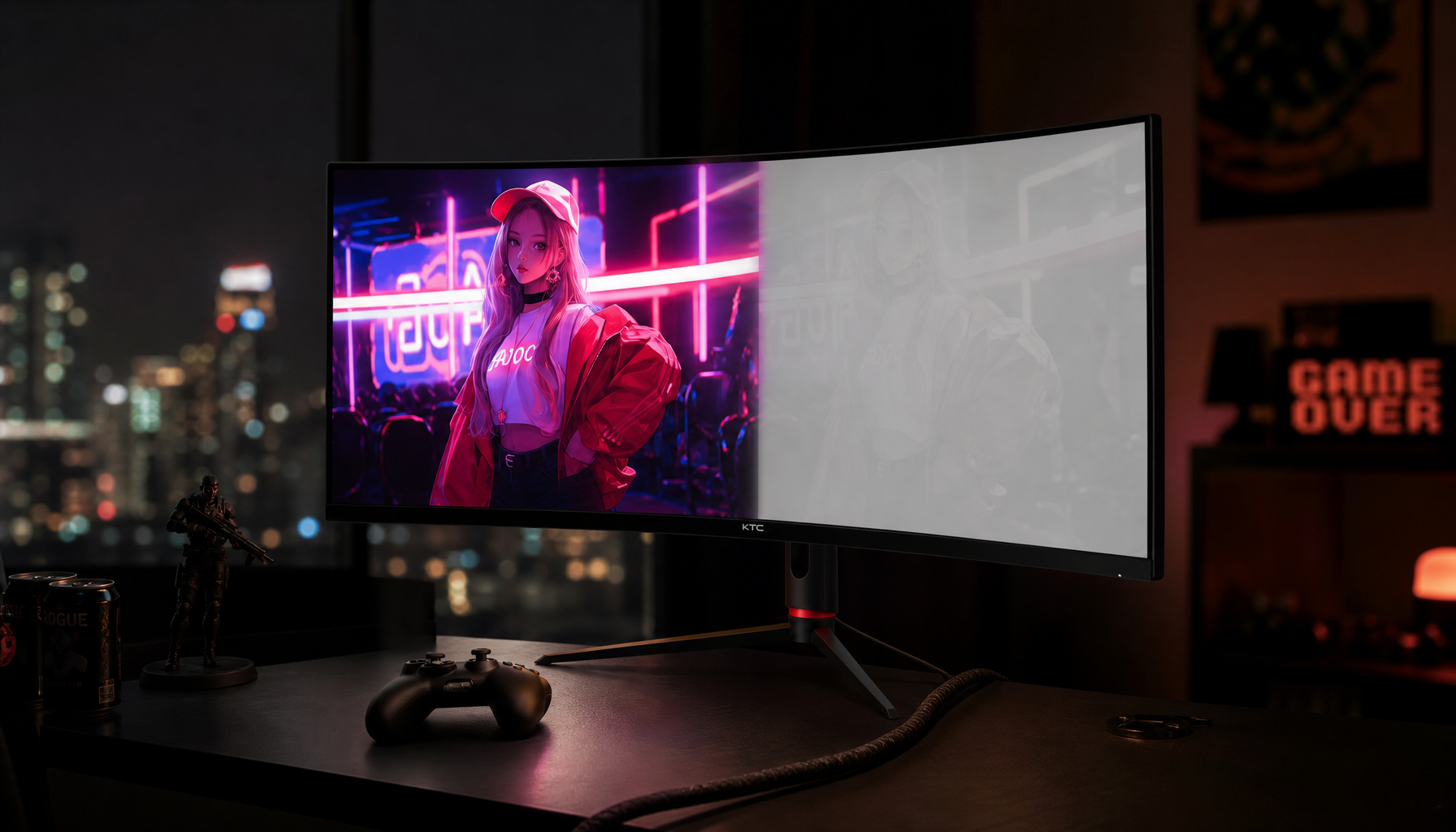
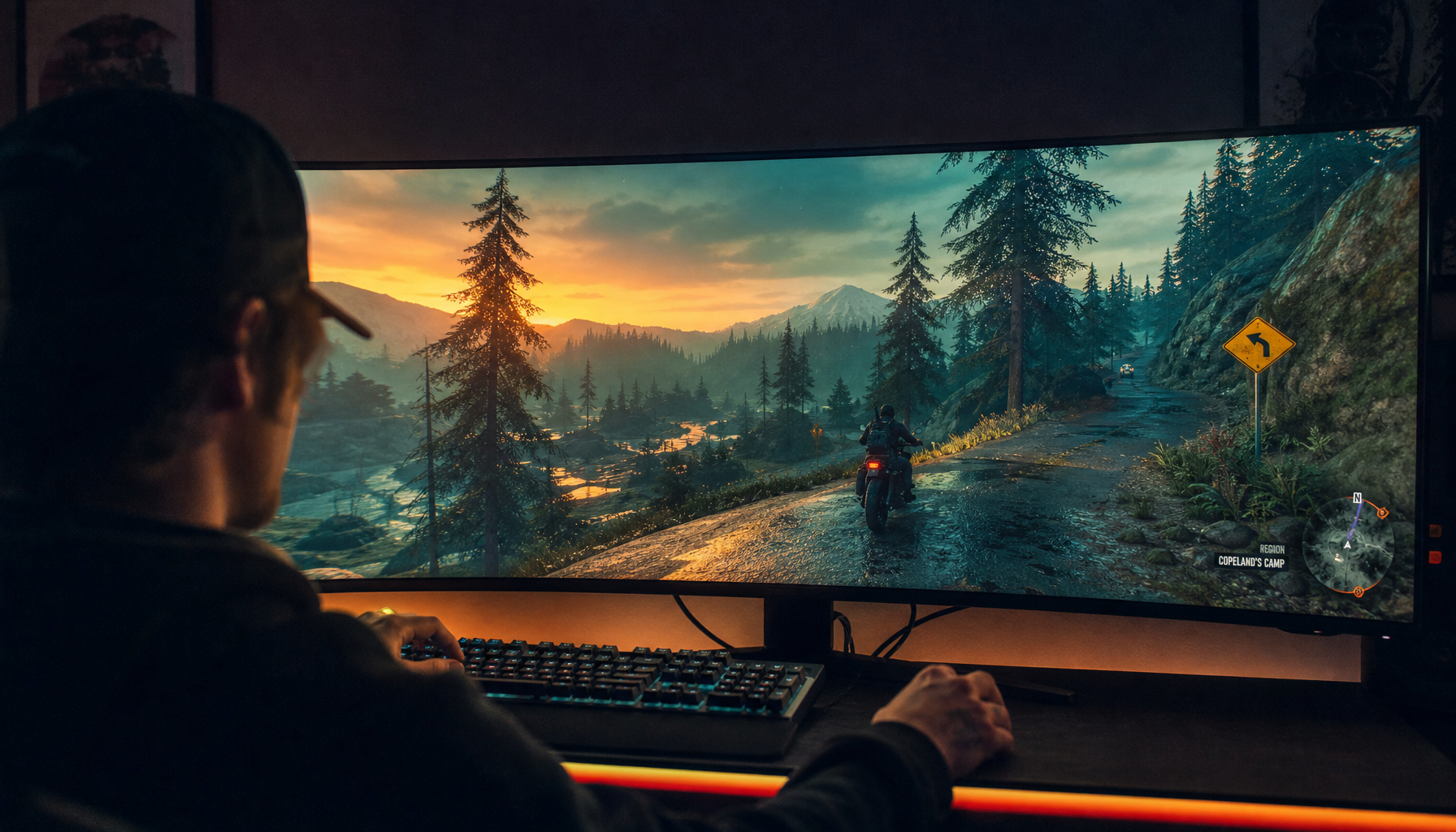
Gaming HDR and video HDR both need high contrast, wide color, and smart tone mapping, but they serve different goals: games must react instantly to player input, while video must preserve a mastered creative image.
Does your HDR game look punchy while the same monitor makes movies look dim, or does a streaming film look controlled while a game blows out the sky? A few display choices, especially peak brightness, local dimming behavior, and calibration mode, can make HDR more consistent without buying the wrong screen. Here is a practical way to match monitor specs and settings to gaming, video watching, and HDR content creation.
The Core Difference: Real-Time Rendering Versus Mastered Playback
Video HDR is usually a finished image. A movie, streaming show, or graded video has already been shaped by a colorist around a target display, mastering brightness, black level, and color volume. HDR10 commonly uses static metadata, while dynamic HDR formats can use scene-level or shot-level metadata to help a display preserve highlights, shadows, and color when the panel cannot reproduce the full mastered range.
Gaming HDR is generated in real time. The engine renders a changing scene, the player moves the camera, the UI must stay readable, and latency matters. That is why a gaming display cannot be judged only by “HDR supported.” It also needs refresh rate, response time, input latency discipline, and HDR calibration that matches the game’s actual output. A monitor that accepts HDR10 may decode the signal, but HDR support alone does not prove that it has enough brightness, contrast, or color performance to make HDR look better than calibrated SDR.

In practical terms, a video display is rewarded for stable accuracy. A gaming display is rewarded for accuracy plus speed. The same 32-inch 4K monitor can be excellent for cinematic games and merely average for HDR video grading if its tone mapping cannot track playback cleanly or if its local dimming changes too aggressively around subtitles and editing interfaces.
Video HDR Needs Creative Consistency First
Why Tone Mapping Matters More Than Raw Brightness
Most consumer monitors cannot reproduce every HDR master directly. Some HDR movies or streams may be mastered for 1,000 nits, while others may carry 4,000-nit metadata. If your monitor peaks at 600 nits, it has to compress the signal into what it can actually show. That process, tone mapping, affects whether a bright window keeps texture, whether a face looks natural, and whether shadow detail is visible instead of crushed.
For video, the best display behavior is predictable. You want accurate EOTF tracking, restrained processing, good black levels, and a picture mode that does not “improve” the image by changing it from scene to scene in uncontrolled ways. HDR calibration is difficult because HDR content is mastered inconsistently, so chasing one movie until it looks perfect can make the next title look wrong.
For example, if one movie’s highlights are authored around 1,000 nits and another title signals 4,000 nits, a 600-nit monitor must make different compromises. Good tone mapping rolls off highlight brightness smoothly so clouds, lamps, and reflections keep detail. Poor tone mapping either clips the highlight to plain white or dims the whole image until the scene loses impact.
What Video-Oriented HDR Displays Should Prioritize
A video-first HDR display should prioritize contrast, black level, color accuracy, and stable tone mapping before gaming speed. OLED often performs beautifully in a dim room because each pixel can shut off independently, giving dark scenes real depth. Mini-LED LCDs can be stronger in bright rooms because they can push higher peak brightness, although dimming-zone behavior can create blooming around credits, subtitles, or bright objects on dark backgrounds.
For HDR video editing, the bar rises. Editing software can support HDR workflows, but hardware is the harder budget problem because HDR footage carries more image information and needs a trustworthy monitoring chain. HDR workflow notes emphasize that editors need an HDR-capable monitor for judging exposure, luminance, and highlight decisions instead of guessing from an SDR preview.

Gaming HDR Needs Speed, Visibility, and Calibration Control
The Display Has to Keep Up With the Player
Gaming HDR has a harder timing problem. A racing game at 120Hz, a shooter with fast camera turns, or an open-world title with bright sun and dark interiors needs HDR rendering without adding noticeable input delay or motion artifacts. High peak brightness is useful, but it does not compensate for slow pixel response, weak overdrive tuning, or local dimming that visibly lags behind moving highlights.
That is why a strong HDR gaming monitor still needs the fundamentals: high refresh rate, low response time, adaptive sync, and a panel mode designed for games. Operating-system Auto HDR can also expand older DirectX 11 and DirectX 12 SDR games into an HDR-like presentation, but native HDR remains the cleaner target because the game engine can expose brightness and paper-white controls directly.
Games also use HDR as a visibility tool. In a dark hallway, the right HDR setup can reveal shadow detail without flattening the mood. In a bright desert or snow scene, it can preserve intensity without hiding enemies or UI elements. If the monitor clips highlights or crushes blacks, the problem is not just beauty; it can affect play.

Why Peak Brightness Is Important but Not Absolute
For gaming, many buyers aim for 600 to 1,000 nits or higher because highlights such as explosions, neon, headlights, and sun glints benefit from headroom. Certification tiers are useful because a clearer baseline is better than vague labels like “HDR Ready.” Entry-level HDR certification can improve compatibility, while higher tiers generally imply stronger brightness, color, and dimming capability.
Still, peak brightness alone is not the full story. A 1,000-nit edge-lit LCD with weak blacks can look worse in a dark game than a lower-brightness OLED with excellent contrast. Some players also enjoy HDR on lower-brightness monitors when the game implementation, color gamut, and tone mapping are good. That does not make 300-nit HDR equivalent to premium HDR; it means the best purchase decision weighs the whole chain, not one spec.
Display trait |
More important for HDR gaming |
More important for HDR video |
Peak brightness |
High impact for effects and bright scenes |
Important, but controlled roll-off matters more |
Black level |
Critical for dark games and horror titles |
Critical for cinematic depth and shadow detail |
Local dimming |
Must react quickly without distracting halos |
Must stay stable around subtitles and credits |
Refresh rate |
Essential for competitive and fast games |
Usually secondary for film and video playback |
Color accuracy |
Important, especially for premium visuals |
Essential for faithful viewing and editing |
Tone mapping controls |
Needed per game or platform |
Needed for consistent mastering intent |
Why Operating Systems and Input Devices Change the Result
HDR is a chain, not a monitor feature in isolation. The input device, cable, operating system, app, game, content metadata, GPU driver, and monitor mode all have to agree. On desktop computers, HDR behavior is especially important because the system may combine SDR apps, HDR video, and games across one or more displays.
Desktop HDR settings can involve tone mapping on the GPU before composition, using monitor color information and HDR metadata. That matters because different HDR modes may change brightness limits and color behavior. In some cases, a certified mode may favor accuracy while another HDR10 mode may raise peak brightness.
A practical desk example: if your monitor offers one HDR mode limited to midrange brightness and another HDR10 mode that reaches higher peak brightness, movie playback may look more controlled in the accurate mode, while a game may feel more impactful in the brighter mode. The right choice depends on whether you value reference-like color or maximum highlight punch for that session.
OLED, Mini-LED, and Standard LCD: Different Strengths for Different HDR Jobs
OLED is the contrast specialist. It is excellent for dark-room video, cinematic games, and scenes where black levels define the image. Its weaknesses are lower full-screen brightness on many models, automatic brightness limiting, price, and burn-in considerations for static desktop elements or long productivity sessions.

Mini-LED is the brightness specialist. It can deliver stronger highlights and better bright-room performance, making it attractive for HDR gaming, mixed office use, and large monitors. Its compromise is local dimming complexity. More zones usually help, but blooming can still appear around crosshairs, subtitles, stars, and UI panels.
Standard edge-lit or globally dimmed LCD is the compatibility option, not the premium HDR option. It may accept an HDR signal and show wider color, but without meaningful local dimming and contrast, HDR can look washed out. For a user who spends 80% of the day in spreadsheets, web apps, and coding tools, a high-quality SDR monitor with excellent ergonomics may deliver more daily value than a low-end HDR label.
Practical Buying and Setup Guidance
If You Mostly Play Games
Choose the gaming foundation first: refresh rate, response time, adaptive sync, and input behavior. Then look for HDR strength through OLED, QD-OLED, or Mini-LED with meaningful local dimming, wide color coverage, and a credible certification tier. For cinematic single-player games, HDR quality can be a major upgrade. For esports, prioritize motion clarity and latency before HDR.
After setup, enable HDR in the monitor, operating system, console, and game only where needed. Use the game’s HDR calibration screen to match the display’s real peak brightness rather than guessing. If the game asks for paper white, a moderate setting usually keeps menus and HUDs readable without turning the whole scene into a flashlight.

If You Mostly Watch HDR Video
Choose contrast, accurate color, and tone mapping stability. In a dark room, OLED is compelling. In a sunlit office or living room, a brighter Mini-LED display may hold HDR impact better. Use accurate cinema-style HDR modes when available, and avoid aggressive dynamic contrast if it fights the content’s metadata.
The most reliable test is not a single spectacular demo clip. Try a dark scene with faces, a bright outdoor scene with clouds, and a mixed scene with subtitles or small highlights. A good video HDR display keeps skin tones believable, shadows readable, and highlights detailed without constantly changing the whole picture.
If You Create HDR Video
Treat the monitor as a measurement instrument, not just a screen. You need stable HDR modes, calibration support, wide color gamut, predictable tone mapping, and enough brightness for the type of content you deliver. For serious HDR mastering, consumer monitors can be useful for client viewing or secondary checks, but they should not be confused with a true reference display.
Keep separate workflows for SDR desktop work and HDR review. HDR left on all day can make SDR apps look off, especially if the SDR brightness slider or monitor mode is poorly set. For editing, judge exposure and color in the correct HDR environment, then check how the result translates on common consumer screens.
Common Mistakes That Make HDR Look Worse
The first mistake is buying the HDR logo instead of the HDR system. Format support such as HDR10 means the display can understand the signal, not that it can reproduce high-quality HDR. The second mistake is leaving HDR on permanently and blaming the monitor when SDR desktop content looks gray or oversaturated. The third mistake is using one global setting for every use case.
The smarter approach is to build modes around tasks. Use calibrated SDR for office work. Use an accurate HDR video mode for movies. Use a low-latency HDR game mode for games, then calibrate inside the operating system, the console, and the game. If your monitor supports separate profiles, saving those modes is worth the small setup time.
FAQ
Is Entry-Level HDR Certification Enough for Gaming HDR?
Entry-level HDR certification can be a starting point, but it is rarely the level where HDR feels transformative. It may improve compatibility and modest highlight handling, yet without strong contrast or local dimming, many games will look closer to bright SDR than true HDR.
Should I Leave HDR On All the Time?
For most mixed-use desktops, no. HDR is best enabled when you are playing HDR games or watching HDR video. For everyday web browsing, office work, and SDR media, a calibrated SDR mode often looks cleaner and more consistent.
Is OLED or Mini-LED Better for HDR?
OLED is better when black level, pixel-level contrast, and dark-room immersion matter most. Mini-LED is better when you need higher brightness, stronger bright-room performance, and less worry about static desktop elements. The best choice depends on whether your HDR life is more cinematic, competitive, creative, or productivity-heavy.
Final Word
Gaming HDR asks a display to be fast, bright, responsive, and configurable. Video HDR asks it to be accurate, stable, and faithful to the master. Buy and calibrate for the job you do most, then keep separate modes for play, viewing, and work; that is how HDR becomes an upgrade instead of a settings fight.