


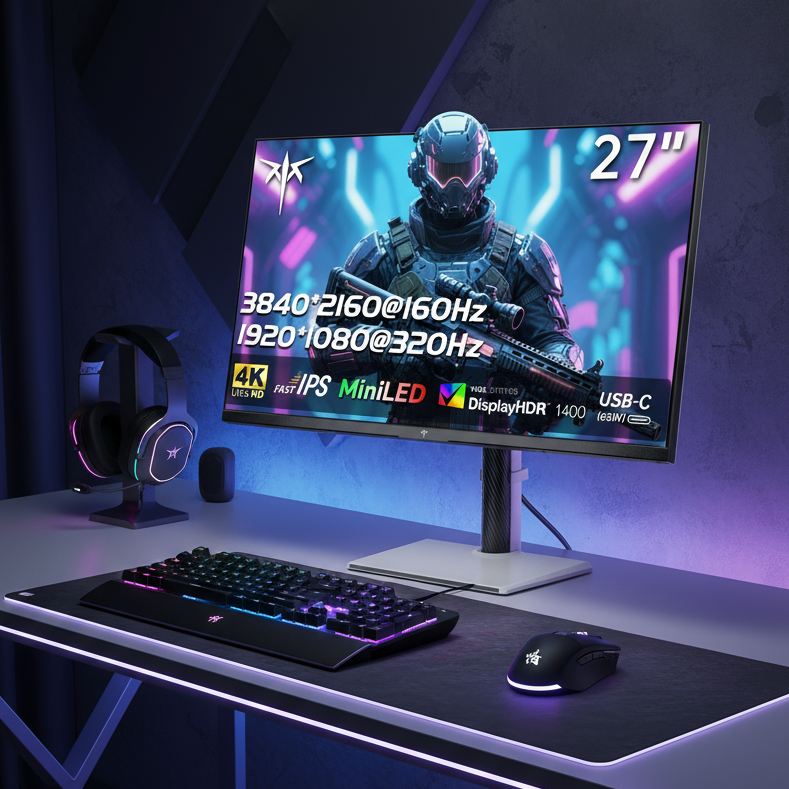
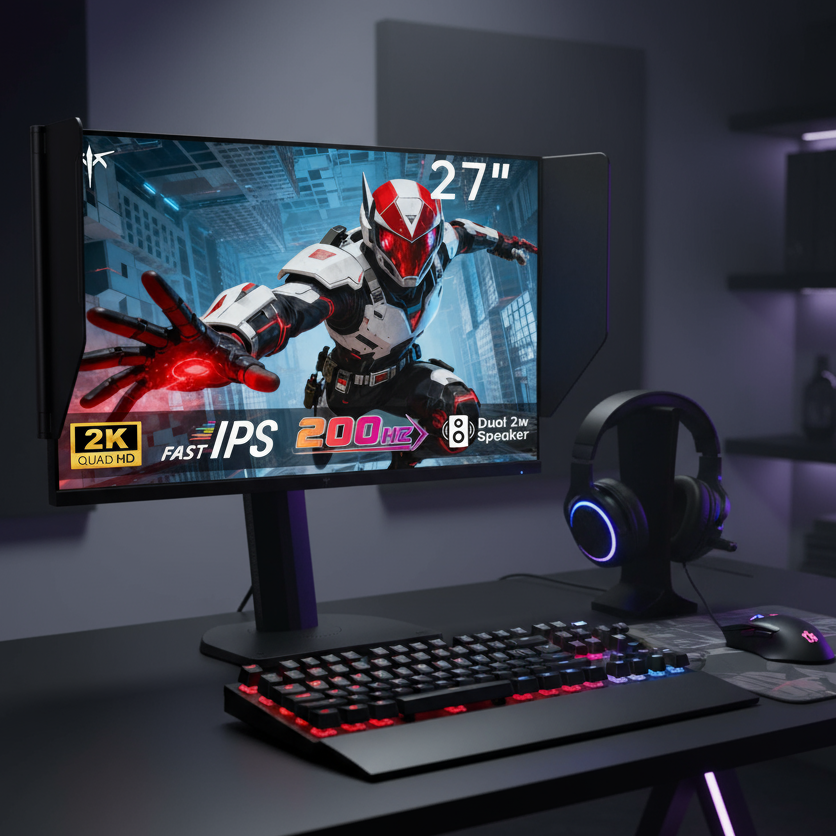
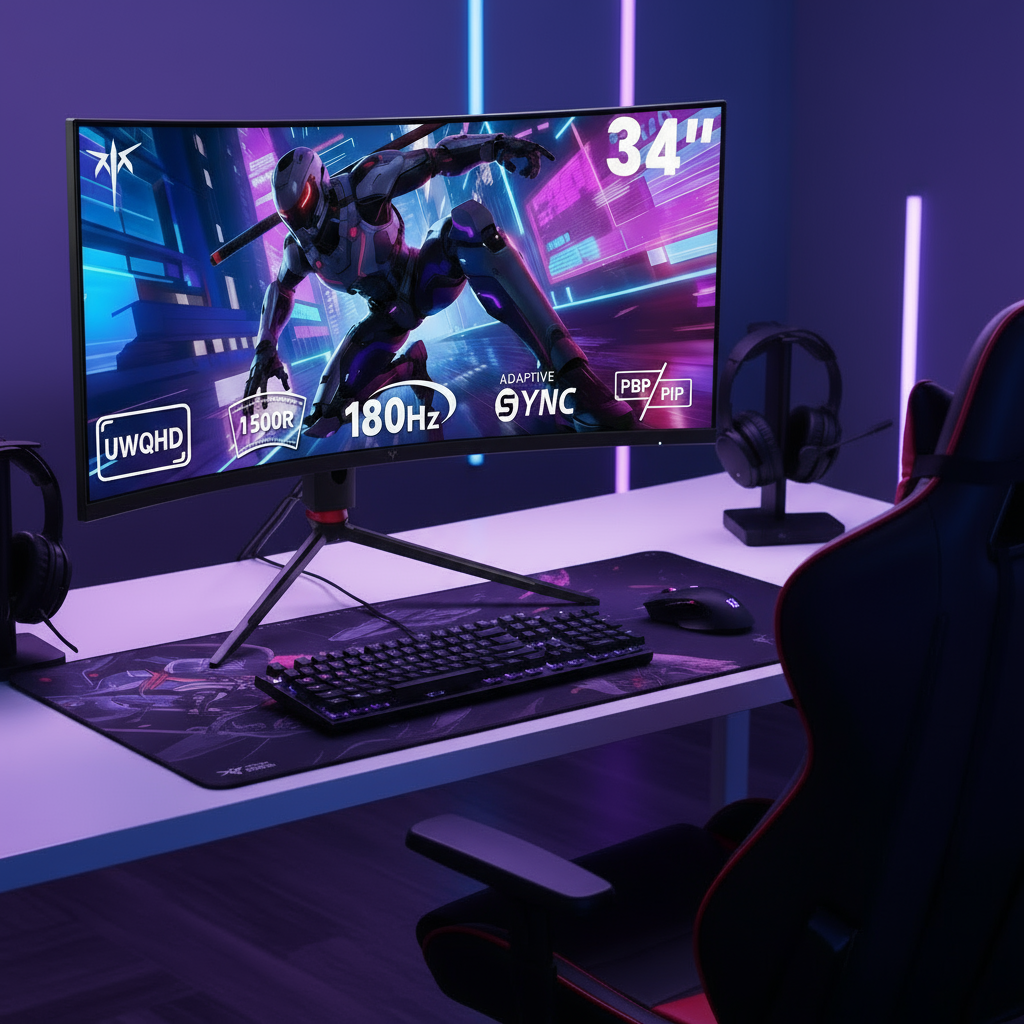


A low gray-to-gray number helps, but it does not guarantee a clear picture in motion. In fast gameplay, true clarity comes from the combination of refresh rate, pixel transition speed, overdrive behavior, and how long each frame stays visible.
Ever bought a gaming monitor that looked great on the spec sheet, then felt blurry the moment you flicked the camera in a shooter or tracked a car through a corner? That mismatch happens all the time, especially when buyers focus on a single advertised response-time figure instead of the full motion chain. This guide will show you how to judge gaming monitors, ultrawide monitors, and even portable monitors by what you actually see during fast play.

What Gray-to-Gray Really Measures
Pixel speed, not full motion quality
A gray-to-gray response time is the time a pixel takes to change from one shade of gray to another, usually measured in milliseconds. Monitor brands use it because it is easy to publish, easy to compare on paper, and often represents a best-case transition rather than the hardest color change the panel has to perform.
That matters because a monitor is not showing one ideal transition over and over. During fast gameplay, pixels are constantly shifting across many brightness levels and colors, so the advertised GtG number is only one part of the story. A display with a fast listed response time can still look soft if other transitions are slower, if overshoot is visible, or if each frame stays on screen long enough to blur during eye tracking.
Why marketing numbers get misunderstood
A company breakdown of response time makes the practical point clearly: pixel response time and motion clarity are related, but they are not the same measurement. At 360Hz, each frame lasts 2.78 ms, so a 5 ms transition means the pixel may still be changing when the next frame arrives.
That is why the same “1 ms” label can produce very different real-world results across gaming monitors. Some panels hit their fast number only in a narrow transition range or with aggressive overdrive enabled, while others stay cleaner across more of the refresh range. For monitor buying guidance, treat GtG as a baseline health check, not a complete verdict.
Why a Fast GtG Monitor Can Still Look Blurry
Persistence blur is a separate problem
Motion clarity depends on both refresh rate and pixel response time, because even a very fast panel can still suffer from sample-and-hold blur. On most modern displays, each frame is held in place until the next one arrives, and your eyes keep moving while the image is being held. The result is perceived blur, even when pixel transitions are already quick.
A platform discussion of response time vs. refresh rate puts numbers on that effect: 60Hz holds a frame for 16.7 ms, while 240Hz holds it for 4.2 ms. That alone reduces motion smear before you even factor in the panel’s pixel speed. So if two monitors have similar GtG but one is running at much higher refresh, the higher-refresh model usually looks clearer in motion.

Real users notice this immediately
A platform user case is a good example of what buyers actually experience. The owner of a 27-inch monitor model rated at 4 ms reported obvious blur not only in games, but also while scrolling pages and moving the cursor. The blur became more noticeable when games were capped at 60Hz, and improved significantly at 120Hz with a strobing mode enabled.
That example highlights the difference between a response-time spec and lived motion performance. The panel was not “slow” on paper, but lowering refresh hurt clarity, while enabling a strobing mode improved it by reducing persistence. The tradeoff was that ghosting and flicker became more obvious in some games, which is exactly why motion quality should be judged as a system, not a single number.

The Specs That Shape True Motion Clarity
Refresh rate sets the ceiling
A company gaming monitor guide groups 144Hz to 200Hz as the common sweet spot and 240Hz to 360Hz+ as the competitive tier. That framing matches what players usually see in practice: higher refresh reduces visible choppiness, lowers frame persistence, and makes tracking targets during fast camera movement easier.
A forum explanation shows why the gain stays visible even when the latency difference looks small on paper. Moving from 144Hz to 240Hz cuts frame time from 6.9 ms to 4.2 ms, just a 2.7 ms gap, yet motion can still look meaningfully clearer because stroboscopic stepping and sample-and-hold blur both improve. That is why refresh rate is not just a latency spec; it is a major image-clarity spec.
Response time has to keep up with refresh
The same company analysis recommends under 2 ms for competitive gaming, 1 to 4 ms for balanced gaming and content work, and 3 to 5 ms for slower-paced single-player use. That is useful because a high-refresh panel only delivers its full benefit if pixel transitions finish quickly enough to avoid stacking one frame on top of the next.
A company explanation of gaming monitor specs also notes that faster overdrive can shorten transitions while raising overshoot. In practice, the best setting is rarely the one with the most aggressive label. You want the mode that balances speed with clean edges, especially if you use variable refresh rate instead of a fixed esports refresh.
Adaptive sync and frame pacing still matter
A company ghosting guide points out that refresh mismatch can worsen artifacts, such as feeding about 100 fps into a 60Hz display. Adaptive sync technologies solve a different problem from GtG, but they still improve the final experience by reducing tearing and uneven motion delivery.
That matters for ultrawide monitors and portable monitors as much as for standard esports panels. On paper, a 24.5-inch 180Hz IPS option like the 24.5-inch FHD 180Hz 1ms wall-mount gaming monitor with adaptive sync support looks sensible for this kind of use, but overdrive tuning and real motion blur still need review-based verification. Motion clarity is always the combined result of panel behavior and frame delivery.
Panel Type and Tuning Change the Outcome
TN, Fast IPS, VA, and OLED do not behave the same
A panel-speed summary from a company lists typical GtG ranges at about 0.5 to 1 ms for TN, 1 to 4 ms for Fast IPS, 3 to 5 ms for VA, and below 0.1 ms for OLED. Those ranges line up with what buyers usually see: TN and OLED tend to look the cleanest in pure motion terms, Fast IPS is the common all-around compromise, and VA is the panel type most likely to show dark smear.
A platform discussion of panel behavior specifically calls out VA panels as the most prone to ghosting in dark-to-dark transitions. That is why a VA ultrawide can look excellent in contrast-heavy single-player games but still disappoint players who spend most of their time in fast competitive titles with rapid camera pans.
Overdrive can help or hurt
A company explanation of monitor response controls notes that many gaming monitors let you raise pixel response speed in the on-screen display. That is worth using, but it is not a “max it out and forget it” setting. Moderate overdrive often removes obvious trailing, while the fastest mode may create bright or dark halos around moving objects.
A ghosting troubleshooting article describes that failure mode as inverse ghosting, where the correction overshoots the target and leaves a visible trail of its own. This is especially important on monitors used with VRR, because some overdrive settings behave well at 240Hz fixed but look messy when the refresh rate fluctuates in the 90 to 165Hz range.
How to Evaluate a Gaming Monitor Before You Buy
Read beyond the headline spec
A company buying guide is right to treat gaming monitors as a package of refresh rate, response time, and sync support. For buying decisions, start by asking whether the panel class fits your use: a 24- to 26-inch competitive monitor at 240Hz or 360Hz rewards fast shooters, while a larger ultrawide aimed at immersion may need stronger motion tuning to stay clean in action-heavy games.
A company motion-testing summary also highlights why deeper reviews matter. Testers who measure rise/fall time, total response time, and overshoot across multiple gray levels are showing you much more than the box spec. That data tells you whether the monitor stays clean across different transitions and refresh rates instead of only under one favorable condition.

Use a practical motion checklist
The forum discussion of motion scaling makes a useful buying point: once GtG is reasonably fast, the biggest visible gains often come from higher refresh, steadier frame delivery, and lower persistence. That means a well-tuned 240Hz Fast IPS monitor can beat a badly tuned “1 ms” panel in real fast gameplay.
A company tuning checklist adds sensible setup steps after purchase: run the monitor at its maximum refresh rate, enable VRR, update firmware and GPU drivers, test overdrive modes, and consider capping frame rate to about 90% of refresh for steadier delivery. Those basics often improve motion more than chasing the smallest possible advertised GtG number.
Comparison Table
Factor |
What it measures |
What it improves |
What it does not guarantee |
Gray-to-gray (GtG) |
Pixel transition speed between shades |
Less ghosting and shorter trails |
Clear motion during eye tracking |
Refresh rate |
How often the image updates each second |
Smoother motion, less persistence blur, lower perceived stepping |
Fast pixel transitions |
Overdrive |
How aggressively the monitor pushes pixels to change faster |
Reduced trailing on LCD gaming monitors |
Clean results without overshoot |
VRR (adaptive sync) |
Match between GPU frame output and panel refresh |
Less tearing and less uneven motion |
Better pixel response |
Backlight strobing / strobe modes / frame insertion |
Reduces the time each frame is visibly held |
Stronger motion clarity in supported modes |
No flicker, no brightness loss, or VRR support at the same time |
Panel type |
Native panel behavior |
Sets likely strengths in speed, contrast, and smear control |
Equal performance across all transitions |
FAQ
Q: Is 1 ms GtG enough to guarantee a clear gaming monitor?
A: No. A 1 ms GtG spec can help reduce ghosting, but motion clarity still depends on refresh rate, overdrive quality, frame pacing, and persistence blur.
Q: Why does 60Hz look blurrier even when response time seems acceptable?
A: A 60Hz display holds each frame for 16.7 ms, which creates more sample-and-hold blur while your eyes track motion. Even decent pixel transitions can look soft when the frame itself stays visible that long.
Q: What panel type is safest for fast competitive gaming?
A: An OLED or a strong Fast IPS panel is usually the safest bet today. OLED has the fastest pixel response, while Fast IPS remains a common balance of speed, price, and availability; VA is more likely to show dark smear.
Final Takeaway
Gray-to-gray response time matters, but it is only one piece of motion performance. For fast gameplay, the best monitor is the one that combines fast-enough pixel transitions with high refresh, controlled overdrive, stable frame delivery, and minimal persistence blur.
Action checklist:
- Prioritize 144Hz or higher for general gaming, and 240Hz or higher for competitive play.
- Treat advertised GtG as a starting point, not the final answer.
- Check review data for overshoot, total response time, and behavior at multiple refresh rates.
- Favor OLED or strong Fast IPS panels if motion clarity is more important than contrast.
- Test overdrive modes instead of assuming the fastest preset is best.
- Enable VRR and run the monitor at its maximum refresh rate.
- If your display supports it, compare strobing modes against normal VRR play before deciding which looks better to you.


%20spec.%20A%20blur-free%20picture%20depends%20on%20refresh%20rate,%20pixel%20speed,%20and%20overdrive.
)