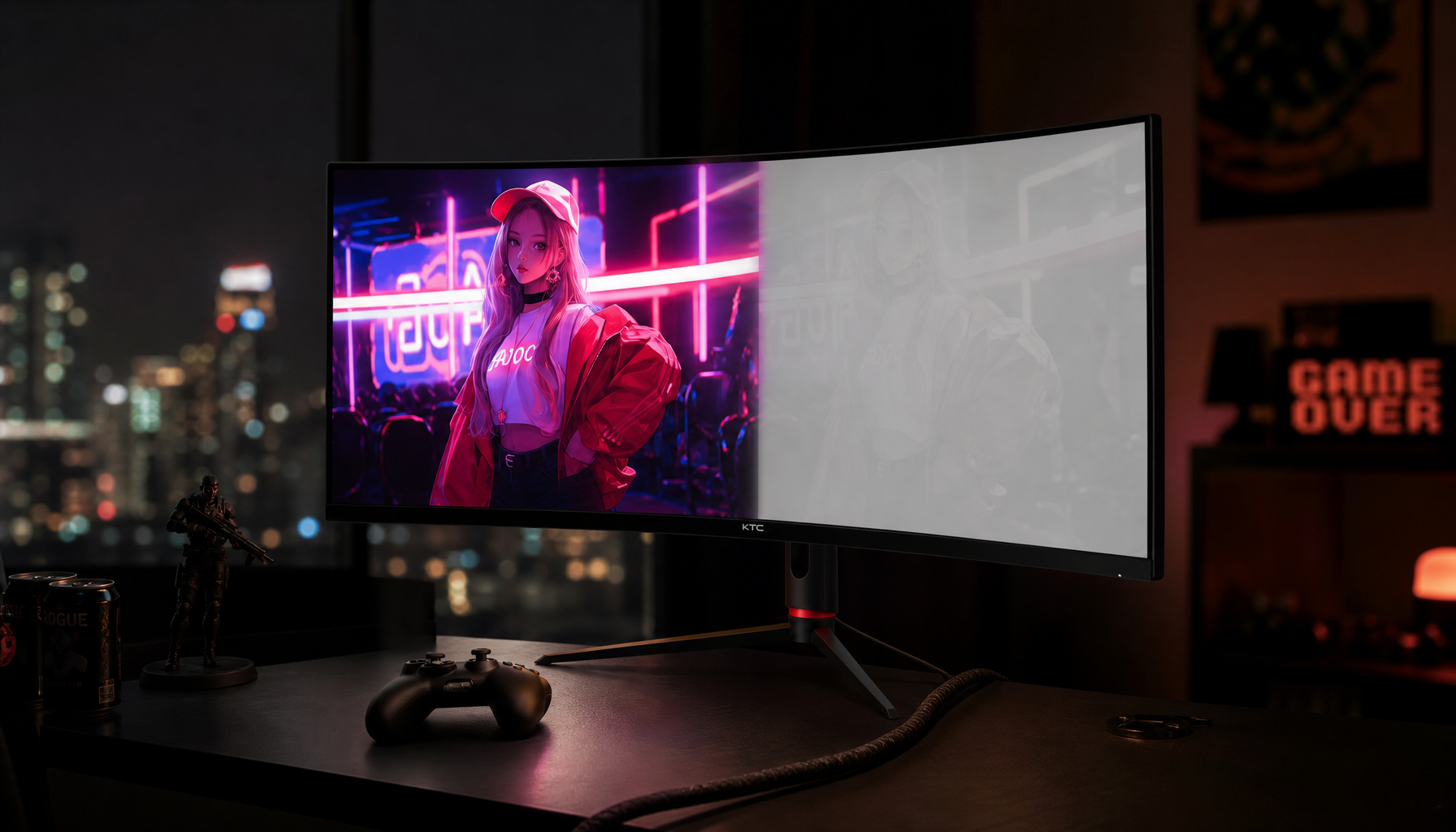
Contrast ratio affects depth by separating bright highlights from dark shadows, giving objects clearer edges, stronger layering, and more believable volume. A higher-contrast display can make an image feel more three-dimensional, but only when black levels, brightness, calibration, room lighting, and source quality are controlled.
Does a game scene look flat even though the resolution is sharp, or does a product render lose its punch on one screen but look premium on another? In practical display setup, correcting contrast, brightness, and black level can reveal shadow detail and highlight texture that were already in the image but hidden by poor settings. This article explains how contrast creates visual depth, when higher contrast helps, and how to tune a monitor for immersion without crushing detail.
What Contrast Ratio Really Means
Contrast ratio is the difference between the brightest white and darkest black a display can produce. If a display is rated at 2,000:1, its brightest white is 2,000 times brighter than its darkest black; this basic definition matters because higher contrast generally improves perceived image quality, including depth, readability, and realism.
That does not mean every bigger number is automatically better. A 1,000,000:1 dynamic contrast claim may rely on backlight tricks that do not represent a normal mixed scene where bright UI, dark shadows, faces, and midtones appear at the same time. For gaming monitors, productivity displays, and portable screens, native contrast and real viewing conditions matter more than inflated marketing figures.
Why Contrast Makes Images Look Deeper
Depth perception on a flat screen is a visual illusion built from cues. Your eyes read brighter highlights as surfaces catching light, darker shadows as recesses, and crisp tonal transitions as object boundaries. Strong contrast makes those cues easier to read.
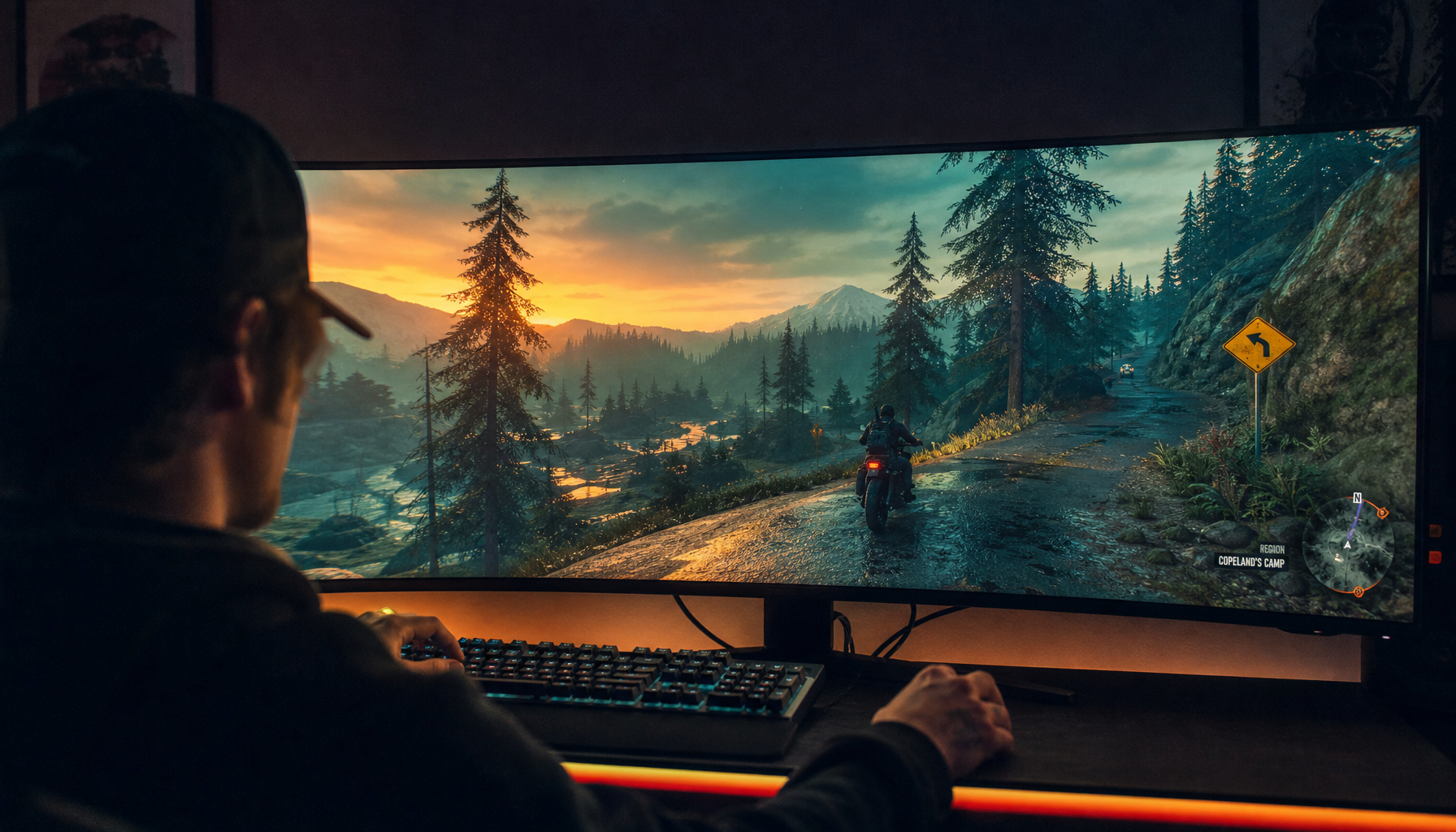
In a racing game, a low-contrast screen can make the road, tire shadows, dashboard, and sky feel pasted onto one plane. A well-tuned higher-contrast screen makes the cockpit feel closer, the track recede farther, and the dark areas under bridges look physically separated from sunlit pavement. The screen is still flat, but the brain has better information.

Medical and vision research also supports the broader principle that contrast affects visual discrimination. The ability to distinguish an object from its background is separate from raw sharpness, and contrast sensitivity helps explain why two displays with the same resolution can feel very different in clarity and depth.
Black Level Is the Foundation of Dimensionality
The most powerful depth improvement often comes from lowering the black floor, not simply making the whole screen brighter. If black looks gray, dark scenes lose atmosphere and objects lose separation. This is why VA and OLED panels often feel more cinematic than many basic IPS panels: VA commonly offers deeper blacks, while OLED can turn pixels fully off for true black.
Panel choice still involves tradeoffs. IPS usually gives more consistent color and wider viewing angles, which is valuable for office productivity and design review. VA can deliver stronger perceived contrast, especially in dark scenes, but some models may show slower dark transitions. OLED gives excellent depth and instant response, but static desktop UI can raise retention concerns for heavy office use.
Display Type |
Contrast Strength |
Best Fit |
Main Caution |
IPS |
Moderate |
Office work, design, shared viewing |
Blacks may look raised in dark rooms |
VA |
High |
Movies, immersive gaming, mixed use |
Dark motion handling varies by model |
OLED |
Very high |
Premium gaming, HDR, media |
Static UI care is important |
TN |
Usually lower |
Competitive speed on older or budget panels |
Weaker color and viewing angles |
The Calibration Trap: More Contrast Can Hide Detail
Turning up contrast is not the same as improving contrast ratio. On many monitors, the contrast control changes near-white behavior. Set it too high and clouds, white shirts, snow, UI highlights, and metallic reflections can merge into flat white blocks. Calibration guidance explains that monitor contrast should preserve bright detail, while brightness strongly affects dark-gray and black visibility; basic brightness and contrast adjustments can noticeably improve readability and SDR image quality.
A practical test is simple. Open a black-level and white-level calibration pattern. You should be able to distinguish near-black steps from black and near-white steps from white. If the first dark patches vanish, your depth cues in shadows are being crushed. If the brightest patches disappear, highlight texture is being clipped.
For a portable monitor, a contrast setting around the upper-middle range is often a better starting point than maximum. Portable display notes recommend roughly 70% to 75% contrast for everyday use, slightly higher for gaming, and a setting that preserves shadow detail for media. That matches real experience: a display that looks punchy for five seconds in a store can become harsh, flat, and tiring after a full work session.
Room Light Can Destroy Perceived Contrast
A monitor’s contrast is not experienced in a vacuum. Ambient light reflects off the screen and raises the apparent black level. In a bright office, a glossy display can make black text, dark UI panels, and game shadows look washed out because the screen is reflecting windows, lamps, and white walls.
This is why projector contrast discussions emphasize light control: ambient and reflected light reduce the advantage of deep blacks. The same principle applies to desktop monitors, just at a smaller scale. A glossy portable screen beside a window may lose more perceived depth than a modest matte screen in controlled lighting.
If your display looks better at night than during the day, the panel may not be the main problem. Move the screen away from direct reflections, reduce bright light behind you, and consider a matte filter for glossy portable displays. Community reports around reflective laptop panels describe matte overlays as a practical mitigation when glare is the source of discomfort, which is consistent with day-to-day setup work.
Contrast, Resolution, and Sharpness Work Together
Contrast creates separation, but resolution and pixel density determine how much fine texture can be shown. A 4K monitor can reveal more edge detail than a 1080p monitor at the same size, and higher PPI means sharper images with more visible detail. Still, resolution alone cannot create depth if blacks are lifted, highlights are clipped, or the panel is in an aggressive vivid mode.
Think of a 27-inch 4K office display showing a product photo. High PPI makes the stitching, brushed metal, and small UI labels clean. Good contrast makes the curved edges, recessed buttons, and shadows believable. Poor calibration can waste both advantages by making the product look either foggy or overprocessed.
For creators and editors, this is also why a display and scopes serve different roles. Scopes measure signal levels, while the display shows the human-facing result, and monitor calibration aligns brightness, white point, contrast, and gamma so decisions are repeatable.
Best Settings for Gaming, Office Work, and Portable Screens
For competitive gaming, contrast should help you identify enemies, edges, and terrain without turning shadows into black walls. A VA or OLED panel can add excellent atmosphere in story games, but for esports you still need visible shadow detail. Disable dynamic contrast first, because it can change the image mid-match and make dark areas unpredictable.

For office productivity, comfort beats maximum punch. Text should look clean, grays should be distinguishable, and white backgrounds should not glare. If black text looks harsh or gray text looks weak, check RGB range, black level, and sharpness. Some video connections can trigger limited-range behavior, and a mismatch between full range and limited range can crush blacks or whites, making the image seem artificially contrasty instead of genuinely clearer.
For portable screens, brightness management is part of performance. Portable monitor notes describe many models in the 200-to-500-nit range and recommend around 300 to 350 nits for indoor work, with brighter settings reserved for outdoor or bright environments. Running maximum brightness all day can reduce battery life and make contrast feel harsher, especially in documents and dashboards.

Native, Dynamic, and ANSI Contrast: Which Number Should You Trust?
Native contrast is the most useful specification for everyday buying decisions because it reflects the panel’s baseline ability to show black and white without heavy processing. Dynamic contrast may sound impressive, but it can involve backlight dimming or other processing that changes from scene to scene. ANSI contrast is valuable because it measures bright and dark areas at the same time, closer to real content, though it is harder to measure consistently.
Contrast Term |
What It Tells You |
Buying Value |
Native contrast |
Real panel-level white-to-black capability |
High |
Dynamic contrast |
Processing-assisted contrast behavior |
Limited |
ANSI contrast |
Mixed-scene contrast with bright and dark areas together |
High when measured well |
Marketing contrast |
Often the largest advertised number |
Treat cautiously |
A monitor with honest 3,000:1 native contrast will usually create stronger dark-scene depth than a 1,000:1 panel, all else equal. But a calibrated 1,000:1 IPS display in a controlled room can look better than a poorly tuned high-contrast screen facing a sunny window.
Practical Buying Advice
If depth and three-dimensionality matter most, prioritize native contrast, black uniformity, anti-glare behavior, and calibration controls before chasing extreme brightness. For immersive gaming and media, VA and OLED deserve serious attention. For office productivity and design work, IPS remains highly dependable when color consistency, viewing angles, and text clarity are top priorities.
For hybrid use, avoid choosing by one number. Look for reviews that measure contrast, response, color accuracy, and real-world behavior. Then tune the display yourself under the lighting you actually use. A monitor’s best image is rarely its default vivid preset.
FAQ
Is a higher contrast ratio always better?
Higher real contrast usually improves depth, but excessive settings can crush shadows or clip highlights. The best result is strong separation with visible detail at both ends.
Does HDR automatically improve depth?
HDR can improve depth when the panel has enough brightness, local dimming or pixel-level control, and proper tone mapping. On weak HDR displays, SDR with good calibration may look more consistent.
Why does my monitor look flat even with a high contrast rating?
Glare, poor calibration, dynamic contrast, limited RGB range mismatches, low-quality source video, and room lighting can all reduce perceived depth. The rating may be technically true in a lab but less meaningful at your desk.
Strong contrast is the engine behind screen depth, but control is what makes it useful. Choose the right panel for your workload, control room light, calibrate black and white detail, and your images will gain the layered, dimensional look that resolution alone cannot deliver.