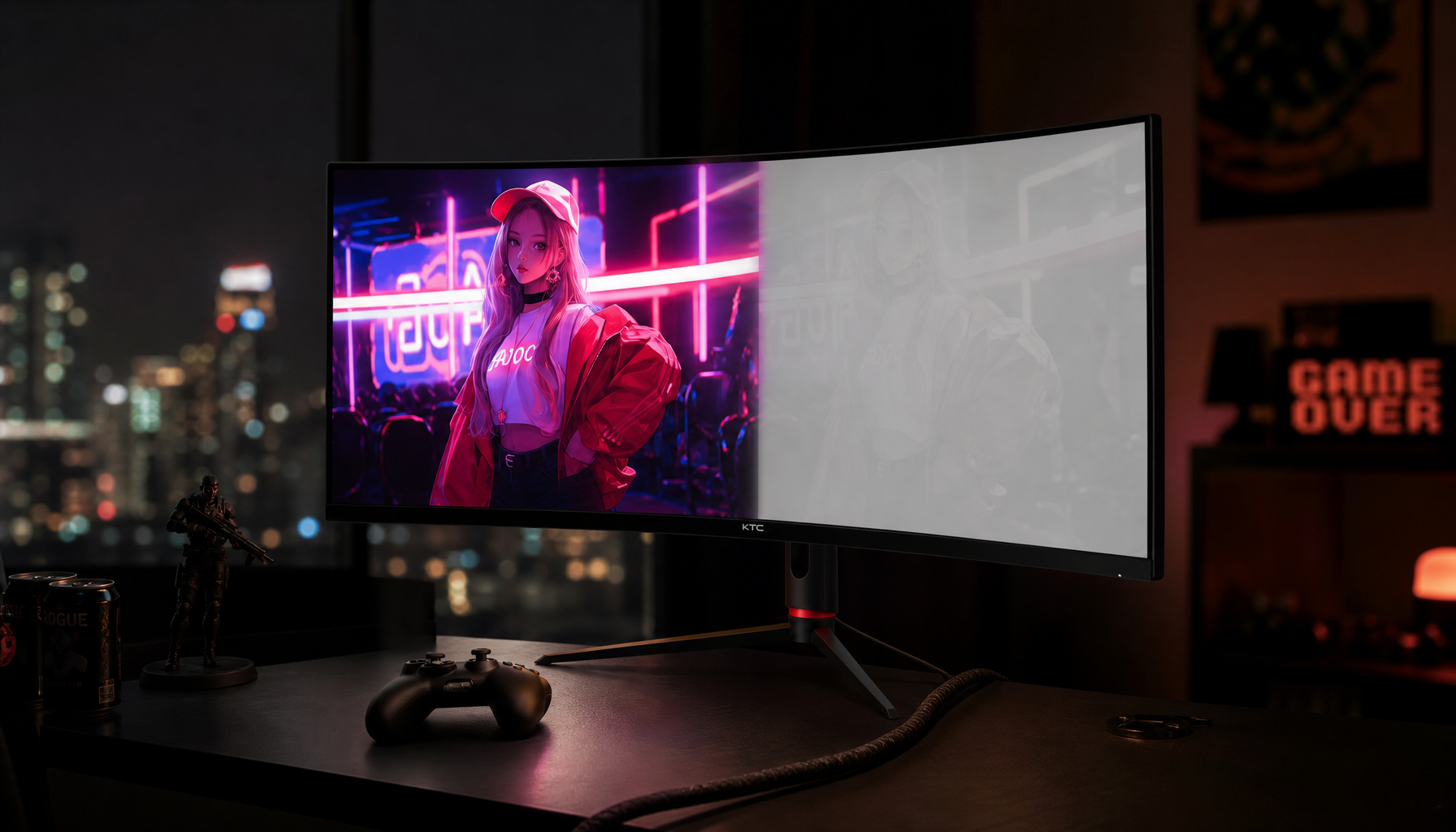
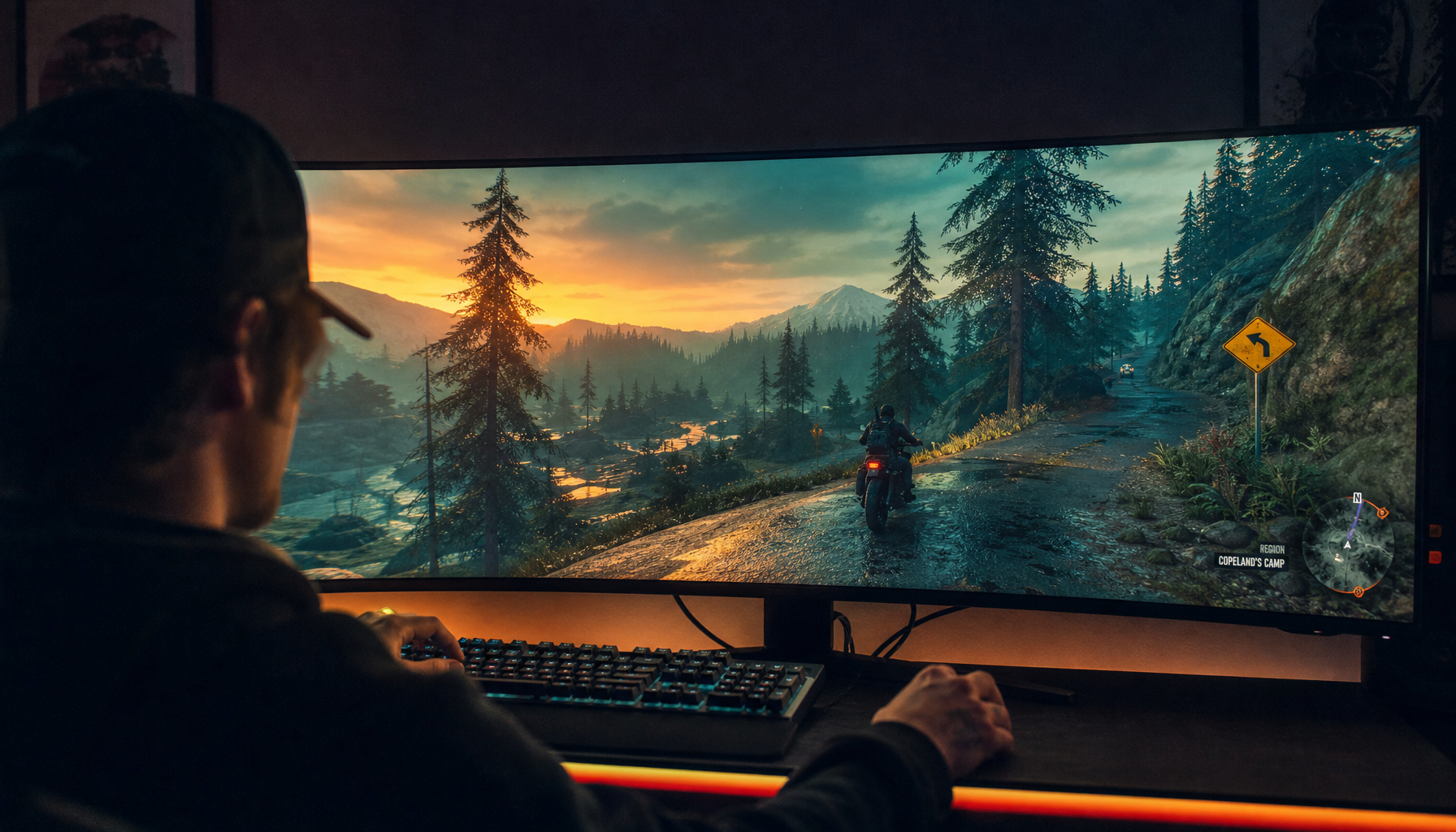
OLED monitors make light at the pixel itself, not from a lamp behind the screen. That self-lit design is why they can show true black, extremely fast pixel transitions, and thinner panels than typical LCD displays.
If you have ever switched from a conventional gaming monitor to an OLED and noticed dark scenes suddenly look deeper and motion looks cleaner, that reaction is real. The practical payoff is easy to see in high-refresh-rate games, HDR titles, and ultrawide setups where backlight glow is more distracting. Here is what actually creates that light, why it changes image quality, and what tradeoffs matter before you buy.
What Actually Creates the Light in an OLED Monitor?
The pixel is the light source
An OLED monitor is self-emissive, which means each pixel creates its own light when current passes through organic material inside the panel. Instead of using an LED backlight and asking liquid crystals to block or pass that light, OLED puts the light generation directly in the display stack.
A basic OLED cell uses a substrate, an anode, organic layers, and a cathode, and the emissive layer converts electrical energy directly into visible light. In simple terms, the monitor sends power into that pixel, electrons and holes meet in the organic material, and the pixel glows. If the monitor wants black, that pixel stays off.
Why no backlight is needed
Because each pixel emits its own light, OLED does not need the separate lighting layer that LCD and Mini-LED monitors rely on. That is the core reason OLED panels can avoid classic LCD issues like backlight bleed and blooming around bright objects on dark backgrounds.
For monitor buyers, that design difference is not just a spec-sheet detail. On a 34-inch ultrawide or a 49-inch super-ultrawide, eliminating the backlight means black bars, dark game scenes, and space-themed backgrounds look more uniform across the full panel, instead of revealing glow from the screen’s lighting system.

Why This Matters So Much for Gaming Monitors
True blacks and stronger HDR contrast
Because OLED pixels can switch off completely, black really is black rather than “very dark gray with some light leaking through.” That gives OLED its strongest advantage in dark-room gaming, horror titles, story-driven HDR games, and movie watching on the same monitor.
On ultrawide OLEDs, that effect is especially noticeable because the screen fills more of your field of view. A 34-inch 21:9 OLED variant cited in hands-on reporting delivered true blacks and HDR impact that clearly outperformed an older IPS display, even though full-screen brightness was not always higher in normal desktop use, as described in this ultrawide OLED monitor experience.

Faster pixel response and cleaner motion
OLED’s other big advantage is motion. Since OLED pixels transition very quickly, they reduce smearing and ghosting that can still show up on slower LCD panels, especially in fast shooters, racing games, and 240Hz to 360Hz esports monitors.
That speed matters more as refresh rates climb. A monitor running at 144Hz, 240Hz, or 360Hz only looks fully sharp in motion if pixels can keep up with each frame. OLED’s near-instant pixel behavior is one reason enthusiasts keep pairing it with high-refresh-rate panels instead of treating it as a movie-only display technology.
OLED vs. LCD for Real Buying Decisions
The short version of the tradeoff
An OLED panel creates light at the pixel level, while LCD-based monitors create an image by modulating a backlight. That one difference explains most of the real-world buying tradeoffs: OLED usually wins on black level, contrast, and motion clarity, while LCD often wins on sustained full-screen brightness and fewer worries about static desktop content.
Here is a practical comparison for monitor shoppers:
Factor |
OLED monitor |
LCD or Mini-LED monitor |
Light source |
Each pixel emits its own light |
Separate backlight shines through LCD layer |
Black level |
True black, pixel can turn fully off |
Black depends on backlight control and panel quality |
Contrast |
Extremely high in dark scenes |
Lower native contrast, though Mini-LED can improve HDR |
Motion clarity |
Very fast pixel response, less blur |
Can be excellent, but depends more on overdrive tuning |
Blooming |
Minimal to none |
Possible around bright objects on dark backgrounds |
Full-screen brightness |
Often lower on bright white screens |
Usually stronger for sustained bright desktop use |
Text rendering |
Can vary with subpixel layout |
Usually predictable with standard RGB stripe |
Burn-in risk |
Present with static content over time |
Far lower concern |
Best fit |
Gaming, HDR, dark-room use, premium ultrawides |
Mixed office use, bright rooms, static-heavy workflows |
A 27-inch 2K 240Hz OLED model such as the a brand’s 27” 2K 240Hz/0.03ms USB-C OLED Gaming Monitor is a practical example of where this tradeoff points: self-lit pixels help deliver deeper blacks and cleaner motion, while the usual OLED considerations around brightness behavior and static desktop use still apply.
Where OLED is strongest
Recent OLED monitor demand has been driven heavily by PC gamers, and LCD monitors still do better in some scenarios such as sustained white-screen brightness and static desktop comfort. That does not make OLED worse overall; it just means buyers should match the panel to the job instead of assuming every premium monitor should be OLED.
For example, a 49-inch OLED ultrawide with 5,120 x 1,440 resolution and 144Hz refresh can feel outstanding for sim racing, open-world gaming, and multitasking without a center bezel. A spreadsheet-heavy office setup used eight to 10 hours a day under bright daylight may still be easier to live with on a strong LCD.
The Tradeoffs Buyers Should Understand Before Choosing OLED
Bright rooms and full-screen brightness
Some OLED monitors advertise peak HDR numbers around 1,000 nits, and newer panels are pushing higher, but that headline brightness does not always reflect normal full-screen desktop use. Bright white documents, browser windows, and productivity apps can look dimmer than they would on a good LCD, especially if the panel is protecting itself from heat and wear.
Room lighting also matters. Some OLED variants can lose some of their black-level advantage in direct daylight, where black areas may appear slightly raised or tinted. If your monitor sits across from a sunny window, OLED still works, but the “perfect black” effect is strongest in controlled lighting.
Text clarity and subpixel layout
Text quality on OLED monitors is not mainly about the light source itself. The more important factor is subpixel layout. Many LCD monitors use a standard RGB stripe that a desktop platform’s text rendering expects, while some OLED variants use layouts that can create color fringing on small text, UI labels, and thin lines.
That is why some buyers love OLED for gaming and media but hesitate for all-day coding, writing, or spreadsheet work. The issue tends to be more obvious on lower pixel density panels and older OLED-variant layouts. Newer designs are improving, but if your main use is reading text for eight hours a day, this is one of the first things to test in person.
Burn-in risk is real, but usage pattern matters
Because OLED materials age as they emit light, static content can wear pixels unevenly over time. In practice, burn-in risk drops a lot when usage is varied and built-in maintenance tools are enabled. Typical mixed gaming is much less risky than leaving the same HUD, taskbar, or financial dashboard on screen all day.

The practical guidance is straightforward: use auto-hide for static UI when possible, let pixel refresh cycles run, avoid unnecessary maximum brightness for desktop work, and vary content during long sessions. Those habits matter more on a desktop monitor than on a TV because monitors display the same interface elements for much longer stretches.
Which Buyers Benefit Most From OLED Today?
Best fit for gaming and ultrawide immersion
For buyers focused on fast games, HDR, and cinematic ultrawide play, OLED’s self-lit pixels solve problems that matter immediately: black smearing, haloing, washed-out dark scenes, and weak motion clarity. That makes OLED especially compelling in 27-inch 1440p esports monitors, 32-inch 4K gaming panels, and 34-inch ultrawides where contrast is part of the experience.
A newer 34-inch OLED panel announced for 2026 combines a 360Hz refresh rate with a vertical-style subpixel arrangement aimed at better text clarity. That direction shows where the market is going: keep OLED’s motion and contrast strengths, then reduce the desktop drawbacks that made some buyers stay with LCD.
Mixed-use desks and portable monitor buyers need more caution
For office-heavy setups, portable monitors, or one-screen-for-everything use, OLED still carries tradeoffs that some LCDs avoid. A portable OLED monitor can look excellent for movies, travel gaming, and photo review because it is thin and high-contrast, but long static toolbars, bright white documents, and outdoor use are not the ideal workload.
The safest buying approach is to decide what fills most of your screen time. If it is games, video, dark-mode apps, and mixed entertainment, OLED makes a strong case. If it is mostly coding, documents, browser tabs, and bright-room work from 9:00 AM to 5:00 PM, a high-quality LCD or Mini-LED monitor may still be the more practical tool.
FAQ
Q: How does an OLED pixel make different colors without a backlight?
A: The pixel’s organic materials emit light directly, and full-color panels produce red, green, and blue subpixels either through separate emitters or through structures that convert emitted light into different colors. The color comes from the pixel structure itself, not from filtering a white backlight behind the panel.
Q: Why do OLED gaming monitors usually look faster than LCD gaming monitors?
A: OLED pixels change state very quickly, so each frame settles faster. At 144Hz, 240Hz, or 360Hz, that means less blur and less visible smearing in motion-heavy games, even before you compare contrast and black levels.
Q: Is OLED a bad choice for productivity?
A: Not necessarily. It depends on your workload. OLED can work well for mixed use, but buyers who spend most of the day reading small text, keeping static windows open, or working in a very bright room should pay extra attention to text clarity, full-screen brightness, and burn-in prevention features.
Final Takeaway
OLED creates light without a backlight because each pixel is its own tiny light source. For monitor buyers, that design leads directly to the strengths people actually notice: true blacks, cleaner motion, thinner panels, and more convincing HDR.
The decision is less about whether OLED is “better” in the abstract and more about whether its strengths match your desk. Choose OLED when gaming performance, ultrawide immersion, and dark-scene image quality are the priority. Think harder before buying if your screen will spend most of its life showing bright static desktop content, small text, or all-day office apps.
References
- OLED - a platform
- What Is an OLED Display? How It Works & Key Benefits
- Organic Light Emitting Diodes (OLEDs) - a company
- An introduction to OLED displays
- What is an OLED gaming monitor?
- No one told me this about ultrawide OLED monitors
- 3 things LCD monitors still do better than OLEDs
- 10 simple ways to prevent burn-in on your OLED monitor
- Why text looks bad on some new OLED monitors
- A company finally brings a vertical-style subpixel layout to an OLED variant
- Upgrading to a 49” Ultrawide Monitor: Worth It in 2025?