Your eyes judge color through biology and context, while a monitor builds color from red, green, and blue light. That gap is why a display can look vivid, accurate, or wrong depending on the panel, the room, and the job you need it to do.
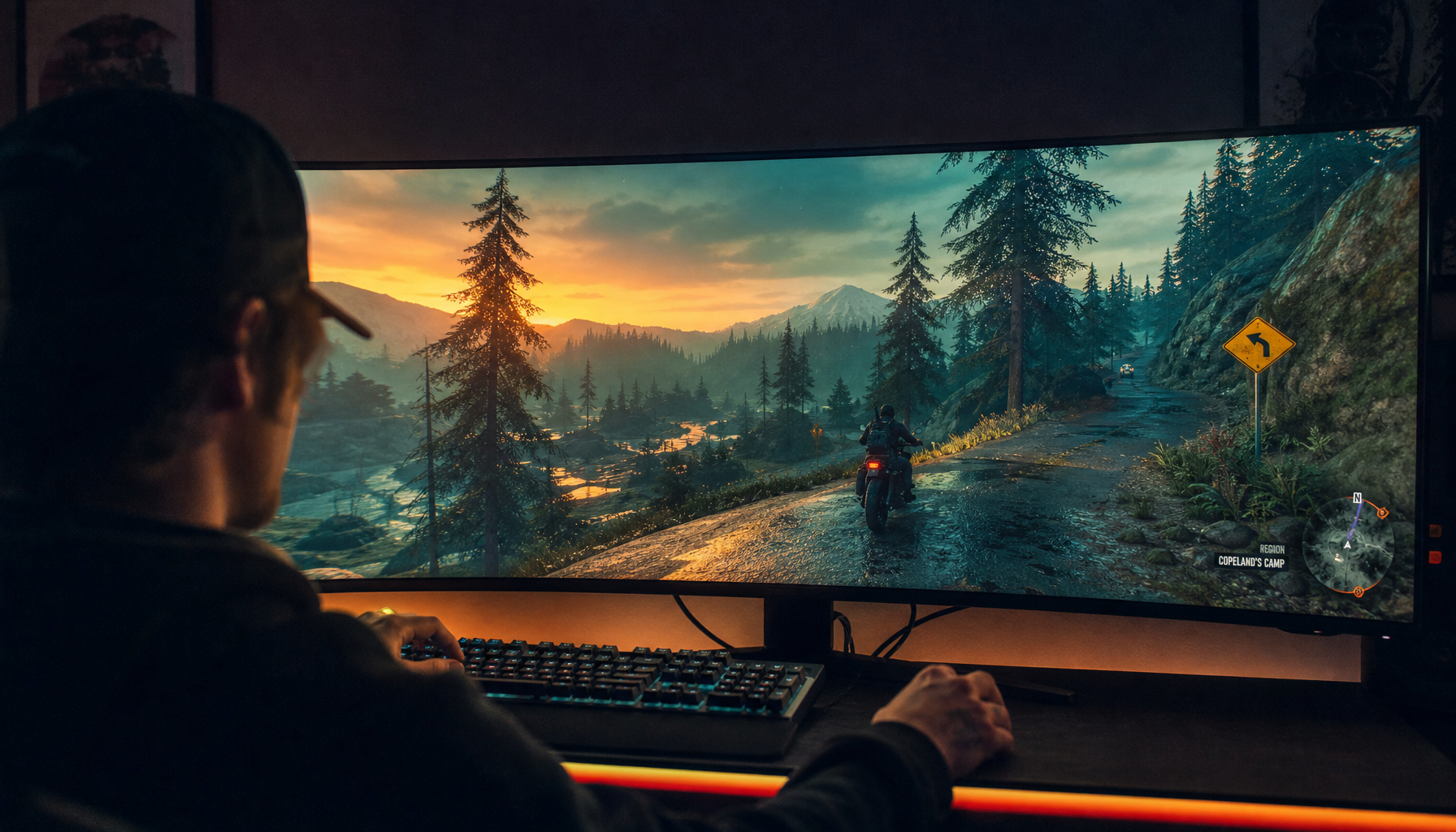
If a game sunset looks dramatic on one screen and washed out on another, the problem is usually not just “bad color.” In controlled vision research, scientists targeted 273 individual cone cells and found that about two-thirds signaled white rather than a distinct color, which is a useful reminder that human vision is more complicated than a simple RGB chart. You will leave with a practical way to understand why screens differ and how to pick a monitor that matches your priorities.
Why your eyes and your monitor are not doing the same job
The eye is measuring light, but the brain is interpreting color
Most people are trichromats, meaning they rely on three cone types that are broadly sensitive to long, medium, and short wavelengths, and estimates for total distinguishable colors commonly land somewhere between about 1 million and 10 million. That sounds close to what a modern monitor can produce on paper, but the match is not direct because the eye is not sampling color in tidy digital steps.
Vision scientists found that many individual cones do not produce a straightforward “this is red” or “this is green” signal; in their test setup, about two-thirds of stimulated cones produced a white-light response instead. For monitor buyers, that matters because perceived color depends on how the brain compares signals, not just on how many colors a spec sheet claims.
Surroundings change what you think you are seeing
Perceived color is context-dependent: nearby colors, contrast, and whether a tone feels warm or cool can all shift your judgment. That is why a gray desktop background can look neutral on one ultrawide monitor but slightly blue next to a warmer secondary display.
A company’s hue test notes that lighting, background colors, tiredness, age, and color-vision differences can all affect results. In practice, the same gaming monitor can look more accurate at 2:00 PM in a bright room than it does at 10:00 PM under warm lamp light, even before you touch any settings.
How a display creates color from only three channels
RGB is an approximation, not a copy of reality
Digital displays use additive RGB synthesis: each pixel emits red, green, and blue light at different intensities, and your brain blends that light into one perceived color. White is the full mix, black is the absence of emitted light, and every in-between shade depends on how well the panel controls those subpixels.
A 24-bit display produces about 16 million possible RGB combinations, but those combinations are not distributed in a way that perfectly matches human sensitivity across the gamut. That is why a spec like “16.7 million colors” sounds definitive yet tells you very little about whether skin tones, shadow gradients, or neon HUD elements will look convincing.
Bit depth helps gradients more than marketing
More than 8 bits per channel mainly helps reduce banding, especially in dark gradients and HDR scenes where small tonal steps are easier to notice. On a monitor review sample, this is where 10-bit support matters more than it does on a basic office screen showing spreadsheets and browser tabs.
Bit depth and gamut are separate issues: 10-bit and 12-bit panels can smooth transitions, while standards like sRGB, DCI-P3, and a wide-gamut color space describe how wide a color range the monitor can show. A wide-gamut gaming display can still look inaccurate if its tones are poorly tuned, and a smaller-gamut portable monitor can still look balanced if its sRGB performance is well controlled.
Why the same image looks different across gaming, ultrawide, and portable monitors
Panel behavior matters as much as the spec list
Color accuracy is not just brightness or resolution; it also includes tone fidelity, dark-detail control, and how stable the image remains from different viewing positions. That becomes obvious on large ultrawide monitors, where edge-to-edge consistency and off-center viewing affect what you perceive more than they do on a smaller screen.
OLED panels can achieve very low Delta E values because each pixel emits its own light, while LCDs depend on a shared backlight and liquid-crystal control. For buyers, the practical takeaway is simple: an OLED gaming monitor may look more precise in shadowed scenes and saturated highlights, while a cheaper LCD may still be excellent for mixed use if its calibration and uniformity are strong.
Two screens on the same desk can still disagree
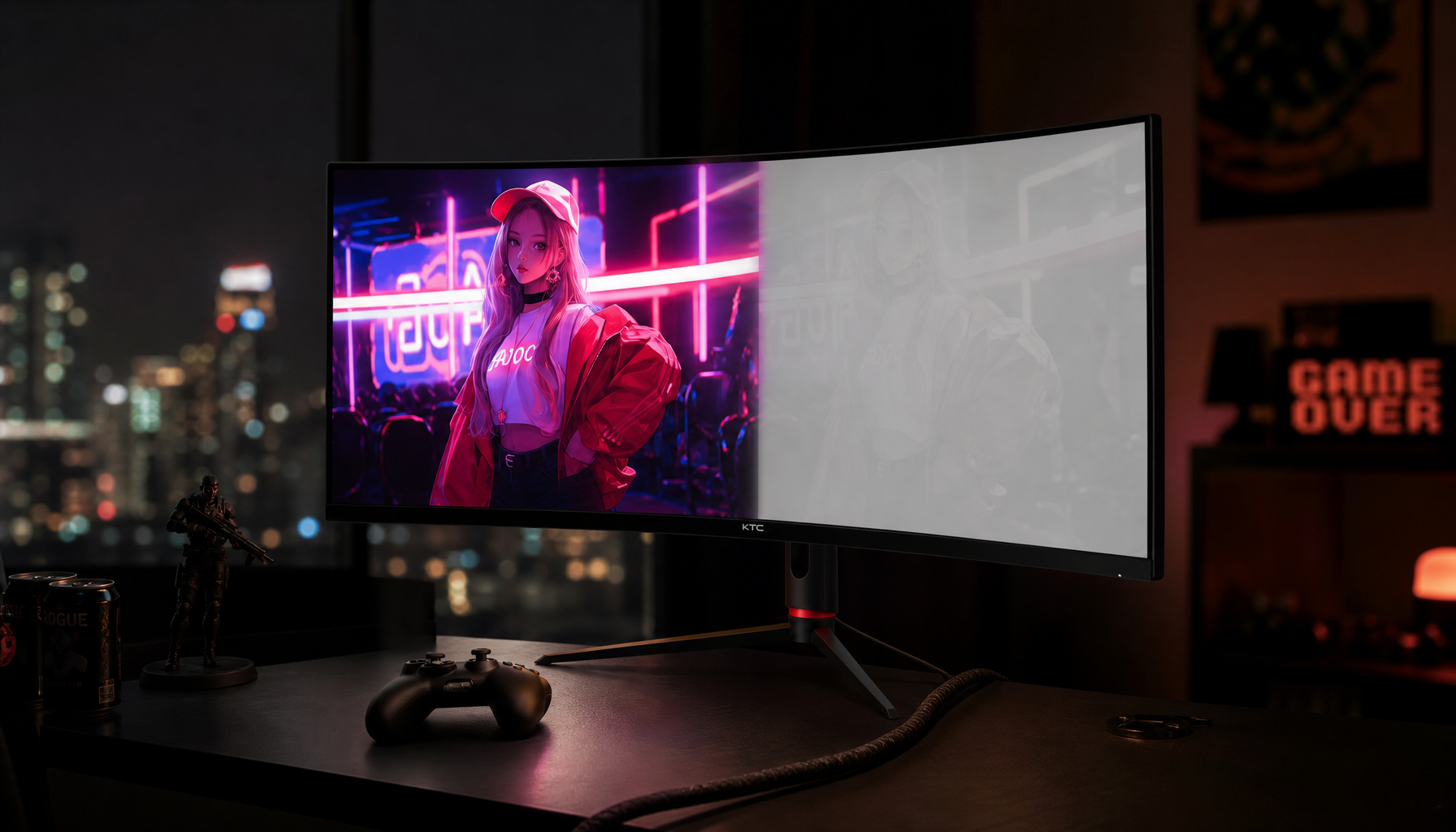
Dual monitors often show noticeably different colors even when they are connected to the same PC. Anyone who has parked a laptop next to a desktop monitor has seen this firsthand: one panel makes whites look icy, the other makes the same page look cream-colored.

Matching two monitors by copying the same RGB values is unreliable because panel-to-panel differences exist even within the same model. If you run an ultrawide main display with a smaller portable side monitor, expect to use separate color profiles rather than assuming one set of settings will translate cleanly.
Which monitor specs actually matter for color accuracy
Start with gamut, Delta E, white point, and gamma
Color gamut tells you how much of a target space a monitor can reproduce, and sRGB is still the most important baseline for web content, most games, and general PC use. If your work is mostly gaming, streaming, and everyday use, solid sRGB coverage is usually more useful than paying extra for a very wide gamut you will not manage correctly.
Delta E is the clearest shorthand for visible color error: values at or below 1 are difficult even for experts to notice, values between 1 and 3 are noticeable to trained viewers, and values at or above 3 are often visible to general users. That makes Delta E more actionable than vague claims about “cinematic color.”
The common white-point target is 6500K and the usual gamma target is 2.2, which is why many monitor reviews treat those numbers as the baseline for “correct” desktop color. If a display is far cooler than 6500K, whites can look bluish; if gamma is off, midtones can look either flat or too dark.
Use the right spec priority for the job
Use case |
What to prioritize |
Why it matters most |
Competitive gaming monitor |
Refresh rate, response behavior, decent sRGB accuracy, stable white point |
Fast motion matters first, but poor color tuning can still make maps and shadows harder to read |
Single-player HDR gaming monitor |
10-bit support, wide gamut, strong contrast, low Delta E |
Smooth gradients and believable highlights improve image depth more than raw color count claims |
Ultrawide for work and play |
Uniformity, viewing-angle stability, sRGB or DCI-P3 coverage, calibration support |
Large screens exaggerate edge inconsistency and color shifts |
Portable monitor |
sRGB balance, brightness consistency, profile support, glare control |
Travel use often happens in changing light where modest but stable color is better than overstated gamut |
Photo or video editing monitor |
Low Delta E, strong uniformity, calibration hardware support, appropriate gamut |
Creator work depends on repeatable results, not just punchy color |
Most web content and many games still assume sRGB behavior, so a monitor that oversaturates sRGB can look exciting in a store yet less truthful at home. That is often why a “vivid” mode impresses quickly but becomes tiring for editing, browsing, and long gaming sessions.
Why calibration changes the result more than people expect
Factory settings are a starting point, not a finish line
Calibration devices such as colorimeters and spectrophotometers measure displayed colors and help correct brightness, white balance, gamma, and profile behavior. If you care about accurate skin tones, product photos, or matching two displays, hardware calibration is the fastest way to stop guessing.

Calibration should be repeated over time because monitors age and drift. A realistic home setup is to calibrate monthly, save each color profile, and keep your room lighting as neutral and consistent as possible.
Software tweaks help, but they do not fix a weak panel
A platform’s color management can apply a custom profile to each display, which is useful when you are trying to get a desktop monitor and a portable monitor reasonably close. That is worth doing, but it will not turn a low-uniformity panel into a reference display.
Some monitors simply have poor native color quality, which means no amount of slider work will fully solve inaccurate tones, weak grayscale tracking, or unstable white balance. Buying a panel with decent out-of-box accuracy is still the better starting point than planning to rescue a bad one later.
How to choose the right display when vividness, speed, and accuracy compete
Buy for the content you actually look at most
A wider gamut is better in principle but not always necessary, especially if your real use is web browsing, schoolwork, office apps, and mainstream games. For many buyers, a well-tuned sRGB monitor with good contrast and a reliable white point will look better day to day than a cheaper “wide color” panel running oversaturated all the time.
High color accuracy matters most when you need the creator’s intended result, such as photo editing, digital art, or video work. If that is only 10% of your week and the other 90% is gaming, then a balanced gaming monitor with decent accuracy may be the smarter buy than a slower professional display.
Treat “realistic” and “more colorful” as different goals
Human color discrimination estimates vary widely, and the visible benefit of extra panel capability depends on where those colors and tonal steps land. That is why a spec sheet can promise more colors than you will ever meaningfully notice, while still failing to reproduce one familiar skin tone correctly.

True tetrachromacy is rare, and standard RGB displays cannot create a fourth color channel for testing it anyway. For normal monitor buying, the practical lesson is not to chase theoretical color counts; chase measured accuracy, stable calibration, and the right feature balance for your desk.
FAQ
Q: Why do monitor colors look different from real life?
A: A monitor only approximates color through RGB light, while your eyes and brain judge color through cone responses, adaptation, contrast, and room lighting. Real objects also reflect light differently than a self-lit panel emits it.
Q: Is a wider color gamut always better for gaming monitors?
A: Wider gamut can produce richer color, but it is not automatically better if the monitor oversaturates standard sRGB content or has weak calibration. For many players, accurate sRGB plus strong contrast and motion handling is the better mix.
Q: Can I use an online test to tell whether my monitor is perfectly color accurate?
A: Online hue tests can be useful for quick self-checks, but they are affected by lighting, fatigue, and the monitor you are viewing them on. Real monitor evaluation is more reliable with hardware calibration, grayscale and gradient checks, and measured Delta E.
Practical Next Steps
Choose the monitor around the mistake you can least afford. If you cannot tolerate blur, prioritize refresh rate and response first, then demand at least solid sRGB accuracy; if you cannot tolerate wrong color, prioritize low Delta E, uniformity, and calibration support before extras.
For most buyers, the safest path is a display with good out-of-box sRGB accuracy, a white point near 6500K, gamma close to 2.2, and the ability to save or load proper color profiles. That combination usually matters more in daily use than inflated color-count marketing.
References
- A company: Tetrachromacy
- A publication: Most of your eye’s color sensors don’t actually see color
- A platform: Color Theory for Digital Displays
- A platform: Monitors display more colors than human eye can distinguish
- A company: How to Evaluate Monitor Color Accuracy
- A company: Best way to match the colors on two different monitors
- A company: Color Accuracy
- A company: Hue Test
- A platform: Color Reproduction