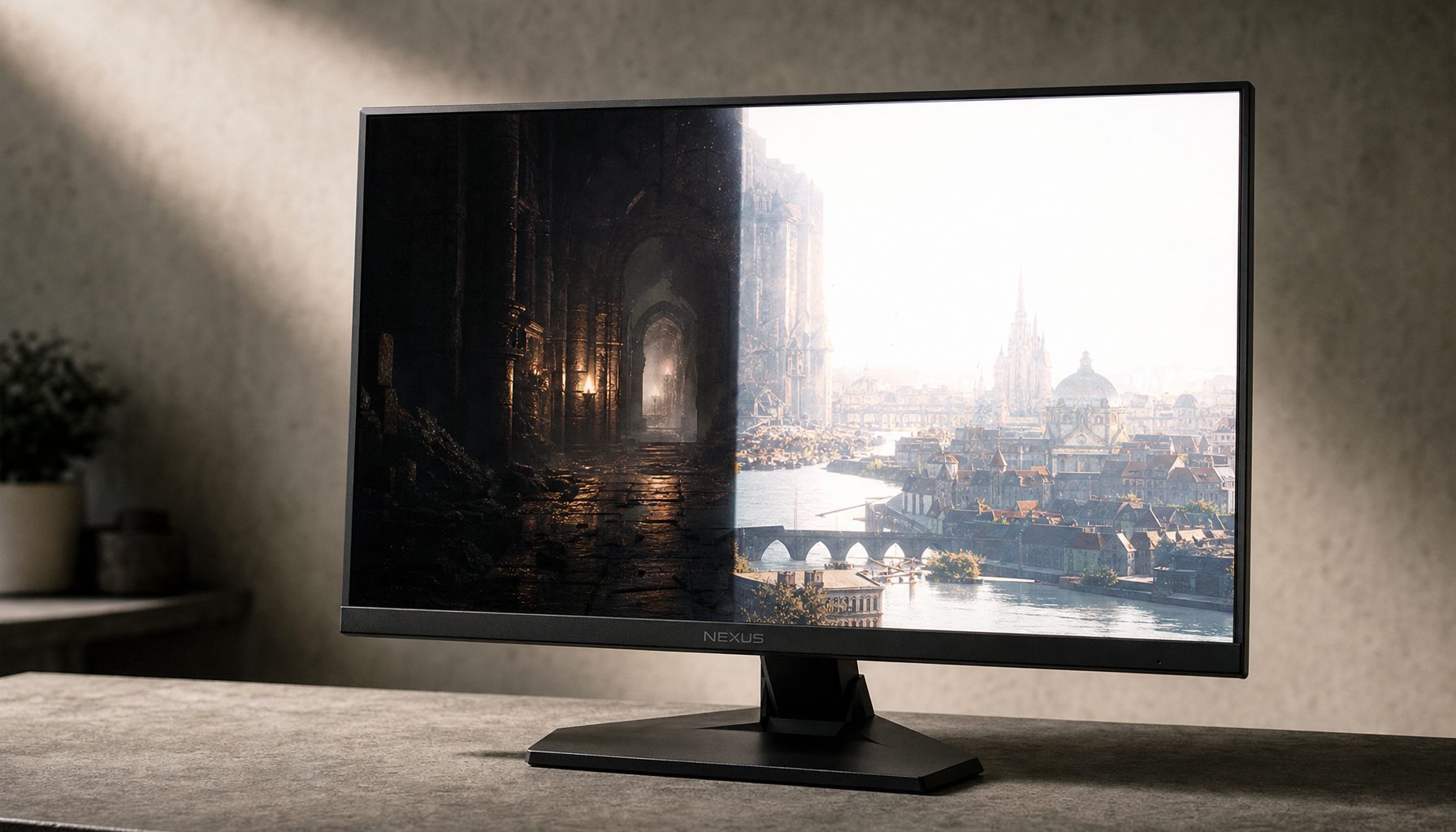
OLED flicker is not automatically worse than LCD flicker, but it is often more noticeable in low-brightness use, dark scenes, and unstable VRR gaming. A good LCD can feel calmer for office work, while a well-tuned OLED can still deliver a more immersive gaming image.
Do your eyes feel fine during spreadsheets, then tense up when a dark game menu pulses on an OLED monitor? In practical testing and user reports, OLED flicker complaints cluster around low-brightness use and VRR frame-rate swings, while many modern LCD monitors are effectively flicker-free unless their backlight dimming is poorly implemented. The key is knowing how to judge the trade-off, test your own display, and tune a setup for comfort without giving up performance.
What Flicker Means on a Monitor

Flicker is a repeated change in light output over time. Sometimes you see it as pulsing, flashing, banding, or brightness instability. Sometimes you only feel the result after a long session: eye fatigue, headaches, reduced focus, or the sense that the screen feels harsh.
On LCD monitors, flicker usually comes from the backlight. The liquid crystal layer shapes the image, but a separate LED backlight provides the light. Many LCDs dim that backlight using pulse-width modulation, or PWM, which rapidly turns the light on and off. A common flicker source is therefore brightness control, not the LCD pixels themselves.
OLED is different because each pixel emits its own light. That brings perfect blacks, instant pixel response, and superb contrast, but it also changes the flicker profile. OLED panels may use PWM at lower brightness levels, and gaming OLEDs can show VRR flicker when refresh rates change rapidly. The issue is less “OLED always flickers more” and more “OLED flicker appears under different triggers.”
OLED Versus LCD: Where Each One Struggles
A traditional LCD can be excellent for eye comfort when it uses DC dimming or very high-frequency PWM. In office work, coding, editing, and productivity apps, a quality flicker-free LCD often gives steady light output for hours. The weakness appears when a monitor uses low-frequency PWM, especially at reduced brightness. If you dim the monitor for evening work and notice camera bands or strobe-like hand motion in front of the screen, the backlight may be pulsing.
OLED’s comfort challenge is more scene-dependent. At low brightness, some OLED panels use more aggressive PWM behavior. During gaming, OLED can also show brightness or gamma fluctuation when VRR is active and frame rate is unstable. OLED VRR flicker is distinct from traditional LCD PWM because it is tied to changing refresh behavior and gamma response, not simply a backlight turning on and off.
Use Case |
OLED Risk |
LCD Risk |
Better Starting Point |
Bright office work |
Usually manageable, but text comfort varies by panel |
Usually strong if flicker-free |
Quality IPS, TN, or productivity LCD |
Dark gaming with VRR |
Higher risk of visible pulsing |
VA LCD can also flicker; IPS/TN often calmer |
OLED if contrast matters, LCD if sensitivity matters |
Low-brightness night use |
PWM can become more noticeable |
PWM can also appear at low brightness |
Test the exact model at your real brightness |
Color and HDR gaming |
Excellent contrast and pixel response |
Lower black depth, possible blooming on some models |
OLED for immersion |
Long spreadsheet or document sessions |
Possible fatigue for sensitive users |
Often steadier illumination |
Flicker-free LCD |
Why OLED Flicker Can Feel Worse in Games
OLED’s biggest advantage, deep black, is also where flicker becomes easiest to notice. In near-black scenes, tiny luminance shifts stand out. A cave, loading screen, dim menu, or night mission can reveal pulsing that would be hidden in a bright desktop window.

Variable refresh rate makes this more complicated. VRR technologies are designed to smooth motion and reduce tearing by matching the monitor’s refresh rate to the GPU’s output. When frame delivery is steady, the experience can feel fluid and responsive. When a game swings from high FPS to low FPS, especially in dark scenes, the OLED panel may show visible brightness fluctuation. Both WOLED and QD-OLED can show it, so panel subtype alone is not a guaranteed escape route.
A simple real-world example is a 240Hz OLED running a demanding game that jumps between 180 FPS in corridors and 70 FPS in open areas. The average FPS may look strong, but the sudden frame-time movement is what matters. For comfort, a locked 120 FPS can look calmer than an uncapped 70-to-220 FPS swing.
Why LCD Flicker Is Usually Easier to Predict
LCD flicker is often more straightforward because the main question is whether the backlight uses PWM, at what frequency, and at which brightness levels. A monitor may be flicker-free at full brightness but introduce PWM at 40% brightness. Another may use high-frequency PWM that most people never notice. A truly steady DC-dimmed backlight is usually the safest bet for long office sessions.
Lighting research reinforces the same principle: flicker is shaped by modulation depth, frequency, and waveform, not just the light source. Effective flicker measurement has to consider how much the light changes, how often it changes, and what shape the light variation takes. For monitors, that means a “flicker-free” label is useful, but it is not the whole story.
This is why a $250 office LCD can feel easier on the eyes than a premium OLED in one setup, while the OLED looks dramatically better in another. The LCD may simply be holding a steadier brightness during static work, while the OLED is being pushed through low-brightness PWM or unstable VRR behavior.
Is OLED Flicker Objectively Worse?
The honest answer is conditional. OLED is more likely to show distracting flicker in dark VRR gaming and low-brightness use. Traditional LCD is more likely to show flicker when its LED backlight uses low-frequency PWM or when the monitor has cable, driver, refresh-rate, or power issues.
For high-performance gaming, OLED’s risk is not a deal-breaker. It is a tuning problem and a model-selection problem. If you play bright esports titles at stable high frame rates, OLED flicker may be minimal or irrelevant. If you play dark single-player games with heavy ray tracing, inconsistent frame pacing, and VRR enabled, OLED flicker can become the one visual flaw that breaks immersion.
For productivity, LCD often has the safer comfort profile. Reading documents, comparing spreadsheets, editing slides, and running dashboards reward stable brightness more than perfect black levels. A flicker-free LCD with ergonomic adjustment, sensible brightness, and a matte coating can be the more reliable daily driver.
How to Test Flicker Before You Commit
Start with the brightness level you actually use. Testing a monitor only at 100% brightness tells you little if you work at 25% brightness every evening. Lower the display to your normal setting, open a white or light gray document, then move your fingers quickly in front of the screen. If motion appears segmented or strobe-like, the monitor may be flickering.
A cell phone camera can reveal banding, but treat it as a rough screen check rather than lab proof. Camera shutter behavior can exaggerate or hide flicker, especially on OLED. Still, if heavy bands appear at low brightness on one display and not another under the same camera settings, that is useful buyer-level evidence.
For OLED gaming, test a dark game scene with VRR on, then cap the frame rate. If the flicker improves after limiting FPS slightly below the monitor’s maximum refresh rate, the issue is likely tied to VRR instability rather than a defective panel. The active VRR range approach reflects the same idea: reduce the size of refresh-rate swings, and flicker often becomes less obvious.
Practical Settings That Reduce OLED Flicker

The first move is frame stability. Do not chase the highest possible FPS if the result is erratic. A consistent cap slightly below the monitor’s peak refresh rate can reduce VRR flicker and make motion feel more controlled. On a 240Hz monitor, that might mean trying a cap around 225 FPS or lower, depending on the game. On a 120Hz screen, a cap near 110 or 115 FPS can be worth testing.

Next, tune the game for minimum FPS, not just average FPS. Shadows, ray tracing, crowd density, volumetrics, and traversal stutter can all create frame-time spikes. Reducing one heavy setting often does more for flicker comfort than dropping everything to medium.
Brightness also matters. If your OLED flickers more at very low brightness, raise the monitor brightness moderately and reduce room lighting glare instead of forcing the panel into its most uncomfortable dimming range. For desktop use, avoid using OLED at extremely dim settings for long reading sessions unless you know that model behaves well.
If your monitor includes an anti-flicker or VRR range option, use it. These modes usually limit refresh-rate fluctuation rather than eliminating flicker completely. That trade-off is reasonable: a narrower VRR window may cost a little flexibility, but it can preserve the OLED strengths that matter most, including contrast, speed, and HDR impact.
When LCD Is the Smarter Buy
Choose a flicker-free LCD if your priority is long work sessions, text clarity, predictable comfort, and low-maintenance setup. This is especially true for programmers, analysts, writers, finance users, and anyone who spends most of the day in bright static interfaces.

A strong LCD is also sensible if you are known to be flicker-sensitive. User communities focused on display strain often report highly individual reactions; one person may tolerate OLED for an hour or two, while another prefers older TN or specific VA LCD panels. Display comfort reports are subjective, but they highlight a real buying truth: your eyes may care more about the exact implementation than the panel category printed on the box.
When OLED Is Still Worth It
Choose OLED when immersion, contrast, motion clarity, HDR, and gaming response are the priorities. For cinematic games, space scenes, horror titles, racing, and high-refresh competitive play, OLED can deliver a level of depth and immediacy that most LCDs cannot match.
The value play is to buy OLED with eyes open. Look for reviews that test VRR flicker, not just response time and color gamut. Favor models with anti-flicker controls, stable firmware support, and enough refresh-rate headroom to cap FPS comfortably. Pair the monitor with a GPU and CPU that can hold consistent frame pacing in the games you actually play.
FAQ
Does higher refresh rate fix flicker?
Higher refresh rate can help motion clarity, but it does not automatically fix flicker. LCD PWM flicker depends on backlight behavior, while OLED VRR flicker depends heavily on frame-rate stability and gamma behavior during refresh changes.
Is QD-OLED better than WOLED for flicker?
There is no universal winner. Some reports find WOLED flicker more noticeable during large FPS drops, while others show QD-OLED looking worse in specific comparisons. The practical answer is to compare the exact monitor model, settings, game, and brightness level.
Should I turn VRR off on OLED?
If VRR flicker bothers you, turning VRR off is a valid test, but it may reintroduce tearing or uneven motion. A better first step is usually to cap FPS, stabilize game settings, and try the monitor’s anti-flicker mode if available.
OLED flicker can be worse than LCD flicker in dark, unstable gaming scenarios, but LCDs are not automatically clean. The best display is the one whose flicker behavior matches your use: stable flicker-free LCD for long productivity, carefully tuned OLED for maximum gaming immersion.