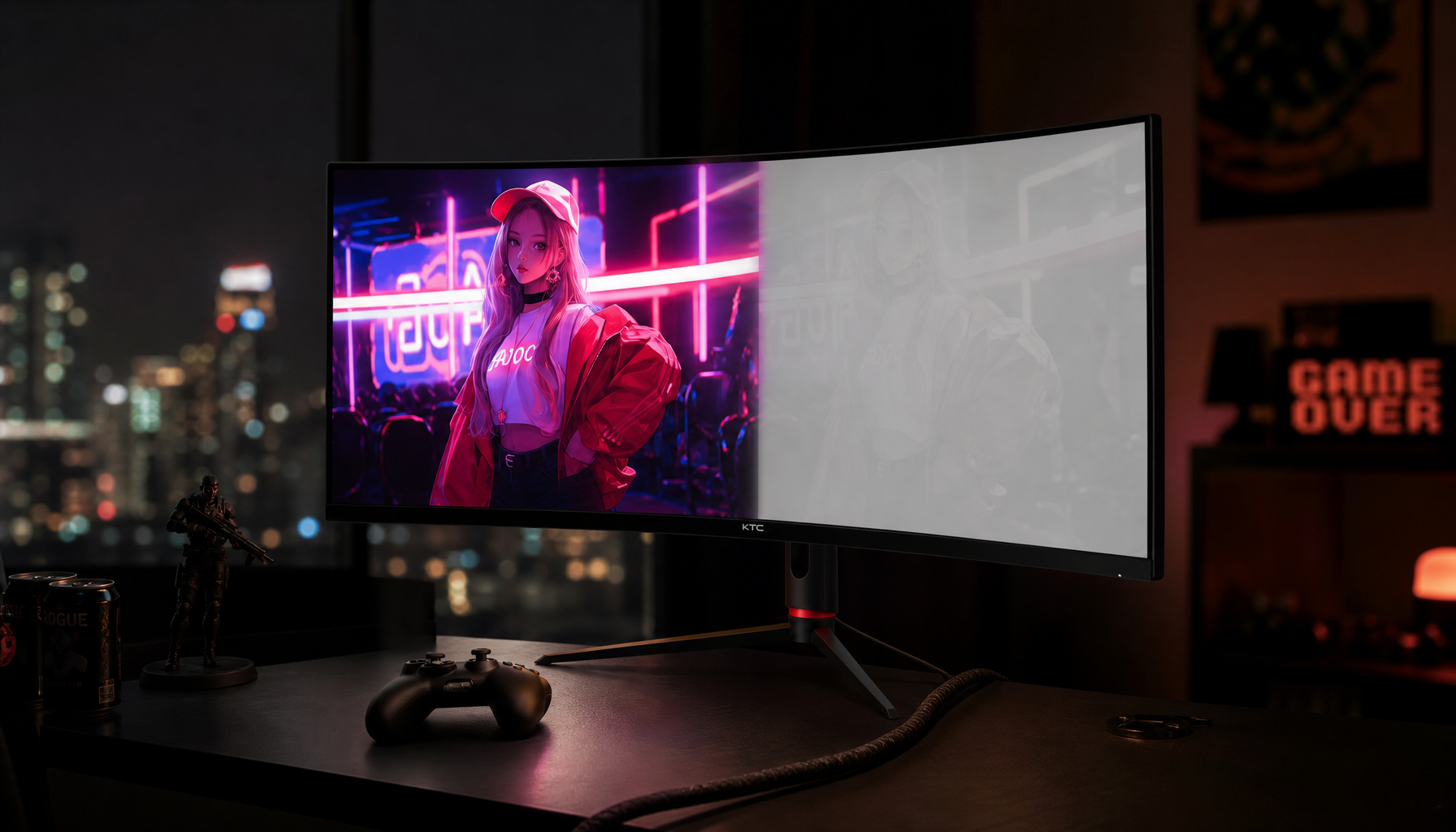
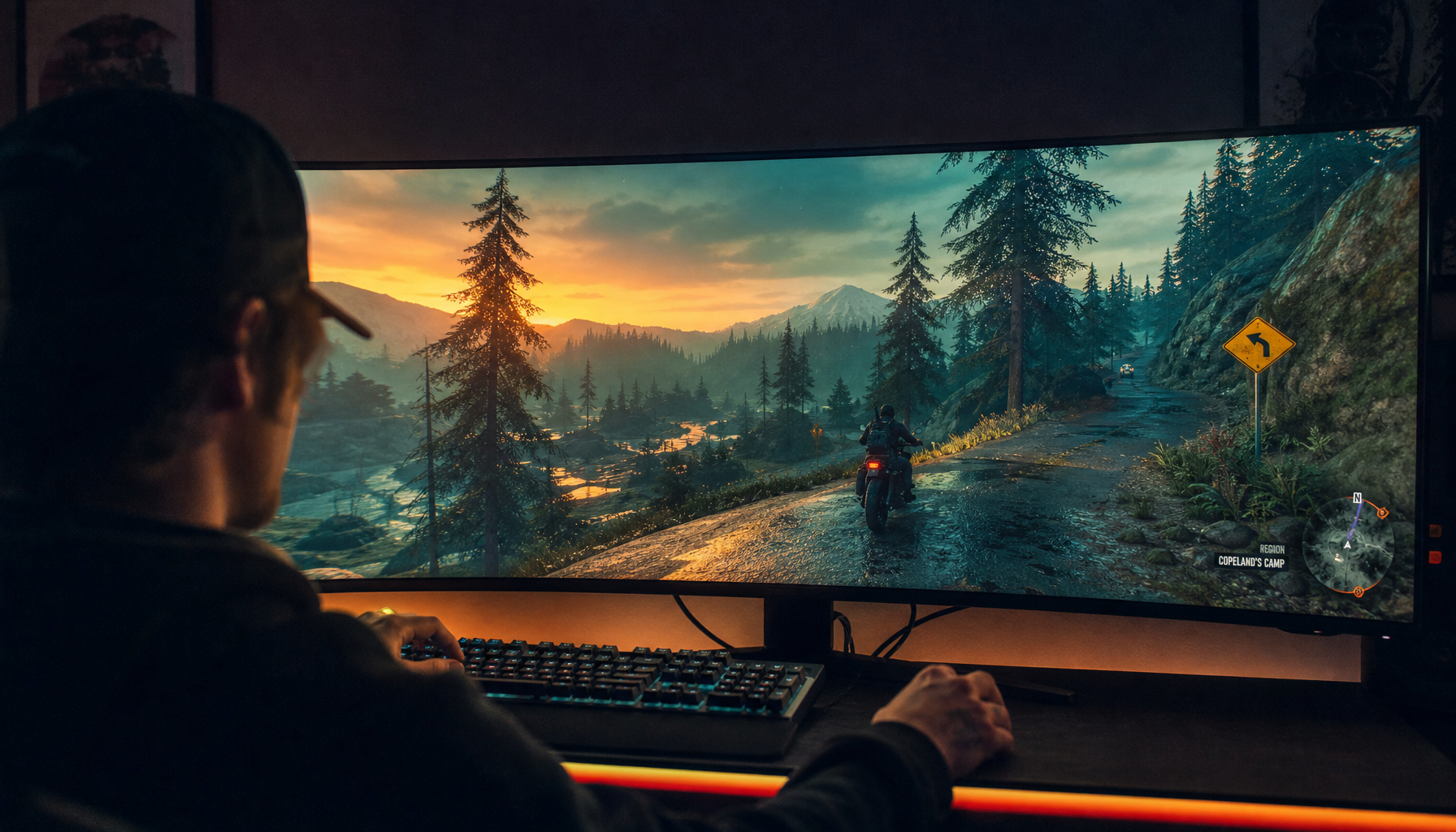
Room lighting can make the same monitor look deeper, flatter, brighter, or darker without changing any display settings. For dark scenes, the best setup combines controlled ambient light, low-glare placement, and stable bias lighting behind the screen.
Can you spot an opponent in a shadowed hallway, or does every night scene collapse into a black patch? A practical bias-light setup around 10% of peak SDR white, paired with glare-free room lighting, gives you a repeatable way to protect dark detail without washing out the image. Here is how to tune your room, monitor, and desk lighting so dark scenes stay visible, cinematic, and comfortable.
Why Dark Scenes Change When the Room Changes
A monitor does not exist in isolation. Your eyes judge black level, contrast, and shadow texture against the brightness of the room around the screen. In a bright room, blacks can look lifted and gray because light reflects off the panel surface. In a pitch-black room, the screen can feel harsh, and subtle near-black tones may be harder to separate because your pupils keep adapting between bright UI elements and dark surroundings.
This is why a night mission can look readable at 8:00 PM with a soft lamp behind the monitor, then look crushed and muddy at noon when sunlight hits the screen from the side. Ambient lighting can improve perceived comfort by reducing glare, contrast shock, eye strain, and tracking fatigue, even though it does not change refresh rate, response time, or panel hardware.
Key Definitions That Matter
Shadow Detail
Shadow detail is the visible texture, shape, or separation inside dark parts of an image. In games, it might be a doorway edge, an enemy silhouette, a trap, or terrain depth. In movies, it might be fabric folds, facial contours, or background objects in a night scene.
Black Crush
Black crush happens when near-black grays collapse into solid black. A dark image is not automatically crushed; a good dark scene still preserves steps between black, dark gray, and slightly brighter gray. When black crush appears, you lose useful information, not just brightness.
Perceived Contrast
Perceived contrast is what your eyes think the screen is doing in your room. A monitor may have the same measured contrast ratio all day, but reflections, wall color, glare, and background brightness can make the image feel flatter or punchier.
Bias Lighting
Bias lighting is a stable, low-level light placed behind the monitor. It lights the wall behind the screen so the display is not floating in a black void. The most useful setup is neutral, dimmable, diffused, and steady rather than bright, pulsing, or strongly colored.
Bright Rooms: The Black-Level Killer

Bright rooms are the hardest environment for dark-scene visibility. Window light, overhead fixtures, white desks, glossy walls, and visible LED points can bounce light onto the panel. Once that happens, the screen’s dark areas are no longer only produced by the display; they are mixed with room reflections.
For a real-world example, place a dark game menu on screen and turn on a ceiling light behind you. If the menu background suddenly looks gray or patchy, your monitor did not lose contrast. The room added unwanted light to the panel surface.
The fix is not simply turning monitor brightness to maximum. That can make highlights brighter, but it does not remove reflected glare from black areas. Better moves include rotating the desk away from direct windows, using blinds or sheer curtains, choosing matte desk surfaces, and moving lamps so they light the desk rather than the display. Natural light should be controlled with blinds or diffusers because unmanaged daylight can create glare, reflections, and uneven screen visibility.
Dark Rooms: More Immersive, Not Always More Accurate
A fully dark room can feel cinematic, especially on OLED or Mini-LED displays. The downside is contrast shock. If the screen is much brighter than the surrounding wall, your eyes adapt aggressively to the display. Bright HUD elements, subtitles, and flashes can feel intense, while very dark tones may become tiring to inspect over time.
That is where bias lighting earns its place. For gaming and streaming setups, a strip mounted roughly 2 to 4 inches behind the monitor and set to about 10% of peak SDR white is a strong starting point. Bias lighting behind the monitor can reduce eye strain, improve perceived screen contrast, and make long sessions more comfortable.

The trick is restraint. If the backlight is too bright, it competes with the image. If it is saturated blue, red, or purple, it can tint your visual perception and make dark-scene judgment less reliable. For color-sensitive work or realistic HDR viewing, neutral white is the safest target.
The Best Lighting Setup for Gaming, Work, and Portable Screens
A high-performance setup uses layers. Ambient lighting gives the room a soft base. Task lighting helps you see your keyboard, notes, controller, or desk surface. Bias lighting stabilizes the area behind the display. Accent RGB can add style, but it should stay secondary when shadow detail matters.

Use Case |
Best Lighting Direction |
Color Temperature |
Brightness Strategy |
Competitive gaming |
Behind screen plus soft side light |
Neutral to cool white |
Keep RGB low and steady so movement stays easy to track |
Cinematic gaming |
Bias light behind display |
Neutral white or soft warm |
Keep the room dim, not black |
Office productivity |
Side task light plus ambient room light |
Warm-neutral to neutral white |
Match screen brightness to room brightness |
Portable monitor use |
Avoid direct window and ceiling glare |
Neutral white when possible |
Recheck brightness in each location |
Color-sensitive work |
Neutral wall light behind screen |
Neutral daylight white |
Avoid mixed warm and cool bulbs |
For desk work, task lighting should sit to the side of the monitor and point toward the keyboard or workspace rather than the screen. That placement keeps paper, controls, and accessories visible without putting a reflection across dark scenes.
Monitor Settings Still Matter
Room lighting cannot rescue a poorly tuned display. If your monitor brightness, black level, gamma, or HDR mode is wrong, the room can only soften the symptoms. Start with the monitor’s Standard, User, Custom, sRGB, or Creator mode rather than an aggressive preset. Disable dynamic contrast, eco mode, automatic brightness, HDR simulation, and eye-care modes while judging shadow detail, because those settings can shift brightness or gamma while you are trying to calibrate.
For SDR gaming and desktop use, gamma 2.2 is a practical baseline. A higher gamma can make blacks look richer, but it may hide near-black steps. A lower gamma can reveal more shadow detail, but it may make the picture look washed out. The goal is not to make every dark corner bright; the goal is to make intentional dark scenes readable without turning black into foggy gray.
A simple test is to use a black-level pattern, often called a PLUGE pattern. Adjust brightness or black level until the darkest near-black steps are barely visible while true black remains black. Then check the same pattern under your normal room lighting. If the steps disappear only when the room lights are on, the room is the problem. If they disappear in every condition, the monitor setting or panel behavior is likely involved.
Panel Type Changes the Lighting Strategy
IPS, VA, OLED, and Mini-LED displays respond differently to room lighting. IPS panels usually have stable viewing angles, but blacks can look gray in a dark room. VA panels often deliver stronger native contrast, but dark tones may shift with viewing angle. OLED can produce true black, but reflections and near-black handling still matter. Mini-LED can deliver impressive HDR punch, but local dimming may suppress subtle low-level detail in some scenes.
This is why one setting rarely works across setups. A VA gaming monitor in a dim room may need careful gamma control. An IPS office display in a bright room may need better reflection management. An OLED used at night may benefit more from gentle bias lighting than from raising brightness.
RGB: Immersion Tool or Shadow Detail Problem?
RGB lighting is not bad. Reactive lighting, wall panels, and desk-edge strips can make a gaming station feel alive. The problem starts when RGB becomes brighter than the screen’s darker image areas or when it changes too quickly. Fast color cycling can pull attention away from movement, crosshair placement, and subtle enemy outlines.
Subtle lighting supports comfort and focus better than aggressive effects when the monitor is the main visual surface. For competitive play, keep ambient RGB static or slow, around 20% to 40% intensity, with floor or desk-edge accents lower. For HDR, OLED, or Mini-LED viewing, avoid bright colored lights close to the screen because they can interfere with perceived black level and color consistency.

Office Lighting and Dark Visibility Are Connected
Productivity lighting is not only about staying awake. It changes how readable your screen feels over a full workday. Too little room light makes a white document feel glaring. Too much overhead light makes dark UI themes and video content look flat. Mixed bulbs can make whites look inconsistent and can fatigue your visual system as you move between screen, desk, and room.
For home office work, layered lighting is recommended: natural daylight, a desk lamp for the active work area, ambient ceiling or floor lighting, and optional monitor backlighting. A practical rhythm is brighter, cooler light in the morning for focus, neutral light through the afternoon, and warmer, dimmer light in the evening.
A Practical Tuning Workflow
Set the room first, then the monitor. Close or diffuse direct window light. Turn off lamps that reflect in the screen. Add soft ambient light so the room is not pitch black. Place bias lighting behind the monitor, dim it until it is noticeable on the wall but not visually dominant, then open a dark test image, game scene, or movie frame you know well.
After that, adjust display brightness for the room. Tune black level with a test pattern. Check gamma or shadow controls only after brightness is close. Revisit in-game brightness last, because raising game brightness too far can destroy the intended mood and make fog, smoke, and shadows look artificial.
The most reliable result is a room where blacks stay dark, near-black details remain visible, and your eyes are not fighting the environment. That is the difference between a setup that only looks impressive in photos and one that performs during a ranked match, a late-night film, or a focused work session.
FAQ
Should I game in total darkness?
Total darkness can feel immersive, but it often increases eye fatigue and contrast shock. A dim room with neutral bias lighting behind the monitor is usually better for long sessions and dark-scene visibility.
Does bias lighting improve actual monitor contrast?
No. It does not change the panel’s measured contrast ratio. It improves perceived contrast and comfort by reducing the brightness gap between the screen and the surrounding room.
Should I raise brightness when dark scenes are hard to see?
Raise brightness only after controlling glare and checking black-level settings. If room reflections are washing out the panel, higher brightness may make highlights harsher while blacks still look poor.
What color should monitor backlighting be?
Neutral white is the safest choice, especially for HDR, OLED, Mini-LED, and color-sensitive work. Strong RGB colors are better treated as low-intensity accents, not the main light behind the display.
Dark-scene visibility is not just a monitor spec; it is a full viewing system. Control glare, add restrained bias lighting, tune black level carefully, and let the screen carry the image instead of making the room fight it.