

Screen curvature usually helps immersion more in open-world RPGs than in competitive games. It makes large scenes feel deeper and more continuous, while competitive play tends to reward speed, clarity, and minimal distraction instead.
Do long rides across a fantasy map feel strangely flat, or does a tense ranked match start to feel cramped and tiring after an hour? The difference is easy to test: a wider curved screen tends to make exploration feel bigger, while a smaller, faster screen usually makes tracking enemies feel cleaner. Here is where curvature genuinely improves the experience, where it can get in the way, and how to choose the right shape for the games you actually play.
What Curvature Really Changes on Your Desk
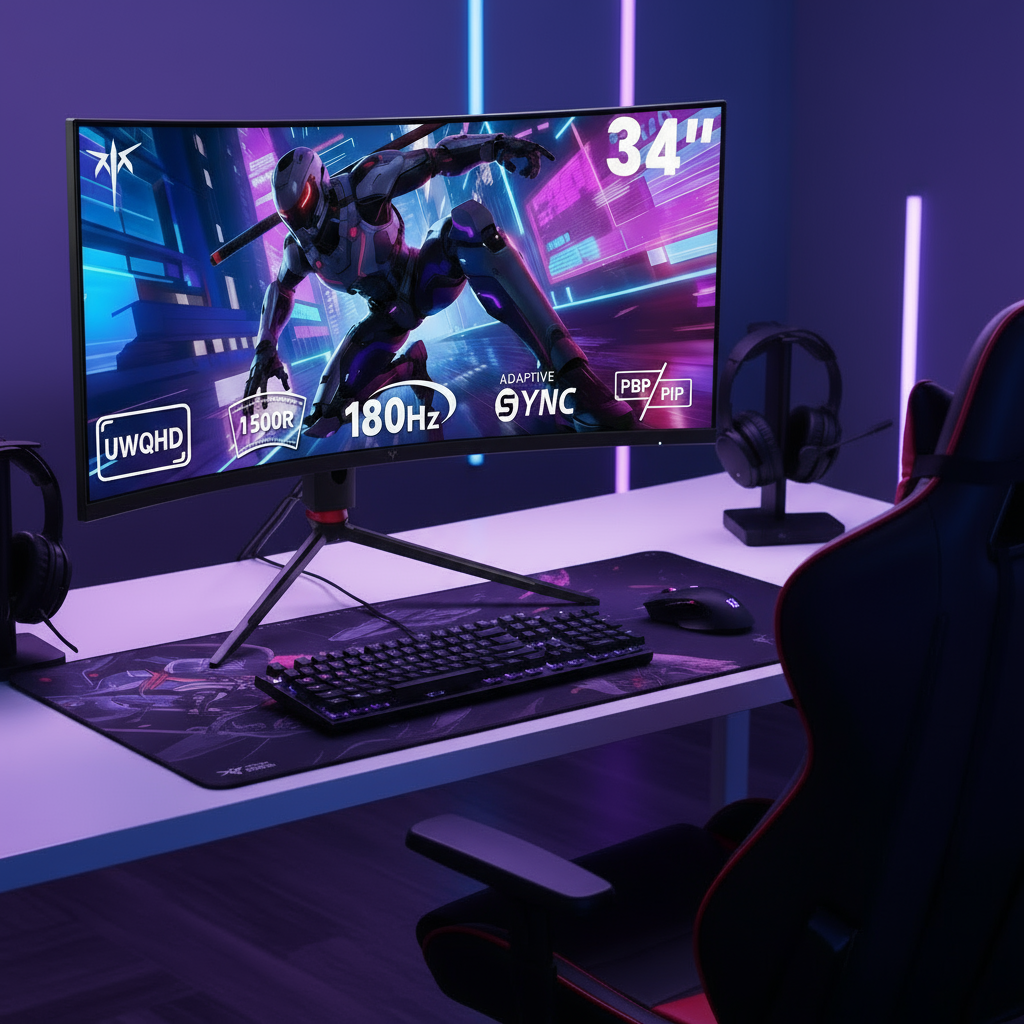
A more natural wraparound field of view is why the effect becomes more noticeable as screens get larger. In real use, that means the edges of a 32-inch or 34-inch display feel less like separate corners you have to check and more like part of one continuous image. That is the core reason curved panels can feel more immersive: they reduce the sense that you are looking at a large rectangle sitting in front of you.
The curvature rating is a radius value, so 1800R is gentler than 1000R, and 800R is more aggressive still. On a 34-inch ultrawide, a gentle-to-medium curve often feels natural after a few minutes. On a very large panel, a deeper curve can help keep the far edges within comfortable view, but if the curve is too aggressive for your viewing distance, side UI elements can feel exaggerated rather than seamless.

Why Open-World RPGs Usually Benefit More
The World Feels Larger, Not Just Wider
For immersion-first gaming, curved ultrawides are often preferred. That matters in open-world RPGs because those games sell atmosphere through scale, horizon lines, weather, architecture, and environmental detail. When you are crossing a desert or scanning a ruined city for side quests, the curve helps the scene feel like it extends around you instead of stopping abruptly at flat edges.
The sense of presence depends on visual and sensory cues, and curved displays support that visual side surprisingly well even outside VR. You are still using a standard monitor, but the effect of the screen fading into the background is stronger when the edges stop competing for attention. That is why a 34-inch 21:9 curved panel often feels transformative in story-driven games even when the same player is only mildly impressed by curve during everyday desktop use.

Long Sessions Feel Easier on the Eyes
A larger perceived field of view can make long sessions feel easier on the eyes. In practice, this matters most in games that invite extended play, such as exploration-heavy RPGs, survival sandboxes, and slow-burn action adventures. If you spend three hours questing, managing inventory, and reading dialogue, comfort matters almost as much as spectacle.
That advantage grows when the rest of the setup also supports focus. A curved monitor cannot fix harsh overhead lighting or a desk that is too shallow, but paired with better room lighting and a centered seating position, it can make the whole viewing experience feel calmer and more cohesive.
Why Competitive Games Judge Curvature More Harshly
Speed and Clarity Matter More Than Wraparound Feel
For competitive gaming, buying advice still starts with core performance, not curvature. That is the key split between genres. In a fast shooter, hero-based action game, or ranked battle arena, you are not trying to soak in scenery. You are trying to acquire targets quickly, read motion cleanly, and keep your eyes centered where the action happens.
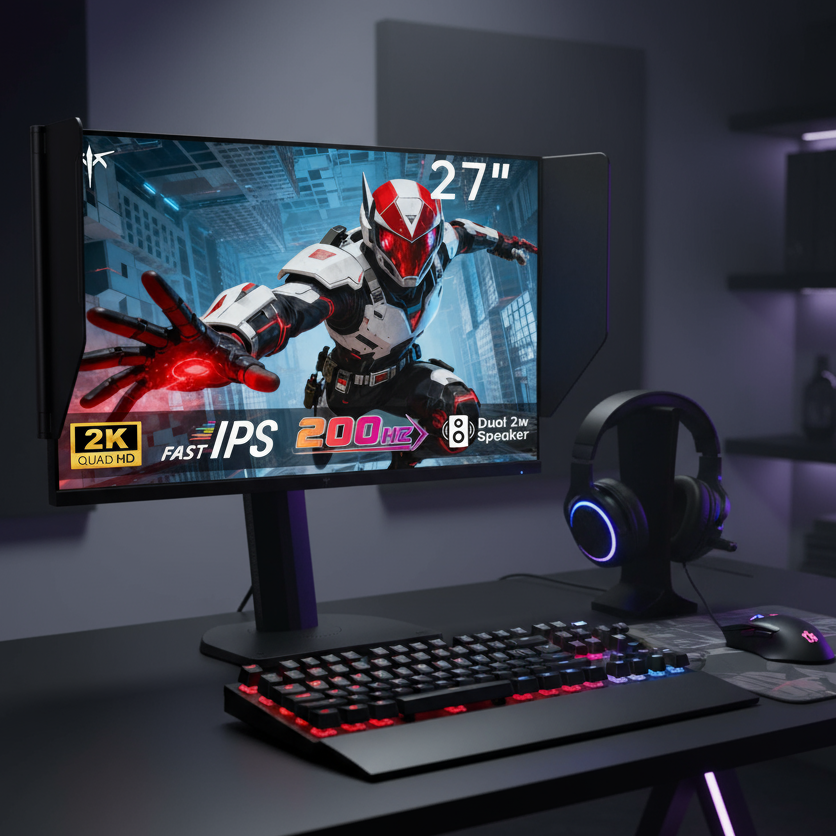
That is also why 24-inch screens are often favored for competitive play. A smaller display keeps more information within immediate central vision. You move your eyes less, your crosshair stays closer to the center of your attention, and the screen asks less of your neck and peripheral scanning. In esports terms, less cinematic is often a feature.

Some Curved Panels Trade Too Much Motion Quality
The panel technology behind many budget curved gaming monitors can introduce motion compromises. That matters more in competitive games than in RPGs. A little dark-scene smear during a dim cave sequence is annoying; the same smear during a snap peek or tracking duel is a real performance problem.
Even when a curved monitor posts high refresh specs, balanced image quality and strong motion handling still matter. That is why many serious competitive players remain happier on flat 24-inch to 27-inch displays, especially at 1080p or 1440p with very high refresh rates. Curvature is not inherently bad for ranked play, but it has to clear a higher bar.
Where Curvature Still Works in Competitive Play
A curved screen can still make sense, especially in the 32-inch or 34-inch class. If you play a mix of tactical shooters, racing games, and open-world titles, a mild curve can be a smart middle ground. You keep some wraparound feel for cinematic games while still getting enough speed for multiplayer if the monitor has the right refresh rate and response performance.
The practical limit is that extra-wide formats do not suit every game equally well. Some competitive titles place important HUD elements too far out, some older games handle ultrawide poorly, and some players simply dislike the extra eye travel. So the question is not whether curved is better, but whether your game mix rewards width and shape more than it punishes extra screen area.
The Best Fit by Game Style
Play style |
Best screen shape |
Why it usually works |
Open-world RPGs and cinematic single-player games |
34-inch curved ultrawide, often 1500R to 1800R |
Better world scale, stronger peripheral pull, and more comfortable long-form exploration |
Flat or mildly curved 24-inch to 27-inch display |
Faster eye-to-target movement, cleaner focus, and easier access to high refresh at lower cost |
|
Mixed gaming plus work |
32-inch curved 16:9 or 34-inch curved 21:9 |
Good compromise between immersion, multitasking space, and everyday usability |
A high-refresh 1440p panel is often the most sensible middle ground for mixed use. If you spend most nights in large, story-driven worlds, lean toward a curved ultrawide. If most of your time goes into ranked tactical matches, keep the screen smaller and faster. If your week swings between spreadsheets, raids, and competitive queues, a moderate curve on a well-tuned 32-inch or 34-inch display is usually the safest value play.

Your desk still decides part of this. A desk about 48 inches wide and 24 inches deep is a practical baseline if you want the monitor centered at a comfortable distance with room for peripherals. A curved screen that is too large for your desk often feels worse, not better, because you end up sitting too close and spend the whole session compensating for scale.
Curvature is at its best when it serves the game in front of you. If your goal is to disappear into a living world, curve is one of the few monitor features that can make a display feel bigger without simply making it larger. If your goal is to win cleaner, faster fights, treat curve as optional and let motion performance lead.