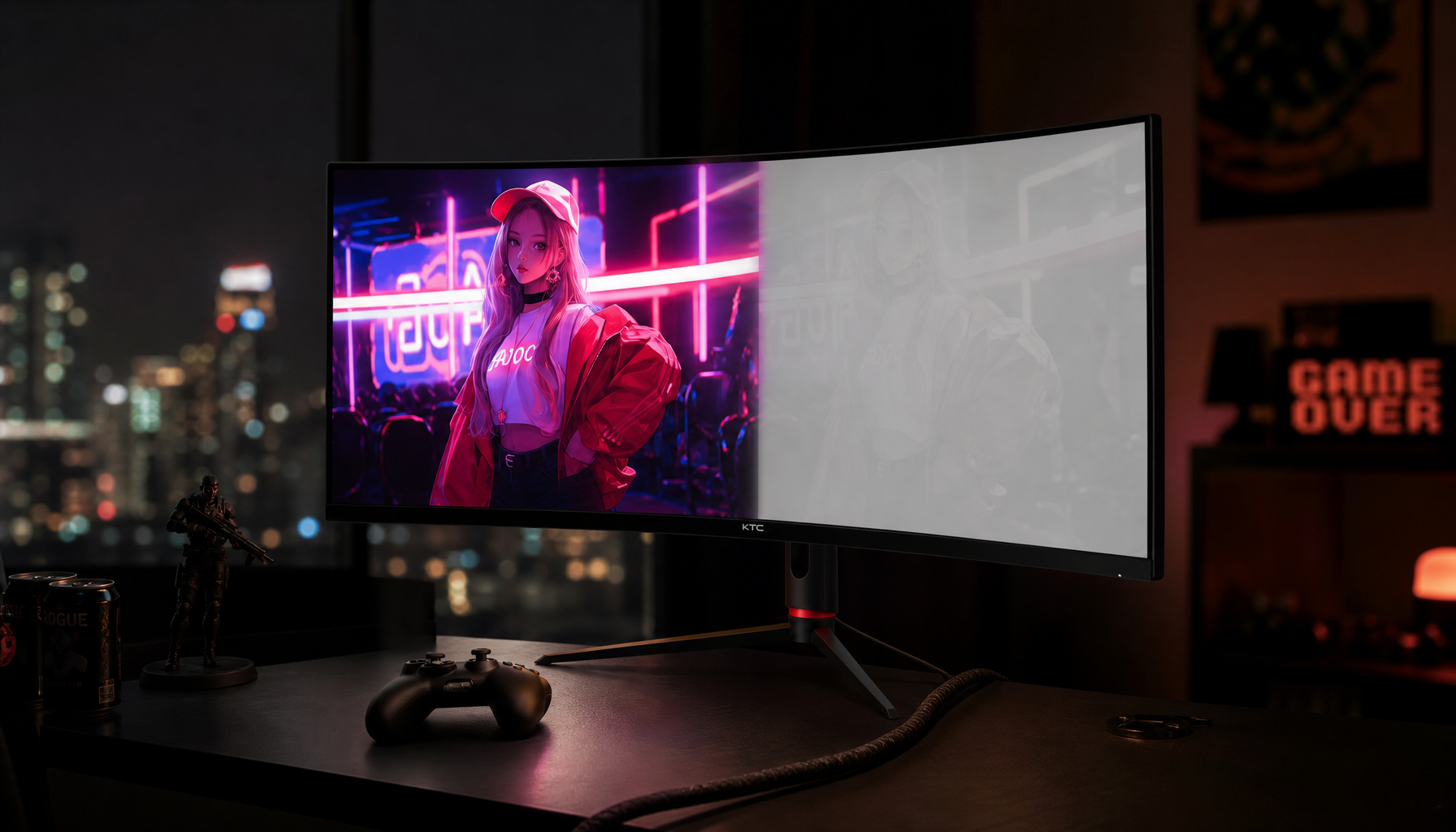
Color accuracy usually degrades when you switch between SDR and HDR because the monitor is no longer using the same brightness target, color mapping, or processing path.
Ever turn on HDR and watch your gaming monitor make the desktop operating system look gray, over-bright, or oddly flat? Real-world reports show this on everything from entry-level HDR screens that barely look different from SDR to a 34-inch ultrawide monitor model where users reported washed-out HDR across multiple firmware versions. The fix starts with understanding which changes come from the signal standard, which come from the monitor, and which come from the operating system or the graphics card.
SDR and HDR ask the monitor to do different jobs
SDR uses one luminance and color path
The first shift is that SDR and HDR signals are interpreted differently by displays, so the same monitor can look balanced in SDR and noticeably wrong in HDR without any hardware defect. In practice, SDR desktop work on a gaming monitor is usually tuned around a much narrower brightness range and a simpler color path, while HDR asks the display to remap both brightness and color more aggressively.
HDR also uses a different calibration target based on ST2084 and Rec2020, which is much harder for real monitors to hit consistently. That matters because no consumer monitor fully covers Rec2020, and HDR brightness is absolute rather than relative, so every panel has to decide how to compress highlights, preserve shadows, and fit wide-gamut color into its own limits.
HDR changes the target, not just the look
The operating system HDR setup process itself shows that HDR calibration is built around darkest detail, brightest detail, and maximum display brightness, not just “more saturation.” On a monitor buyer’s level, that means switching from SDR to HDR changes the image math underneath the picture, so white balance, midtones, and near-black detail can all move at once.

That is why many users describe HDR desktops as washed out while HDR movies or games look more believable. The monitor may be handling true HDR content reasonably well, but SDR apps inside an HDR desktop are still being remapped, and that remapping can make skin tones, grays, and shadow detail look less accurate than they did in plain SDR.
Factor |
SDR Mode |
HDR Mode |
What You Usually See |
Brightness target |
Narrower desktop range |
Much higher peak range with tone mapping |
Whites, shadows, and midtones shift |
Color target |
Conventional SDR gamut |
Wider HDR gamut target |
Reds and greens may look duller or over-punched |
Calibration path |
SDR profile and desktop tuning |
Separate HDR calibration path |
An SDR-calibrated monitor can still look wrong in HDR |
Backlight behavior |
More stable |
More dynamic on HDR LCDs |
Raised blacks, black crush, or blooming |
App behavior |
Predictable in most desktop apps |
Mixed support across operating system apps and games |
Desktop may look worse than actual HDR video or games |
SDR settings and HDR settings do not transfer cleanly
Separate picture modes are normal
Many displays effectively behave like two different profiles, one for SDR and one for HDR. That is why a monitor that looks excellent in an sRGB or DCI-P3 SDR preset can look punchier, brighter, or less neutral in HDR mode: the display is often switching contrast logic, gamut handling, and internal tone mapping all at once.
A concrete example comes from the monitor HDR issue reports, where users described normal SDR but washed-out HDR with raised blacks on a 34-inch ultrawide OLED monitor. One user tested firmware MCM104 and MCM201 on a current desktop operating system with a high-end graphics card and graphics driver 566.03, yet the HDR color problem remained, which is exactly the kind of real-world mismatch buyers run into when a monitor’s SDR tuning is better than its HDR path.

Separate calibration is usually required
The operating system color pipeline changes enough that an SDR ICC profile does not reliably carry over into HDR mode. In that discussion, participants noted that SDR gamma corrections become invalid once HDR is enabled, and newer operating system behavior separates SDR profiling from HDR profiling instead of treating them as one continuous color space.
For a buyer or gamer, the practical lesson is simple: calibrate SDR and HDR separately, and do not assume your SDR result proves HDR accuracy. If your monitor includes multiple presets, keep one for everyday SDR desktop use and another for HDR gaming or video, because the cleanest workflow is usually mode-specific rather than one “universal” setting.
Monitor hardware determines how much color shift you see
Backlight control changes shadows and highlights
LCD HDR accuracy depends heavily on how the backlight is controlled. A global-dimming LCD treats the whole screen as one zone, so simultaneous contrast stays close to the panel’s native limit, while better HDR monitors use local dimming with multiple zones to separate bright and dark parts of the image more effectively.
That sounds ideal, but local dimming is still a compromise. In a multi-zone LCD backlight, one zone may be responsible for thousands of pixels at once; a 4K local-dimming LCD display with 1,152 zones still groups roughly 7,200 pixels per zone. When a bright HUD element and a dark shadow share the same zone, the monitor cannot optimize both perfectly, so blacks may lift, highlights may clip, or colors may shift as the backlight tries to split the difference.

Budget HDR often looks like brighter SDR
The weakest HDR experiences usually come from monitors with minimal backlight control and limited brightness. In one entry-level HDR gaming monitor discussion, the user pointed out that the display had no local dimming zones and that HDR looked very similar to SDR except brighter, which is a common result on entry-level “HDR” monitors.
Washed-out color and banding also become more likely when HDR settings are mismatched between the graphics card, monitor, and operating system, or when the screen does not deliver strong 10-bit handling, useful tone mapping, or enough brightness headroom. This is why high-refresh-rate gaming monitors can advertise HDR support on the box but still fail to deliver convincing HDR accuracy in actual use.
Even good HDR hardware can trade one error for another
Forum reports from desktop gamers show that poorly tuned HDR can make images look flat, washed out, or even yellow, and one recurring complaint is raised blacks where true black behaves more like a dark gray. In practical terms, a monitor may preserve highlight sparkle at the cost of darker shadow depth, or protect shadow detail while making bright scenes look less vivid than expected.

That tradeoff is especially visible on gaming monitors that chase brightness but do not control the low end well. For monitor buyers, the key point is that HDR quality is not just a peak-nits number; it is the combined result of panel contrast, dimming behavior, bit depth, and how well the monitor’s HDR mode is tuned.
Operating system, graphics card, and cable settings can make good panels look wrong
OS controls can skew SDR inside HDR mode
The operating system itself can introduce visible shifts because SDR content brightness and HDR brightness controls affect how SDR and HDR content balance on screen. The platform vendor also notes that the blue-light reduction feature can make HDR look red-tinted or over-saturated, some SDR desktop apps do not respond correctly until restarted, and HDR behavior can change on laptops when switching between battery and wall power.
That matters on a desk with multiple displays, portable monitors, or a laptop-and-monitor setup, because the user may blame the panel when the real culprit is the OS state. If your desktop looks wrong only after enabling HDR in the operating system, start with the HDR sliders, blue-light reduction status, and whether the app you are judging was launched before or after HDR was enabled.
Output format and link bandwidth matter on gaming monitors
The signal chain from graphics card to monitor can also distort color before the panel even renders it. In the monitor troubleshooting thread, one of the first recommendations was to verify 10 bpc output and check whether the graphics card was using RGB or YCbCr444, because a wrong output format can alter perceived sharpness, black level, and color neutrality.
Connection limits are another hidden cause. The operating system vendor’s HDR guidance says updated display drivers help, a higher-bandwidth display connection is preferred where possible, and if another display connection’s bandwidth is a problem, lowering refresh rate or dropping to 1920 x 1080 at 60 Hz can reduce rendering issues. On high-refresh ultrawide or 4K gaming monitors, that makes bandwidth a real part of color accuracy, not just a convenience spec.
How to improve SDR and HDR consistency before you buy or calibrate
Use HDR for actual HDR content first
The safest approach for many setups is to leave HDR off except for HDR movies or games unless the monitor and workflow are well tuned. That advice is not anti-HDR; it reflects the fact that mixed SDR-on-HDR desktop use still adds conversions that can reduce accuracy, especially on wide-gamut monitors and budget HDR implementations.
Real user reports also show that proper HDR usually looks best with actual HDR content and after operating system HDR settings are adjusted. If the desktop looks bad but a native HDR game looks better, that does not mean the monitor is broken; it usually means the SDR-to-HDR desktop path needs work, or that the screen’s HDR mode is only worth using selectively.
Calibrate both modes and buy for the hardware, not the badge
The most practical fix is to run separate HDR calibration in a current desktop operating system with its HDR calibration app, then keep a separate SDR setup for normal desktop use. When you adjust the saturation slider, stay conservative; the platform vendor notes that excessive saturation and post-processing can make HDR look unnatural even when the panel is otherwise performing correctly.

When shopping, filter aggressively. A monitor with weak HDR implementation, no local dimming, or a bare-minimum HDR tier is much more likely to shift color noticeably when you toggle modes, while a better-tuned OLED or a stronger local-dimming LCD usually holds up better. For gaming monitors, that means reading beyond the “HDR supported” label and looking for evidence of separate HDR tuning, credible dimming behavior, and stable graphics card compatibility.
FAQ
Q: Should I leave HDR on all the time in the operating system?
A: Usually not if your priority is accurate SDR desktop color. Mixed SDR-on-HDR desktop mode is where many users see washed-out or inconsistent color, so HDR is often best reserved for native HDR games and video unless your monitor is well calibrated in both modes.
Q: Why does my monitor look fine in SDR but washed out in HDR?
A: The most common reasons are separate monitor processing, operating system HDR slider balance, wrong graphics card output format, or weak HDR hardware. Reports about a 34-inch ultrawide monitor model are a good example: users saw normal SDR and poor HDR even after firmware changes, which shows that HDR can fail independently of SDR quality.
Q: Can one gaming monitor be accurate in both SDR and HDR?
A: Yes, but usually only with compromise and separate setup. You typically need one SDR calibration, one HDR calibration, correct graphics card output, and hardware that is good enough to manage HDR brightness and contrast without crushing shadows or lifting blacks.
Practical Next Steps
If your colors change too much between SDR and HDR, assume the issue is the pipeline first and the panel second. SDR and HDR are different standards with different calibration targets, and many monitors handle them through separate internal modes.
- Reset the monitor’s HDR mode, then check the operating system HDR sliders, the blue-light reduction feature, and whether the app was launched before HDR was enabled.
- Verify graphics card output settings such as 10 bpc, RGB or YCbCr444, and use a higher-bandwidth display connection if your monitor supports it.
- Calibrate SDR and HDR separately, and if your monitor is only entry-level HDR-class with no local dimming, expect limited improvement because the hardware itself is the constraint.