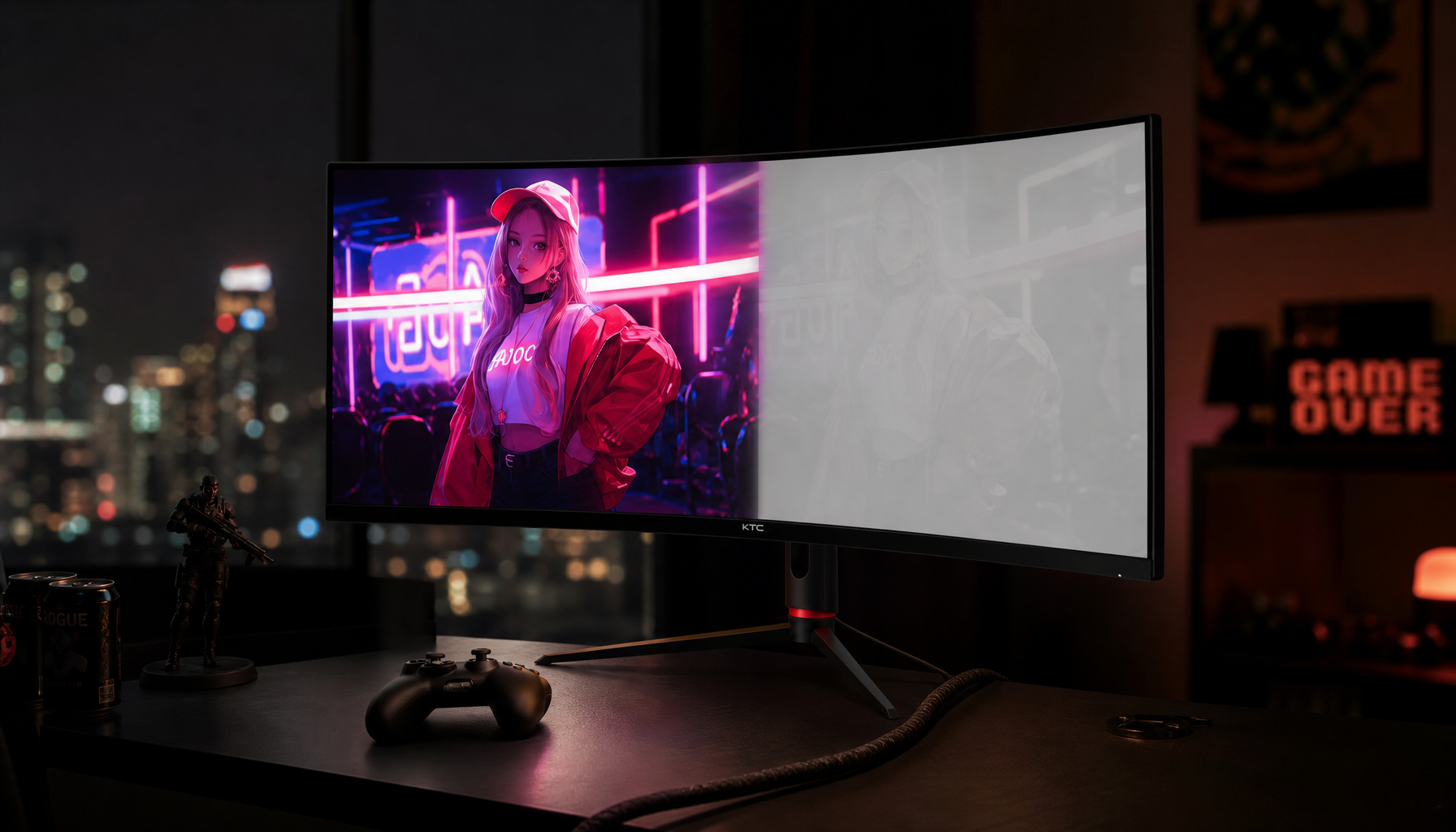
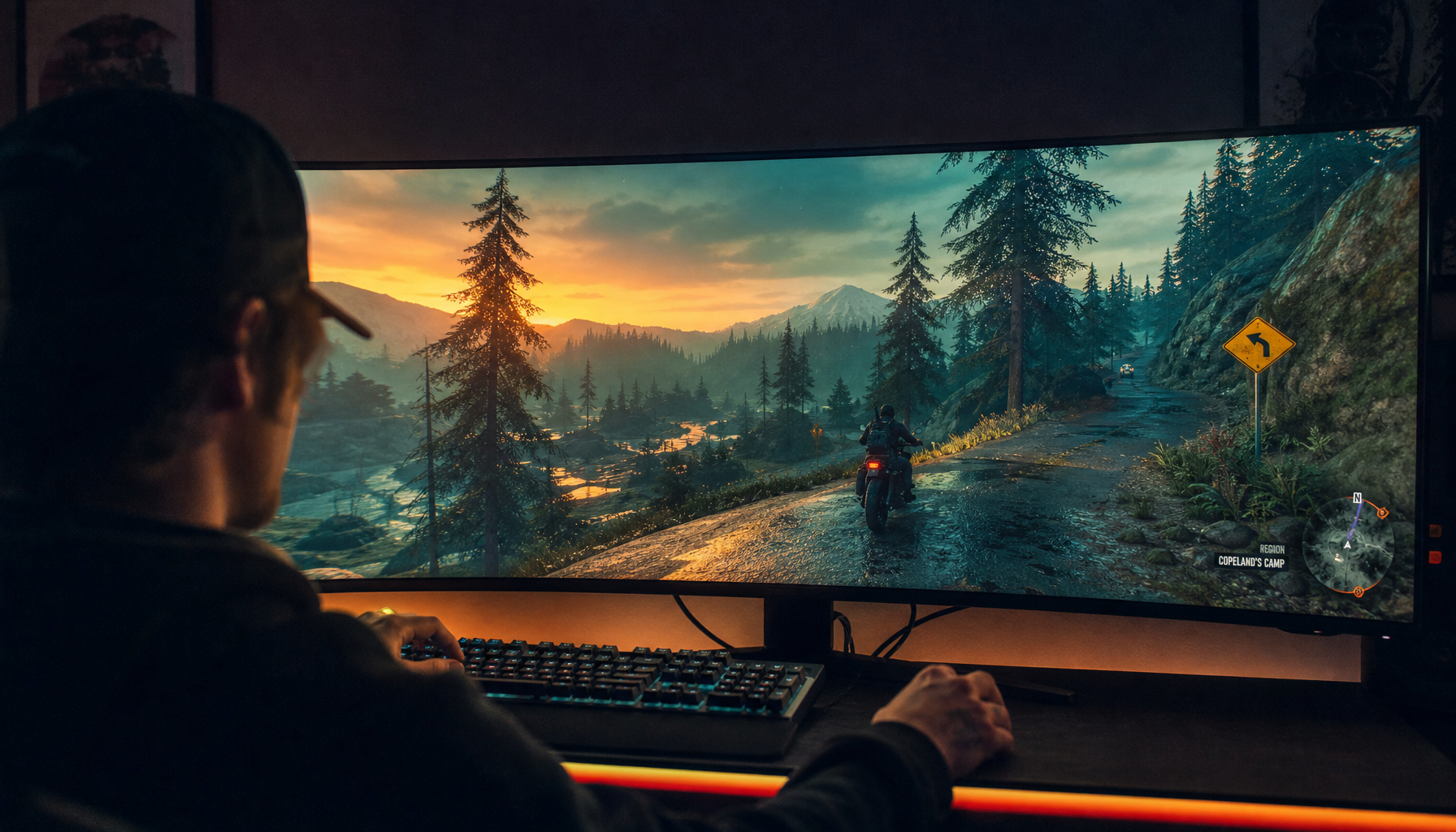
Ultrawide monitors do not automatically mean “more view” in every game. Whether a 21:9 or 32:9 display feels expansive, cropped, stretched, or awkward depends on how the game engine and the developer define field of view, aspect ratio, camera behavior, and UI scaling.
Have you ever launched a game on a 3440 x 1440 monitor and wondered why one title shows more of the world while another feels zoomed-in at the edges? Real ultrawide setup notes show why this happens: a 21:9 FOV calculation can land around 121.66° horizontal FOV while still mapping to about 73.73° vertical FOV, depending on the baseline the game uses. This guide explains how Unity, Unreal, and proprietary engines treat ultrawide FOV differently, and how that should affect your next gaming monitor choice.
Why Ultrawide FOV Is Not One Universal Setting
FOV Can Be Horizontal, Vertical, or Relative to a Baseline

A field-of-view slider is not always measuring the same thing. Some games expose horizontal FOV, some expose vertical FOV, and some calculate FOV relative to a fixed baseline such as 16:9. In one ultrawide discussion about 3440 x 1440 displays, players noted that a game may treat “90 FOV” as the view inside a centered 16:9 frame, then add extra horizontal image on a 21:9 monitor many games calculate FoV.
That difference matters when comparing settings across games. A 90° FOV in one shooter may feel natural on a 34-inch ultrawide, while the same number in another game may feel cramped, distorted, or too fast at the edges. For monitor buyers, this means the panel’s aspect ratio is only half the story; the game’s FOV convention determines what the extra screen width actually does.
Aspect Ratio Changes the Camera Math
A 16:9 display, a 21:9 ultrawide, and a 32:9 super-ultrawide are not just wider rectangles. They change the relationship between horizontal and vertical viewing angles. If a game preserves vertical FOV, a wider monitor usually expands the horizontal view. If a game preserves horizontal FOV, a wider monitor can reduce the vertical view and make the image feel cropped.
This is why two games running at the same resolution class can feel completely different. A 3440 x 1440 monitor may provide a useful wider side view in one title, while another title may simply scale the image, cap the camera, or add black bars during cutscenes. Before buying an ultrawide display primarily for one game or genre, the key question is not “Does the monitor support 21:9?” but “Does the game support 21:9 in gameplay, menus, HUD, and cutscenes?”
Unity vs Unreal vs Proprietary Engines

Unity: Often Vertical-FOV Friendly, but Implementation Still Rules
Unity’s perspective camera workflow is commonly built around vertical FOV. In practical terms, that often means a wider aspect ratio can reveal more horizontal scene area while keeping the vertical view consistent. For a 21:9 gaming monitor, this can produce the behavior many ultrawide buyers expect: the center view remains familiar, while the edges show more of the game world.
However, Unity does not guarantee perfect ultrawide behavior by itself. A developer can clamp FOV, use custom camera scripts, lock gameplay to a target aspect ratio, or anchor UI elements in ways that break on wide screens. In a Unity game, ultrawide comfort often depends on whether the developer tested the actual gameplay camera, HUD, menus, and cinematic framing beyond 16:9.
Unreal: Powerful Camera Controls, More Variation by Project
Unreal Engine gives developers robust camera and projection controls, but that flexibility also means ultrawide behavior varies by title. Some Unreal games expand cleanly on 21:9 monitors, some preserve a fixed framing target, and some use letterboxing or FOV limits for cinematics, multiplayer balance, or art direction. The result is that the engine can support ultrawide well, but the shipped game decides how much of that support players actually receive.
This is especially visible in shooters and action games. A player may expect 21:9 to add peripheral vision, but a developer may choose to preserve competitive framing or avoid animation and level-design issues at the edges. For high-refresh-rate ultrawide shoppers, Unreal-based games are worth checking title by title rather than assuming the engine name predicts the experience.
Proprietary Engines: Best-Case Polish or Hardcoded Friction
Proprietary engines can be excellent for ultrawide when the studio designs around wide displays from the start. Racing simulators, flight sims, and cockpit-style games often benefit from careful FOV setup because believable world scale depends on monitor size, viewing distance, aspect ratio, bezel width, and side-screen angle benefit more from correct FOV setup. In those cases, a proprietary engine may include detailed camera tools, triple-screen modes, or cockpit calibration options that general-purpose engines do not expose by default.
The downside is that proprietary engines can also be more rigid. Some older or console-first engines hardcode menus, cutscene framing, FOV caps, or HUD positions around 16:9. When that happens, a 32:9 display may run the game, but the useful experience may include stretched UI, cropped subtitles, black side bars, or gameplay elements placed too far from the player’s central vision.
Common Ultrawide Behaviors and What They Mean
Engine or Implementation Style |
Typical Ultrawide Behavior |
What You See on 21:9 or 32:9 |
Buying Implication |
Vertical FOV preserved |
Horizontal expansion |
More side view with similar center framing |
Strong fit for ultrawide monitors |
Horizontal FOV preserved |
Vertical cropping |
Image feels zoomed or shorter vertically |
Check user reports before buying |
16:9 baseline with extra width |
Center stays familiar, sides expand |
Often comfortable on 21:9 |
Good if HUD and cutscenes scale well |
Fixed FOV cap |
Limited adjustment |
May feel too narrow on large displays |
Riskier for 34-inch and 49-inch monitors |
Letterboxed ultrawide |
Black bars in some scenes |
Gameplay may work, cinematics may not |
Acceptable if cutscenes are secondary |
Poor UI anchoring |
HUD pushed to far edges |
Health, minimap, or ammo hard to scan |
More noticeable on 32:9 |
Horizontal Expansion Feels Like the “Correct” Ultrawide Result
For most monitor buyers, the preferred result is horizontal expansion. The center of the image remains comparable to a 16:9 display, while the sides add peripheral information. In a single-player RPG, racing game, flight sim, or open-world title, this can make a 34-inch or 49-inch monitor feel more immersive without changing the basic camera scale.
This behavior is often described as keeping the same FOV value from 16:9 to 21:9 and letting the wider aspect ratio add view. One player in the ultrawide FOV discussion mentioned using 90 FOV in Battlefield 4 on both 16:9 and 21:9 because it felt normal on the wider screen BF4 at 90 FOV. That kind of practical consistency is what many buyers should look for when comparing monitor reviews and game compatibility notes.
Cropping, Stretching, and Hard Caps Are the Warning Signs
Vertical cropping is the behavior that disappoints many ultrawide users. Instead of adding side vision, the game keeps the horizontal view similar and trims the top and bottom. On a wide display, that can feel like sitting too close to a screen with the camera zoomed in.
Stretching is different but equally problematic. If the game stretches a 16:9 image to fill 21:9 or 32:9, character models, UI elements, and world geometry look wider than intended. FOV hard caps can also be an issue: if a game only allows a narrow FOV range, a large ultrawide monitor at a close desk distance may feel uncomfortable even when the resolution is technically supported.
Monitor Shape, Curvature, and Desk Distance
Curvature Changes Viewing Geometry, Not Image Quality
Curved ultrawide monitors can feel more enveloping because the edges sit closer to your eyes than they would on a flat panel of the same diagonal size. That does not increase resolution, pixel count, sharpness, or text clarity; curvature changes viewing geometry rather than raw display quality curvature does not increase.
This matters when reading monitor marketing. A 34-inch 21:9 curved monitor may feel more natural at the edges than a flat ultrawide, but it will not make a game’s FOV implementation better. If a title crops vertically or locks FOV, curvature cannot fix that camera behavior.
Match Curve Radius to How Far You Sit
Curve ratings use an “R” value, where lower numbers mean a tighter curve. A 1000R curve is stronger than 1500R, and 1500R is stronger than 1800R. Practical distance references put 1000R around 3.3 ft, 1500R around 4.9 ft, and 1800R around 5.9 ft curve radius.
Most gaming desk setups place the viewer roughly 27-32 inches from the screen, while productivity setups often sit around 30-35 inches. At those distances, a 34-inch 21:9 monitor with moderate curvature is usually easier to scan than a very large flat ultrawide. A 49-inch 32:9 display, such as the KTC 49” DQHD 180Hz 1000R curved gaming monitor, can be useful for racing and flight sims, but its fit depends on engine FOV behavior and seating distance more than the spec sheet alone.

Performance and Competitive Considerations
Wider Resolution Raises GPU Load
FOV is camera math, but ultrawide gaming also affects performance. A 3440 x 1440 monitor pushes more pixels than 2560 x 1440, and a 5120 x 1440 super-ultrawide pushes even more. If your goal is high-refresh-rate play at 144 Hz, 165 Hz, or 240 Hz, the extra width can reduce achievable frame rates unless your GPU has enough headroom.
This is especially important for competitive shooters. A wider view may help spatial awareness in supported games, but lower frame rate or inconsistent frame pacing can hurt aim tracking and motion clarity. For esports-first buyers, a fast 16:9 or 24.5- to 27-inch display may still be the better tool if the favorite title limits ultrawide FOV or if the PC cannot hold high frame rates at ultrawide resolution.
Fairness Rules Can Limit Ultrawide Advantages
Some developers cap FOV, restrict aspect ratios, or letterbox competitive modes because wider views can reveal more information than intended. That is not always a technical limitation; sometimes it is a design or fairness decision. The same engine may support wide rendering in single-player but use stricter rules in ranked multiplayer.
For monitor buyers, the practical step is to check the specific games and modes you actually play. A 21:9 monitor may be excellent for single-player immersion and still offer mixed value for competitive play if ranked modes use FOV caps, centered HUDs, or 16:9 framing. A 32:9 monitor is even more dependent on game-specific support because the far edges can become peripheral context rather than actionable gameplay information.
How to Evaluate Ultrawide Support Before Buying
Action Checklist
- Check whether your favorite games use horizontal expansion, vertical cropping, or fixed 16:9 framing.
- Look up whether the FOV slider is horizontal FOV, vertical FOV, or based on a 16:9 reference.
- Test HUD placement in gameplay, not just screenshots; minimaps and health bars can sit too far out on 32:9.
- Confirm cutscene behavior, because many games support ultrawide gameplay but letterbox cinematics.
- Compare your target refresh rate against the resolution load: 3440 x 1440 and 5120 x 1440 need more GPU power than standard 1440p.
- Match monitor curvature and size to your desk distance, especially if you sit around 27-32 inches from the screen.
- Prioritize genre fit: sims, racing, flight, open-world, and cinematic games usually benefit more than tightly regulated competitive titles.
A Practical Buying Example
If you mainly play open-world games, racing titles, and flight sims, a 34-inch 3440 x 1440 ultrawide is often the balanced choice. It gives a wider view than 16:9, is easier to drive than 5120 x 1440, and usually fits normal desk distances without pushing key UI too far away.
If you mostly play competitive shooters, check the exact game first. If the game preserves fair 16:9 framing or caps FOV, a 240 Hz 16:9 monitor may feel better than a larger ultrawide. If your favorite shooter supports clean 21:9 horizontal expansion and your GPU can sustain your target frame rate, an ultrawide can still be a strong choice, but the decision should be based on game behavior rather than panel specs alone.
FAQ
Q: Why does one game show more on my ultrawide monitor while another game looks zoomed in?
A: The games are likely using different FOV rules. One may preserve vertical FOV and expand horizontally, while the other may preserve horizontal FOV and crop vertical view. Some games also calculate FOV from a 16:9 baseline, so the same slider number can produce different results on 21:9 or 32:9 displays.
Q: Is Unity or Unreal better for ultrawide gaming monitors?
A: Neither engine guarantees better ultrawide support by name alone. Unity projects often behave naturally with wider horizontal views when vertical FOV is preserved, while Unreal projects can offer excellent ultrawide support when configured well. In both cases, the developer’s camera settings, HUD layout, cutscene framing, and multiplayer rules matter more than the engine label.
Q: Does a curved ultrawide monitor increase FOV?
A: Not in the game-engine sense. Curvature can make the screen feel more enveloping because the edges sit closer to your eyes, but it does not add pixels, increase resolution, or force a game to render more scene area. The actual in-game FOV still depends on the title’s camera and aspect-ratio implementation.
Key Takeaways
Ultrawide FOV is a game-and-engine behavior, not just a monitor feature. Unity, Unreal, and proprietary engines can all support excellent 21:9 or 32:9 experiences, but the shipped game decides whether you get horizontal expansion, vertical cropping, letterboxing, fixed FOV, or clean UI scaling.
For most buyers, the safest path is to choose the monitor around your actual game library. A 34-inch 21:9 high-refresh-rate display is the most broadly practical ultrawide option for immersive PC gaming. A 49-inch 32:9 monitor is more specialized and shines when the game supports wide FOV, cockpit views, or simulation-style camera calibration. Before spending the money, verify FOV behavior, HUD placement, cutscenes, and performance at your target refresh rate.