Faster head movement makes motion blur feel stronger because the image sweeps across your vision more quickly, even when refresh rate, response time, overdrive, and in-game blur settings stay unchanged.
Does the screen look clean when you aim slowly, then smear the moment you snap your view across a hallway or racing apex? In practical monitor tuning, a simple slow-pan versus fast-flick check can separate display-caused blur from movement-caused blur without changing a single setting. You’ll learn why head speed changes what you perceive and how to play, test, and set up your screen for clearer motion.
Why Head Movement Speed Changes Blur Perception
Perceived motion blur is not only a monitor problem. It is the result of the display, the game camera, your eyes, and your head working together. When your head or in-game view rotates quickly, more of the scene crosses your field of view in less time. That faster sweep gives your visual system less opportunity to hold fine detail, so edges, textures, nameplates, crosshairs, and distant targets can look softer.
This matters because motion blur in games can describe several effects: a game-rendered blur filter, object blur, camera blur, or the real blur you perceive when motion is too fast to resolve cleanly. If you disable the game’s motion blur and still see smear during fast turns, your monitor may not be adding blur by itself. Your movement speed may simply be pushing more visual information across your eyes than you can comfortably track.
The key idea is retinal motion. When your head turns or your camera pans, the image moves across your retina. Slow movement gives the eyes time to follow. Fast movement creates more retinal slip, which means the image shifts faster than your eyes can stabilize it. In gameplay, that can feel like a clear monitor suddenly became muddy, even though the monitor settings did not change.

Monitor Settings Stay Fixed, But Motion Load Changes
A monitor set to the same refresh rate and response mode behaves consistently, but the content you feed it does not. A slow camera pan across a wall may move texture detail only a short distance per frame. A fast flick can move that same wall many more pixels per frame. The monitor is still refreshing at the same pace, but each refresh now contains a much larger visual jump.
An explanation of sample-and-hold behavior is useful here because most flat-panel displays hold each frame until the next one appears. During fast tracking, your eyes continue moving while the frame remains on screen, so the held image can smear perceptually. Higher refresh rates shorten the time each frame is held, but they do not make extremely fast head or camera motion perfectly sharp.
Here is the practical version. If you turn slowly at 120 Hz, the scene may shift a manageable amount between refreshes. If you whip the camera across the same angle, the scene may travel several times farther between refreshes. Nothing in the on-screen display changed, yet the perceived blur increased because the motion demand increased.
Gameplay movement |
What changes visually |
Likely perception |
Slow scan across a room |
Small frame-to-frame movement |
Higher detail retention |
Controlled tracking of a target |
Moderate movement with eye following |
Good clarity if frame rate is stable |
Fast flick or panic turn |
Large visual jump per frame |
More perceived smear and lost texture detail |
Wide racing or flight turn |
Large peripheral motion |
Edge softness feels stronger |

Head Movement Versus Camera Movement
In traditional monitor gaming, your physical head movement and your in-game camera movement are often linked indirectly. You may lean, tense, or shift your head while your mouse, controller, or steering wheel rotates the view. On a desktop monitor, the screen does not move with your head, but your eyes and attention do. On a portable smart screen or a close desk setup, even small head shifts can change viewing angle, focus distance, and perceived edge clarity.
In head-mounted displays, the connection is more direct because the scene responds to head motion. Research into head-mounted displays treats eye behaviors such as blinking and saccades as important comfort signals, which reinforces a practical point for screen users: motion clarity is partly physiological, not only a spec-sheet result. When your eyes make rapid jumps or your head moves quickly, visual comfort and perceived sharpness can change even before you touch monitor settings.
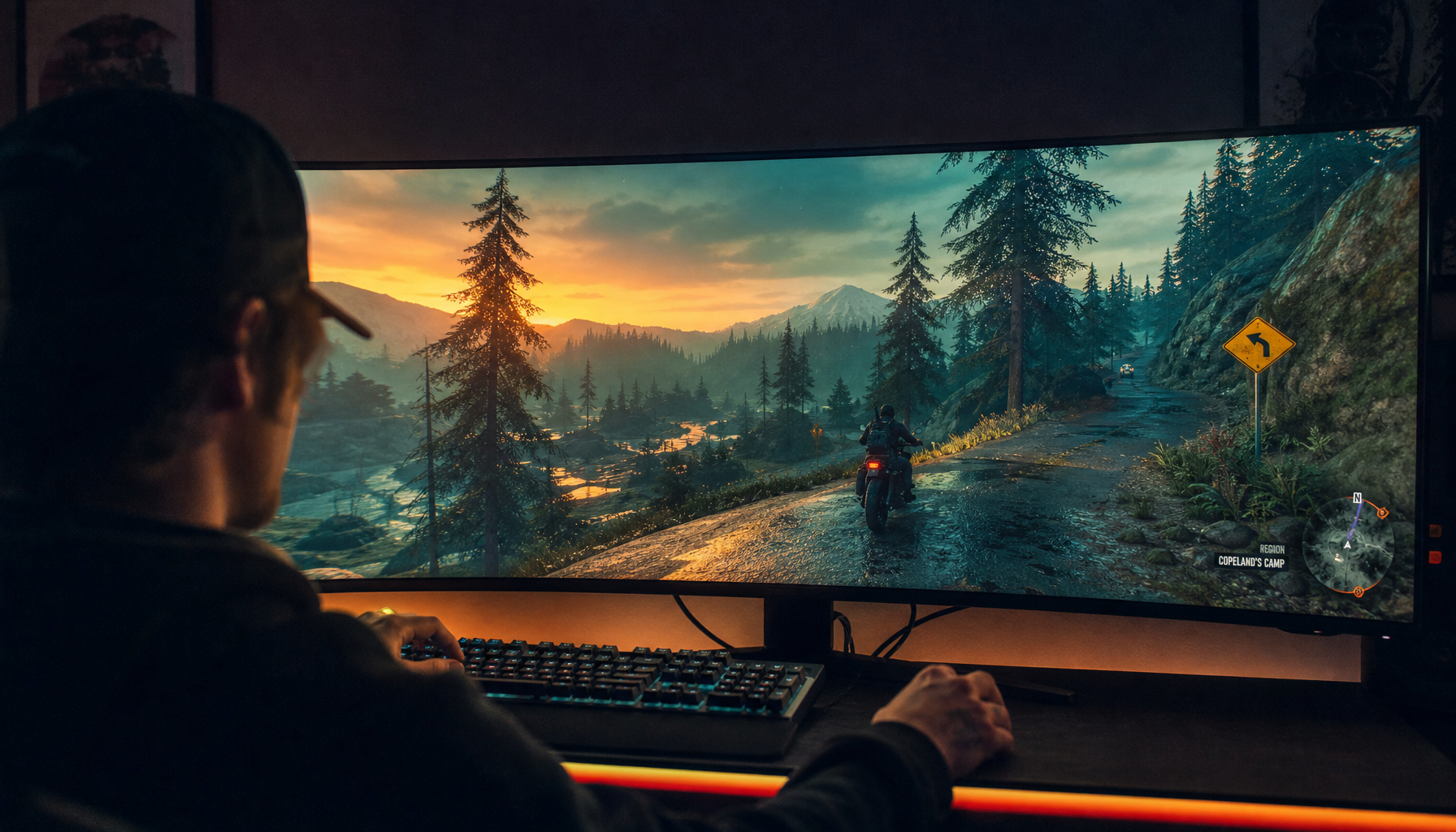
For desktop play, think of head speed as a multiplier. A 27-inch competitive monitor at arm’s length keeps most action central and easier to scan. A large curved ultrawide or a close portable screen can put more motion into your peripheral vision, making the edges feel softer during fast sweeps. That does not mean the display is bad; it means the display format changes how much moving image your eyes must process.
Definitions That Keep the Diagnosis Clean
Motion blur is the perceived loss of sharpness during movement. It can come from the game engine, the display, or the viewer’s visual tracking.
Ghosting is different. It is a visible trail or shadow caused by pixels transitioning too slowly from one state to another. A fast head turn can expose ghosting, but head speed does not create slow pixels. It makes the weakness easier to see.
Response time is how quickly pixels change. Overdrive pushes pixels harder to reduce trails, but aggressive settings can create inverse ghosting, where bright or dark halos appear behind motion. Monitor-tuning notes frame overdrive settings as a balance: faster is not always cleaner if artifacts appear.
Refresh rate is how many times per second the display updates. Higher refresh can improve motion clarity, but your head or camera speed still determines how far the image moves between updates. This is why a 240 Hz display can look excellent during controlled tracking yet still blur during a violent 180-degree flick.
The Pros and Cons of Faster Head and Camera Movement
Fast movement has real performance value. In competitive shooters, quick turns help you clear angles, react to flanks, and reposition your aim under pressure. In racing and flight games, rapid view changes can improve situational awareness. For immersive single-player games, quick camera motion can make the world feel more alive and physically responsive.
The downside is visual cost. Faster movement reduces the time available to inspect detail. It can make enemies blend into backgrounds, make UI elements harder to read, and amplify blur from sample-and-hold behavior, slow pixel response, low frame rate, or game-rendered blur. Competitive players commonly disable motion blur because clarity matters more than cinematic speed cues in games such as shooters.
For productivity displays and portable screens, the same principle appears in a quieter form. Rapid head shifts between a laptop, external monitor, and notes can create focus strain and momentary softness. Work-monitor guidance links display choice and ergonomics to comfort for long computer sessions, and ergonomic monitor features such as height, tilt, rotation, and easy repositioning help keep the screen aligned with natural viewing behavior.
How to Test Whether Head Speed Is the Cause
Use one scene, one monitor mode, and one frame-rate target. Pick a training map, racing replay, or open-world area with fine detail, such as fences, text signs, distant windows, or weapon edges. Keep your refresh rate, overdrive, brightness, game motion blur, and resolution fixed.

First, pan slowly across the scene and notice whether detail stays readable. Then repeat the same path at a medium speed. Finally, perform a fast flick or hard turn. If blur increases mainly with speed, the cause is at least partly motion load rather than a bad setting. If trails remain visible even during slow motion, pixel response or overdrive may be involved. If the entire image smears only when the game’s blur option is enabled, the game effect is the main culprit.
A simple calculation helps. At 120 Hz, the display updates 120 times per second. If your camera turn is twice as fast, the scene travels roughly twice as far between those updates. Your monitor did not get worse; each frame is now carrying a larger positional jump.
Practical Setup Advice for Clearer Motion
Start with game motion blur off for competitive play. A common fix-it workflow begins with the game’s graphics menu because unwanted blur often comes from the game itself, and higher frame rates can also reduce perceived blur while improving fluidity. For cinematic games, a low or per-object blur setting may feel better than full-screen camera blur because it preserves more scene readability during turns.
Use controlled mouse or controller sensitivity rather than chasing extreme flick speed. A lower, repeatable sensitivity can keep targets sharper because your view moves at a speed your eyes can track. This is especially useful on large screens, ultrawides, and close portable displays where motion occupies more of your field of view.
Tune overdrive in real gameplay, not just in a menu. Medium overdrive is often the reliable starting point because maximum modes can trade blur for halos. Keep brightness comfortable for the room, since excessive brightness can make smear and artifacts feel harsher, while too little brightness can hide detail in motion. For office and hybrid gaming setups, balanced lighting also matters because poor visual conditions force the eyes to work harder during screen use.
Screen size and distance should match your movement style. A 24- to 27-inch display suits fast competitive scanning because the action stays central. A 32-inch or ultrawide screen can be excellent for immersion, racing, strategy, editing, and multitasking, but it rewards smoother camera control. If you use a portable smart screen, raise it closer to eye level and avoid playing hunched over it; head bob and off-axis viewing can make blur feel worse than the panel actually is.

FAQ
Does moving my physical head faster always create more blur?
Not always, but it often increases perceived softness because your eyes must stabilize more motion. On a fixed desktop monitor, mouse or camera speed usually matters more than physical head speed. On close screens, portable displays, and head-tracked systems, physical head movement becomes more important.
Can a better monitor eliminate blur from fast head movement?
A faster monitor can reduce it, but not eliminate every case. High refresh rates, fast pixel response, well-tuned overdrive, and blur-reduction modes can improve clarity, yet extremely fast camera motion still moves the scene across your vision quickly.
Should I use blur reduction or backlight strobing?
Use it when your frame rate is stable and the brightness tradeoff is acceptable. Blur-reduction modes can sharpen motion, but they may reduce brightness and can feel worse if frame pacing is inconsistent.
Closing Thought
Head movement speed changes perceived motion blur because clarity is a system outcome: screen behavior, game rendering, frame rate, viewing distance, and visual tracking all interact. Keep the monitor fast and well tuned, but train the motion path too; the clearest setup is the one that lets your eyes stay in control when the game accelerates.