VESA DisplayHDR 1400 delivers the clearest upgrade path for players who want stable highlights and deeper shadows in story-driven AAA titles, provided the monitor uses enough local dimming zones to control blooming.

Beyond the Spec Sheet: Why HDR1400 is the New Benchmark for AAA Gaming
Many gamers treat HDR as a simple brightness increase, yet the certification tiers differ sharply in how they handle real game content. VESA DisplayHDR 1400 sets the current ceiling for consumer monitors by requiring both extreme peak output and deep black levels that lower tiers cannot match. The result shifts the experience from merely visible HDR effects to scenes that retain detail in bright skies and dark interiors at the same time. Mini-LED vs. OLED: Which Display Technology Wins for Gaming in 2025? explains the hardware differences that make this possible without OLED burn-in concerns.
Decoding the Specs: Peak Brightness, Sustained Luminance, and Black Levels
Peak brightness measures the maximum light a small highlight area can produce, such as sunlight glinting off metal or an explosion core. Sustained brightness tracks how long the panel maintains high output across larger areas like snow fields or desert skies before power limiting reduces intensity. Black level defines how close to true black the screen can reach when no light should be emitted.

HDR Tier Performance Comparison
HDR1400 maintains higher sustained brightness and deeper blacks than lower tiers while delivering the required peak output.
Show data table
| Tier | Peak Brightness (nits) | Sustained Brightness (nits) | Black Level (nits) |
|---|---|---|---|
| DisplayHDR 400 | 400 | 300 | 0.40 |
| DisplayHDR 1000 | 1000 | 600 | 0.05 |
| DisplayHDR 1400 | 1400 | 900 | 0.02 |
As this VESA performance criteria page states, HDR1400 requires 1400 nits peak luminance in a 10 percent window and 900 nits sustained full-screen output. The same source confirms the 0.02-nit black-level target. How-To Geek notes that sustained output matters most when large bright areas dominate the frame, while peak output controls small specular highlights.
HDR1400 vs. HDR1000: Is the Contrast Jump Visible in Real Gameplay?
The move from 0.05 nits to 0.02 nits black level produces roughly 3.5 times higher dynamic contrast, according to VESA’s own comparison. Shadow detail in dark corridors or night scenes becomes noticeably cleaner instead of appearing milky. The 900-nit sustained floor also reduces the brightness pumping that can occur when HDR1000 panels throttle output during extended bright sequences. Mini-LED IPS vs. Standard IPS: Is the Advanced Backlight Worth the Upgrade? covers how zone counts affect this stability.
HDR1400 therefore functions as a fidelity buffer rather than constant extra brightness. Games mastered at 1000 nits still benefit from the extra headroom because the panel avoids aggressive tone-mapping roll-off that can darken mid-tones.
How HDR1400 Transforms AAA Scenes: Highlights, Shadows, and Readability
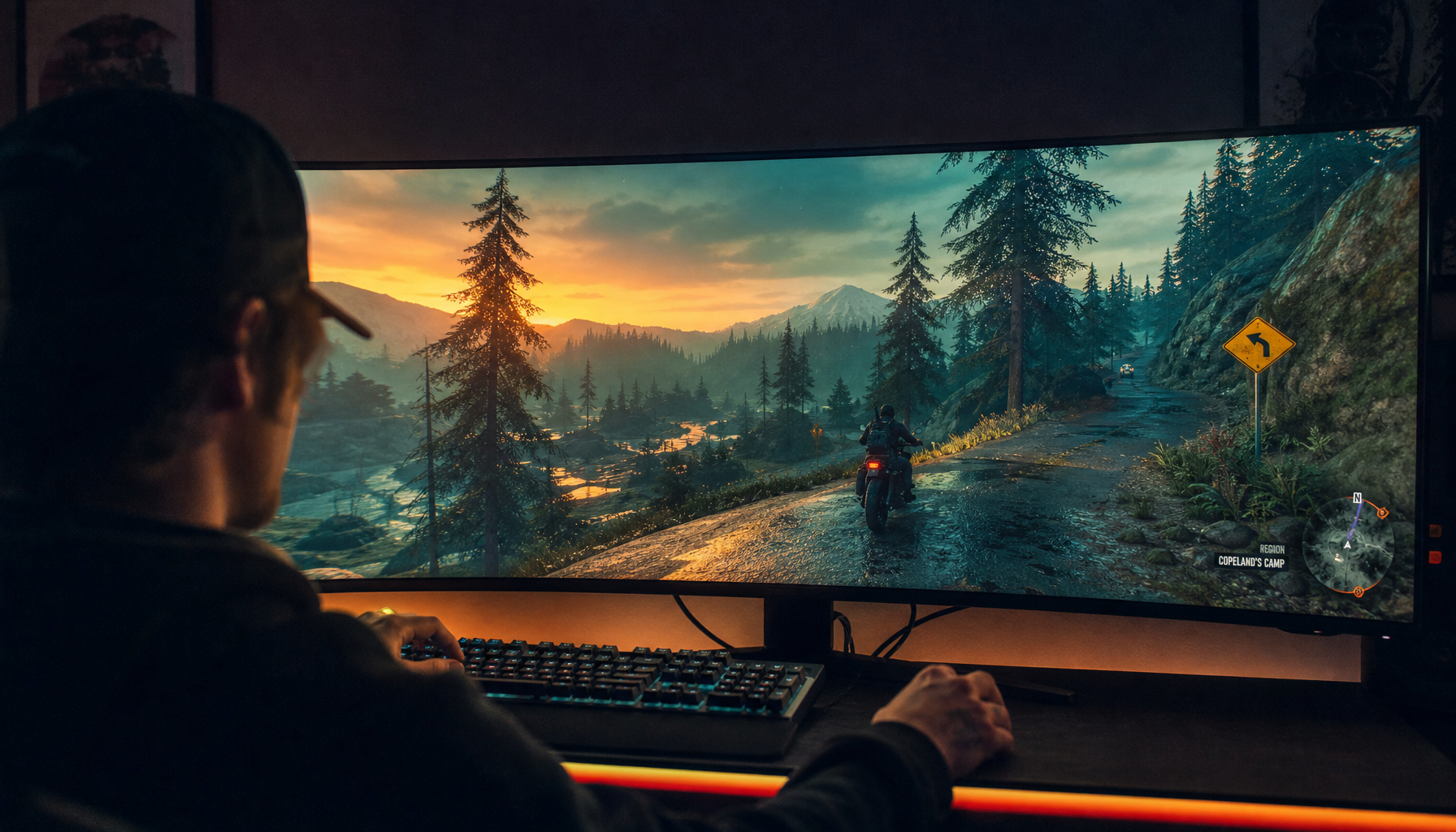
In Cyberpunk 2077, neon signs and vehicle headlights retain punch without clipping surrounding detail. Microsoft Flight Simulator keeps cloud layers and snowfields bright instead of fading toward gray during long daylight flights. Elden Ring and similar dark-atmosphere titles gain depth because blacks stay inky rather than lifting toward gray. VESA’s updated 1.2 specification adds a subtitle-flicker test that keeps UI elements and on-screen text stable when they appear against dark backgrounds. How HDR Content Mastering Inconsistency Should Shape Your Display Calibration Decisions discusses why these stability improvements matter across varying game masters.
The Enthusiast’s Checklist: What to Verify Before Your HDR Upgrade
Look for at least 1152 local dimming zones when targeting HDR1400 performance; fewer zones often produce visible blooming around bright objects. Confirm the monitor carries current VESA DisplayHDR 1.2 certification rather than an older label. Check for 95 percent or better DCI-P3 coverage so bright highlights do not desaturate. Bright-room or mixed-light setups gain the most from the 900-nit sustained output because ambient glare is easier to overcome. What “Local Dimming Zones” Mean in Monitor Backlight Technology explains how zone count and algorithm quality interact with these requirements.
Choosing Your Tier: When to Invest in HDR1400 Performance
Players who prioritize cinematic story-driven games in controlled or mixed lighting benefit most from the full HDR1400 specification. The KTC M27P6 pairs 4K resolution with 1152 Mini-LED zones and verified HDR1400 output, making it a strong fit for console and high-end PC setups that value contrast over maximum refresh rate. The M27T6 offers the same HDR1400 tier at 1440p with 180 Hz, suiting enthusiasts who want higher frame rates without sacrificing local-dimming depth. Those focused on competitive play may prefer the M27T6S, which trades some sustained brightness for 200 Hz speed while still delivering Mini-LED contrast. Does HDR Actually Slow Down Your Gaming Monitor’s Response Time? addresses concerns about latency when enabling full HDR modes.
Review room lighting first: sustained brightness above 600 nits becomes valuable once ambient light rises. Check game library next: titles with frequent large bright areas or deep shadow detail show the largest difference. Budget and desk space then narrow the choice between 4K fidelity and higher refresh-rate options.
Frequently Asked Questions
Does HDR1400 Improve Competitive FPS Performance?
HDR1400 primarily enhances contrast and highlight stability rather than input lag or frame rate. Competitive players usually notice the difference most in story-driven or visually dense scenes rather than pure esports titles.
How Many Local Dimming Zones Are Needed For HDR1400?
Monitors need roughly 1152 or more zones to keep blooming under control at the 1400-nit peak while preserving the 0.02-nit black level. Lower zone counts can still reach the brightness targets but often produce visible halos around bright objects.
Can I Use An HDR1400 Monitor In A Bright Room?
Yes. The 900-nit sustained specification helps maintain visible contrast when ambient light is high, unlike lower-tier panels that dim large bright areas more aggressively.
Is HDR1400 Worth Upgrading From HDR400?
The jump from HDR400 to HDR1400 changes both peak output and black-level depth dramatically, making the upgrade noticeable in any game that uses proper HDR mastering. The difference is smaller when moving from HDR1000, where the main gains are sustained brightness stability and shadow depth.
Do All HDR1400 Monitors Support The Latest VESA 1.2 Tests?
Only monitors certified under the updated 1.2 specification include the subtitle-flicker test and tighter stability requirements. Check the certification label or manufacturer specifications before purchase.
What Happens If A Game Is Mastered At Only 1000 Nits?
The extra headroom still prevents aggressive tone-mapping roll-off and keeps large bright scenes stable, so the image quality remains higher than on an HDR1000 panel even when content never reaches 1400 nits.