Viewing angle can make local dimming look less uniform because LCD light control is optimized for a centered viewer. As you move off-axis, blooming, contrast loss, raised blacks, and brightness shifts become easier to see.
Is a bright game HUD, subtitle, or cursor leaving a pale glow when you lean back, share the screen, or sit beside your monitor? A simple center-seat check compared with a 30-degree side-seat check can quickly reveal whether the issue is the dimming system, the LCD panel, or your room setup. This article explains how viewing angle changes local dimming uniformity, when Mini LED is still worth it, and how to set up your display for cleaner HDR without giving up productivity comfort.
Viewing Angle and Local Dimming Uniformity, Defined Clearly
Viewing angle describes how far you can sit left, right, above, or below the center of a display before the image noticeably loses brightness, contrast, or color accuracy. For a gaming monitor, office display, or portable smart screen, that matters because you rarely view every pixel from the exact same angle, especially on 32-inch, ultrawide, or close-range desk setups.
Local dimming is the backlight system’s attempt to deepen blacks by dimming dark zones while keeping bright zones active. In Mini LED monitors, those zones may number in the hundreds or thousands, and Mini LED uses dense backlight arrays to improve brightness, HDR contrast, and black-level control compared with conventional LCD backlights. The catch is that the LCD layer and optical stack still sit in front of that backlight, so the viewer’s angle affects how cleanly those dimmed and brightened zones appear.
Uniformity means consistency across the screen. With local dimming enabled, uniformity is not just about whether a white spreadsheet looks even. It also includes whether black areas stay black near a bright object, whether corners look washed out, whether halos expand from the side, and whether a moving highlight drags a visible light trail.
Why Off-Axis Viewing Makes Blooming More Visible
Local dimming works best when the viewer is centered because the backlight, diffusion layers, polarizers, LCD cells, and front coating are all engineered around a primary viewing cone. Move away from that cone and the light path changes. The bright zone behind a small object can appear to spread farther into neighboring dark areas, so blooming that looked acceptable head-on can look foggy from the side.
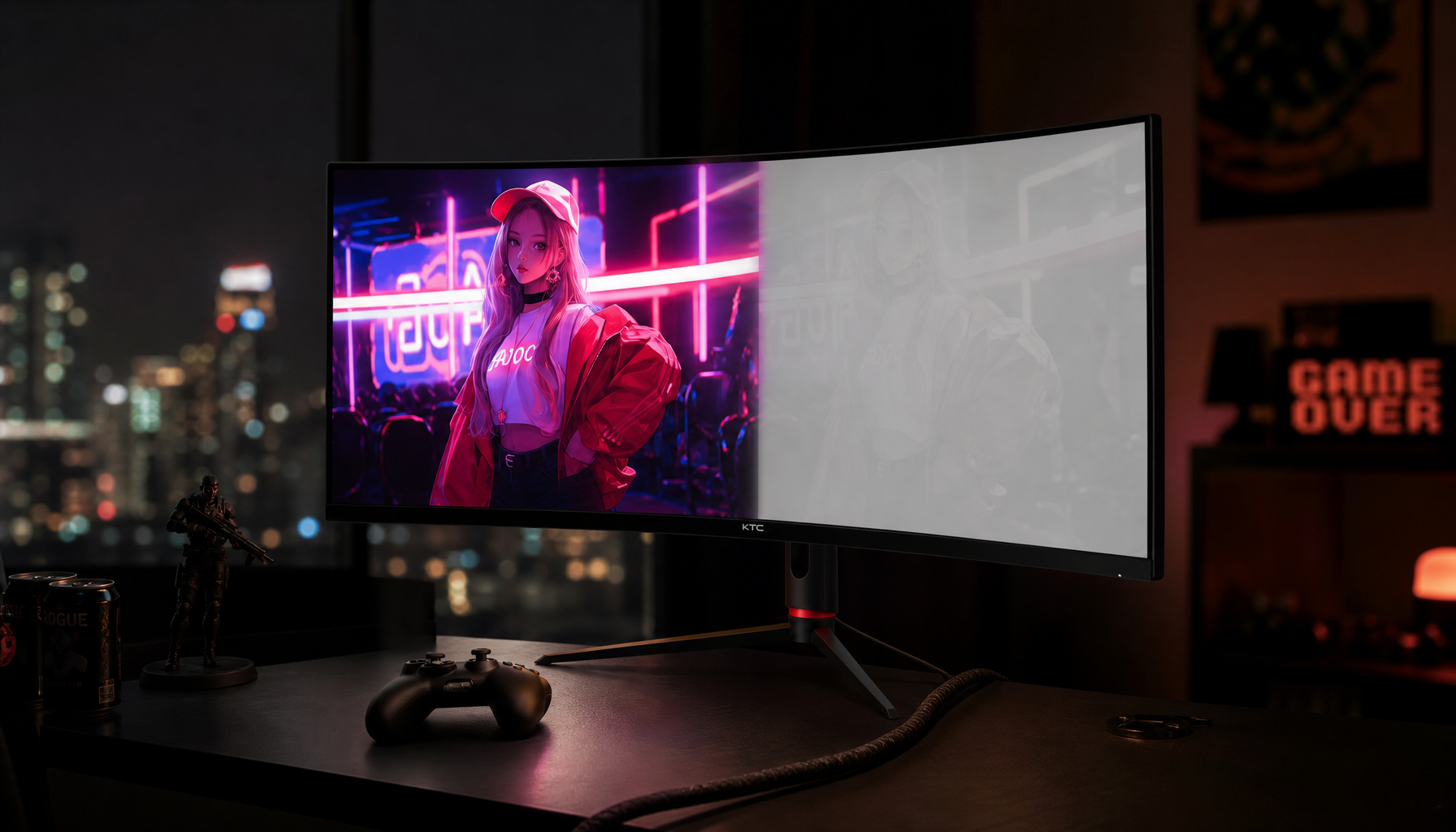
The effect is especially obvious in dark HDR scenes. Imagine a white crosshair, moon, starfield, or subtitle on a black background. If the bright object is smaller than the dimming zone behind it, the monitor has to light more area than the object itself. Blooming occurs when a bright object is smaller than the controlled backlight region, which is why tiny highlights on black backgrounds are such a demanding test.
This is also why a high zone count does not automatically mean excellent off-angle uniformity. A 1,152-zone 32-inch monitor usually has finer control than a 384-zone model of the same size, but the local dimming algorithm, panel contrast, coating, diffuser design, and response timing still decide whether the result looks precise or smeared. Strong peak-brightness and zone-count specs can still produce foggy dark scenes, flicker, or sluggish dimming when implementation is weak.
Panel Type Changes the Severity
Mini LED is a backlight technology, not a panel type. That distinction is critical. A Mini LED monitor can use IPS, VA, or other LCD variants, and the underlying panel strongly shapes off-axis local dimming uniformity.
IPS-based Mini LED displays generally hold color and brightness more consistently from the side, so they are often better for shared viewing, creative review, and large desktop layouts. The tradeoff is weaker native contrast, which can make the dimming system work harder to make blacks look deep. VA-based Mini LED displays usually start with stronger native contrast and deeper blacks head-on, but their side-angle performance can drop faster, making halos and gamma shifts more visible from off-center seats. TN is rarely the right foundation for premium local dimming because its viewing-angle weakness can overpower the benefit of backlight control.
Panel foundation |
Viewing-angle behavior |
Local dimming uniformity impact |
Best fit |
IPS Mini LED |
Wider color and brightness stability |
Blooming may remain visible, but side-seat color shifts are usually better controlled |
HDR gaming, creative work, shared desk viewing |
VA Mini LED |
Stronger head-on contrast, weaker side consistency |
Blacks can look excellent centered but lift or shift off-axis |
Dark-room media, single-user centered setups |
OLED |
Self-emissive pixels, very strong angle behavior |
No zone blooming because pixels dim individually |
Dark-room cinema, premium visuals, burn-in-managed use |
TN LCD |
Narrow angle behavior |
Local dimming benefits are limited by image shift |
Competitive budget displays, not HDR-first setups |
For buyers comparing IPS, VA, and TN, panel technology affects viewing angles, color accuracy, contrast, and use-case fit. That is why two Mini LED monitors with similar zone counts can behave very differently once you move your chair 1 ft to the side.
The Large-Screen Problem: Your Edges Are Already Off-Axis
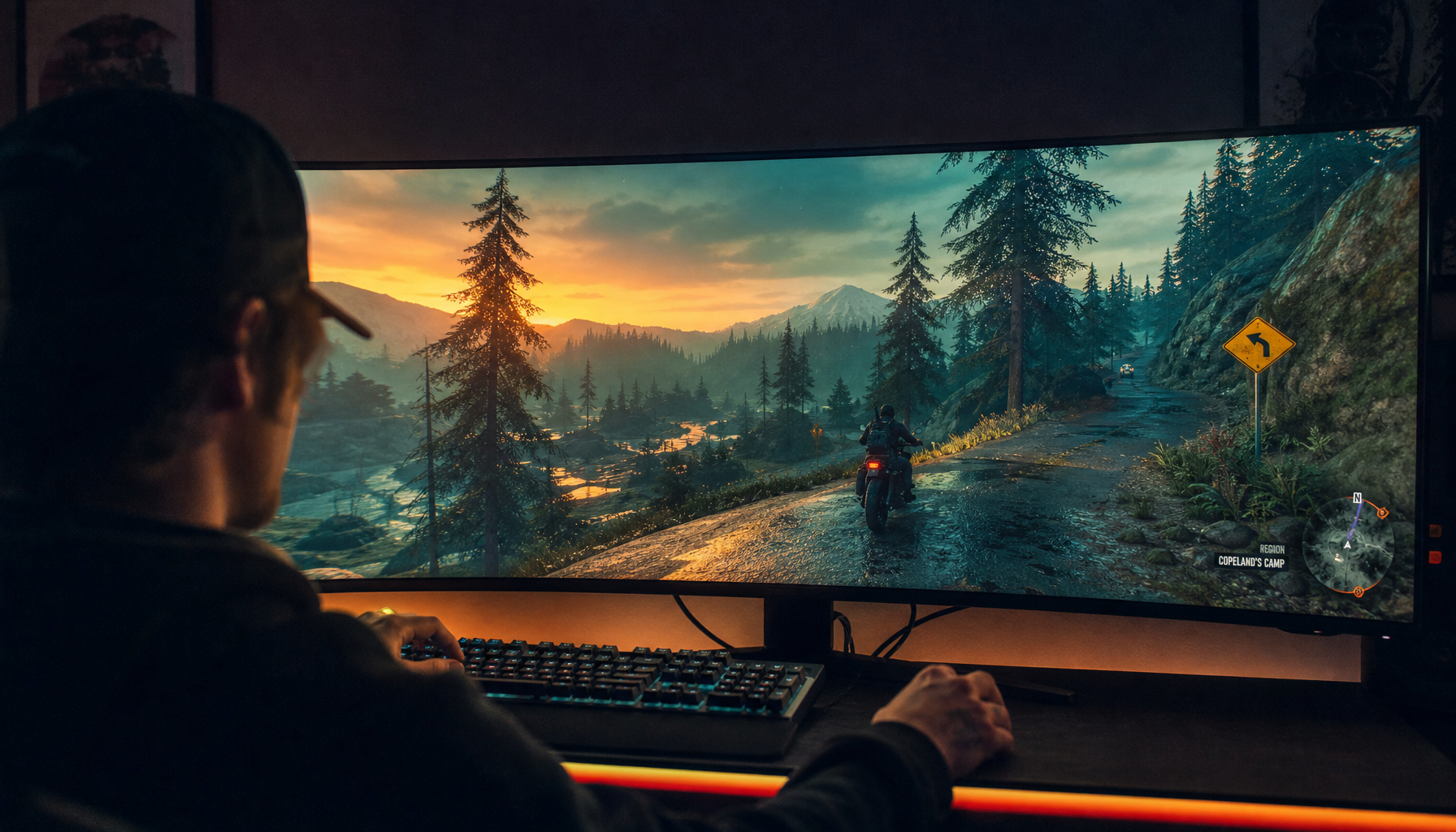
Even if you sit perfectly centered, the left and right edges of a large monitor are viewed at an angle. On a 32-inch desktop display at arm’s length, your eyes see the center directly while the corners are meaningfully off-axis. On an ultrawide, the outer edges can behave like side seats in a living room.

That geometry makes local dimming uniformity harder. A bright object near the edge may show a wider-looking halo than the same object in the center. A dark game scene may look deeper in the middle and more lifted at the sides. A productivity display with local dimming enabled may show uneven white backgrounds or dim-looking edges, which is distracting in spreadsheets, code editors, or document work.
This is where curved monitors can help, but they do not magically fix local dimming. A curve aims more of the panel surface toward your eyes, reducing edge angle on ultrawides. It can improve perceived consistency for one centered user, but it can worsen shared viewing because side viewers see a more uneven angle across the screen.
Settings Matter: HDR and SDR Need Different Priorities
For HDR games and movies, local dimming is usually worth enabling because the whole point is stronger contrast between intense highlights and deep shadows. For SDR office work, the best-looking setting is often the opposite. Static white and gray interfaces expose uniformity shifts, while deep black levels matter less than stable brightness.
General Mini LED setup advice is practical here: for desktop work, turning Local Dimming off and enabling brightness uniformity can keep panel brightness more consistent. For HDR, local dimming should be on, but aggressive halo suppression can reduce peak brightness or hide shadow detail. That tradeoff is not a flaw; it reflects how local dimming has to choose between black depth, highlight punch, and artifact control.
A good real-world routine is simple. Use a uniformity-first mode for documents, web browsing, dashboards, and coding. Then switch to an HDR-first mode for games, movies, and visual work where highlight depth matters. If your monitor supports custom local dimming strength, the middle setting often gives the cleanest balance: fewer harsh halos than maximum dimming, less washed-out contrast than minimum dimming.
How to Test Viewing-Angle Effects at Home
You do not need lab equipment to identify the problem. Open a black background with a small white object, such as a cursor, subtitle, logo, or starfield. Sit centered, then move about 2 ft to either side while keeping your eyes at the same height. If the glow expands, blacks lift, or the object seems to drag light behind it, you are seeing viewing-angle interaction with local dimming.

Next, repeat the same test with local dimming off. If the whole screen looks gray but even, the panel’s native contrast is the limit. If local dimming on makes the image punchier head-on but uneven from the side, the dimming system is working but has off-axis artifacts. If both modes shift heavily, the panel type or coating is likely the larger issue.
Glare control matters too. A bright window or overhead light can make off-angle blacks look worse because reflected light stacks on top of LCD leakage. For shared screens, glare worsens picture quality, so placement, blinds, and screen angle can improve perceived uniformity without changing hardware.
Mini LED vs OLED for Viewing-Angle Uniformity
OLED has the cleanest answer to viewing-angle local dimming issues because it does not use local dimming zones. Each pixel emits its own light, so a white star on black does not require a larger backlight zone to illuminate. That gives OLED superb black uniformity and much cleaner small highlights in dark scenes.
Mini LED’s advantage is different. It can deliver higher sustained brightness, strong HDR impact, and better confidence for long static desktop sessions where burn-in risk matters. For a productivity-heavy user who games after work, Mini LED can be the more reliable value play. For a dark-room cinematic setup where black precision and wide seating are priorities, OLED remains the cleaner visual technology.
The decision is less about which technology is better and more about where the weaknesses show up. OLED generally outperforms Mini LED for viewing angles because it avoids LCD light-filtering limits, but OLED also brings brightness and static-content concerns. Mini LED is still compelling when you need bright-room punch, long office sessions, and HDR that can fight ambient light.
Buying Advice for Gaming, Office, and Portable Screens
For pro gaming, prioritize a display that combines enough dimming zones with fast, stable dimming behavior. A monitor that blooms slightly but responds quickly can feel better than one that crushes shadows or lags behind motion. If you play dark shooters or space games, test subtitles, crosshairs, and small HUD elements on black backgrounds before judging the panel.
For office productivity, do not overvalue local dimming. Uniform whites, stable grays, text clarity, and ergonomic positioning matter more across an eight-hour workday. A Mini LED monitor that lets you disable local dimming in SDR and preserve brightness uniformity is more practical than a display that forces aggressive dimming everywhere.
For portable smart screens, viewing angle is often more important than peak HDR ambition. These displays are moved, shared, propped up, and viewed from odd heights. IPS or OLED-style angle stability usually matters more than a headline dimming feature, especially if the screen is used for presentations, travel work, or second-monitor workflows.
Practical Setup Recommendations
Place the display so your primary eye line hits the center region, with the top of the screen near or slightly below eye level. Keep large Mini LED monitors a little farther back than smaller displays so the edges are viewed from a less extreme angle. If you use a 32-inch or ultrawide screen, a monitor arm with tilt and swivel is not a luxury; it is part of the optical setup.

Use local dimming high enough to add HDR depth, but not so high that it erases shadow texture or makes halos pulse around moving objects. In bright rooms, control ambient light before blaming the monitor. At night, lower room lights slightly rather than playing in a completely black room if blooming bothers you; a small amount of bias lighting can make halos less obvious without destroying contrast.
Viewing angle does not break local dimming, but it exposes the limits of zone-based LCD light control. The strongest setup is a centered viewer, controlled glare, sensible SDR/HDR profiles, and a panel chosen for the way you actually sit, work, and play. For immersive performance with fewer compromises, judge the whole display system, not just the zone count on the spec sheet.