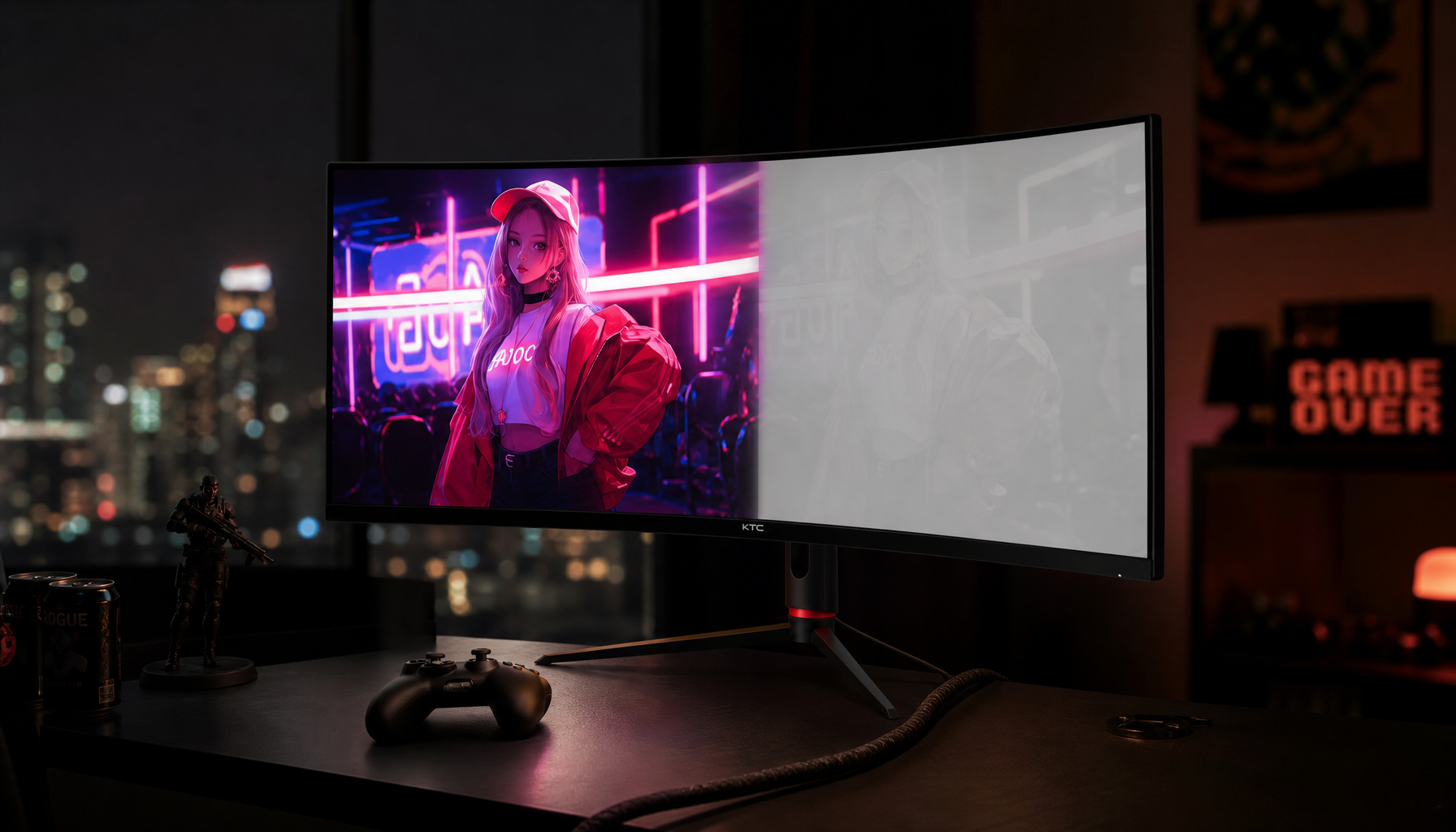
Local dimming can overshoot brightness when backlight zones react faster, stronger, or less precisely than the LCD pixels and image-processing algorithm can settle. The result is a brief flash, halo, or “too bright” pop when a scene jumps from black to a bright highlight.
Does your Mini-LED monitor suddenly flare when a game cuts from a dark tunnel to daylight, or when white subtitles appear over a black loading screen? A practical test, such as moving a bright window or cursor across a black background, can quickly reveal whether the issue comes from local dimming response, halo control, or an aggressive HDR mode. Once you know the cause, you can reduce the effect without giving up the immersive contrast you paid for.

What Local Dimming Is Actually Doing
An LCD monitor does not create light at each pixel; it uses an LED backlight shining through an LCD layer to form the image. In HDR LCDs, LED backlight brightness is adjusted so darker areas can be dimmed while brighter areas receive more light, improving perceived contrast beyond what the LCD panel can deliver on its own.
Local dimming divides that backlight into zones. Edge-lit models may control broad columns or bands, while full-array and Mini-LED monitors place many smaller lighting zones behind the panel. Full-array local dimming commonly uses hundreds to more than a thousand zones, while simpler 1D edge-lit systems may use only a small number of vertical zones. The higher the zone density, the more precisely the display can separate a bright HUD icon from a dark background.
The core benefit is obvious in HDR games and movies: deeper blacks, stronger highlights, and a punchier image. The tradeoff is that the monitor must coordinate three moving parts at once: the video signal, the LCD pixel response, and the backlight-zone response. Brightness overshoot appears when that coordination is imperfect.
Why Dark-to-Bright Transitions Overshoot
Brightness overshoot usually happens because the monitor is trying to avoid looking slow. When a scene jumps from dark to bright, the local dimming algorithm sees a new highlight and rapidly increases power to the relevant backlight zone. If it drives that zone too hard before the frame stabilizes, the viewer sees a brief burst of brightness before the monitor settles into the intended level.
This is especially visible in high-contrast HDR scenes. A bright muzzle flash, lightning strike, white menu, or subtitle can cause one zone to brighten even though the object covers only a small part of that zone. Blooming, or the halo effect, appears when a bright object lights up a zone covering multiple pixels. Brightness overshoot is the time-based cousin of that problem: instead of a static halo, you notice a short-lived flare during the transition.

There is also a speed mismatch. LCD pixels need time to change state, while the backlight driver can ramp LEDs quickly. If the backlight reaches a high output before the LCD layer fully controls the new frame, the monitor can briefly show more light than expected. On a 144 Hz display, each frame lasts only about 6.94 milliseconds, so even tiny timing errors are easier to notice during fast camera cuts or competitive gameplay.
Zone Count Helps, But It Does Not Solve Everything
More zones reduce the size of each lighting area, which usually improves control. A Mini-LED screen with hundreds or thousands of zones can isolate highlights better than a basic edge-lit display. Mini-LED displays can use dense LED arrays with zone-level brightness control, improving contrast, power control, and HDR highlight handling.
But zone count is not pixel-level lighting. Even a strong Mini-LED monitor may assign thousands of LCD pixels to one backlight zone. If a bright crosshair, starfield, spreadsheet cell, or subtitle appears in that zone, the entire zone may brighten. The diffuser and optical stack then spread that light to make the panel look uniform, which can soften precision and make bright transitions feel larger than the source object.

That is why a 1,152-zone monitor can still show overshoot while a lower-zone model with conservative processing may look calmer. The algorithm matters as much as the hardware. A display tuned for maximum HDR impact may push zones harder and faster, while one tuned for stability may accept slightly flatter highlights to avoid flashes.
Local dimming behavior |
What you see |
Main benefit |
Main risk |
Aggressive zone boost |
Brighter HDR highlights and deeper blacks |
Stronger immersion in games and movies |
Overshoot, blooming, black crush |
More stable brightness transitions |
Better desktop comfort and fewer flashes |
Less dramatic HDR contrast |
|
Local dimming off |
Uniform backlight behavior |
Predictable office and SDR use |
Washed-out blacks and weaker HDR |
Why It Shows Up More in Gaming Monitors
Gaming monitors make the problem more visible because they are built for speed. High refresh rates, variable refresh rate, low input lag, HDR tone mapping, overdrive, and local dimming all interact. When the frame rate changes under VRR, the monitor may need to adjust timing and brightness behavior on the fly.
This is similar in spirit to pixel overdrive overshoot. Aggressive display tuning can create bright coronas or ghost-like artifacts when a monitor pushes transitions too hard, so repeatable motion patterns are useful for checking whether a setting is helping or making artifacts more distracting. The same performance-first mindset applies to local dimming: the fastest or most dramatic setting is not always the cleanest one.
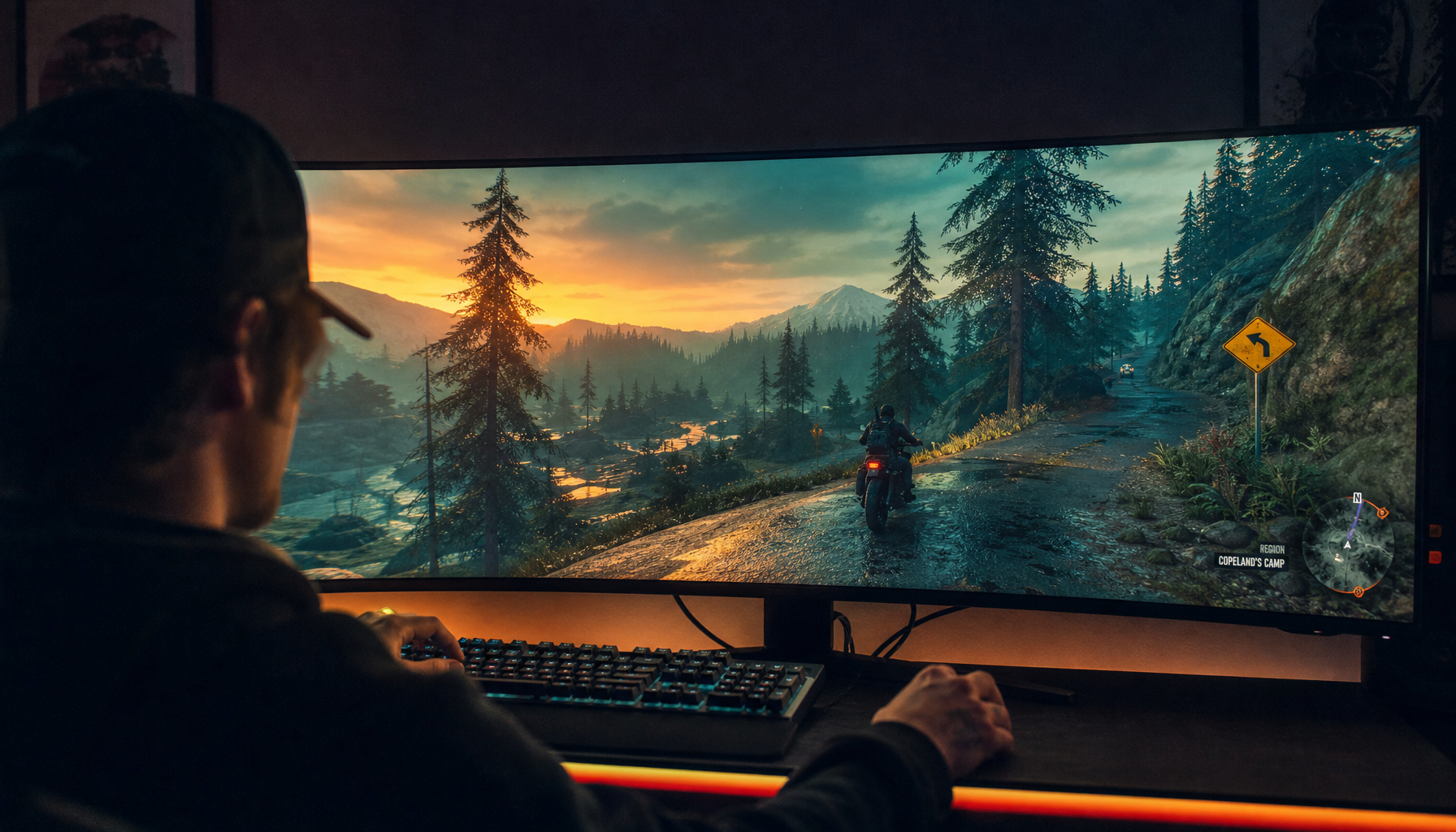
For example, in a dark shooter running at 144 Hz, an aggressive local dimming mode may make neon signs and explosions look spectacular. Then a white scoreboard opens, and the surrounding area flashes brighter than expected for a split second. In a slower office workflow, that same behavior can feel worse because you are staring at static white windows against dark-mode apps all day.
How to Reduce Brightness Overshoot Without Killing HDR
Start by separating SDR and HDR use. For SDR office work, web browsing, coding, spreadsheets, and document editing, local dimming is often better off. Consistent panel brightness is usually more comfortable than dramatic contrast when you are moving white windows over dark backgrounds for hours.
For HDR games and movies, leave local dimming on, but avoid the most aggressive mode if you see flashes. A “High” or “Level 3” mode may deliver the deepest blacks, yet it can also hide shadow texture or make transitions more obvious. A balanced HDR setup usually means lowering local dimming intensity and using halo control around the 80 to 90 range when the strictest setting reduces highlight quality or crushes detail.
If your monitor has separate controls for brightness uniformity, halo dimming, HDR peak brightness, or local dimming level, change one setting at a time. Use a repeatable test: a dark room in a game, a black desktop with a white window, a paused movie with subtitles, or a starfield scene. The goal is not to remove all blooming, because LCD local dimming cannot behave like OLED pixel lighting. The goal is to make transitions predictable enough that your eyes stay in the scene.
For portable smart screens and productivity displays, prioritize stable brightness over maximum HDR punch. Local dimming on a monitor can improve contrast and HDR impact, but halos can appear around bright objects on dark backgrounds, and performance depends heavily on the number of zones. On a smaller portable display used for email, dashboards, or travel work, a calm SDR mode is usually more useful than cinematic contrast.
When Overshoot Is Acceptable and When It Is a Dealbreaker
A small flash during extreme HDR transitions is normal for many LCD and Mini-LED displays. It becomes a problem when it distracts during ordinary content, makes desktop work uncomfortable, hides dark game detail, or creates obvious light trails behind moving bright objects.
The buying lesson is simple: do not judge a monitor only by peak brightness or zone count. Look for full-array or Mini-LED local dimming if HDR matters, but also look for hands-on tests that show dark-scene subtitles, moving highlights, and Game Mode behavior. Full-array local dimming is the strongest LCD approach because it gives the display more independent control, but it also requires more processing, circuitry, and thermal management.
If you already own the monitor, the most reliable workflow is to use separate presets. Keep an SDR productivity preset with local dimming off or low, moderate brightness, and uniformity enabled if available. Keep an HDR gaming or movie preset with local dimming on, but tuned below the most aggressive level if flashes bother you. That gives you the visual horsepower when it matters without making every spreadsheet feel like an HDR stress test.

FAQ
Is brightness overshoot the same as blooming?
No. Blooming is usually a spatial artifact, where light spills around a bright object on a dark background. Brightness overshoot is a timing artifact, where the zone gets too bright for a moment during a transition. They often appear together because both come from zone-based backlight control.
Does OLED have this problem?
OLED does not use LCD local dimming because each pixel emits its own light. That avoids zone blooming and zone-transition overshoot, although OLED has its own tradeoffs, including brightness limits, burn-in considerations, and panel-specific behavior.
Should I turn local dimming off?
For SDR office work, often yes. For HDR games and movies, usually no; reduce the local dimming level or halo control first. The best setup is content-specific, not one universal setting.
Local dimming overshoot is the cost of pushing LCD technology toward OLED-like contrast with zone-based lighting. Tune it like a performance feature: aggressive for HDR immersion, restrained for daily work, and always judged by real scenes instead of spec-sheet brightness alone.