




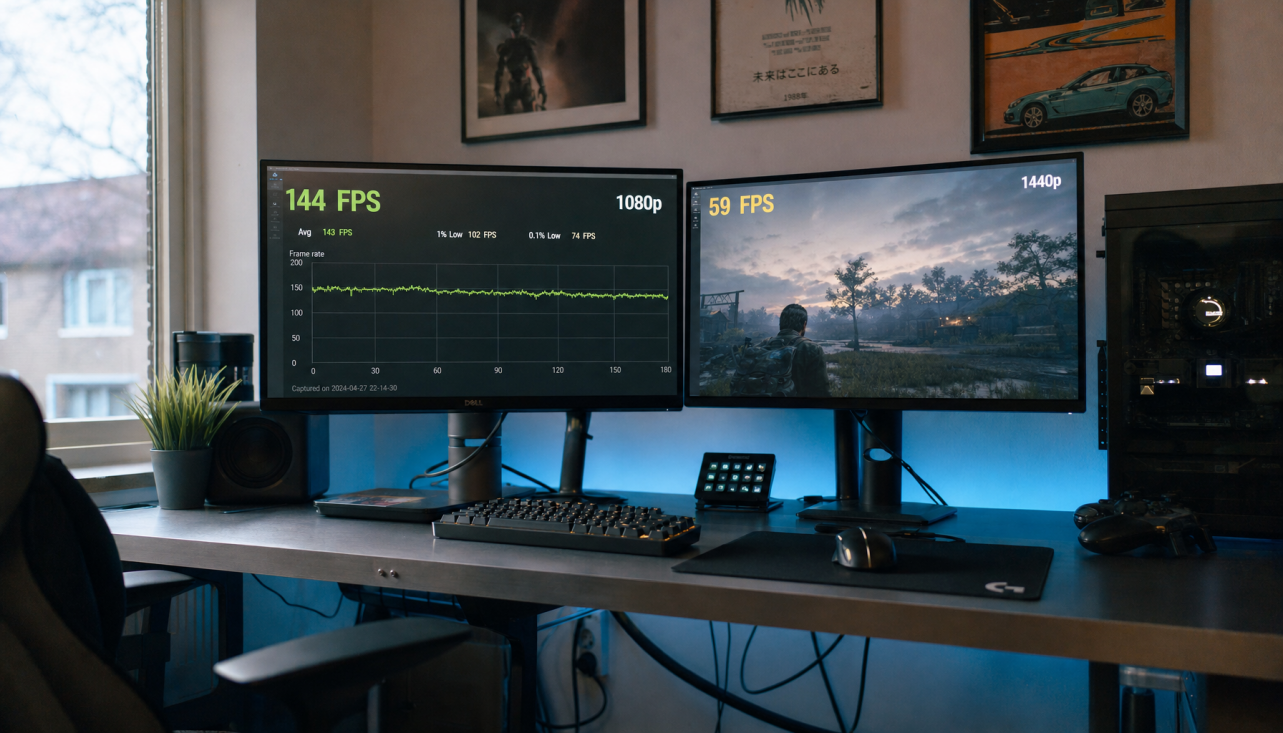
Low Framerate Compensation, or LFC, is a VRR safety net that repeats frames when your game’s FPS drops below a monitor’s adaptive-sync range. It activates automatically on supported displays, helping motion stay steadier instead of falling into obvious tearing or uneven stutter.
How LFC Works
A variable refresh rate monitor adjusts its refresh rate to match the frames your GPU is actually producing. That matters because refresh rate and FPS are separate: the monitor updates in Hz, while the PC renders frames in FPS, and smoother play depends on how well those two stay aligned through changing scenes.
LFC steps in when FPS falls below the monitor’s normal VRR floor. Instead of letting adaptive sync disengage, the monitor shows the same frame multiple times so the effective refresh rate stays inside the supported range.
For example, if a monitor works from 48 Hz to 144 Hz and your game drops to 35 FPS, LFC can show each frame twice, creating a 70 Hz refresh rhythm. The game is still running at 35 FPS, but the display pipeline remains more stable.

When Does LFC Activate?
LFC activates when the game’s frame rate drops below the monitor’s minimum VRR refresh rate. On a 48 Hz to 144 Hz display, that means it may engage below 48 FPS; on a 40 Hz to 160 Hz display, it may engage below 40 FPS.
The key requirement is enough refresh-rate headroom. A monitor needs a high enough maximum refresh rate to multiply low FPS back into the VRR window, which is why wider-range gaming displays are commonly associated with LFC.
At 47 FPS on a 48 Hz minimum, LFC may begin doubling frames. At 35 FPS on that same display, it can double frames to an effective 70 Hz. At 25 FPS, it may need triple presentation if supported. At 90 FPS on a 48 Hz to 144 Hz display, normal VRR can handle the frame rate without LFC.
Why It Matters for Gaming Feel
LFC does not create new game frames, so it will not make 35 FPS feel like true 70 FPS. What it can do is reduce the harsh transition that happens when a game dips below the VRR floor.
That is especially valuable in demanding scenes: open-world cities, heavy particle effects, big multiplayer fights, 4K rendering, or ray-traced workloads. These are the moments when average FPS may look acceptable, but frame pacing can still feel rough.

For competitive players, LFC is a fallback, not a performance strategy. You still want your system to hold high FPS most of the time, especially for shooters where 144 Hz, 240 Hz, or higher refresh targets are common.

What LFC Does Not Fix
LFC is not a cure for weak hardware, bad frame pacing, or excessive input lag. If your game is CPU-limited, shader-stuttering, maxing out VRAM, or bouncing wildly between 25 and 80 FPS, LFC can smooth the display handoff but cannot fix the root performance problem.

It also does not replace good monitor fundamentals. Pixel response, overdrive tuning, cable bandwidth, HDR mode, and the active refresh setting still affect motion clarity.
Some forum discussions mention forcing or extending LFC behavior, but the reliable buying path is to choose a monitor with confirmed LFC support rather than relying on undocumented tweaks.
How to Choose a Monitor With LFC
Look for a gaming monitor with confirmed LFC support, not just basic adaptive sync. Also check the listed VRR range, because a wider range gives LFC more room to work.
For most value-focused gamers, a 144 Hz to 240 Hz monitor with VRR and LFC is the sweet spot. Esports players may still prioritize 240 Hz or higher, while immersive single-player and productivity users may care more about resolution, panel quality, and screen size.
The practical rule is to buy the display your GPU can feed consistently. LFC is there for the dips, but the best experience still comes from stable FPS, clean frame timing, and a monitor that can keep up.


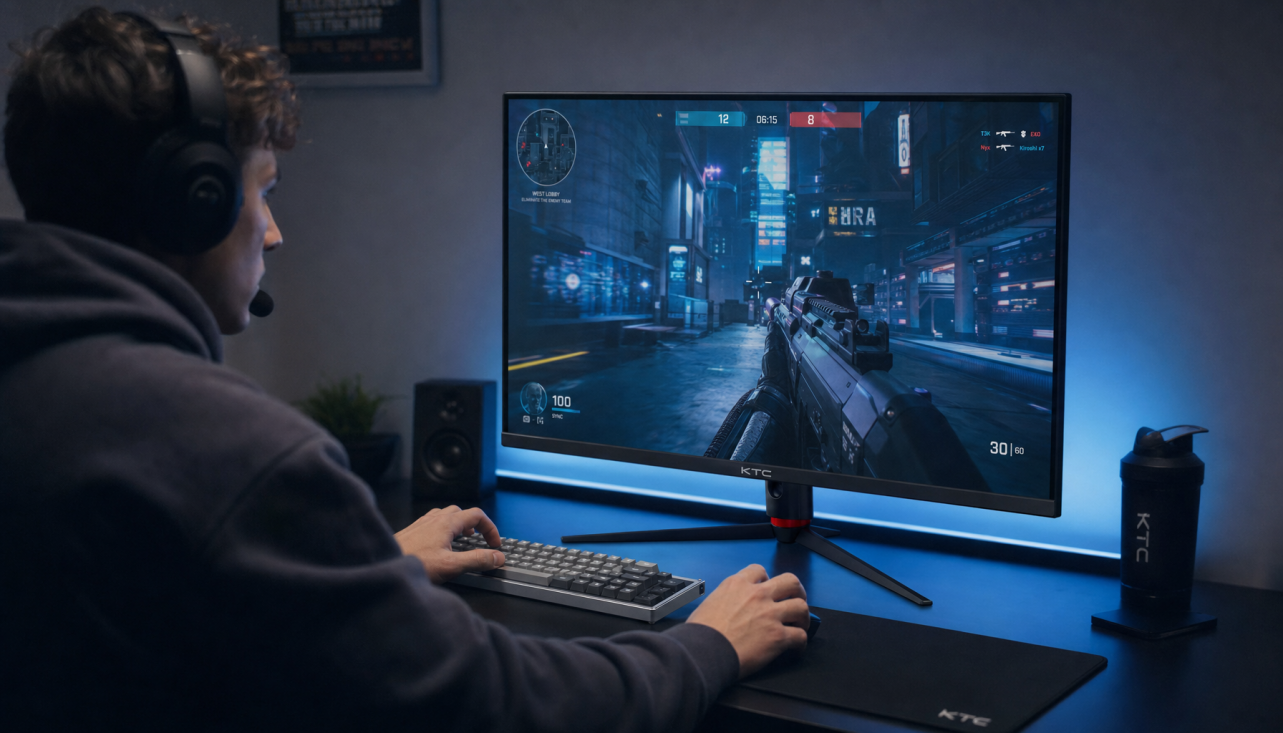
%20prevents%20stutter%20and%20tearing%20when%20your%20game's%20FPS%20drops%20below%20the%20monitor's%20VRR%20range.%20This%20technology%20repeats%20frames%20to%20keep%20motion%20steady.
)